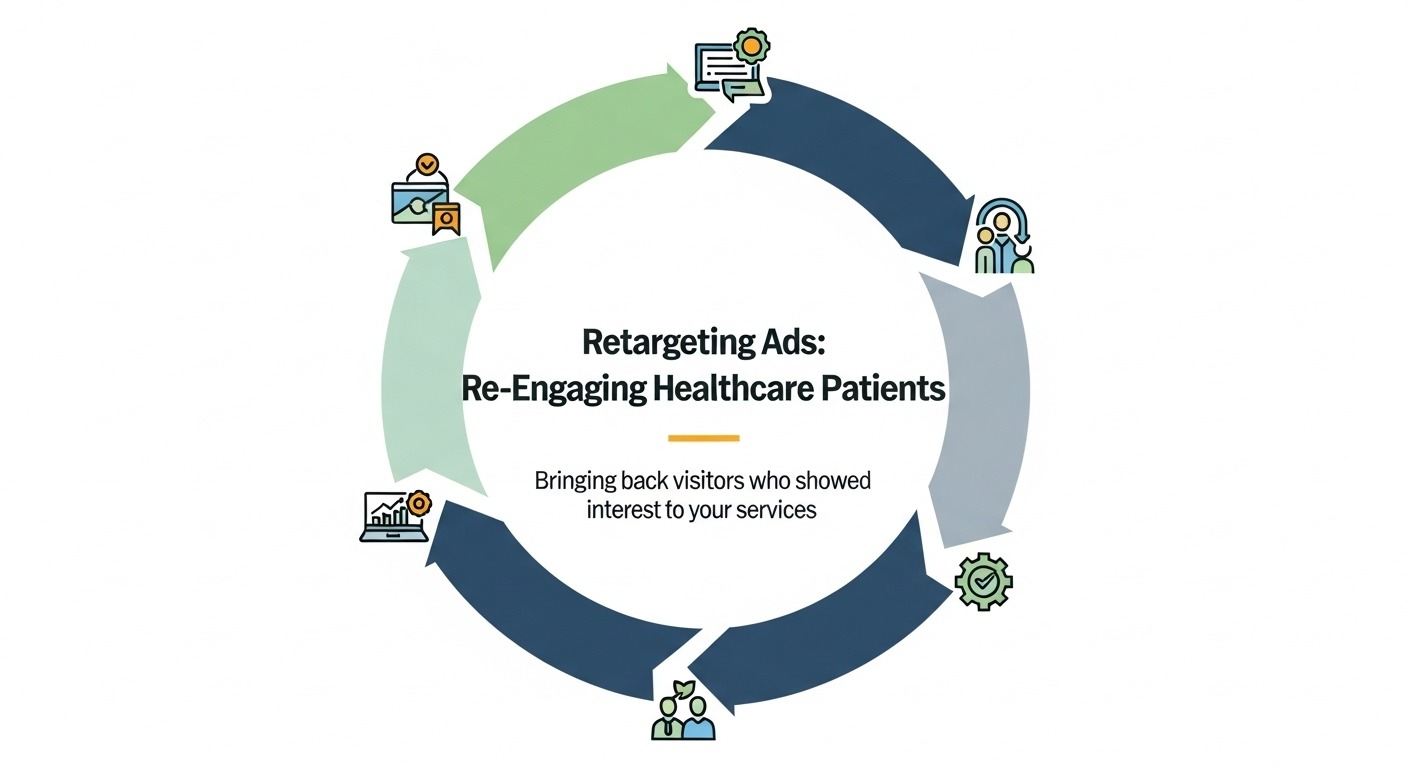
Imagine spending thousands of dollars driving potential patients to your healthcare website — only to watch 97% of them leave without taking any action. Frustrating, right?
That’s the reality for most healthcare providers today. But here’s the good news: retargeting ads let you follow up with those visitors, remind them of your services, and bring them back to complete that appointment booking.
In this guide, you’ll learn exactly how to build a compliant, effective retargeting strategy tailored to healthcare — from setting up your pixel to crafting HIPAA-aware ad copy that converts.
📋 Table of Contents
- What Is Retargeting and Why Does It Matter for Healthcare?
- How Healthcare Retargeting Actually Works
- HIPAA Compliance: The Rules You Must Follow
- Best Platforms for Healthcare Retargeting Ads
- How to Segment Your Healthcare Audience
- Writing Ad Copy That Converts (Without Violating Privacy)
- Best Retargeting Campaign Types for Healthcare
- Key Metrics to Track and Optimize
- Common Mistakes Healthcare Providers Make
- Your 30-Day Action Plan
1. What Is Retargeting and Why Does It Matter for Healthcare?
Retargeting (also called remarketing) is a form of online advertising that shows your ads specifically to people who have already visited your website. Using a small piece of tracking code called a pixel, you can “follow” those visitors across the internet and display targeted ads on platforms like Google, Facebook, Instagram, and YouTube.
For healthcare providers — whether you’re a clinic, hospital, specialist practice, or telehealth company — retargeting is one of the most cost-effective tools available. Here’s why it’s a game-changer:
💡 Real-World Example: A patient searches “knee replacement surgeon near me,” visits your orthopedic practice website, browses your services page, but doesn’t book. With retargeting, they’ll later see your ad on Facebook saying “Still considering knee replacement? Our board-certified surgeons are accepting new patients.” That single touchpoint can be the nudge that converts them.
2. How Healthcare Retargeting Actually Works
The key technical element is the tracking pixel — a small snippet of JavaScript code embedded in your website. When a visitor lands on your site, the pixel fires and drops an anonymous cookie in their browser. This cookie allows ad platforms to identify and re-serve ads to that visitor as they browse the web.
Learn more about how retargeting pixels work from Google’s official remarketing guide.
3. HIPAA Compliance: The Rules You Must Follow
⚠️ Critical Warning for Healthcare Marketers
Healthcare retargeting involves Protected Health Information (PHI). Unlike other industries, you cannot retarget based on specific medical conditions, diagnoses, or treatment history. Violations can result in fines up to $1.9 million per category per year under HIPAA.
Here’s what you CAN and CANNOT do:
| ✅ ALLOWED (Compliant Practices) | ❌ NOT ALLOWED (HIPAA Violations) |
|---|---|
| Retarget visitors of your general homepage | Retarget visitors of pages about specific diagnoses (e.g., /cancer-treatment) |
| Target by geography, demographics, interests | Use pixel data that captures PHI like names or health conditions |
| Promote general wellness and preventive care | Reference a visitor’s past health-seeking behavior in ad copy |
| Use BAA-signed vendors for tracking tools | Share PHI with ad platforms without a Business Associate Agreement |
| Obtain proper patient consent for data collection | Use third-party data to infer medical conditions |
For the full regulatory framework, review HHS’s HIPAA guidance for digital marketing and consult with your compliance officer before launching campaigns.
The FTC’s health advertising guidelines also apply and require honesty in all health-related ad claims.
4. Best Platforms for Healthcare Retargeting Ads
Not all ad platforms are equal for healthcare. Here’s a breakdown of the most effective options:
| Platform | Best For | Healthcare Restrictions | Avg. CPC | Effectiveness |
|---|---|---|---|---|
| Google Display Network | Brand awareness, appointment booking | Moderate | $1–$3 | ⭐⭐⭐⭐⭐ |
| Google Search Remarketing (RLSA) | High-intent searchers, specialists | Low | $5–$15 | ⭐⭐⭐⭐⭐ |
| Facebook / Instagram | General wellness, cosmetic, elective | High (medical restrictions) | $0.50–$2 | ⭐⭐⭐⭐ |
| YouTube (Google Ads) | Educational content, procedure demos | Moderate | $0.10–$0.30 CPV | ⭐⭐⭐⭐ |
| B2B health services, referral networks | Low | $5–$12 | ⭐⭐⭐ |
💡 Pro Tip: For most healthcare practices, Google Display + RLSA is the safest and most effective combination. It has lower HIPAA risk than social media while still delivering excellent reach and conversion rates. Read more at Google’s Remarketing Ads guide.
5. How to Segment Your Healthcare Audience
Segmentation is what separates good retargeting from great retargeting. Instead of showing the same ad to everyone, you create tailored experiences for different visitor groups.
Homepage Visitors
Broad awareness audience. They know your brand exists but haven’t explored yet.
→ Show: General brand awareness ads
Service Page Visitors
High-intent visitors who looked at specific service pages (e.g., dental implants, physical therapy).
→ Show: Service-specific benefit ads
Booking Page Abandoners
Started the appointment process but didn’t complete it. Your hottest leads.
→ Show: Urgency-driven reminder ads
Blog/Content Readers
Engaged with your educational content. Research-mode patients early in decision journey.
→ Show: Educational + trust-building ads
📌 Important: Always create a customer exclusion list from your existing patient database. You don’t want to retarget people who already booked — it wastes budget and creates a poor patient experience.
6. Writing Ad Copy That Converts (Without Violating Privacy)
The golden rule: never acknowledge that you know what the user was looking at. Instead, focus on the benefit-driven, general messaging that still feels relevant.
DON’T Write This
“Since you visited our orthopedic surgery page, book now!”
❌ References specific health-seeking behavior
DO Write This
“Accepting new patients. Expert joint care, personalized treatment plans. Book a free consultation today.”
✅ Benefit-focused, no health condition reference
High-Converting Ad Copy Formulas for Healthcare
| Formula | Example |
|---|---|
| Benefit + Trust Signal | “Pain-Free Life Starts Here — 20+ Years of Trusted Care” |
| Urgency + Easy Action | “Same-Week Appointments Available — Book Your Consultation” |
| Social Proof + CTA | “500+ 5-Star Reviews. Voted Best Clinic 2024. Schedule Today.” |
| Empathy + Solution | “We Know Waiting Is Hard. New Patient Slots Now Open.” |
| Unique Value + Action | “Virtual Visits from Home. Board-Certified Doctors. Start Now.” |
7. Best Retargeting Campaign Types for Healthcare
Different goals require different campaign structures. Here are the most effective retargeting campaign types for healthcare providers:
Standard Retargeting (Site-Wide)
Shows ads to all recent website visitors. Best for building brand recognition and keeping your practice top-of-mind during the patient’s research phase.
Recommended Window: 30 days
Sequential Retargeting
Shows a series of ads in a specific order — first an awareness ad, then a testimonial ad, then a booking CTA. This mirrors the patient decision-making journey and dramatically improves conversion rates.
Best for: Elective procedures, specialists
Cross-Device Retargeting
Follows visitors from desktop to mobile and back. Critical since over 60% of healthcare searches begin on mobile. Google’s Customer Match and cross-device remarketing features make this seamless.
Key Stat: 60%+ of health searches are mobile
Customer List Retargeting (CRM Matching)
Upload a hashed list of lapsed patient emails to re-engage patients who haven’t visited in 12+ months for annual checkups or follow-up care. Must be done with proper HIPAA safeguards and BAAs in place.
Requires: BAA with ad platform + legal review
8. Key Metrics to Track and Optimize
Retargeting without measurement is guesswork.
Set up proper conversion tracking in Google Ads and Meta Pixel to capture form fills, phone call clicks, and appointment bookings as conversion events.
⚡ Optimization Tip: If your frequency exceeds 7 impressions per user per month, you’ll likely see ad fatigue — rising costs and declining CTR. Rotate ad creatives every 3–4 weeks to maintain performance.
9. Common Mistakes Healthcare Providers Make (And How to Avoid Them)
❌ Mistake 1: Retargeting Sensitive Condition Pages
Fix: Exclude all symptom, condition, and diagnosis pages from your retargeting pixel. Only fire the pixel on general pages (homepage, about, contact, general services).
❌ Mistake 2: No Frequency Capping
Fix: Set a frequency cap of 5–7 impressions per week per user. Showing the same ad 30 times annoys people and damages your brand reputation.
❌ Mistake 3: Sending Retargeted Traffic to Your Homepage
Fix: Create dedicated, HIPAA-compliant landing pages for retargeting campaigns. A page specifically designed to convert warm visitors will dramatically outperform your general homepage.
❌ Mistake 4: Not Using Exclusion Lists
Fix: Always exclude people who have already converted (booked appointments). Upload your current patient list as an exclusion audience — running ads to existing patients wastes budget and can confuse them.
❌ Mistake 5: Ignoring Mobile Optimization
Fix: Design ads and landing pages mobile-first. Over 60% of healthcare web traffic comes from mobile devices. If your booking form doesn’t work on mobile, your retargeting budget is largely wasted.
Ready to Master Healthcare Marketing?
Retargeting is just one piece of the puzzle. Learn the complete healthcare digital marketing system — from SEO and paid ads to patient journey optimization and compliant content marketing — in one comprehensive course designed specifically for healthcare professionals.
✅ Retargeting Campaigns
✅ SEO for Healthcare
✅ Patient Acquisition Systems
🚀 Enroll in the Healthcare Marketing Course →
Join thousands of healthcare professionals already growing their practice
10. Your 30-Day Healthcare Retargeting Action Plan
Ready to launch? Follow this step-by-step 30-day plan to go from zero to a fully operational, HIPAA-conscious retargeting machine:
Week 1: Foundation Setup
- Conduct a HIPAA compliance audit of your current website and identify sensitive pages
- Install Google Ads remarketing tag on approved pages only (exclude sensitive condition/symptom pages)
- Set up conversion tracking for appointment booking, phone clicks, and form submissions
- Sign Business Associate Agreements (BAAs) with all ad platforms and analytics vendors
- Create your exclusion audience from existing patient data
Week 2: Audience Building & Ad Creation
- Define and build your 4 core audience segments (homepage, services, booking abandoners, blog readers)
- Write 3 sets of ad copy for each audience segment
- Design responsive display ad creatives in all required sizes (300×250, 728×90, 300×600, 320×50)
- Build a dedicated retargeting landing page with fast load speed and clear booking CTA
- Set up A/B test variations for headlines and CTAs
Week 3: Launch & Monitor
- Launch campaigns with conservative daily budgets ($20–$50/day to start)
- Set frequency caps (5 impressions/week max per user)
- Enable automated bidding (Target CPA) after 30+ conversions are recorded
- Monitor daily for compliance flags, policy violations, or unusual spending patterns
- Confirm your privacy policy and cookie consent banner are live and compliant
Week 4: Optimize & Scale
- Review performance data — pause underperforming ad variations
- Double budget on top-performing audience segments
- Add YouTube retargeting using your Google Ads audience lists
- Build lookalike audiences based on converters for prospecting expansion
- Present results to stakeholders with a clear ROI report
Conclusion: Turn Missed Visitors Into Loyal Patients
Retargeting ads are one of the most powerful and cost-effective tools available to healthcare marketers today. By strategically re-engaging the 97% of visitors who leave without booking, you can significantly increase patient acquisition while maintaining a lower cost per new patient than traditional advertising methods.
The key is to do it right — respecting HIPAA regulations, crafting empathetic ad copy, and building segmented campaigns that speak to where each visitor is in their healthcare decision journey.
Start with your Google Display retargeting foundation, measure obsessively, and scale what works. Your future patients are already visiting your website — retargeting is how you make sure they come back.
Healthcare Marketing Expert
Helping healthcare providers grow their patient base through ethical, compliant digital marketing strategies.
#RetargetingAds
#DigitalMarketing
#PatientAcquisition
#HIPAA
Frequently Asked Questions
▶ Is retargeting legal for HIPAA-covered healthcare providers?
Yes, retargeting is legal for healthcare providers when done correctly. You must avoid collecting or using PHI through your tracking pixels, not retarget based on medical condition pages, sign BAAs with ad vendors, and maintain proper consent mechanisms. Always consult with a HIPAA compliance attorney before launching campaigns.
▶ How much budget do I need to start healthcare retargeting?
You can start with as little as $20–$50 per day. For meaningful data and optimization, plan for $500–$1,500/month for a small-to-mid practice. The ROI typically improves significantly after the first 60 days once your targeting algorithms have enough conversion data.
▶ How long should my retargeting window be?
For most healthcare services, a 30-day window works well. For elective procedures with longer decision timelines (e.g., cosmetic surgery, LASIK), extend to 60–90 days. For urgent care or telehealth, shorten to 7–14 days for maximum relevance.
▶ Can I use Facebook retargeting for a medical practice?
Yes, with caution. Meta has strict policies against targeting based on health conditions. You can retarget general website visitors but cannot use the “health and wellness” interest targeting categories in combination with retargeting. Facebook does not currently offer a BAA, which is an important compliance consideration. Google Display is generally safer for HIPAA-covered entities.