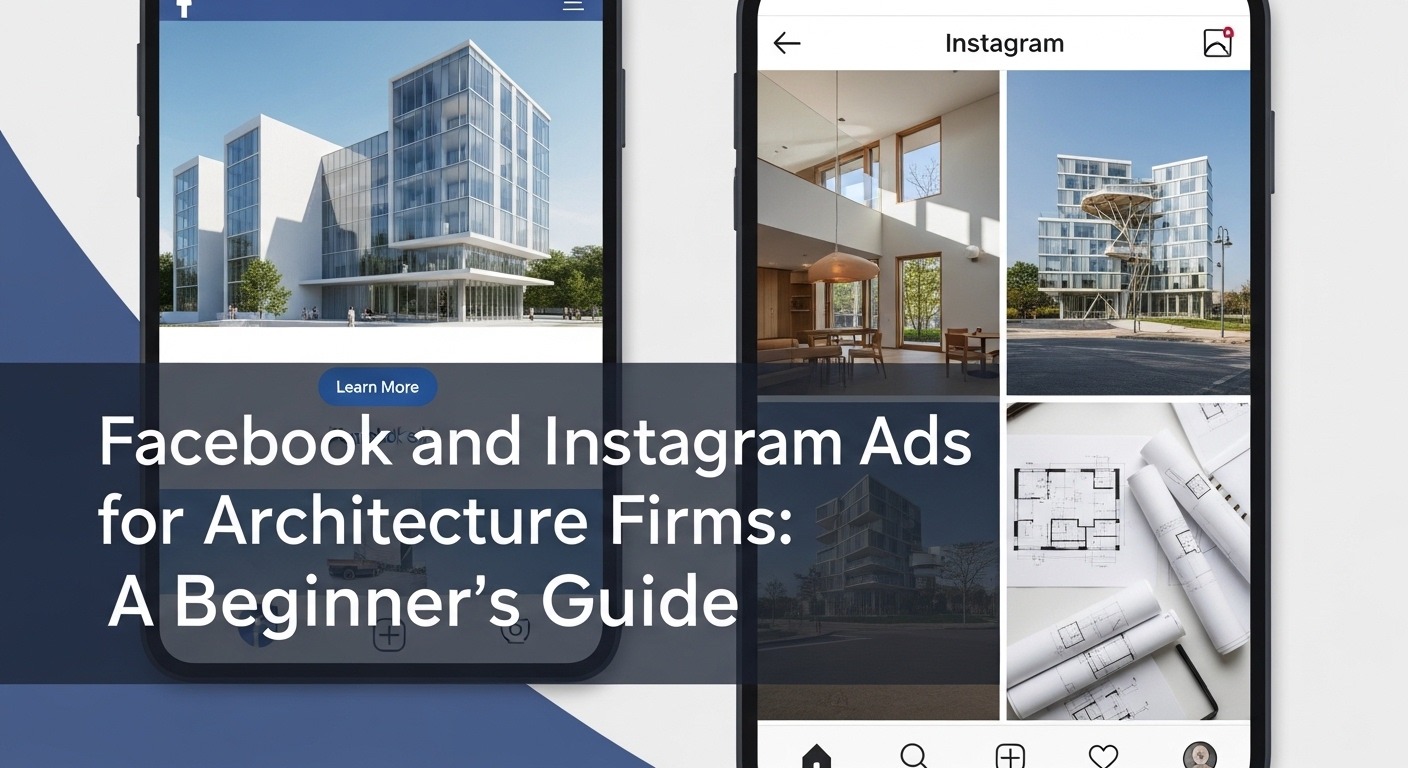
For most architecture firms, business development still relies on three things: referrals, reputation, and relationships. These are powerful — but they are entirely outside your control. Paid social advertising on Facebook and Instagram is the first channel most architects encounter that gives them something rare: the ability to generate demand on demand.
The hesitation is understandable. Architecture feels too premium, too considered, too long-cycle for a platform associated with cat videos and holiday photos. But this perception is wrong — and the firms that have discovered this are quietly using Meta’s advertising platform to fill their pipeline with exactly the clients they want, while competitors wait for the phone to ring.
This guide will walk you through everything: why Meta ads work for architects, how to set up your first campaign, what to say in your ads, how to target the right audience, how much to spend, and how to measure success — without needing a marketing degree or an agency budget.
Sources:
Statista ·
WordStream ·
Meta Business Help
In This Guide
- Why Meta Ads Work for Architecture Firms (When Done Right)
- Facebook vs. Instagram: Which Platform for Which Client?
- Setting Up Your Meta Business Suite & Pixel
- Targeting the Right Audience: The Architecture Ads Playbook
- Ad Types & Creative Formats That Convert for Architects
- Writing Ad Copy That Stops the Scroll
- Campaign Structure, Objectives & Budgets for Beginners
- Retargeting: The Most Profitable Ads Architecture Firms Ignore
- Measuring What Matters: Metrics & Optimisation
- 7 Costly Mistakes Architects Make With Paid Social
- Build a Complete Architecture Marketing System
Why Meta Ads Work for Architecture Firms — When Done Right
The objection most architects raise about paid social is timing: “Our clients aren’t on Facebook looking for an architect.” This is true — and it misunderstands how Meta advertising works. Unlike Google Ads, which capture demand that already exists, Meta Ads create and cultivate demand by reaching the right people at the right life stage, before they begin an active search.
A developer browsing Instagram who sees a compelling before/after reel of a commercial renovation isn’t searching for architects yet — but they’re planning their next project. A homeowner who just got planning approval in principle is on Facebook right now, and your targeted ad showing exactly the type of extension they’re envisioning can put your name at the top of their shortlist before they Google a single competitor.
This is demand generation, not demand capture. Both are essential components of a full marketing system, and most architecture firms have neither.
Unrivalled Targeting
Target by postcode, household income, property ownership status, recent home purchase, business owner status, job title, and dozens of interest categories. No other platform gets this specific.
Visual-First Medium
Architecture is inherently visual. Meta’s image and video formats are designed to showcase exactly the kind of stunning spatial photography and design transformations your firm produces.
Accessible Budget Scaling
You can start testing with as little as £5–£10 per day and scale what works. A single architecture project won from Meta ads can return 100× the ad spend. The risk-to-reward is extraordinary.
Measurable Results
Unlike print ads or networking events, every Meta campaign gives you precise data: cost per click, cost per lead, reach, engagement, and conversion rate — so you always know what’s working.
“The average architecture project fee is £50,000–£500,000+. If a Meta ad campaign costing £300/month generates a single qualified consultation that converts to a project, the ROI is between 16,000% and 166,000%.”
— The core economic case for architecture firm paid social advertising
Facebook vs. Instagram: Which Platform for Which Architecture Client?
Facebook and Instagram are both run through Meta Business Suite and share the same advertising infrastructure — but they attract different audiences with different mindsets. Understanding this distinction is essential for choosing the right platform for your specific client type.
| Core demographics | 35–65+ years | 18–44 years |
| Best for architecture | Commercial, developers, B2B | Residential, aspirational, design-led |
| Content mindset | Information-seeking, community | Inspiration, aesthetics, lifestyle |
| Top ad format | Lead forms, link click, video | Reels, carousels, Stories |
| Avg. cost per click | £0.50–£1.50 | £0.70–£2.00 |
| Lead generation | Excellent | Good (awareness → web) |
| Recommended starting priority | Start here for B2B | Start here for residential |
Table 1 — Facebook vs. Instagram Platform Comparison for Architecture Firms
Run on Both Simultaneously
Meta’s ad system lets you run the same campaign across both platforms automatically, with the algorithm allocating more budget to whichever is performing better. For most architecture firms, starting with both platforms on a shared budget is the most efficient approach — let the data tell you where your specific audience lives.
Setting Up Your Meta Business Suite & Pixel
Before spending a penny on ads, you need the right technical foundations in place. Skipping these steps is the most common reason architecture firms waste their first advertising budget. Here’s the correct setup sequence:
Create a Meta Business Account
Go to business.facebook.com and create a Business Manager account separate from your personal profile. This keeps your advertising assets professionally managed and shareable with any future team members or agencies.
Connect Your Facebook Page & Instagram Account
Inside Business Manager, add your firm’s Facebook Page and link your Instagram Professional account. Both should be active with at least 6–12 posts of project photography before running ads — your profile is your first impression after someone clicks.
Install the Meta Pixel on Your Website ⭐ Critical
The Meta Pixel is a small piece of code installed on your website that tracks visitor behaviour. It is the most important technical step in Meta advertising. Without it, you cannot retarget website visitors (your warmest audience), cannot track conversions, and cannot build lookalike audiences based on your actual leads. Install it before running your first ad. Instructions are inside Meta Events Manager.
Set Up an Ad Account & Add Payment Method
Create your Ad Account within Business Manager. Set your currency and time zone correctly — these cannot be changed later. Add a business credit card or debit card. Set a daily or lifetime budget limit as a safety cap before your first campaign.
Verify Your Business Domain
Verifying your website domain inside Business Manager protects your advertising account and unlocks certain targeting and optimisation features. It also builds trust signals that improve ad delivery quality.
Targeting the Right Audience: The Architecture Ads Playbook
Audience targeting is where Meta advertising becomes genuinely powerful — and where most beginners either over-target (too narrow, too expensive) or under-target (too broad, wasted on irrelevant users). Here are the audience types and specific targeting combinations that work best for architecture firms:
| Audience Type | How to Build It | Temperature | Best Campaign Goal |
|---|---|---|---|
| Interest-Based | Interior design, property development, self-build, architecture, home renovation + location radius | Cold | Awareness / Lead Gen |
| Behavioural | Recent home mover, home improvement purchaser, likely to move soon, recent property purchase | Cold-Warm | Lead Gen |
| Demographic | Age 30–65, household income top 25%, homeowner, specific postcodes / zip codes in your target area | Cold | Awareness |
| Website Custom Audience | People who visited your website in last 30/60/90 days — via the Meta Pixel | Warm | Retargeting / Lead Gen |
| Engagement Audience | People who engaged with your Facebook page, Instagram profile, or watched your videos | Warm | Retargeting |
| Customer List | Upload your existing email list — past clients, prospects, referral partners — Meta matches them to profiles | Hot | Re-engagement |
| Lookalike Audience ⭐ | Meta finds people who share characteristics with your existing leads or clients — your highest-ROI cold audience | Cold–Best | Lead Gen / Scale |
Table 2 — Meta Audience Types for Architecture Firm Advertising
Proven Audience Combinations for Architecture Ads
Ad Types & Creative Formats That Convert for Architects
Architecture is a visual profession — and Meta’s ad formats are built for visual storytelling. Choosing the right format for your goal is the difference between an ad that is ignored and one that generates enquiries. Here’s how each format maps to your objectives:
Reels / Short Video
15–60 second before/after transformations. The single highest-reach format on Instagram. A site walkthrough with dramatic reveals performs exceptionally well for residential and hospitality clients.
Lead Generation Ads
Native Meta forms that collect name, email, phone — without the prospect leaving Facebook/Instagram. Pre-filled from their profile data. Dramatically lowers friction. Ideal for “Book a free consultation” or “Download our project guide” offers.
Single Image Ads
One powerful image — typically a stunning completed project photo — with a headline and description. Fastest to produce, easiest to test. Use professional photography exclusively; poor imagery undermines credibility immediately.
Carousel Ads
2–10 image/video cards in a swipeable format. Perfect for project walkthroughs (exterior → interior → detail → result), service showcases, or case study storytelling. Each card can have its own link.
Instant Experience (Canvas)
Full-screen, immersive mobile experience that loads instantly when clicked — no website load time. Combine imagery, video, text, and links. Ideal for showcasing a flagship project or firm overview.
Stories Ads
Full-screen vertical format (9:16 ratio) appearing between organic Stories. Brief, punchy, visually bold. Site progress timelapse videos or “one thing you didn’t know about this project” formats work brilliantly.
Writing Ad Copy That Stops the Scroll
Your image or video stops the scroll. Your copy closes the click. Most architecture firm ads fail on copy — defaulting to generic descriptions (“Award-winning architects serving London”) that say nothing differentiating. Here’s the anatomy of ad copy that actually converts, plus proven headline formulas:
Ad Copy Anatomy — What Each Part Must Achieve
Line 1
2–4 lines
Final line
Proven Headline Formulas for Architecture Ads
| Formula | Example | Best Ad Objective |
|---|---|---|
| The Specific Result | “We got planning approved in 6 weeks. Here’s how.” | Lead Gen |
| The Before/After | “Dark Victorian terrace → light-filled open-plan home. £240k project, 14 months.” | Awareness / Traffic |
| The Fear/Risk Hook | “Most homeowners waste £8,000 before hiring an architect. How to avoid this.” | Engagement / Leads |
| The Question | “Do you know what your extension could really look like? Swipe to see.” | Carousel / Reel |
| The Social Proof | “82 families in Manchester have extended with us. Here’s what they wish they’d known.” | Lead Gen / Retarget |
Table 3 — Ad Headline Formulas for Architecture Firms
Campaign Structure, Objectives & Budgets for Architecture Firms
Meta organises advertising into a three-level hierarchy: Campaign → Ad Set → Ad. Understanding how to use this structure correctly prevents wasted spend and ensures your budget is working as efficiently as possible.
The Meta Ads 3-Level Structure
Recommended Starting Budgets by Firm Size
| Firm Stage | Monthly Budget | Expected Leads/Month | Focus |
|---|---|---|---|
| Testing / New | £150–£300 | 3–8 | Pixel warming, audience testing, creative testing |
| Growing Practice | £300–£800 | 8–20 | Lead gen + retargeting + lookalike audiences |
| Established Firm | £800–£2,000 | 20–50 | Full funnel: awareness + lead gen + retarget + nurture |
| Multi-location / Scaling | £2,000+ | 50+ | Geographic expansion, audience scaling, A/B testing |
Table 4 — Starting Budget Recommendations for Architecture Firm Meta Ads · Figures approximate; adjust based on local market competitiveness
Retargeting: The Most Profitable Ads Architecture Firms Ignore
Most architecture firm websites convert only 1–3% of visitors into enquiries on their first visit. That means 97–99% of people who found your website, looked at your projects, and showed genuine interest — left without contacting you. Retargeting lets you follow them with a second, third, and fourth touchpoint until they’re ready to act.
According to Criteo’s retargeting research, retargeted ads are 70% more likely to convert than first-touch ads. For architecture firms, where the decision cycle spans months, retargeting is not optional — it’s the highest-ROI component of your entire ad strategy.
The Architecture Firm Retargeting Sequence
Measuring What Matters: Metrics & Optimisation
Meta Ads Manager provides hundreds of metrics. Most of them are irrelevant to your business goals. Here’s exactly what to track, what’s healthy, and what to do when performance drops:
| Metric | Healthy Range | What to Do If Low |
|---|---|---|
| CPM (Cost per 1,000 impressions) | £5–£20 | Widen audience; reduce targeting restrictions; adjust placement |
| CTR (Click-Through Rate) | 1–5% | Test new creative; improve headline; try different ad format |
| CPC (Cost per Click) | £0.50–£2.50 | Improve ad relevance score; test better creative; review audience overlap |
| CPL (Cost per Lead) | £8–£40 | Rewrite offer/CTA; switch to Lead Form format; improve landing page |
| Frequency | 1.5–3.5 | If >4: refresh creative to avoid ad fatigue; expand audience size |
| Lead Quality (offline) | Track manually | If low quality: tighten targeting; add qualifying question to Lead Form |
Table 5 — Meta Ads Key Metrics for Architecture Firm Campaigns · See Meta Ads Help Centre for full metric definitions
7 Costly Mistakes Architects Make With Paid Social
Mistake 1: Sending Ads to a Weak Website
Your ad creates curiosity. Your website must convert it. If your site loads slowly, shows poor photography, has no clear CTA, or lacks social proof — your ad budget is evaporating. Before spending on ads, ensure your website converts at 3%+ on mobile.
Mistake 2: Not Installing the Pixel Before Running Ads
Running ads without the Pixel means every visitor who bounces is gone forever. The Pixel is what allows retargeting — the highest-converting component of your entire strategy. Install it on day one, even before you create your first ad.
Mistake 3: Targeting Too Narrow an Audience
Stacking 12 interest layers on an audience until it shows “potential reach: 4,200 people” creates extremely high CPMs and starves Meta’s algorithm of the data it needs to optimise. Aim for audiences of 50,000–300,000 people. Let Meta do the optimisation work.
Mistake 4: Running Only One Ad Creative
Meta’s algorithm needs data to optimise. A single ad gives it nothing to compare. Always run 2–4 creative variants per ad set — different images, different headlines, different hooks. After 7–10 days, pause the underperformers and allocate budget to winners.
Mistake 5: Changing Campaigns Before the Learning Phase Ends
Meta’s algorithm requires approximately 50 conversion events to exit the “Learning” phase. If you change budgets, audiences, or creative before this, the algorithm restarts from zero. Give campaigns at least 7–10 days and 50 events before making major changes.
Mistake 6: Using Low-Quality Photography
In architecture advertising, your creative is your product. A dark, low-resolution phone photo of a project actively damages your brand. Every pound invested in professional architectural photography multiplies across every ad you will ever run. It is not an optional expense — it is your most important marketing asset.
Mistake 7: No Lead Follow-Up System
Meta Lead Form submissions sit in Ads Manager with no automatic notification. Leads that aren’t followed up within 5 minutes are 80% less likely to convert, according to Lead Response Management research. Connect your lead form to your email via Zapier, or manually check Ads Manager at least twice daily. Speed of response is your conversion variable.
Ads Are One Piece. Build the Complete Architecture Marketing Machine.
Meta ads generate leads. But converting those leads into high-value architecture projects requires a complete system: positioning, content, proposals, email nurture, SEO, and social strategy working together. The only course built specifically for architecture firms shows you how all of it fits together.
Marketing Course for Architectural Firms Includes:
Explore the Architecture Marketing Course →
Designed exclusively for architects & architectural firms
Your First 30 Days: A Simple Action Plan
The most important thing about Meta advertising is to start. The firms winning clients through paid social today didn’t have a perfect strategy on day one — they started, learned, iterated, and built. Here’s a simple 30-day action plan:
Key Takeaways
- Meta ads generate demand — they reach prospects before they search, not after. This is a competitive advantage most architecture firms don’t use.
- Install the Meta Pixel on your website before anything else — it enables retargeting, the highest-ROI ad type available.
- Facebook converts better for B2B/commercial clients; Instagram works best for residential/design-led audiences. Start both and let the data guide you.
- Use interest + behavioural + demographic targeting combinations, with audience sizes of 50,000–300,000 for optimal performance.
- Lead Generation ads with native Meta forms produce the lowest cost-per-lead for architecture firms.
- Always run 2–4 creative variants. Let the learning phase complete (7–10 days, 50+ conversions) before making changes.
- Retargeting sequences (portfolio → social proof → lead magnet → CTA) are your most profitable ad investment.
- Follow up on leads within 5 minutes. Speed of response is your most important conversion variable.
Architecture Marketing Series
Easy Marketing School · Updated 2025
For Architects, Designers & Built Environment Professionals
#ArchitectureMarketing
#PaidSocial