Stop guessing and start tracking. Here is how to prove your email efforts are actually paying the rent.
In the competitive retail landscape of 2026, “hoping” your marketing works isn’t a strategy—it’s a gamble. While social media algorithms fluctuate, email marketing remains the workhorse of retail, boasting an average return of $36 for every $1 spent according to Litmus data.
But how do you know if your specific campaigns are hitting the mark? Measuring the **Return on Investment (ROI)** of your email marketing is the only way to scale your business with confidence. Let’s break down the metrics that actually matter for shop owners.
1. The Basic ROI Formula for Retailers
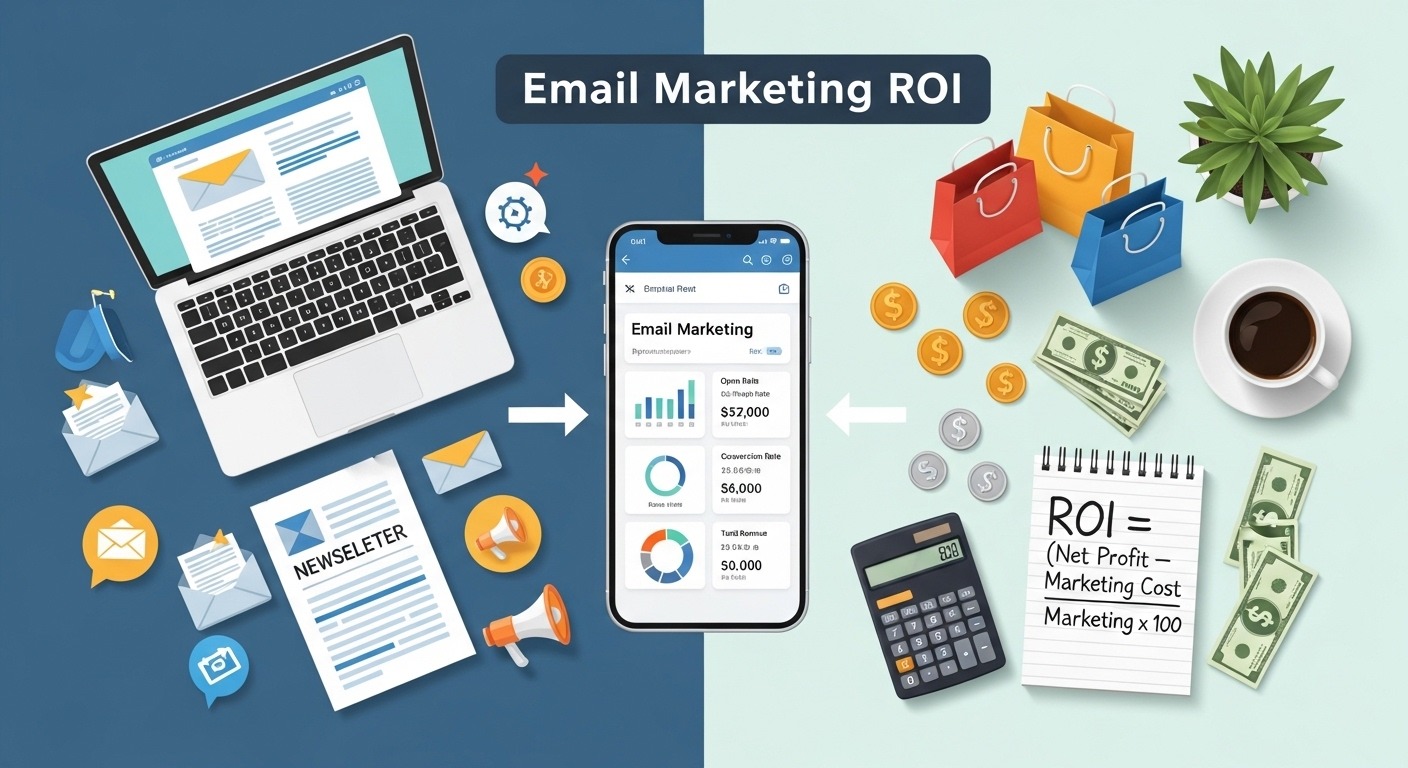
At its simplest level, ROI is the profit you make from your email campaigns minus the cost to run them. For a retail store, costs include your email service provider (ESP) fees, the cost of labor (or your time), and any specific discounts offered in the email.
The Email ROI Calculation
Example: If you spend $100 and generate $1,000 in sales, your ROI is 900%.
2. KPIs: Beyond the “Open Rate”
While open rates are great for the ego, they don’t pay the bills. To measure true retail success, you need to track these three Key Performance Indicators (KPIs):
| Metric | What It Tells You | Retail Benchmark |
|---|---|---|
| Conversion Rate | The % of people who clicked AND bought. | 1.5% – 3.0% |
| Average Order Value (AOV) | Are email shoppers spending more than social shoppers? | Varies by Niche |
| List Growth Rate | How fast you’re replacing “churned” subscribers. | 2% – 5% Monthly |
3. Attribution: Online vs. In-Store
One of the biggest hurdles for brick-and-mortar retailers is measuring “Offline ROI.” If you send an email and a customer walks into your store the next day, how do you track that?
The Strategy: Use trackable in-store coupons (unique QR codes) or “Email-only” events where customers must mention the email at the register. Platforms like Shopify POS can bridge the gap between your digital marketing and physical sales.
Stop Marketing in the Dark
Measuring ROI is just one piece of the puzzle. To truly scale, you need a full 360-degree marketing roadmap designed specifically for the modern retail landscape.
4. Tracking Customer Lifetime Value (CLV)
ROI shouldn’t just be measured per campaign; it should be measured per customer. A subscriber who buys a $20 candle today but returns five times a year because of your nurturing emails has a much higher ROI than a one-time flash-sale buyer.
Focus on your Retention Rate. If your email marketing reduces the time between purchases, your ROI is working even if the individual campaign numbers look modest.
The Bottom Line
ROI isn’t just about a spreadsheet—it’s about understanding what resonates with your community. By tracking conversions, attribution, and lifetime value, you turn your email list from a cost center into your store’s most predictable revenue driver.