Very few courses teach marketing to animation studios specifically. Search for one and you mostly find courses on making animation, plus a handful of business programmes for freelance motion designers, general freelancing and branding courses for creatives, and memberships run by people from the industry. Some of those are excellent; they are built for different people. This guide compares six options from other providers on format, length, price and certificate, using what each provider’s own page showed as of October 2026, and sets our own course for animation studios beside them, limits included.
Who is searching, and what they need
- Owners of small animation studios (a few people, often started by an animator or director). You need a clear position, a showreel aimed at the clients you want, a steady pipeline of enquiries that does not depend on one producer’s contacts, and clients who come back.
- Freelance animators and motion designers. You need to find and book clients, set rates, handle budget conversations and present your work so it brings commissions rather than only followers.
- Producers and business developers inside studios. You need a repeatable way to win work from agencies, brands and production companies, and to report what marketing brings in.
Most of the options below were written for the freelancer. That is useful to a studio owner, but it is worth knowing before you pay.
Marketing and business courses for animation studios compared
| Program | Type | Format and length | Price | Certificate | Best for |
|---|---|---|---|---|---|
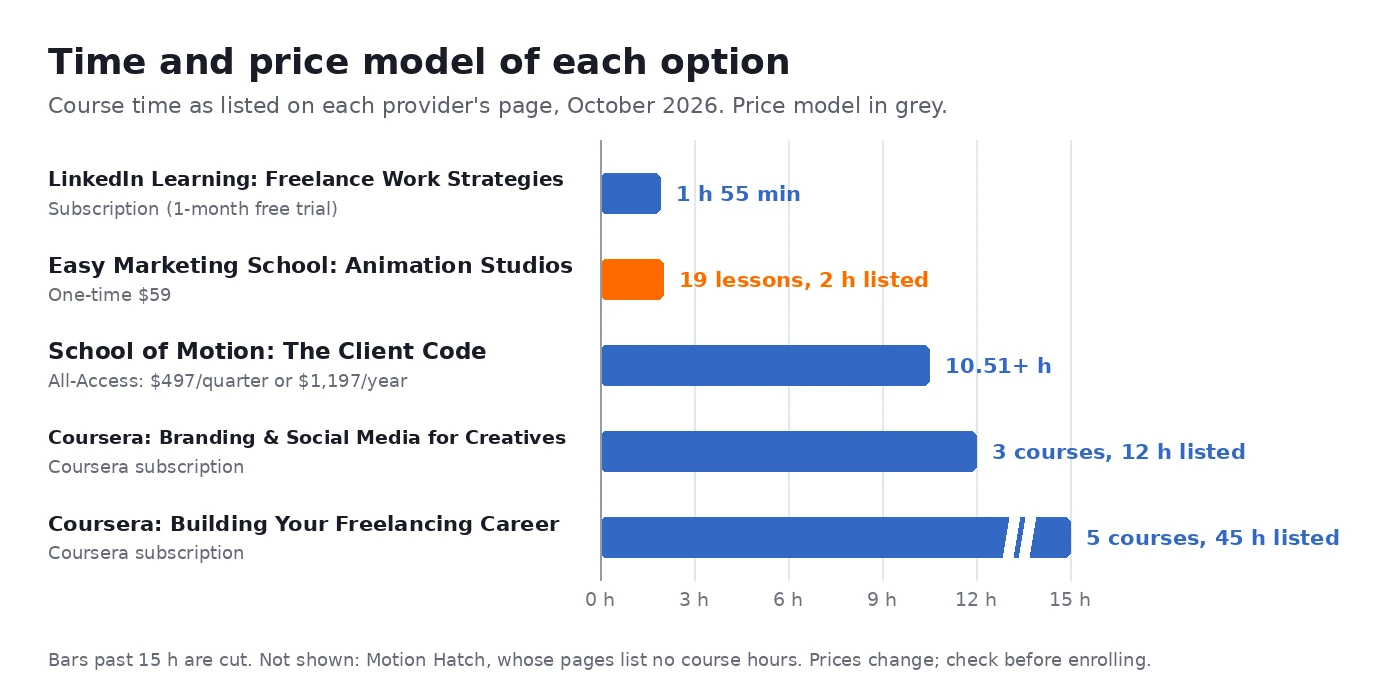
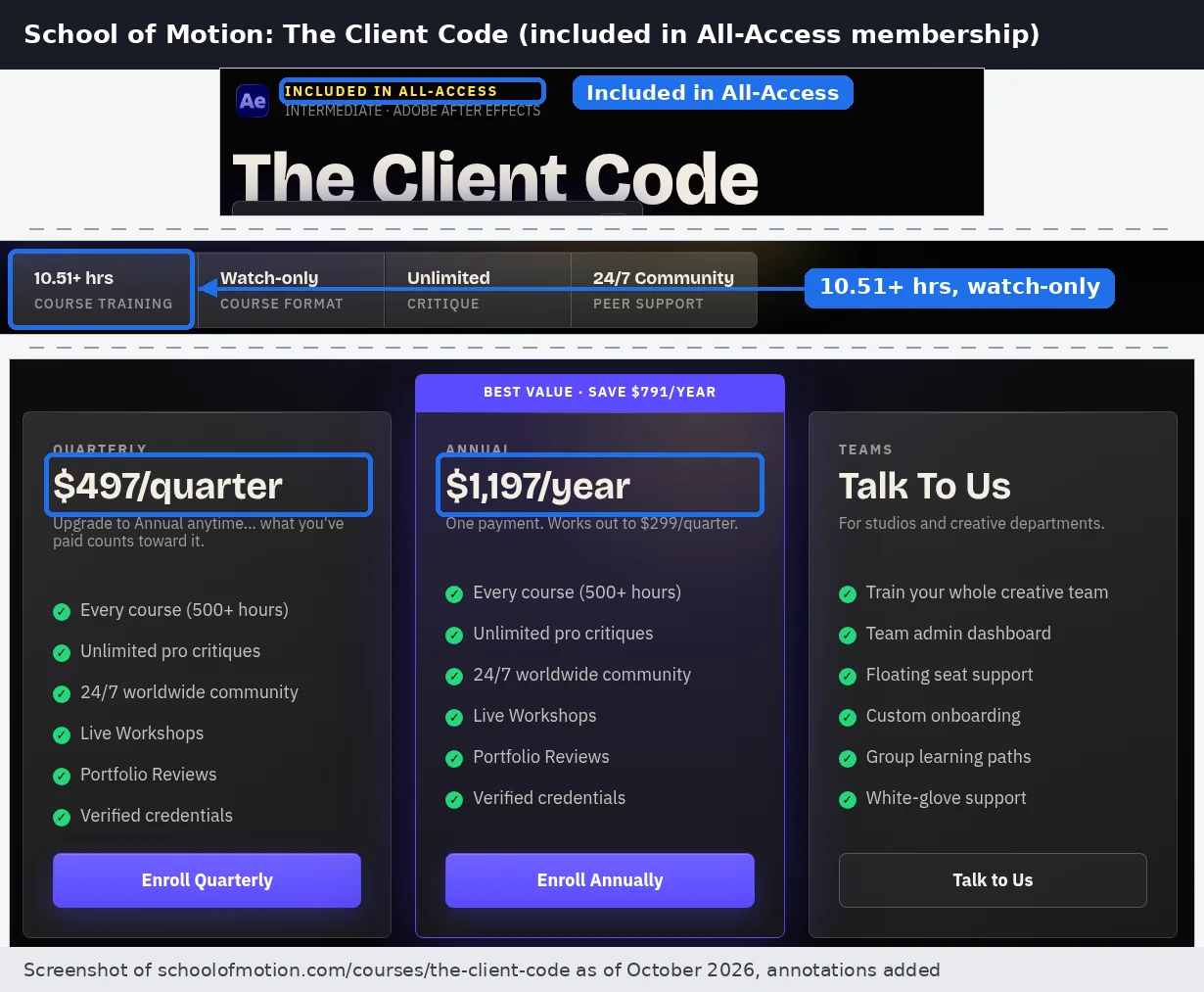
| School of Motion: The Client Code | Course inside a motion design school’s membership | 10.51+ hrs, watch-only, intermediate | Included in All-Access: $497/quarter or $1,197/year | Membership lists “verified credentials” | Freelance motion designers who want a full client-finding system and the rest of the school’s library |
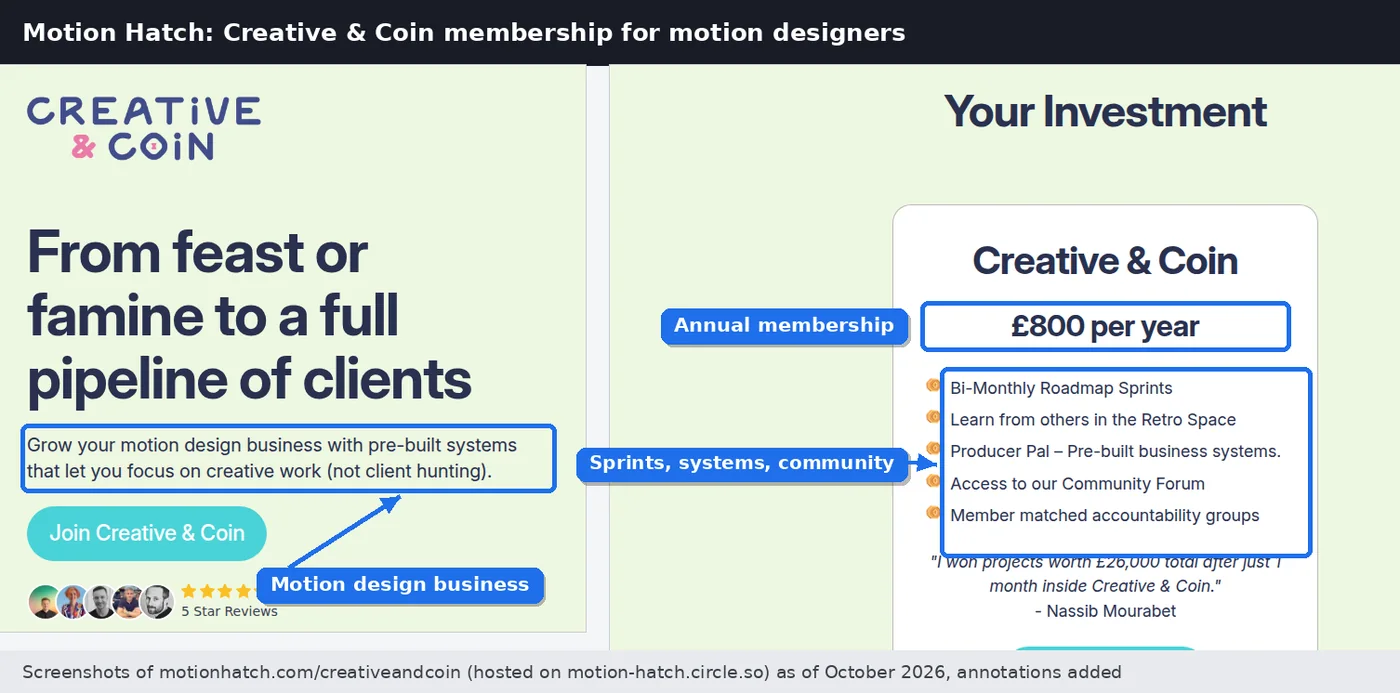
| Motion Hatch: Creative & Coin | Business membership for motion designers and studio owners | Roadmap sprints every other month, pre-built business systems, community | £800 per year | Not stated on the page | Motion designers and small studios who want ongoing systems and accountability |
| Motion Hatch: Get Your Next Client in Just 5 Days | Free email course | 5 emails, a workbook and video lessons over 5 days | Free (email sign-up) | Not stated on the page | Freelancers who want a quick push to find the next client |
| LinkedIn Learning: Freelance Work Strategies for Video and Motion Graphics Creators | Short video course | 1h 55m, released 6/25/2018 | LinkedIn Learning subscription, 1-month free trial | Certificate of completion | Video and motion freelancers who want the business basics, including rates |
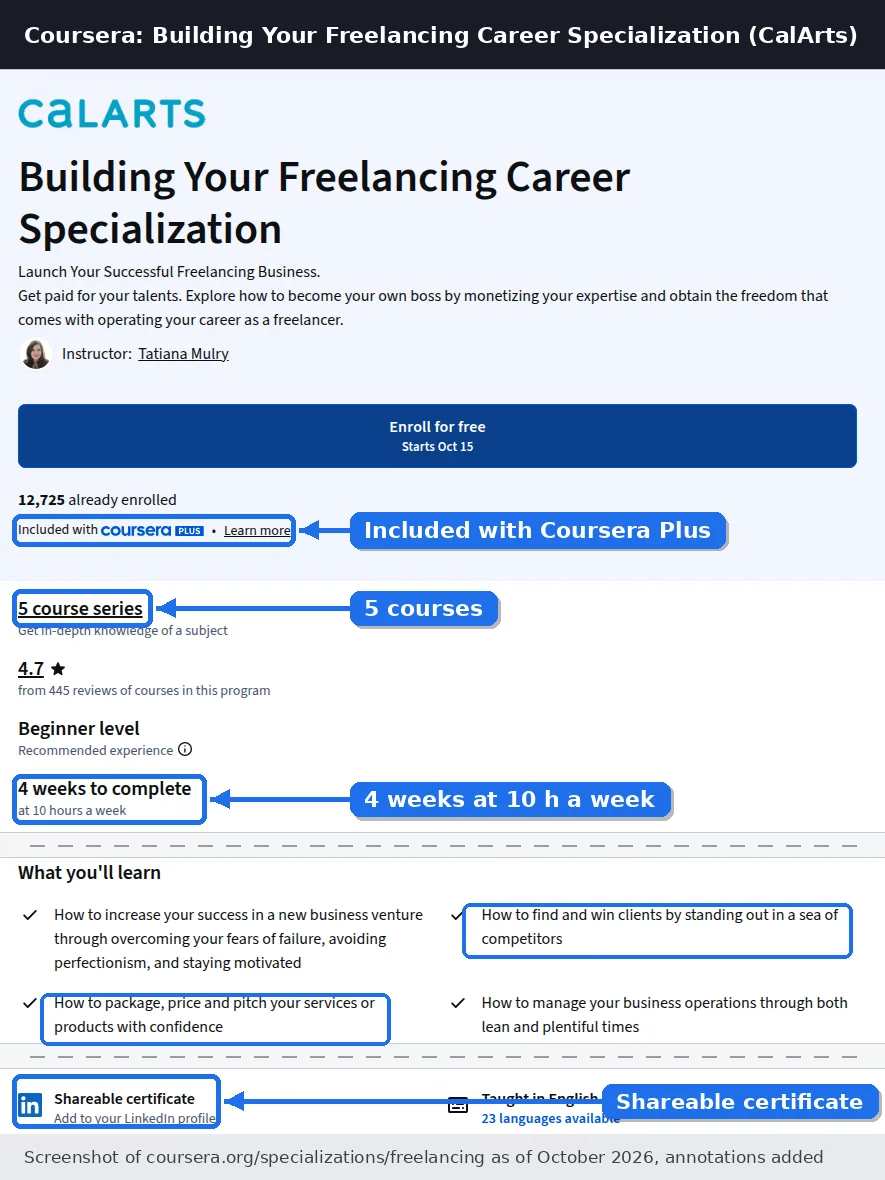
| Building Your Freelancing Career Specialization, CalArts (Coursera) | Specialization, 5 courses | Course hours listed add up to 45; page says 4 weeks at 10 hours a week | Coursera subscription (“Included with Coursera Plus”) | Shareable certificate | Creatives starting out on their own who want structure from an arts school |
| Branding & Social Media Marketing for Creatives Specialization, Skillshare (Coursera) | Specialization, 3 courses | 3 courses of 4 hours each; page says 4 weeks at 10 hours a week | Coursera subscription (“Included with Coursera Plus”) | Shareable certificate | Creatives who want to build a brand and make their own marketing videos |
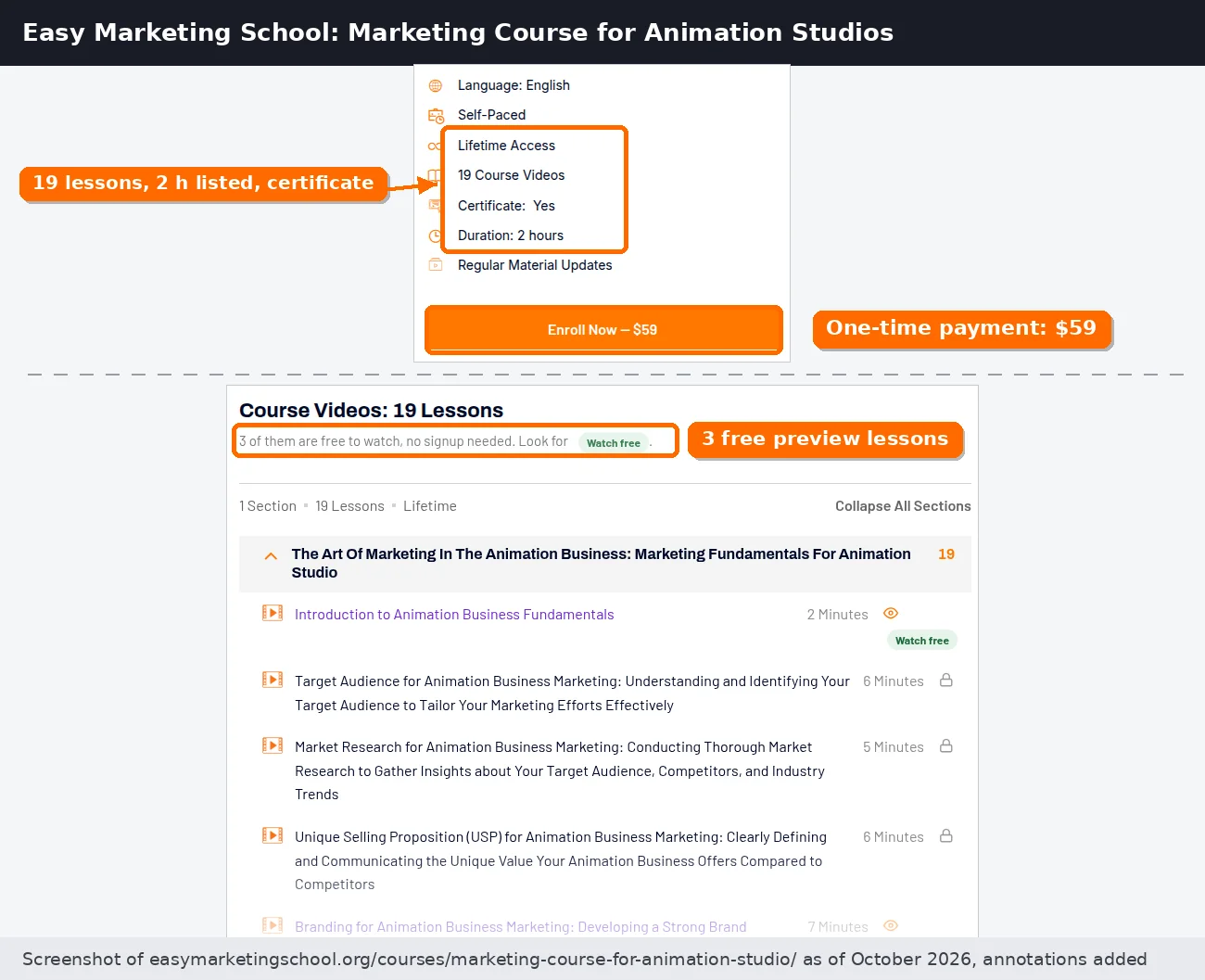
| Easy Marketing School: Marketing Course for Animation Studios | Self-paced marketing course for studios | 19 video lessons, listed at 2 hours, lifetime access | $59 one-time | Certificate of completion | Studio owners who want the marketing fundamentals applied to an animation business |
Details and prices come from each provider’s public page as of October 2026 and change often; confirm on the provider’s page before enrolling. Coursera and LinkedIn Learning did not show a subscription price on the pages we checked, so none is quoted here.
Each option: what it is good for, and what it is not
School of Motion, The Client Code: the most complete client course for motion designers
As of October 2026, The Client Code is “Included in All-Access”, marked intermediate, and described as “The freelancer’s guide to finding, booking, and keeping clients.” It lists 10.51+ hrs of course training in a watch-only format. The curriculum covers the freelance mindset, hunting for clients, making yourself bookable (portfolio, social presence, budget conversations and the hold system), lead generation with LinkedIn and Google, copywriting for motion designers, and expert interviews with studio people, including from Ordinary Folk, Sarofsky and Thinkmojo. The course is part of the All-Access membership, listed at $497/quarter or $1,197/year, which includes every course in the library, critiques, community, live workshops, portfolio reviews and verified credentials.
Good for: freelance motion designers who also want to improve their craft, since the membership covers the whole school. Less good for: a studio owner who only wants the business side; the page presents the course as a freelancer’s guide, and you pay for a full creative library to get it.
Motion Hatch, Creative & Coin: a business membership, not a course
Creative & Coin promises to help you “Grow your motion design business with pre-built systems that let you focus on creative work (not client hunting).” The page lists systems for getting high-paying clients, client onboarding, creating case studies, pricing and finance, and goals and planning. As of October 2026 it costs £800 per year and includes bi-monthly roadmap sprints, a “Retro Space”, Producer Pal (pre-built business systems), a community forum and member-matched accountability groups. Sprints run every other month, membership renews each year, and the initial commitment is one year. When we checked, the sign-up button in the pricing section read “Join the waitlist”.
Good for: motion designers and small studio owners who want ongoing structure and peers, not a one-off lesson. Less good for: anyone who wants a short course they can finish this week, or who cannot commit to a year.
Motion Hatch also offers a free 5-day email course, Get Your Next Client in Just 5 Days. The page lists 5 emails, a workbook and step-by-step video lessons, sent after you subscribe with your name and email address.
LinkedIn Learning: business basics for video and motion freelancers
Freelance Work Strategies for Video and Motion Graphics Creators, taught by Amy DeLouise, lists 1h 55m, skill level General and a release date of 6/25/2018, with a certificate of completion and a 1-month free trial of LinkedIn Learning. Its chapters cover getting started, brand identity, business essentials, growing your business, managing relationships, setting and getting your rate, and work-life balance.
Good for: a compact overview that includes rates and getting paid. Less good for: current channel tactics; it was released in 2018, so check whether its examples still match how clients find studios today.
CalArts on Coursera: freelancing from an arts school
Building Your Freelancing Career is offered by California Institute of the Arts and taught by Tatiana Mulry. As of October 2026 the page lists a 5-course series with courses of 9, 10, 8, 6 and 12 hours, “4 weeks to complete at 10 hours a week”, beginner level, a shareable certificate, and access included with Coursera Plus. Its stated outcomes include finding and winning clients by standing out, packaging, pricing and pitching your services, and managing operations through lean and busy times.
Good for: creatives going independent who want a structured programme with a well-known arts school’s name on the certificate. Less good for: an established studio; it is about building a freelance career, not running a team.
Skillshare on Coursera: branding and social video for creatives
Branding & Social Media Marketing for Creatives is offered by Skillshare on Coursera: three courses of 4 hours each, beginner level, a shareable certificate, and “Recently updated! July 2026”. It teaches building a brand identity with Adobe Express and planning, filming, editing and publishing marketing videos and short-form social content, with TikTok among the tools listed.
Good for: making your studio’s own social content more consistent. Less good for: winning commissioned work from agencies and brands, which depends more on positioning, showreels and relationships than on posting.
How to choose: a short checklist
- Freelancer or studio? Freelancer courses focus on booking yourself. A studio also needs positioning for the team, a pipeline that does not depend on one person, and client retention.
- Course or membership? A course teaches once; a membership keeps you accountable for a year. Decide which you will actually use.
- Does it cover showreels and case studies? In animation, the reel and the case study usually do the selling. A course that ignores them is a general marketing course.
- Does it cover pricing and proposals? If your problem is winning work at the right rate, look for those words in the syllabus.
- Check the date. Channels change. A release date or “recently updated” label tells you how current the examples are.
- Add up the real cost. Quarterly, annual and monthly fees add up; a one-time price is fixed.
- Watch something first. Free trials, free email courses and free preview lessons let you check the teaching style before you pay.
Where our course fits, and its limits
The marketing course for animation studios is written for studio owners rather than freelancers, by an instructor who runs an animation studio (Animators) alongside the school. It has 19 self-paced video lessons, listed on the course page at 2 hours, for a one-time payment of $59 with lifetime access and a certificate of completion. Three lessons are free to watch without signing up.
The lessons take the core marketing toolkit and apply it to an animation business: target audience and market research, unique selling proposition, branding and positioning, the marketing mix, integrated communications, client relationship management, data-driven marketing and segmentation, thought leadership and content, social media, partnerships with other studios and production companies, website and search, client retention, reputation management, showreels and demo reels, and industry events and festivals.
What it is not:
- It teaches marketing, not animation, and it is not accredited. The certificate is a certificate of completion from Easy Marketing School.
- It is a video course. There is no community, portfolio critique or coaching, which School of Motion and Motion Hatch include in their memberships.
- There is no dedicated lesson on setting rates or writing proposals; the LinkedIn Learning and CalArts courses cover pricing directly.
- Many lessons follow classic marketing frameworks adapted to animation, rather than step-by-step outreach scripts.
Because studios sell mostly to other businesses, our guides on B2B lead generation channels for small teams and the best B2B marketing courses online are useful next reads.
Frequently asked questions
Is there a marketing course made specifically for animation studios?
Very few. Most business courses in this field are written for freelance motion designers or creatives in general. Our course is aimed at studio owners; School of Motion’s The Client Code and Motion Hatch’s Creative & Coin come from inside the motion design industry and lean toward freelancers and small studios.
How do animation studios usually get clients?
Mostly through showreels and case studies that match a client’s need, referrals from past clients, partnerships with agencies and production companies, and visibility at festivals and industry events. Social media helps a studio get noticed; it rarely replaces those relationships.
Should a small studio pay for a membership or a course?
If you need accountability and peers for a year, a membership can be worth it. If you need a clear plan you can set up in a few evenings, a course is cheaper and faster. Many owners start with a free option or a short course and join a membership later.
Do these courses give an industry-recognised credential?
Not in the sense of a licence or accreditation. Coursera specializations give a shareable certificate from the institution, School of Motion lists verified credentials in its membership, and our course gives a certificate of completion. Clients judge a studio on its reel and references more than on certificates.