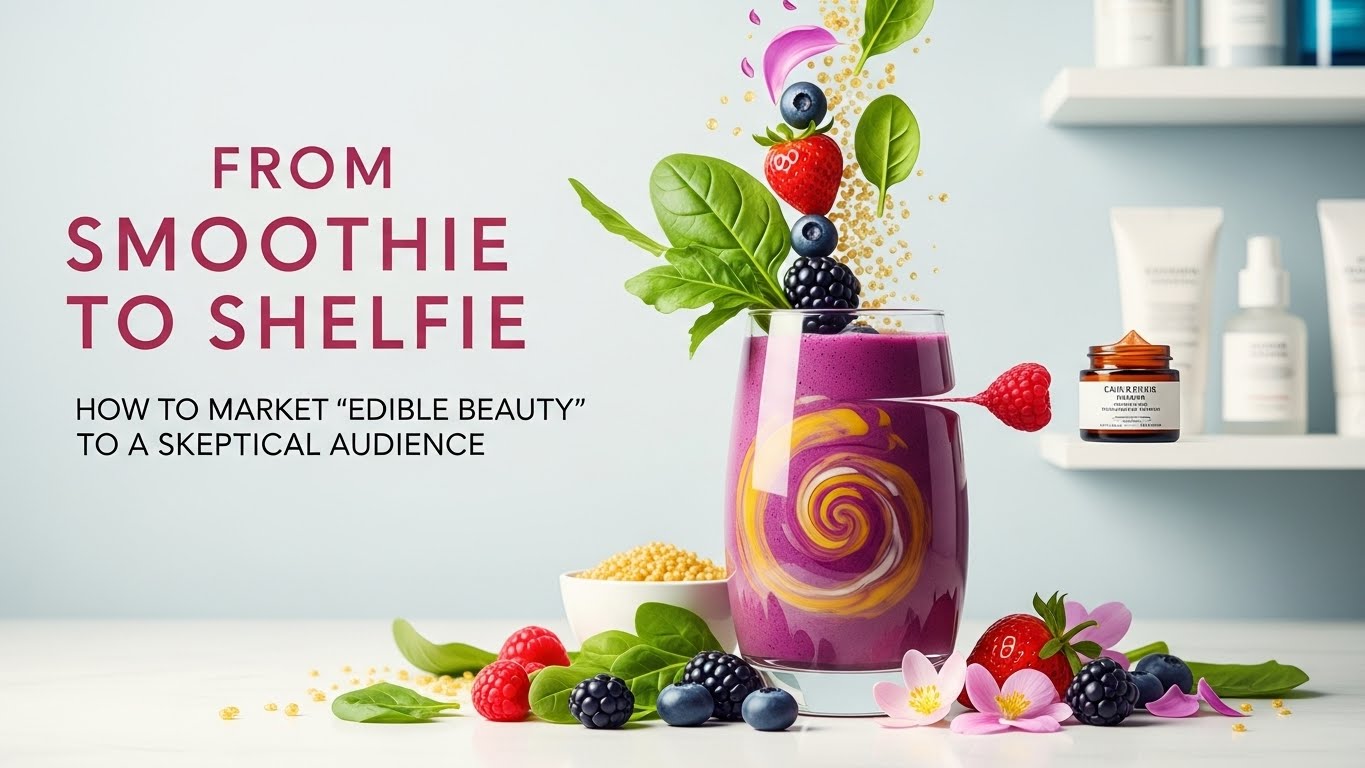
Turning kitchen ingredients into credible skincare—without losing your audience to DIY tutorials Your customer is standing in the skincare aisle, holding a moisturizer that lists “avocado oil” as a hero ingredient. She thinks: “I have avocados in my fridge. Why am I paying $48 for this?” She puts it back, goes home, and Googles “DIY avocado face mask.” You’ve just lost a sale to her kitchen. This is the edible beauty paradox: the very thing that makes your products appealing—familiar, food-based ingredients—also makes them seem unnecessary. If it’s just matcha and honey, can’t I make it myself? The edible beauty movement—skincare formulated with ingredients you’d find in a smoothie or salad—has exploded in popularity. Brands like Youth to the People (kale, spinach, green tea), Glow Recipe (watermelon, avocado), and Fresh (soy, sugar) have built empires on the premise that what you eat should also feed your skin. But marketing these products requires a delicate balance: highlight the familiarity and naturalness while proving professional formulation beats DIY mashing. This article will show you how to market edible beauty products to skeptical consumers who wonder why they should buy when they could blend. You’ll learn to bridge the gap between pantry and vanity, educate without condescending, and convert kitchen skeptics into loyal customers. Before we can convert skeptics, we need to understand exactly what makes them skeptical. Edible beauty products face objections that conventional skincare doesn’t—and ignoring these concerns is marketing malpractice. According to Grand View Research, the organic personal care market is projected to reach $54.5 billion by 2027, with food-based ingredients being a major driver. But the same research shows that 43% of consumers who try natural/edible beauty products return to conventional products within 6 months—often citing inefficacy or confusion about value. Your marketing must address these objections head-on, not sidestep them. Acknowledge the skepticism, then systematically dismantle it with education, proof, and positioning that makes professional formulation the obvious choice over DIY experimentation. Strategy: Lead with ingredients they know and trust. “Made with matcha, coconut, and avocado” creates immediate comfort and interest. Goal: Lower barrier to entry with familiar, non-intimidating ingredients Strategy: Explain extraction methods, concentration levels, stabilization. “Cold-pressed avocado oil at 15% concentration” sounds professional, not kitchen-made. Goal: Demonstrate expertise and efficacy beyond DIY capability Strategy: Clinical studies, before/afters, dermatologist endorsements. Show that your formulation delivers results that kitchen experiments can’t. Goal: Build trust through proven effectiveness Strategy: Show how edible beauty fits into a holistic wellness lifestyle. Beauty from within AND without. Position as part of a healthy, intentional life. Goal: Create emotional connection beyond just product efficacy Strategy: Compare time, stability, consistency, safety. DIY is risky, time-consuming, and unpredictable. Your product is reliable, tested, and convenient. Goal: Make premium price feel justified and DIY feel like the riskier choice Core Principle: Never apologize for using food ingredients. Embrace them, then elevate them with science, safety, and superior formulation. DIY is experimentation; your product is optimization. The biggest threat to edible beauty brands isn’t other products—it’s Pinterest. Thousands of DIY recipes promise the same benefits for pennies. Rather than pretending this doesn’t exist, address it strategically. Don’t shame DIY enthusiasts. Instead, position your product as the evolved, optimized version: Edible beauty is more than skincare—it’s a lifestyle statement. Your customers aren’t just buying moisturizer; they’re buying into a philosophy that what nourishes the body should also nourish the skin. Your visual storytelling must bridge the gap between the kitchen and the bathroom vanity seamlessly. This requires a specific visual language that shows edible beauty as part of a holistic wellness routine, not a gimmick. Here’s how to create imagery that converts lifestyle-conscious consumers. Show edible beauty as part of a complete wellness morning routine: This visual journey shows your product as one element of a holistic lifestyle—not the entire lifestyle, but an essential component. Create split-screen or side-by-side visuals that draw direct connections: This visual technique validates the edible beauty premise while differentiating your product from literal food. Create aspirational flat lay photography that shows your products among other wellness items: This positions your brand within a broader wellness ecosystem—you’re not just skincare, you’re part of an intentional, healthy life. Show parallel beauty routines—internal and external nourishment: This reinforces the edible beauty philosophy while showing your products as the external complement to internal nutrition. Take customers on a visual journey from farm to formulation: This transparency builds trust while emphasizing that professional formulation involves expertise, not just blending ingredients. Feature real customers integrating edible beauty into their daily lives: Authenticity sells lifestyle brands. Show real integration, not aspirational fantasy that feels unattainable. Glow Recipe, with their watermelon and avocado-based products, excels at pantry-to-vanity storytelling. Their Instagram shows fresh-cut watermelon next to their sleep mask, creates flat lays with actual fruit and skincare products, and features customers holding smoothies in one hand and Glow Recipe products in the other. They’ve built a visual language that says: “We’re not pretending these aren’t food ingredients—we’re celebrating that they are, while showing you why our formulation is superior.” Result? Multi-million dollar valuation and cult following among wellness-conscious millennials. When you master pantry-to-vanity visual storytelling, you don’t just sell skincare—you sell a lifestyle philosophy. You become part of your customer’s wellness identity, not just their bathroom shelf. That’s when edible beauty transcends skepticism and becomes aspiration. Learn the proven strategies successful wellness brands use to convert kitchen skeptics into loyal customers. Master visual storytelling, overcome DIY objections, and build an edible beauty brand that commands premium prices. Explore the Beauty Marketing Course → Transform skeptics into superfans with authentic lifestyle marketing Skeptical consumers need education, but they don’t want to feel talked down to. Here’s how to teach the science behind edible beauty without sounding like a textbook: Start with what they already believe, then build on it: Example: “You know avocados are full of healthy fats that nourish your body. The same fatty acids—omega-3, omega-6, and omega-9—penetrate deeply into skin to restore barrier function. But unlike mashing an avocado at home, our cold-pressed extraction preserves delicate nutrients that oxidize within minutes of exposure to air. That’s why our formula works where DIY falls short.” Use analogies they already understand: Example: “Making skincare from blueberries is like making wine from grapes. Sure, you can juice grapes at home. But winemakers control fermentation, pH, aging—that’s what creates a $100 bottle vs. grape juice. We do the same with skincare: take incredible ingredients and optimize them for maximum benefit.” Share insider knowledge that makes them feel smart: Example: “Here’s what beauty brands don’t tell you: Most ‘matcha’ skincare uses cheap matcha dust, not ceremonial grade. It’s like comparing instant coffee to artisan espresso. We use organic, ceremonial-grade matcha at 5% concentration—you’d need to mash 10 matcha lattes to get the same antioxidant level we deliver in one pump.” Educate on DIY dangers without being preachy: Example: “We love DIY culture, but here’s what concerns us: Food has bacteria. Your skin has pH requirements. Mismatch these, and you risk everything from breakouts to chemical burns. Our products are pH-balanced (5.5, ideal for skin), preservative-stabilized, and dermatologist-tested. DIY is fun experimentation. Our products are safe confidence.” This is where many edible beauty brands lose customers. Someone sees “avocado + honey” and thinks “$3 worth of ingredients, $48 price tag—no thanks.” Your job is to reframe the value proposition entirely. Don’t let customers fixate on the sticker price. Break it down: “This $48 serum lasts 3 months with daily use. That’s $0.53 per day for professional-grade skincare. Less than your morning coffee for skin that glows all day.” Make the investment feel reasonable by showing the cost per use, not just the upfront price. Edible beauty brands have a unique opportunity: because your ingredients are familiar, you can be radically transparent in ways that conventional beauty brands can’t. Use this to your advantage. List every ingredient with its purpose and percentage. “Avocado Oil (15%) – Rich in oleic acid for deep hydration.” No hiding behind “proprietary blends.” When customers can Google your ingredients and verify they’re actually beneficial, you build trust. Show your production process. Take customers inside your facility. Introduce your formulators. When you have nothing to hide, flaunt that transparency. Instagram Stories of “how we make your matcha mask” humanizes your brand and proves you’re not just repackaging grocery store items. Acknowledge what your products can’t do. “Our honey cleanser won’t erase 20 years of sun damage overnight. But with consistent use, it gently brightens and nourishes.” Honesty about limitations makes your claims about what DOES work more believable. Show where ingredients come from. “Our matcha comes from Uji, Japan, where it’s been grown for 800 years.” Link to farms, fair trade certifications, organic verifications. This elevates your ingredients from “food” to “premium sourcing.” The skepticism around edible beauty isn’t a problem—it’s an opportunity. Every objection is a chance to educate, differentiate, and demonstrate value. The brands that thrive in this space don’t shy away from the food connection; they celebrate it while proving their professional formulation is superior to DIY attempts. When you master the smoothie-to-shelfie journey—showing ingredients customers recognize while demonstrating expertise they can’t replicate—you create powerful positioning. You’re not competing with Pinterest recipes; you’re offering the evolved, optimized, safe version of what those recipes promise but can’t deliver. “Edible beauty isn’t about convincing people that food belongs on their face—they already believe that. It’s about showing them that professional formulation takes that belief to the next level: safer, more effective, more convenient, and more reliable than anything they could create at home. Master that message, and skeptics become superfans.” So embrace the pantry. Show the vanity transformation. Bridge the gap with authentic lifestyle storytelling. Educate on formulation science. Justify your pricing through value, not just ingredients. And always, always be transparent—because when customers can verify everything you claim, trust becomes inevitable. The kitchen is where wellness begins. The bathroom is where you help it flourish. From smoothie to shelfie—that’s not just a tagline. It’s your entire positioning strategy. 🥑✨ Share this guide with edible beauty founders navigating skeptical markets! Keywords: edible beauty marketing, food-based skincare, kitchen ingredients skincare, natural beauty products, DIY skincare alternative, wellness lifestyle brands, organic beauty marketing, food to face beauty, smoothie to shelfie, sustainable beauty marketingUnderstanding the Skepticism: Why Edible Beauty Faces Unique Challenges
The Five Objections to Edible Beauty
“I can make this at home for $5” → Why should I pay premium prices for ingredients I already own?
“Is this actually effective?” → Does a blueberry serum really work, or is it just marketing hype?
“Won’t this spoil quickly?” → If it’s made from food, how long will it last on my shelf?
“This seems gimmicky” → Is this real science or just trendy marketing playing on food-as-wellness culture?
“How is this different from DIY?” → What makes your professional formulation better than Pinterest recipes?From Kitchen to Credibility: The Edible Beauty Framework
Familiarity Hook: Start with Recognition
Formulation Education: Show the Science
Efficacy Proof: Results Over Recipes
Lifestyle Integration: Pantry to Vanity Bridge
Value Justification: Why Professional Beats DIY
The DIY Objection: Turning Competition into Collaboration
How to Message This Without Sounding Condescending
Visual Storytelling for Lifestyle Brands: Bridging Pantry and Vanity
The Pantry-to-Vanity Visual Strategy
1. The Morning Ritual Sequence
2. Ingredient Mirroring: Kitchen Meets Bathroom
3. Lifestyle Integration: The Wellness Flat Lay
4. The “Beauty From Within” Comparison
5. Environment Storytelling: Where Your Ingredients Come From
6. The User Journey: Real People, Real Routines
Real Example: Glow Recipe’s Visual Mastery
Ready to Master Edible Beauty Marketing?
Ingredient Education: Teaching Without Lecturing
The “You Know This” Approach
The Comparison Shortcut
The “Dirty Little Secret” Reveal
The Risk Warning (Without Fear-Mongering)
Pricing Strategy: Justifying Premium Costs for Kitchen Ingredients
The “Cost Per Use” Reframe
Building Trust Through Transparency
The Transparency Framework
Full Ingredient Disclosure
Behind-the-Scenes Content
Honest Limitations
Source Documentation
From Kitchen Experiments to Beauty Empire
Resources for Edible Beauty Brands