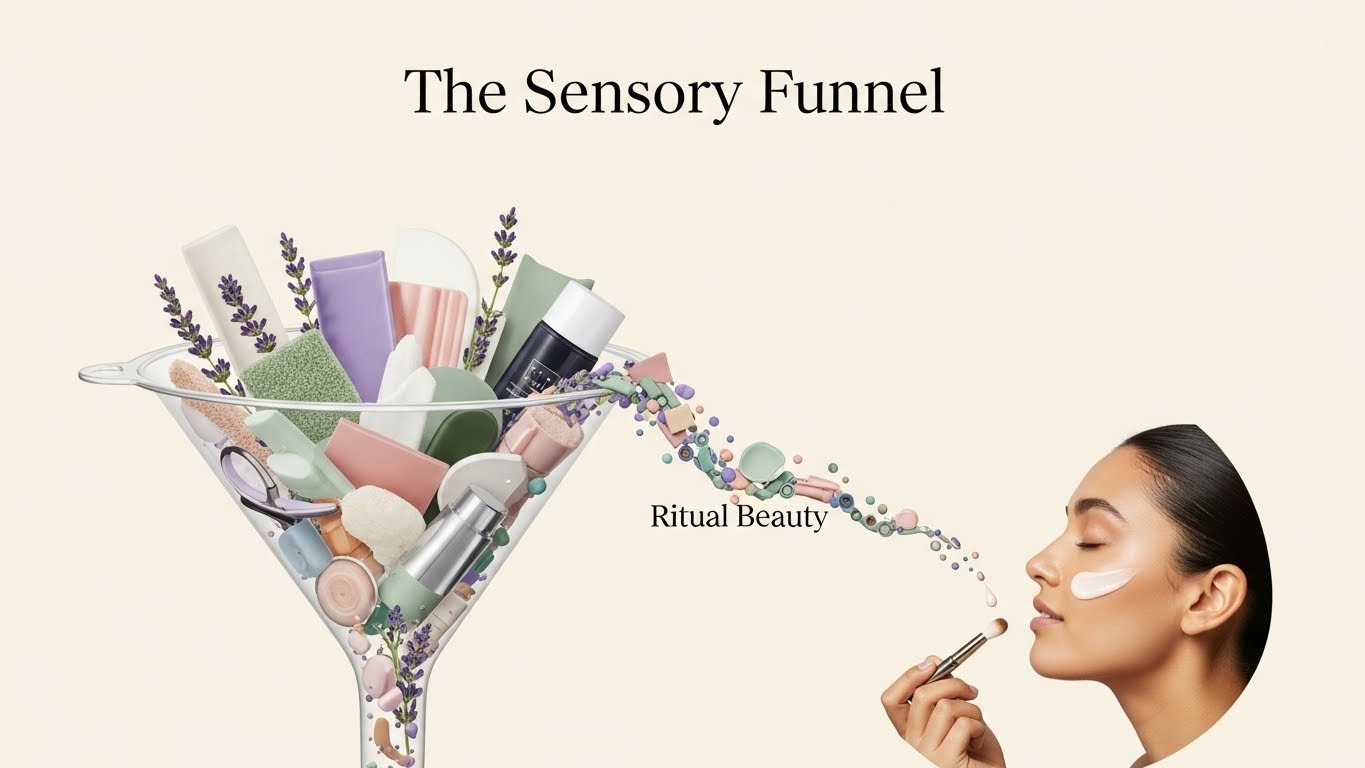
Transforming skincare from functional task into mindfulness practice through multi-sensory storytelling It’s 11 PM. She’s been in Zoom meetings since 8 AM. Inbox: 47 unread. Brain: overstimulated. She opens Instagram—endless scroll, more stimulation. Then she sees your ad: hands massaging rose-scented oil into skin, slow circular motions, deep breath. For 15 seconds, she exhales. She clicks. Not because your serum promises wrinkle reduction. Because it promises quiet. This is ritual beauty—skincare positioned not as functional routine but as sensory meditation, intentional pause, embodied self-care. While the rest of beauty marketing screams “RESULTS! BEFORE-AFTER! 7 DAYS!”—ritual brands whisper: “Stop. Breathe. Feel the texture. Smell the lavender. This moment is yours.” The challenge: how do you sell sensory experience through screens that can’t transmit smell, texture, or temperature? How do you market lavender-scented face oil when customers can’t inhale the aroma before purchasing? How do you convey the weight of a stone gua sha or the cooling sensation of a gel mask when they’re shopping from phones during subway commutes? According to research, 73% of consumers report feeling “chronically stressed,” and 68% say they’re seeking products that offer “wellness benefits beyond functionality.” The wellness-beauty intersection—where skincare becomes self-care ritual—is projected to reach $17.8B by 2027, growing at 8.3% annually. Stressed consumers are actively seeking moments of calm, and they’re willing to pay premium prices for products that deliver sensory relief. But here’s the conversion gap: sensory products require sensory proof. Functional beauty can show before-after photos. Ritual beauty must transmit feeling through digital channels designed for visual consumption. You’re not just selling a product; you’re selling an embodied experience that customers can’t fully perceive until after purchase. This article will show you how to market ritual beauty through the sensory funnel—a customer journey that translates smell, texture, temperature, and sound through video storytelling, ASMR techniques, and emotional positioning. You’ll learn to make scent visible, texture tangible, and ritual irresistible through screens that engage only two senses (sight, sound) yet must evoke all five. Before building the sensory funnel, understand who’s buying ritual beauty and why: According to McKinsey wellness research, 79% of wellness consumers say mental wellbeing is their top priority, and 82% consider “small moments of calm” essential to daily life. Skincare ritual is one of the most accessible daily calm moments. The key insight: ritual beauty customers aren’t shopping for wrinkle reduction—they’re shopping for stress relief. Your competition isn’t other serums; it’s meditation apps, bath bombs, and any other product promising momentary peace. Market accordingly. Strategy: Visually slow content—hands moving slowly, neutral palettes, minimal text. Create scroll-stopping pause through visual pace, not shock. Goal: Trigger stress recognition—”I need this calm” Strategy: Make invisible senses visible—rose petals for scent, hand movements for texture, steam for warmth. Use visual metaphors for multi-sensory experience. Goal: Create sensory imagination—customers “smell” through screen Strategy: Step-by-step ritual tutorials—not just “apply serum” but “warm between palms, inhale deeply, massage in circular strokes for 60 seconds.” Choreograph calm. Goal: Position product use as intentional practice, not task Strategy: ASMR audio, ambient sound (water, birds), slowed pacing. Make videos environments to inhabit, not just watch. Add temporal depth—morning vs. evening rituals. Goal: Transport viewers into desired state—feel the ritual Strategy: Email series with ritual prompts, time-of-day reminders, seasonal ritual variations. Support the practice, not just sell the product. Goal: Convert one-time purchase into daily meditation dependency Core Principle: The sensory funnel transforms stressed scrolling into embodied experience by interrupting with visual calm, evoking invisible senses through proxies, guiding ritual application as meditation, immersing in full sensory environments, and sustaining daily practice. When customers feel the relief before they buy, stress becomes your conversion trigger. Same product, different emotional framing. One sells tasks; one sells moments: Never compete on efficiency with ritual beauty. Slow application is a feature. Scent is therapy. Texture is meditation anchor. Time investment proves it’s a practice, not a task. When skincare requires attention, it delivers presence—your most valuable product benefit. This is the ritual beauty paradox: your products’ primary value proposition—how they smell, how they feel on skin, the temperature shift, the weight in hand—cannot be transmitted through screens. Customers can’t smell lavender through Instagram. They can’t feel silky texture through TikTok. Yet these sensory properties are exactly why stressed customers will pay $78 for your face oil instead of $12 for a drugstore alternative. The challenge: translate embodied sensory experience into visual/audio storytelling that evokes the missing senses. Make customers FEEL the texture, SMELL the scent, SENSE the ritual through proxies—visual cues, audio design, pacing, and emotional context that trigger sensory imagination. The Challenge: Screens can’t transmit smell—how do you make lavender oil’s aroma compelling? The Visual Scent Proxy Strategy: Show the Source (Botanical Romance): “Open with lavender fields swaying in breeze. Close-up of purple blooms. Customer knows what lavender smells like from memory—visual triggers olfactory recall. Text overlay: ‘Pure lavender essential oil—calming, grounding, home.'” Capture the Inhale (Embodied Action): “Show person holding bottle near nose, eyes closing, visible deep breath, shoulders dropping. Universal body language for ‘smelling something pleasant.’ Customer mirrors the breath—creates somatic engagement.” Use Scent Descriptors (Linguistic Evocation): “Don’t just say ‘lavender scent.’ Say: ‘Provence lavender—herbaceous, slightly sweet, like sun-warmed linen.’ Descriptive language activates scent memory. Compare to familiar experiences: ‘smells like a spa day’ or ‘like your grandmother’s garden.'” Show Aromatherapy Context (Functional Benefit): “Cut to person applying oil before bed, lighting candle, settling into pillow. Connect scent to sleep ritual. Text: ‘Lavender signals to your nervous system: it’s time to rest.’ Educational framing makes scent therapeutic, not just pleasant.” Add Ambient Sound (Multi-Sensory Cueing): “Layer soft instrumental music—flute, acoustic guitar—instruments associated with relaxation. Gentle wind sounds suggesting lavender field breeze. Sound creates mood that mind associates with scent. Customer ‘hears’ calm = ‘smells’ calm.” The Scent Translation Formula: Botanical source imagery + visible inhale action + descriptive language + aromatherapy context + ambient sound = olfactory imagination. Customers don’t smell your product, but their brain fills in the scent from cues. Why this works: Human brains are highly suggestible—visual and linguistic cues trigger scent memory, embodied actions (inhaling) create mirror neuron activation, contextual framing (bedtime ritual) assigns meaning to scent, multi-sensory cueing compensates for missing olfactory channel. The Challenge: How do you convey silky oil texture, cooling gel sensation, whipped cream lightness? The Haptic Visual Proxy Strategy: Close-Up Texture Shots (Extreme Detail): “Macro lens showing oil spreading on skin—watch how it glides. Gel melting under fingertip—see the transformation. Cream peaks holding shape. Make texture visually dramatic through close-ups that show movement and consistency.” Hand Movement Language (Kinesthetic Storytelling): “Slow, deliberate massage strokes. Palms rubbing together to warm oil. Fingertips patting gel onto skin. Hand movements communicate texture—fast absorption = light texture, slow massage = rich oil, gentle tapping = cooling gel.” Comparison Metaphors (Familiar Anchors): “Text overlays: ‘Silk on skin’ (for oil), ‘Whipped clouds’ (for cream), ‘Cool water’ (for gel). Compare to textures customers already know. Show silk fabric flowing, whipped cream peaks, water droplet—create tangible texture associations.” Before/After Skin Appearance (Touch Proof): “Show skin texture before application (dry, rough-looking), during (product visible), after (smooth, glowing). Skin appearance change suggests how product FELT during application—dry to dewy implies rich hydration.” ASMR Sound Design (Tactile Audio): “Amplify texture sounds—oil bottle opening (satisfying pop), product dispensing (gentle glug), hands rubbing together (soft friction), application sounds (gentle skin contact). ASMR triggers tactile imagination—customers ‘feel’ through ears.” The Texture Translation Formula: Extreme close-ups showing movement + hand language communicating consistency + comparison metaphors + skin transformation + ASMR sound = haptic imagination. Customers see texture behave = understand how it feels. Why this works: Visual texture cues (how product moves, spreads) inform touch predictions, hand movements demonstrate application experience, metaphors bridge to familiar tactile memories, ASMR sound creates somatic response that mimics touch, skin appearance suggests product performance. The Strategy: Visual and contextual cues that suggest temperature sensation. Temperature Signaling Techniques: Why this works: Color grading (cool blues vs. warm ambers) triggers temperature associations, contextual props (ice, steam) provide visual temperature cues, facial expressions communicate sensation, seasonal framing makes temperature benefit relevant. The Strategy: Choreograph complete sensory journey in short-form video. The 5-Shot Sensory Sequence: Shot 1 (0-3 sec): The Stress Moment Tight shot of tense face, hands clutching phone, rapid scrolling. Establish stress state. Sound: ambient city noise, notifications. Shot 2 (4-8 sec): The Ritual Begin Hands opening product, close-up of texture. Slow motion. Person inhales visibly. Sound fades to soft instrumental. Visual calm begins. Shot 3 (9-15 sec): The Sensory Experience Macro shot of product application—texture visible, hand movements slow and intentional. Show scent source (lavender field B-roll). ASMR sounds. Text overlay: “Breathe. This moment is yours.” Shot 4 (16-24 sec): The Transformation Wide shot—person’s shoulders dropped, face relaxed, eyes closed. Show completed ritual. Skin glowing. Environment calm (candle, soft light). Visual proof of stress → stillness. Shot 5 (25-30 sec): The Invitation Product shot with brand name. Text: “Your daily ritual awaits.” CTA button appears. Sound: one final exhale, silence. Why this works: Begins with stress recognition (relatability), transitions to visual calm (relief promise), showcases sensory experience through proxies (imagination), demonstrates transformation (proof), ends with invitation (conversion moment). Journey from chaos to calm = your product story. The Strategy: Use autonomous sensory meridian response triggers to create physical relaxation response. High-Performance ASMR Sounds for Ritual Beauty: ASMR Note: Record with high-quality microphones close to sound source. Amplify satisfying sounds, mute distracting ones. Sound should be present but not overwhelming—like someone whispering ASMR, not shouting it. Why this works: ASMR triggers parasympathetic nervous system (rest response), creates physical tingling/relaxation sensation viewers associate with product, sound design compensates for missing touch/smell by activating alternate sensory pathway, ritual sounds become Pavlovian relaxation cues. The Strategy: Use video pacing to create physiological calm response in viewers. The Slow Video Technique: Ritual Beauty Pacing: “Slow cuts (3-5 seconds each), minimal text, hands moving at real-time or slightly slow-motion speed. No rapid edits, no jumpy transitions. Video pacing should match desired emotional state—viewers’ nervous systems entrain to visual rhythm. Slow video = slow breath = relaxation.” Contrast with Fast Beauty: “Fast beauty ads: quick cuts, upbeat music, energy. Ritual beauty: lingering shots, ambient sound, stillness. Your slow pacing signals: ‘This isn’t another product demanding your attention—this is permission to rest.’ Pacing becomes brand differentiator.” Why this works: Human nervous systems mirror visual rhythms, slow pacing triggers parasympathetic response (rest/digest), creates scroll-stopping contrast in fast-feed environments, positions your brand as anti-chaos sanctuary, pacing itself becomes sensory experience. Herbivore built a $30M+ ritual beauty brand largely through sensory video excellence. Their strategy: (1) Every product video shows botanical source first—pink clay from Brazil, rose petals from Morocco—visual scent cues, (2) Extreme macro shots of texture—oil spreading on skin, crystals in face masks, gel melting—haptic imagination, (3) ASMR-optimized sound design—bottle opening clicks, product squelching, water sounds—creates physical tingle response, (4) Visible inhale moments in every video—person smelling product, eyes closing, shoulders dropping—teaches ritual behavior, (5) Slow pacing (4-second cuts) with ambient instrumental music—entrains calm nervous system response, and (6) Consistent color story (pastels, soft lighting) that signals gentle, calming experience before product even appears. Their Instagram engagement rate is 3.2% (vs. beauty industry average 1.1%) because videos trigger relaxation response—viewers FEEL better after watching. Comments consistently mention “this video calmed me down” and “I can almost smell it through the screen.” By mastering sensory translation, they sell $78 face oils to stressed Millennials who willingly pay premium for products promising embodied calm—and the videos themselves deliver that calm before purchase, creating trust in the ritual promise. When you translate scent through botanical visuals + visible inhales + descriptive language + aromatherapy context + ambient sound, texture through macro close-ups + hand language + metaphors + ASMR + skin transformation, temperature through color grading + contextual props + facial expressions, ritual through 5-shot sensory sequences, ASMR through satisfying sounds, and pacing through slow temporal rhythms—customers don’t just see your product. They imagine experiencing it. The sensory gap closes through sophisticated multi-modal storytelling. Learn the proven strategies successful sensory brands use to build the sensory funnel, translate scent and texture through video storytelling, and create ritual positioning that converts stressed shoppers into devoted practitioners—turning mindfulness into your most powerful marketing tool. Explore the Beauty Marketing Course → Market ritual beauty powerfully—build sensory brands that soothe Beyond product videos, create content that sustains ritual practice: Different sensory needs for different times: Example: “AM: Energizing citrus mist ritual—wake your senses. PM: Grounding lavender oil ritual—release the day.” Teach temporal rituals that structure entire day around sensory moments. Voice-guided application meditation: Example: “Close your eyes. Warm the oil between your palms. Feel the texture. Inhale deeply—what do you smell? Now, massage your face in slow circles…” Turn product use into guided meditation practice. Connect products to seasonal sensory needs: Example: “Winter ritual: Warming face massage with rich oil. Summer ritual: Cooling mist + lightweight gel.” Seasonal content keeps rituals feeling fresh and relevant year-round. Encourage customers to share their practices: Example: “#MorningMoment challenge—show us your AM ritual. Best videos win a ritual kit.” UGC creates community of practitioners, shows diverse ritual interpretations, builds social proof for sensory experience. Ritual beauty commands premium pricing through demonstrated experiential value: “$78 isn’t just for face oil—it’s for lavender aromatherapy + massage meditation + botanical luxury + stress relief ritual. You’re paying for 5-minute daily calm practice.” “Hand-blended in small batches, cold-pressed botanicals, custom scent development. The craft process creates superior sensory experience—you smell and feel the difference.” “Compare to: Meditation app subscription ($70/year), therapy copay ($40/session), yoga class ($25). Your $78 ritual provides 3 months of daily stress management. Cost-per-moment of calm: $0.87.” We live in the most overstimulated era in human history—constant notifications, infinite content, decision fatigue at every scroll. Stressed consumers aren’t just looking for better skin; they’re desperately seeking moments when they can stop, breathe, and feel present in their bodies. Ritual beauty meets this need by transforming skincare from functional routine into embodied meditation. When you market your lavender face oil not as wrinkle-reducer but as “60 seconds of mandatory calm,” when your cooling gel becomes “instant grounding,” when application instructions read like mindfulness prompts—you’re not competing with other serums. You’re competing with meditation apps and therapy sessions. And you’re winning because you deliver both skin benefits AND stress relief in one intentional act. “The future of ritual beauty marketing is multi-sensory storytelling that translates embodied experience through screens designed for only two senses. Interrupt scrolling with visual calm. Evoke scent through botanical sources, visible inhales, descriptive language, and ambient sound. Translate texture through macro close-ups, hand movements, metaphors, skin transformation, and ASMR. Convey temperature through color grading and context. Guide ritual application as meditation practice. Immerse viewers in full sensory environments through slow pacing and sonic design. When your videos trigger relaxation response BEFORE purchase, customers trust that the product will deliver calm AFTER purchase. The sensory funnel doesn’t just sell products—it creates devotees who depend on your brand for their daily moment of stillness in chaos. Stressed shoppers aren’t shopping for cosmetics; they’re shopping for peace. Give them that through every frame, every sound, every slowed breath in your content—and they’ll pay premium prices not for what your products do to their skin, but for how they make them feel in a world that never stops demanding attention. Market ritual. Deliver presence. Build brands that soothe souls, not just smooth skin.” So build your sensory funnel. Interrupt with calm visuals. Translate scent and texture through video mastery. Guide meditation rituals. Immerse in ASMR environments. Sustain practice through community. Price as wellness tool. Because in a world that never stops scrolling, the brands that help people pause win everything. Market ritual beauty boldly. Make the invisible senses felt. Build brands that offer rest. 🕯️✨ Share this guide with sensory beauty founders! Keywords: ritual beauty marketing, sensory funnel, ASMR skincare, scent translation video, texture storytelling, mindful beauty, stress relief skincare, wellness beauty positioning, multi-sensory marketing, embodied self-careUnderstanding Ritual Beauty Buyers: The Stressed-Out Segment
The Seven Characteristics of Ritual Beauty Customers
Chronically overstimulated: Constant notifications, screen time, decision fatigue—seeking moments of sensory calm
Wellness-oriented: Practice yoga, meditation, mindfulness—extend these values to beauty routine
Experience-driven: Value how products make them FEEL over clinical efficacy alone—pleasure matters
Sensory-sensitive: Notice scent, texture, weight, temperature—attuned to embodied experience
Intentionality seekers: Want skincare to slow them down, not speed them up—anti-efficiency positioning
Premium-willing for peace: Pay more for products that deliver stress relief alongside skin benefits
Authenticity-demanding: Detect fake “wellness-washing”—require genuine ritual design, not just spa aestheticThe Sensory Funnel: From Stress to Stillness
INTERRUPT: Stop the Scroll (Visual Calm)
EVOKE: Suggest the Sensory (Scent/Texture Proxies)
GUIDE: Teach the Ritual (Application as Meditation)
IMMERSE: Create the Environment (Full Sensory Context)
SUSTAIN: Build the Daily Practice (Ritual Habit Formation)
Functional Marketing vs. Ritual Positioning
The Ritual Positioning Rule
Translating Scent and Texture Through Video Ads (Essential for Sensory Brands)
The Video Sensory Translation Framework
1. Scent Translation: Making Aroma Visible
2. Texture Translation: Making Touch Visible
3. Temperature Translation: Conveying Warmth & Cooling
4. The Full Ritual Video Structure (15-30 Seconds)
5. ASMR Integration (Sonic Sensory Activation)
6. Pacing as Sensory Strategy (Temporal Manipulation)
Real Example: Herbivore Botanicals’ Sensory Video Mastery
Ready to Master Ritual Beauty Marketing?
Content Strategy: Building the Ritual Practice Community
“Morning Ritual” vs. “Evening Ritual” Series
“Guided Ritual” Audio Content
“Seasonal Ritual” Adaptations
“Ritual Moments” User-Generated Content
Pricing Ritual as Premium (Stress Relief Justifies Cost)
The Ritual Premium Positioning Framework
Multi-Sensory Experience > Single Function
Artisanal Craft > Mass Production
Daily Wellness Tool > Cosmetic Product
The Future Is Felt: Building Sensory Brands for Overstimulated Consumers
Resources for Ritual Beauty Brands