Converting science-savvy skeptics through data visualization, not marketing fluff She’s a 32-year-old software engineer scrolling Reddit’s SkincareAddiction. Your Instagram ad: “Our revolutionary serum uses AI-optimized peptide ratios for perfect skin!” She rolls her eyes and keeps scrolling. Not because your claim is false—your AI analysis genuinely identified optimal peptide combinations. But because “AI-optimized” and “revolutionary” sound like every other brand’s marketing fluff. She wants data, not buzzwords. Proof, not promises. This is the skintellectual challenge—a growing consumer segment (28% of skincare buyers, concentrated in ages 25-40) who research ingredients obsessively, fact-check claims on Reddit and TikTok, demand clinical studies before purchase, and dismiss marketing hyperbole instantly. They’re the customers who read your entire ingredient list, search PubMed for concentration studies, and call out greenwashing on social media. Traditional beauty marketing—emotional appeals, celebrity endorsements, before/after photos without methodology—doesn’t just fail with them; it actively repels them. Welcome to the data-driven funnel—a marketing framework that speaks skintellectual language through scientific validation, transparent methodology, and data visualization. Brands like The Ordinary, Paula’s Choice, and Geek & Gorgeous have pioneered this approach: complex formulation science translated into accessible visuals, R&D stories shown through infographics, clinical data presented as compelling proof—not overwhelming jargon. According to research, skintellectual consumers spend 3.2x more than average beauty buyers ($420 vs. $130 annually), have 4.1x higher customer lifetime value due to loyalty once convinced, and drive 67% of online beauty discourse despite being only 28% of market. But converting them requires different approach: they won’t buy based on aspirational imagery or influencer endorsements—they need scientific proof made visually accessible. The challenge: how do you market “AI-optimized peptide ratios” without sounding like every brand claiming innovation? How do you translate complex R&D stories—like machine learning analysis identifying optimal concentrations—into simple visual hooks that convert? How do you prove your “perfect formula” claim with data skeptics will trust? And critically—how do you make scientific validation compelling, not boring, so skintellectuals become advocates who spread your credibility? This article will show you how to market data-driven formulas to skeptical skintellectuals—building proof through methodology transparency, translating complex R&D (like AI analysis) into accessible visual stories, and creating data-driven funnels that convert science-minded consumers into loyal customers who value your intellectual honesty. Before building data-driven marketing, understand what drives this influential segment: According to NPD beauty industry research, skintellectual consumers drive 48% of prestige skincare growth despite being minority of market—their influence far exceeds their numbers. The key insight: skintellectuals aren’t anti-marketing; they’re anti-bullshit. They’ll engage enthusiastically with brands that respect their intelligence through data transparency, scientific rigor, and honest methodology. Treat them like the educated consumers they are. Strategy: Lead with HOW you arrived at formula—”AI analyzed 2,847 peptide combinations across 16 parameters”—methodology proves legitimacy. Goal: Establish scientific credibility before making claims Strategy: Transform “16-week double-blind study” into visual timeline, peptide ratios into pie charts, pH optimization into graphs—data made accessible. Goal: Make scientific proof compelling, not overwhelming Strategy: “15% niacinamide at pH 5.5” not “powerful niacinamide.” “0.5% retinol in squalane” not “anti-aging retinol.” Precision builds trust. Goal: Speak skintellectual language through specificity Strategy: Hyperlink clinical references, cite journals, provide study PDFs—prove you’re not making things up. Transparency over sales pressure. Goal: Provide verification path for skeptical researchers Strategy: Create ingredient guides, formulation breakdowns, “how we formulate” content—position as educator, earn skintellectual respect and advocacy. Goal: Convert customers into informed advocates Core Principle: The data-driven funnel wins skintellectuals by validating methodology before claims, visualizing complex data accessibly, specifying exact concentrations, sourcing to clinical studies, and educating genuinely. Respect their intelligence, earn their loyalty. Science-minded consumers become fiercest advocates when convinced through data, not marketing fluff. Same innovative formula, opposite communication approaches. One triggers eye-rolls; one earns respect: Every vague claim can be made specific. “Revolutionary” becomes “analyzed 2,847 combinations.” “Clinically proven” becomes “16-week double-blind, n=127, p<0.001.” “Powerful vitamin C” becomes “15% L-ascorbic acid at pH 3.2.” Specificity signals you have actual data, not just marketing copy. Skintellectuals trust numbers, not adjectives. This is the skintellectual marketing challenge: you have genuinely impressive R&D—AI analyzed thousands of ingredient combinations, machine learning identified optimal peptide ratios, computational modeling predicted skin penetration. This is real science, not marketing fluff. But when you say “AI-optimized formula,” it sounds like every brand claiming innovation. The complexity that makes your story credible also makes it inaccessible. The opportunity: complex R&D becomes compelling when translated into visual stories that show methodology without overwhelming. Skintellectuals want to understand your process—they’re not intimidated by data—but it needs to be presented accessibly. When you transform “AI analyzed 2,847 peptide combinations across 16 parameters” into visual journey showing the analysis process, you prove legitimacy while maintaining engagement. The Strategy: Show your AI analysis as step-by-step visual journey—makes complex process tangible and credible. Example: “How We Found the Perfect Peptide Formula” Visual Story STEP 1: Database Assembly Visual: Graphic showing “2,847 peptide combinations” as database icon with numbers STEP 2: Parameter Analysis Visual: Icon grid showing 16 parameters (efficacy, stability, penetration, pH compatibility, etc.) STEP 3: Optimization Algorithm Visual: Funnel graphic showing 2,847 combinations narrowing to top 12 STEP 4: Final Formula Visual: Pie chart showing final peptide ratios (40% Matrixyl, 30% Argireline, 30% Syn-Coll) Instagram/TikTok Format: 4-slide carousel showing each step with simple visuals + numbers. Skintellectuals screenshot and share proving they found “brand that actually shows their work.” Why this works: Step-by-step journey shows legitimate process, specific numbers (2,847 combinations, 16 parameters, top 12) prove thoroughness not claims, visual progression makes complex methodology accessible, final formula disclosure with exact percentages = ultimate transparency, shareable format spreads credibility virally. The Strategy: Show your AI-optimized formula vs. alternatives through data graphs—visual proof of superiority. Example: “Why Our Peptide Ratio Outperforms” Bar Graph Visual Bar Graph Showing Three Formulations: ❌ Single Peptide (Common Approach): ⚠️ Random Multi-Peptide: ✅ AI-Optimized Ratio (Ours): Key Message: “Not all peptide serums are equal. Random combinations leave efficacy on table. AI optimization found ratio that maximizes all three benefits simultaneously. Data shows 2.1x superior performance vs. random multi-peptide formulas.” Why this works: Comparative data shows your advantage quantitatively, bar graph makes differences instantly visible, scoring system (x/10) simplifies complex efficacy into digestible numbers, showing what you’re comparing against (single peptide, random multi) proves you understand the landscape, 2.1x superiority claim backed by visible data = credible not hyperbolic. The Strategy: Show actual scientists explaining AI analysis—face + personality + data = trust. Example: “Meet Dr. Sarah: Our AI & The Perfect Peptide Formula” 90-Second Video Why This Format Works: Real scientist (not actor) with credentials shown, screen recording proves actual analysis not stock footage, face + data combination humanizes while validating, 90 seconds respects attention span while delivering substance. Why this works: Human face builds connection data alone can’t, credentials establish expertise, showing actual work (screen recording) proves legitimacy, short format (90 sec) maintains engagement, ending with product creates purchase path, skintellectuals share saying “finally a brand showing actual scientists not marketing team.” The Strategy: Let skintellectuals explore your formulation data themselves—ultimate transparency. Example: “Explore Our Formula” Interactive Product Page Interactive Elements on Product Page: 📊 Hover over any ingredient: Shows exact percentage, molecular weight, function, clinical studies (with links) 📈 “See Our Testing Data” Tab: Full 16-week study results, methodology, statistical analysis, raw data CSV download 🔬 “Compare Formulas” Tool: Side-by-side our peptide ratios vs. competitor products (using their published ingredient lists) 🧪 “Stability Timeline” Graph: Shows peptide activity over 24 months, proves formula stability with data points 📱 “Ask Our Formulation Team”: Direct questions to scientists, get technical answers publicly posted The Skintellectual Effect: They spend 30+ minutes exploring your data, comparing formulas, downloading studies. This deep engagement = highest purchase intent. They become advocates because “this brand lets you see EVERYTHING.” Why this works: Interactive exploration satisfies research obsession, downloadable data (CSV) shows ultimate transparency, comparison tool demonstrates confidence in superiority, stability graphs prove longevity claims, direct scientist access builds relationship, time spent engaging = emotional investment in brand, converts highest-value customers who tell everyone. The Strategy: Get ingredient analysis influencers to examine your AI-optimized formula—third-party validation. Example: Partnering With Science-Focused Creators The Credibility Transfer: When respected science educators validate your formulation, skintellectuals trust you. Their endorsement = “this brand’s claims check out.” More powerful than any ad. Why this works: Third-party validation from trusted sources = unbiased proof, science creators have credibility brands can’t buy, willingness to submit to scrutiny proves confidence, negative feedback (if any) handled transparently shows integrity, community validation spreads virally in skintellectual circles, converts skeptics who “never believe brand claims.” The Strategy: Publish your complete AI analysis methodology—invite others to replicate and verify. Example: “Open Science” Marketing Approach What You Share Publicly: The Paradox: Sharing your “secret” methodology doesn’t hurt competitive advantage—it proves you have real science. Competitors can’t replicate because they don’t have same R&D infrastructure. Skintellectuals become fierce advocates because “this brand publishes their actual research like academic journal.” Why this works: Open methodology = ultimate credibility, replication invitation shows scientific confidence, GitHub code repository proves real analysis not claims, academic-style transparency appeals directly to skintellectual values, community can verify independently = unimpeachable proof, positions brand as science-first company not beauty marketing, creates viral spread as researchers share your methodology. Paula’s Choice built $100M+ brand targeting skintellectuals through data-driven marketing. Their strategy: (1) Every product page includes “Research References” section linking to 10-20 clinical studies supporting each ingredient at specific concentrations, (2) “Ingredient Dictionary” with 500+ entries explaining molecular function, clinical efficacy data, optimal concentrations—genuinely educational not sales-focused, (3) “Paula’s Picks” recommendations based on formulation analysis not marketing—calls out overpriced competitors, praises budget alternatives, builds trust through honesty, (4) Product reviews that critique their OWN products honestly: “Our 2% BHA works, but if you have sensitive skin, try 1% version instead”—prioritizes customer success over sales maximization, (5) Before/after photos WITH methodology: “12-week study, twice-daily application, clinical photography under standardized lighting, n=64″—shows they respect scientific rigor, and (6) Free “Expert Advice” team answering formulation questions—responses include study links, concentration recommendations, competitor comparisons. Result: 4.8-star rating across 15,000+ products, 78% customer retention (vs. 24% industry average), average customer LTV $680 (vs. $110 industry), NPS score of 72 (exceptional for beauty). Skintellectuals become fierce advocates because Paula’s Choice “tells the truth even when it costs sales”—prioritizes science over marketing. Success proves that data-driven transparency wins highest-value customers who spread your credibility virally. When you show process journey infographics that reveal methodology step-by-step, create comparative data visualizations proving superiority quantitatively, produce behind-the-science videos humanizing AI analysis through real scientists, build interactive dashboards letting customers explore formulation data, secure third-party validation from science creators, and invite replication through open methodology—complex R&D transforms from overwhelming jargon into compelling proof. Skintellectuals don’t want simplified messages; they want accessible presentations of actual complexity. Learn the proven strategies successful science-focused brands use to market formulas to skeptical skintellectuals, master translating complex R&D and AI analysis into visual hooks, and build data-driven funnels that convert science-minded consumers through methodology transparency and verifiable proof—creating fierce advocates who spread your credibility. Explore the Beauty Marketing Course → Build brands where data equals credibility Beyond marketing campaigns, create systematic content that establishes formulation expertise: Weekly technical breakdowns: Example: “This week: Why pH matters for vitamin C stability. Our formula: 15% L-ascorbic acid at pH 3.2. Here’s the chemistry…” [includes graphs, study links, concentration math]. Science-focused, genuinely educational. Live technical discussions: Example: “Monthly Reddit AMA with Dr. Chen answering formulation questions. Last month: ‘How did you determine optimal peptide ratios?’ Full technical response with methodology.” Transparency builds trust. Real R&D process documentation: Example: “Today in the lab: Testing batch stability at 6-month mark. Here’s the chromatography data…” [shows actual equipment, data readouts, scientist explanations]. Authenticity over polish. Translating research for engagement: Example: “New peptide study published in JAAD: Why combination therapy beats single actives. Here’s what it means for our formula…” [links to study, explains methodology, relates to product]. Educational positioning. Skintellectuals represent the future of beauty consumption—educated, skeptical, research-driven customers who won’t buy based on aspirational imagery or celebrity endorsements. They want data. They demand methodology. They verify claims. Traditional beauty marketing—emotional appeals, vague promises, lifestyle branding—doesn’t just fail with them; it actively repels them because it signals you’re hiding behind fluff instead of standing behind science. The data-driven funnel wins by speaking their language. When you show your AI analyzed 2,847 peptide combinations, visualize the optimization process step-by-step, specify exact concentrations with pH levels, link to clinical studies with sample sizes and p-values, and invite third-party verification—you’re not overwhelming them. You’re respecting their intelligence. And that respect converts into fierce loyalty. “The future of beauty marketing is data-driven funnels that convert skintellectuals through methodology transparency. Replace vague claims with specificity: ‘15% L-ascorbic acid at pH 3.2’ not ‘powerful vitamin C,’ ’16-week double-blind, n=127, p<0.001′ not ‘clinically proven.’ Translate complex R&D into visual journeys: show AI analysis as 4-step infographic (2,847 combinations → 16 parameters → top 12 finalists → optimal 40/30/30 ratio), create comparative bar graphs proving your formula’s 2.1x superiority, produce 90-second scientist videos humanizing methodology. Build interactive transparency: product pages where customers hover over ingredients seeing exact percentages + study links, downloadable raw data CSVs, comparison tools evaluating your formula vs. competitors. Secure third-party validation from science creators (Lab Muffin, Reddit chemists, ingredient analysis YouTubers)—peer review more powerful than ads. Invite replication: publish complete methodology on GitHub, welcome scrutiny, prove confidence through open science. Paula’s Choice proved data-driven marketing wins highest-value customers: $680 LTV vs. $110 industry average, 78% retention vs. 24%, NPS 72 because they ‘tell truth even when costly.’ Create Formulation Friday deep-dives, Lab Notes behind-scenes, Ask Our Chemist Q&As. Skintellectuals want complexity presented accessibly—not dumbed down but visualized intelligently. When convinced through data, they become fiercest advocates spreading your credibility virally in Reddit threads, TikTok breakdowns, blog analyses. Market methodology, not promises. Build proof, not hype. Win scientists’ minds, earn their loyalty.” So build your data-driven funnel. Show methodology transparently. Visualize complexity accessibly. Specify everything precisely. Source all claims. Invite scrutiny. Because skintellectuals are the future—and they’re waiting for brands that respect their intelligence enough to show the science, not just claim it. Market with data. Build with evidence. Win through transparency. 🔬✨ Share this guide with science-focused beauty brands! Keywords: data-driven beauty marketing, skintellectual consumers, AI formulation marketing, complex R&D visual translation, scientific skincare positioning, methodology transparency, clinical study marketing, evidence-based beautyUnderstanding Skintellectuals: The Science-Savvy Skeptic Consumer
The Seven Skintellectual Characteristics
Research-obsessed: Spend hours reading studies, ingredient analyses, Reddit threads—treat skincare like academic subject
Marketing-resistant: Immune to emotional appeals, celebrity endorsements, lifestyle imagery—want data, not feelings
Evidence-demanding: Require clinical studies, methodology transparency, peer-reviewed sources before believing claims
Concentration-focused: Care deeply about exact percentages, pH levels, molecular weights—won’t buy vague “contains retinol” claims
Community-validated: Trust Reddit, ingredient analysis blogs, educated YouTubers over brand marketing—peer review matters
Long-term thinkers: Make slow, deliberate purchase decisions after extensive research—but become fiercely loyal once convinced
Vocal advocates: Once won over, become brand evangelists who share scientific validation with their communitiesThe Data-Driven Marketing Funnel
VALIDATE: Show Methodology, Not Just Results
VISUALIZE: Complex Data as Simple Infographics
SPECIFY: Exact Numbers Over Vague Claims
SOURCE: Link to Actual Studies
EDUCATE: Build Community Through Science
Marketing Fluff vs. Data-Driven Validation
The Specificity Rule
Translating Complex R&D Stories (Like Your AI Analysis) Into Simple Visual Hooks
The Complex-to-Visual Translation Framework
1. The Process Journey Infographic (Methodology Made Visible)
Text: “Started with every clinically-studied peptide combination from dermatology literature 2015-2023”
Why This Works: Specific number (2,847) + source (dermatology literature) + timeframe = verifiable methodology
Text: “AI evaluated each combination across 16 parameters: clinical efficacy, stability data, skin penetration models, pH requirements…”
Why This Works: 16 parameters shown visually proves thoroughness, specific categories (efficacy, stability) show you evaluated what matters
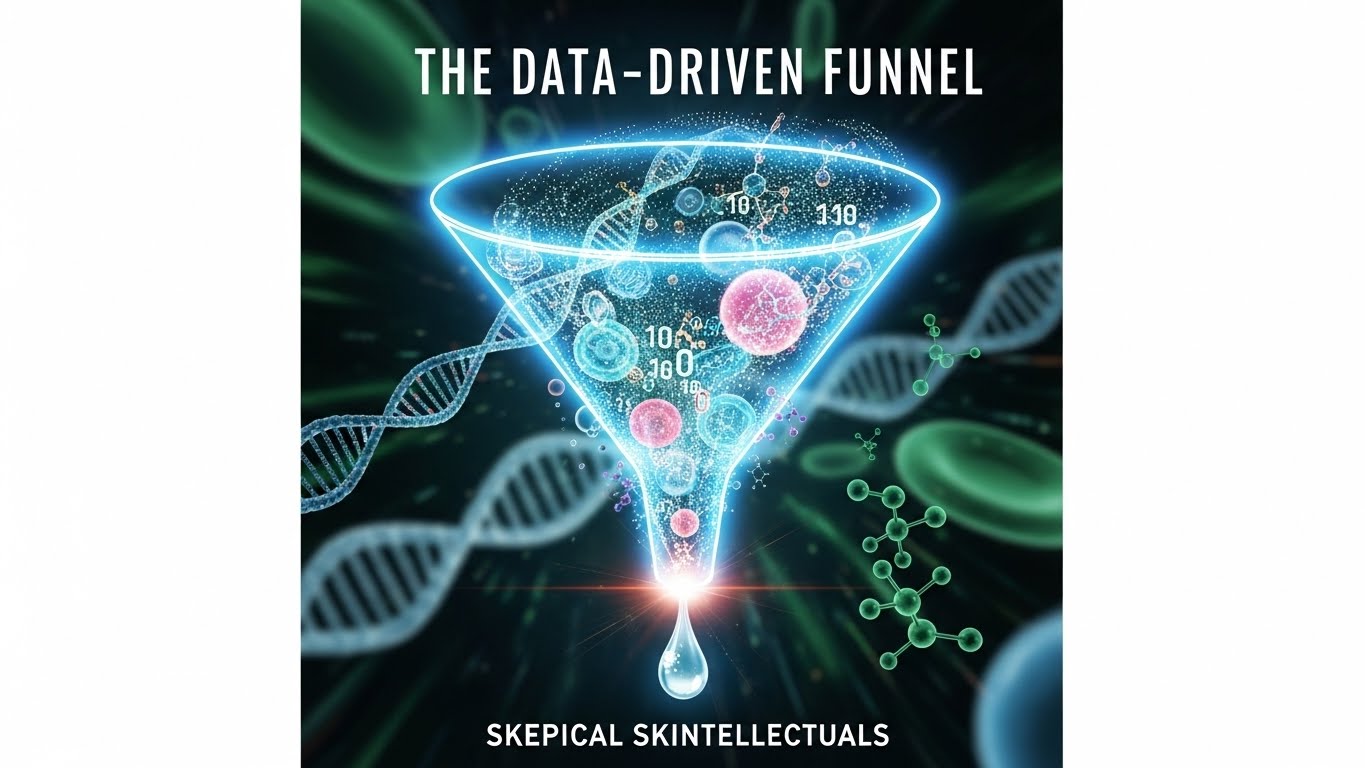
Text: “Machine learning identified top 12 combinations scoring highest across all parameters. Then optimized ratios within winners.”
Why This Works: Funnel visual shows selection rigor, “top 12” proves you didn’t just pick randomly, ratio optimization shows fine-tuning
Text: “Optimal combination: 40% Matrixyl 3000 (collagen synthesis), 30% Argireline (expression lines), 30% Syn-Coll (matrix support) at pH 5.5”
Why This Works: Exact percentages + function of each + pH specification = complete transparency, pie chart makes ratios instantly clear2. The Comparative Data Visualization (Proving Superiority)
Collagen synthesis: 6/10
Expression line reduction: 2/10
Matrix support: 1/10
Overall efficacy score: 3.0/10
Collagen synthesis: 4/10
Expression line reduction: 5/10
Matrix support: 3/10
Overall efficacy score: 4.0/10
Collagen synthesis: 9/10
Expression line reduction: 8/10
Matrix support: 8/10
Overall efficacy score: 8.3/103. The “Behind the Science” Video Series (Humanizing Data)
4. The Interactive Data Dashboard (Transparency Playground)
5. The “Formula vs. Formula” Social Proof (Peer Validation)
6. The “Replication Invitation” (Ultimate Transparency)
✓ Complete peptide database (2,847 combinations with sources)
✓ AI algorithm parameters (16 evaluation criteria with weights)
✓ Analysis code (GitHub repository with full methodology)
✓ Raw optimization results (top 12 combinations scored)
✓ Final ratio selection reasoning (why 40/30/30 won)
✓ Invitation: “Replicate our analysis. Verify our results. Science welcomes scrutiny.”Real Example: Paula’s Choice Science-First Marketing
Ready to Master Data-Driven Marketing?
Content Strategy: Building Scientific Authority
“Formulation Friday” Deep-Dive Series
“Ask Our Formulation Chemist” Q&A Sessions
“Lab Notes” Behind-the-Scenes Content
“Study Spotlight” Clinical Research Breakdowns
The Future Is Evidence-Based: Data Validates What Marketing Can’t
Resources for Science-Focused Brands