How to Build a High-Converting Integrated Marketing Communication (IMC) Strategy for Your Beauty Brand

Is your Instagram feed aesthetic flawless, but your email newsletters feel like an afterthought? Do your influencer partnerships tell a different story than your website’s homepage? In the hyper-competitive beauty industry, disconnected messaging is the fastest way to lose consumer trust.
The secret to scaling a cult-favorite beauty brand isn’t just spending more on ads; it’s about creating a seamless, immersive universe for your customers. This is where an **Integrated Marketing Communication (IMC) strategy** becomes your most powerful tool.
A robust IMC strategy ensures that every touchpoint—from a TikTok unboxing to a Sephora shelf display—delivers the same powerful message, driving higher conversions and deeper brand loyalty. Here is your guide to building one.
What exactly is IMC in the Beauty Context?
Integrated Marketing Communication is not just about using multiple channels. It is the strategic coordination of all marketing messages and channels to create a unified brand experience.
For a beauty brand, it means that the “dewy glow” promised in your YouTube tutorial is reinforced by the copy in your Facebook ad, confirmed by the before-and-after photos on your product page, and reiterated in the “thank you” insert inside the shipping box. It is about consistency in tone, visuals, and value proposition.
Step 1: Define Your Core “Beauty Persona” and USP
Before you integrate channels, you must define what you are integrating. If you try to speak to everyone (Gen Z TikTokers and anti-aging focused Boomers), your message will dilute.
- Who is she? Define your target audience beyond demographics. What are her skin insecurities? Who are her style icons? Does she value sustainability over luxury packaging?
- What is your Unique Selling Proposition (USP)? Are you the “cleanest” clinically-proven brand? The most inclusive shade range? The fastest routine for busy moms?
(For deeper insights on defining brand identity, respected marketing resources like Harvard Business Review often discuss the importance of singular brand focus.)
Step 2: Select Your Channels (The Beauty Mix)
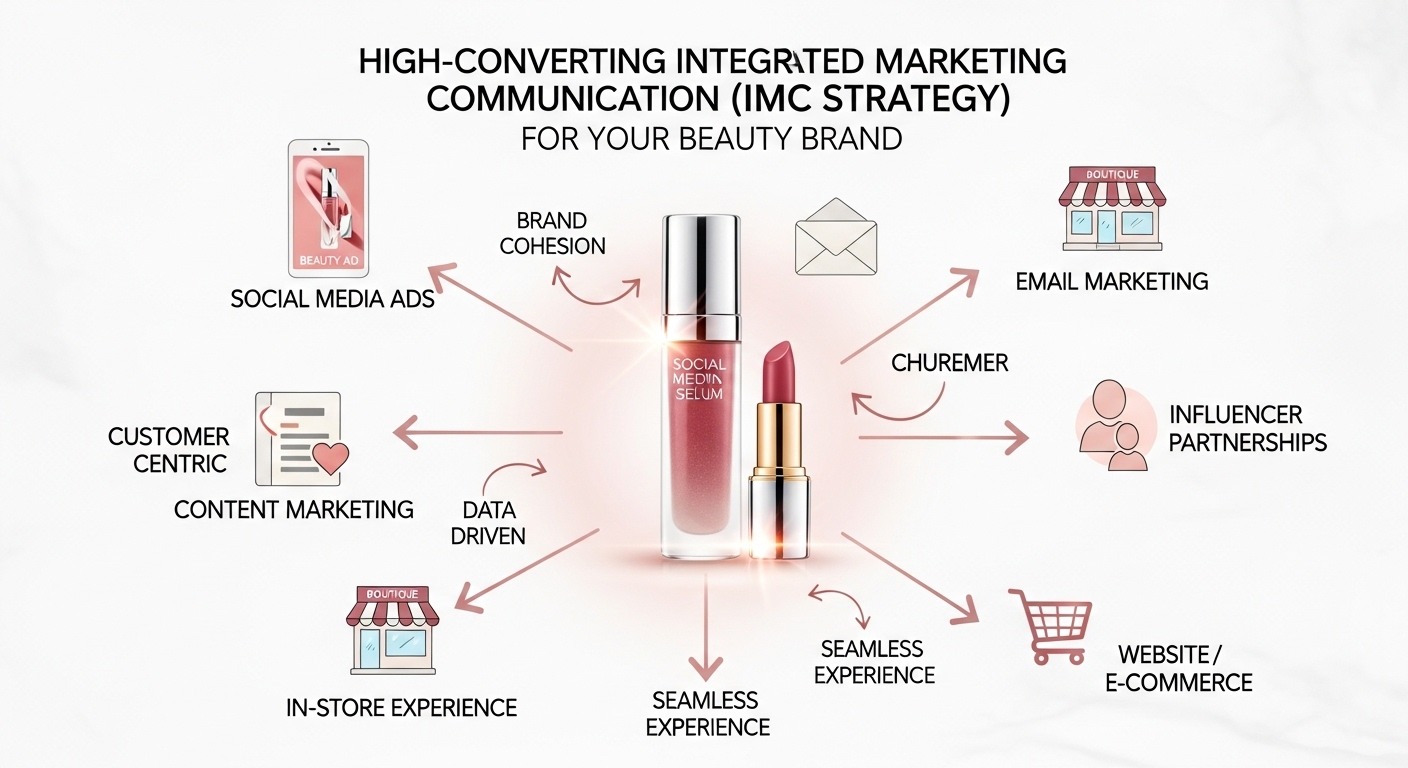
Not every beauty brand needs to be on every platform. An IMC strategy focuses on the channels where your persona hangs out. Below is a visualization of how different channels serve different purposes in the beauty buyer’s journey.
[INFOGRAPHIC: The Beauty Buyer’s IMC Journey]
+->+Consideration+(YouTube+Reviews/Blog)+->+Decision+(Email+Offer/Website))
*Ensure your visuals connect the awareness stage directly to the decision stage with consistent branding.*
Step 3: Synchronize Your Execution
This is where most beauty brands fail. They have a great email team and a great social team, but they never talk to each other.
When launching a new serum, for example, the IMC approach requires a unified timeline. Your audience needs to see the message multiple times, across different mediums, for it to stick.
| Timing Phase | Channel & Action | Unified Message Goal |
|---|---|---|
| Pre-Launch (1 Week Out) | IG Stories teasers; “Waitlist” email sign-up. | Generate curiosity and exclusivity. |
| Launch Day | Website hero banner update; Email blast announcing “It’s Here”; Influencer unboxings go live. | Drive immediate traffic and validate with social proof. |
| Post-Launch (2 Weeks Out) | Retargeting Ads using UGC (User Generated Content); Educational blog post on ingredients. | Overcome objections and nurture hesitant buyers. |
Ready to Master Beauty Marketing?
Building an IMC strategy is complex. It requires juggling creative assets, analyzing data across platforms, and understanding the nuances of the modern beauty consumer.
If you are a beauty brand owner or marketer looking to move beyond fragmented tactics and build a cohesive, high-converting machine, you need structured guidance tailored specifically to this unique industry.
Enroll in the Complete Beauty Marketing Course
Learn the exact frameworks to scale your beauty brand.
Conclusion
In the crowded beauty landscape, the brand that tells the most consistent story wins. By implementing an Integrated Marketing Communication strategy, you stop fragmenting your efforts and start compounding your results. Stop shouting mixed messages and start singing one powerful song that your customers can’t ignore.
In today’s saturated beauty market, customers don’t just encounter your brand once — they experience it across Instagram ads, email campaigns, influencer posts, retail shelves, TikTok videos, podcast sponsorships, and more. The brands winning right now aren’t the ones with the biggest budgets — they’re the ones delivering a consistent, compelling message across every single touchpoint.
That’s what Integrated Marketing Communication (IMC) is all about: creating a unified brand experience where every channel — from social media to packaging to customer service — works together like a well-orchestrated symphony. This guide will walk you through exactly how to build a high-converting IMC strategy specifically designed for beauty brands.
📋 What’s Inside This Guide
What Is Integrated Marketing Communication (IMC)?
Integrated Marketing Communication is a strategic approach that unifies all marketing channels and messages into a cohesive brand narrative. Instead of treating social media, email, PR, influencer marketing, and retail as separate silos, IMC creates a synchronized ecosystem where each channel amplifies the others — delivering a seamless customer experience from first awareness to repeat purchase.
Originally defined by marketing scholars Don Schultz and Philip Kotler in the 1990s, IMC has become essential in the digital age. According to research from the American Marketing Association, brands with integrated strategies see up to 23% higher customer retention and 19% faster revenue growth compared to brands with fragmented approaches.
Fragmented Marketing vs. Integrated Marketing
| Aspect | Fragmented Approach ❌ | Integrated Approach ✅ |
|---|---|---|
| Messaging | Inconsistent across channels; each team creates their own copy | One core message adapted for each channel’s format |
| Brand Experience | Disjointed — customer confused by mixed signals | Cohesive — customer feels recognized across touchpoints |
| Data & Insights | Siloed analytics; no cross-channel attribution | Unified customer journey tracking across all channels |
| Team Collaboration | Social team vs. email team vs. PR team — internal competition | Cross-functional collaboration toward shared goals |
| Customer Perception | “This brand feels scattered and unprofessional” | “This brand really gets me — they’re everywhere I am” |
7 Powerful Benefits of IMC for Beauty Brands
The beauty industry moves faster than almost any other category. New trends explode overnight on TikTok. Influencers can make or break a product launch. Packaging must work as content. An IMC approach isn’t optional anymore — it’s the baseline for survival. Here’s why:
Stronger Brand Recognition
When customers see the same messaging, visuals, and tone across Instagram, email, and retail, brand recall increases by up to 3.5x. Consistency breeds familiarity — and familiarity breeds trust.
Higher Marketing ROI
IMC eliminates redundant campaigns and wasted spend. When channels work together (e.g., Instagram ad → email nurture → retargeting), customer acquisition costs drop by an average of 15–25%.
Improved Customer Experience
Customers don’t think in channels. They expect a seamless journey. IMC ensures whether they discover you on TikTok or in Sephora, the experience feels intentional and personalized.
Better Attribution & Data
Integrated campaigns let you track customer behavior across touchpoints. You finally know if someone clicked an Instagram ad, then bought via email — and optimize accordingly.
Faster Campaign Execution
With pre-aligned messaging frameworks and shared creative assets, your team launches campaigns faster. No more reinventing the wheel for every channel.
Crisis Resilience
When a PR crisis hits (bad review, influencer backlash, product issue), IMC ensures your response is coordinated across all channels — protecting brand reputation.
Higher Customer Lifetime Value
Cohesive brand experiences create loyal customers. Research shows customers exposed to integrated campaigns purchase 20% more frequently and stay subscribed 30% longer.
73%
of consumers expect consistent brand experiences across all channels — yet only 29% of brands deliver it effectively. (Source: Salesforce State of Marketing Report)
The 5 Pillars of Effective Beauty Brand IMC
Before you build campaigns, you need a solid foundation. Every high-converting IMC strategy for beauty brands rests on these five core pillars:
Brand Identity
Clear positioning, voice, values, and visual system that guides every touchpoint
Customer Insight
Deep understanding of your audience’s needs, behaviors, and channel preferences
Core Message
One central value proposition adapted (not changed) for each channel
Channel Strategy
Strategic selection and orchestration of owned, earned, paid, and shared media
Measurement Framework
Unified KPIs and analytics to track cross-channel performance
These pillars aren’t sequential — they’re interconnected. Your brand identity informs your message. Your customer insight determines your channel strategy. Your measurement framework validates everything. For beauty brands specifically, Google’s research on beauty consumer behavior reveals that customers touch an average of 7–10 different touchpoints before making a purchase decision — making integration non-negotiable.
The 6-Step Framework: Building Your IMC Strategy
Now for the practical part. Here’s the exact step-by-step process to build a high-converting IMC strategy for your beauty brand:
Audit Your Current State
Before you integrate, you need to know what you’re working with. Conduct a comprehensive audit of:
- All active marketing channels (social, email, paid ads, influencer partnerships, PR, retail, events)
- Messaging consistency — take screenshots of your Instagram bio, email header, website hero, and packaging. Do they tell the same story?
- Visual brand consistency — fonts, colors, photography style, logo usage
- Customer touchpoint mapping — every place a potential customer might interact with your brand
- Current performance metrics — what’s working, what’s not, where there are gaps
Define Your Core Brand Narrative
This is your North Star. Create a master brand document that includes:
- Brand Purpose: Why you exist beyond selling products
- Target Customer: Who you serve (psychographics, not just demographics)
- Positioning Statement: How you’re different from competitors
- Core Message: The single most important thing you want customers to understand
- Brand Voice & Tone: How you sound (playful? scientific? luxurious?)
- Visual Identity System: Mood boards, color codes, typography, photography guidelines
Example: “We’re a clean beauty brand empowering Gen Z to embrace their authentic skin through transparent, TikTok-native education and science-backed skincare that actually works.”
Map the Customer Journey
Identify every stage of your customer’s path and which channels play a role at each stage. For beauty brands, this typically looks like:
Create Channel-Specific Adaptations
Your core message stays the same, but the execution must be optimized for each platform’s format and audience expectations. For example:
- Instagram: Visual storytelling through carousels, Reels with trending audio, Stories for behind-the-scenes
- TikTok: Raw, authentic content with educational hooks and community participation
- Email: Longer-form storytelling, personal tone, exclusive offers
- Packaging: Unboxing-optimized design, QR codes to community, handwritten notes
- Retail/In-Store: Sampling stations, shelf talkers, demo videos on loop
Build Cross-Channel Campaign Calendars
Instead of launching isolated campaigns, design integrated campaign arcs where every channel supports the same goal during the same window. Example: A new serum launch might look like:
Week 1 (Teaser): Instagram countdown stickers + influencer unboxing videos + email “Coming Soon” with waitlist
Week 2 (Launch): TikTok launch day content + paid social ads + PR outreach + website banner + SMS blast + in-store displays
Week 3–4 (Amplification): User-generated content resharing + email testimonial sequence + retargeting ads + tutorial content + podcast mentions
Establish Unified Measurement & Optimization
Set up tools and processes to track performance holistically. This includes:
- UTM parameters on all external links
- Multi-touch attribution software (e.g., Triple Whale, Northbeam, Google Analytics 4)
- Weekly cross-functional team sync to review performance
- Quarterly IMC audits to refine messaging, reallocate budget, and test new channels
Channel Integration Blueprint: Making Your Channels Work Together
The secret to IMC isn’t just being present on multiple channels — it’s making them amplify each other. Here’s how the most successful beauty brands orchestrate their channel ecosystem:
| Channel Pair | Integration Strategy | Example |
|---|---|---|
| Instagram + Email | Use Instagram Stories to tease email-exclusive content; collect emails via swipe-up/link-in-bio | “Our best sale of the year goes live in 6 hours — but email subscribers get early access NOW 👀” |
| TikTok + Website Blog | Post short-form TikTok hooks, then direct to long-form educational blog for deeper content | TikTok: “3 ingredients that age your skin faster” → CTA to blog article with full science breakdown |
| Packaging + Social UGC | Make packaging Instagram-worthy with branded hashtags, QR codes to community, photo-friendly inserts | Include card: “Show us your unboxing! Tag #MyGlowUp for a chance to be featured” → reshare best UGC |
| Paid Ads + Retargeting | Cold ads drive awareness; retarget with testimonials, urgency, or value prop reminders | Initial ad: “Meet your new holy grail serum” → Retarget: “Still thinking about it? Here’s what customers are saying…” |
| Email + SMS | Email for storytelling/education; SMS for time-sensitive promotions and cart abandonment | Email announces new launch with full story → SMS: “Launch day! Your exclusive code inside 🎁” |
| Influencer + Retail | Time influencer posts with retail launches; use influencer content as in-store displays | Influencer posts 2 days before Sephora launch → Print influencer testimonials as shelf talkers → QR codes link to full videos |
The key principle: each channel should make the others more effective. Your Instagram content drives email signups. Your email nurtures drive website traffic. Your website converts and triggers UGC. Your UGC feeds back into social content. It’s a flywheel, not a funnel. For more on building effective cross-channel strategies, HubSpot’s marketing statistics provide valuable benchmarks on multi-touch attribution and channel performance.
Measuring Your IMC Success: Metrics That Actually Matter
You can’t optimize what you don’t measure. But IMC requires holistic metrics — not just channel-specific vanity numbers. Here are the KPIs that tell you if your integrated strategy is actually working:
- Brand awareness surveys
- Branded search volume
- Social sentiment analysis
- Share of voice vs. competitors
- Multi-touch attribution data
- Average touchpoints to conversion
- Channel assist rates
- Customer journey time
- Overall conversion rate
- Channel-specific CVR
- Average order value
- Cost per acquisition (blended)
- Repeat purchase rate
- Customer lifetime value (LTV)
- Churn rate
- Net Promoter Score (NPS)
- Engagement rate by channel
- UGC submission rate
- Email open & click rates
- Social share & save rates
- Marketing-attributed revenue
- Return on ad spend (ROAS)
- Revenue per channel
- Month-over-month growth
Pro Tip: The “North Star” Metric
Choose ONE primary metric that best reflects your business goal (e.g., Customer Lifetime Value or Revenue per New Customer). All channels should be optimized toward this single North Star — not competing for their own isolated KPIs.
Real Beauty Brand IMC Success Stories
Let’s look at how industry-leading beauty brands have executed integrated strategies that drove massive growth:
6 Deadly Mistakes That Sabotage Your IMC Strategy
Even well-intentioned brands fall into these integration traps. Here’s what to avoid:
Treating “Integration” as Just Using More Channels
Being on TikTok + Instagram + email isn’t IMC if each tells a different story. Integration means coordinated channels working toward shared goals with consistent messaging.
Siloed Teams with Competing KPIs
If your social media team is measured on engagement, email team on revenue, and PR team on mentions — they’ll never collaborate. Align incentives around shared business outcomes.
Inconsistent Brand Identity
Your Instagram is playful memes, your website is clinical science-speak, and your packaging is minimalist luxury? Customers are confused. Pick ONE brand personality and execute it everywhere.
No Centralized Content Calendar
When channels operate independently, you launch conflicting campaigns or miss opportunities for amplification. Use a shared calendar where all teams can see what’s launching when.
Ignoring Channel-Specific Best Practices
Integration doesn’t mean posting identical content everywhere. A TikTok video needs different pacing than an email. Adapt the message format while keeping the core idea consistent.
Lack of Executive Buy-In
IMC requires cross-departmental coordination. Without leadership support, teams revert to silos. Make IMC a company-wide priority from the top down.
The brands that win in beauty aren’t the ones with the biggest marketing budgets — they’re the ones who make every dollar work harder by ensuring every channel amplifies the others.
Your Next Steps: Building Your IMC System
Integrated Marketing Communication isn’t a project — it’s a operating system for how your beauty brand shows up in the world. When executed correctly, IMC transforms disconnected tactics into a unified growth engine that compounds over time.
The beauty brands dominating in 2025 aren’t the ones shouting the loudest on every platform — they’re the ones delivering consistent, valuable, memorable brand experiences that meet customers wherever they are. They understand that a customer who sees your Instagram ad, receives your welcome email, unboxes your product, and joins your community should feel like they’re interacting with the same brand at every step.
Start with the fundamentals: audit your current state, define your core narrative, map your customer journey, and build cross-functional collaboration into your team structure. Then execute with discipline, measure holistically, and optimize continuously. The brands that commit to true integration — not just multi-channel presence — will be the ones still growing when the next algorithm change or platform shift happens.
Your move. Build the system that makes every marketing dollar work harder. Create the brand experience your customers will remember — and recommend.
#BeautyMarketing
#IntegratedMarketing
#BrandStrategy