
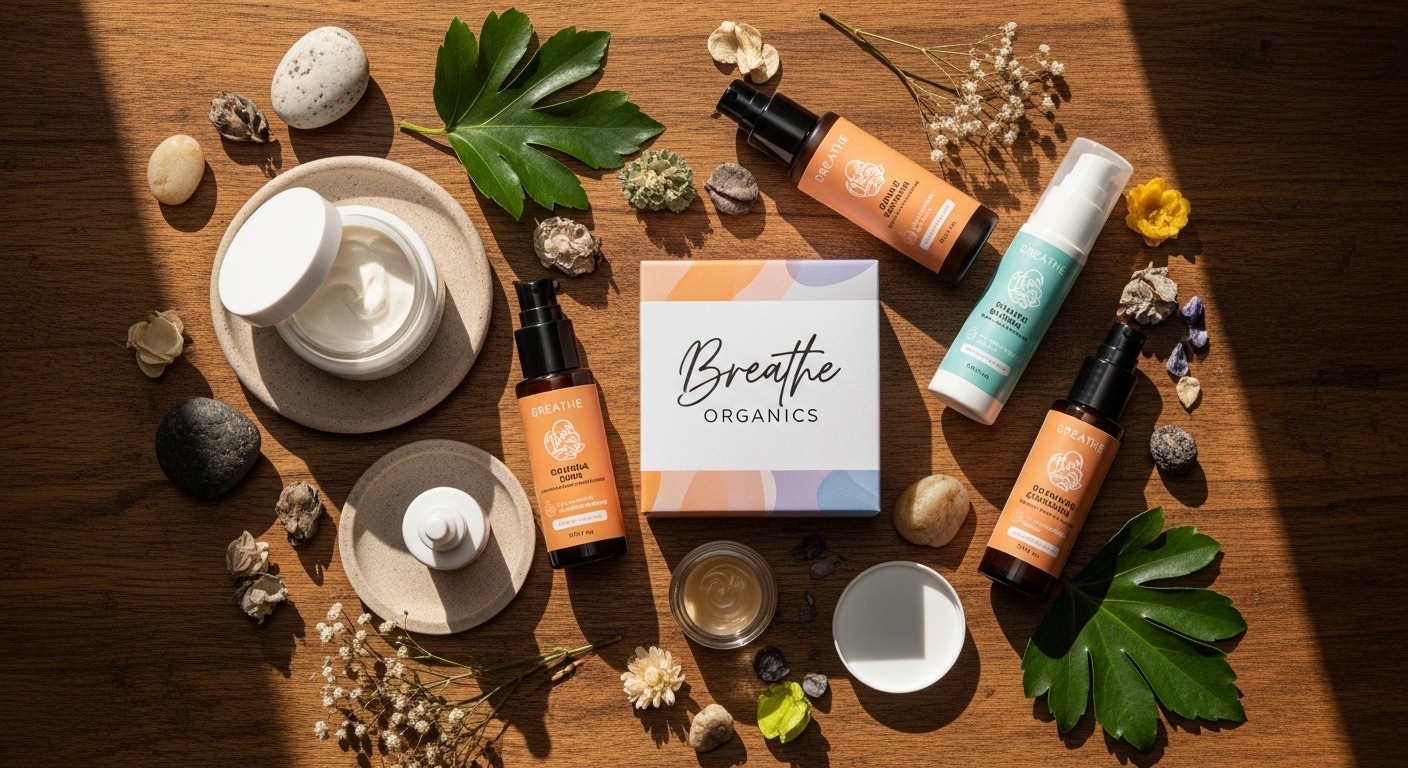
The Ultimate Business Guide for Beauty Founders
How to Position Your Organic Skincare Business in a Saturated Market to Stand Out from Competitors
The clean beauty space is booming — and crowded. Here’s exactly how to carve out a unique, profitable position that makes customers choose YOU over everyone else.
You’ve formulated the perfect serum. Your packaging is beautiful. Your ingredients are ethically sourced and certified organic. But when you open your Instagram and look at the explore page, you see hundreds of other brands saying the exact same thing.
The global organic skincare market was valued at over $13.8 billion in 2024 and is projected to reach $25+ billion by 2030, according to Grand View Research. Incredible opportunity — but also incredible competition.
The brands that win in this space are not the ones with the most beautiful formulas. They’re the ones who know exactly who they’re talking to, what they uniquely stand for, and how to communicate that with clarity and consistency. This guide gives you the strategic roadmap to do exactly that.
📋 What You’ll Learn
- Understanding the Saturated Market Reality
- What Brand Positioning Actually Means
- Finding Your Profitable Niche
- Defining Your Ideal Customer Avatar
- Crafting Your Unique Selling Proposition (USP)
- Building a Brand Story That Converts
- Pricing Strategy for Premium Organic Brands
- Content Marketing & SEO for Skincare Brands
- Social Proof & Community Building
- Your 90-Day Positioning Action Plan
1. Understanding the Saturated Market Reality 🌿
Saturation isn’t the same as impossibility. When a market is saturated, it means there’s proven consumer demand — the opportunity is real. The question is how to claim your slice of it.
Positioning in a crowded category is covered in depth in our beauty and cosmetics marketing course, alongside selling online, clean and sustainable beauty marketing, and long-term influencer partnerships.
Most organic skincare brands fail at positioning because they try to appeal to everyone — and end up resonating with no one. According to Mintel’s Beauty Research, consumers are becoming increasingly sophisticated — they can detect inauthentic “greenwashing” instantly and reward brands that demonstrate genuine values alignment.
📊 Organic Skincare Market: Key Numbers 2025
Sources: Grand View Research, Mintel, Statista 2024–2025
Key Insight: “In a crowded market, the riches are in the niches. The brands dominating organic skincare aren’t the ones with the biggest budgets — they’re the ones with the sharpest positioning.”
2. What Brand Positioning Actually Means 🎯
Brand positioning is the mental space your brand occupies in your customer’s mind. It’s not your logo. It’s not your tagline. It’s the answer to the question: “Why this brand and not any other?”
Effective positioning is built on three pillars — what makes you unique, who you’re uniquely for, and why it matters. Let’s look at how the best organic skincare brands do it.
| Element | ❌ Weak Positioning | ✅ Strong Positioning |
|---|---|---|
| Target Audience | “Women who like natural skincare” | “Busy mothers over 35 with sensitive skin who’ve failed with every conventional brand” |
| Brand Message | “Pure, clean, organic ingredients” | “Formulated by a dermatologist-herbalist duo specifically for reactive skin that needs both science and nature” |
| Value Proof | “Made with love and care” | “93% of users saw visible redness reduction within 21 days — clinically measured” |
| Price Position | Competing on price, always discounting | Premium with clear justification — customers feel it’s worth it |
| Brand Voice | Generic wellness aesthetics, same as everyone else | Distinct, recognizable, feels like a person — customers say “this brand just gets me” |
3. Finding Your Profitable Niche 🔍
Most organic skincare entrepreneurs fear niching down because they think it means leaving money on the table. The opposite is true: the narrower your niche, the easier it is to become the go-to authority and the more loyal your customer base becomes.
Think about it: “Eczema-focused organic skincare for Black women” is an immediately compelling category with passionate searchers — versus the undifferentiated sea of “natural skincare brands.”
🌿 The Profitable Niche Formula
High-Opportunity Niche Examples
| Niche Concept | Target Audience | Opportunity Level |
|---|---|---|
| Perimenopause skincare | Women 40–55, hormonal skin changes | 🔥 Very High |
| Acne for men of color | Men 18–35, often underserved market | 🔥 Very High |
| Baby + toddler eczema | Parents, deeply emotional buy | ⚡ High |
| Post-chemo skin recovery | Cancer survivors, ultra-sensitive skin | 🔥 Very High |
| Athletes with outdoor skin stress | Runners, surfers, climbers | ⚡ High |
4. Defining Your Ideal Customer Avatar 👤
Your Ideal Customer Avatar (ICA) is a detailed profile of the one person you’re speaking to. Not a demographic range — one specific person. Brands that talk to everyone persuade no one.
Research tools like Answer the Public, Reddit communities (r/SkincareAddiction has 1.5M+ members), and your own customer reviews are goldmines for understanding your audience at a deep emotional level.
🎯 Sample Ideal Customer Avatar
5. Crafting Your Unique Selling Proposition (USP) 💎
Your USP is the one sentence answer to: “Why should I buy from YOU specifically?” It must be believable, specific, and impossible (or very hard) to copy.
According to Forbes Business Insights, 77% of customers buy from brands that share their values — which means your “why” is as important as your “what.”
🛠️ The 5 Building Blocks of a Powerful USP
6. Building a Brand Story That Converts 📖
Humans are neurologically wired for story. Neuroscience research confirms that when we hear a compelling story, oxytocin releases in the brain — creating trust and a sense of connection. This is your most powerful marketing tool.
Your brand story follows a proven structure: The Problem → The Journey → The Discovery → The Transformation → The Mission. It should make your ideal customer feel: “She built this for someone exactly like me.”
7. Pricing Strategy for Premium Organic Brands 💰
One of the biggest mistakes organic skincare founders make is underpricing out of fear. Paradoxically, low prices often signal lower quality to the exact customers you want to attract. Premium buyers expect premium pricing.
| Tier | Price Range | What You Must Deliver | Example Brands |
|---|---|---|---|
| Accessible Clean | $15–$40 | Clean ingredients, friendly packaging, relatable voice | Acure, Andalou |
| Premium Natural | $40–$90 | Certifications, clinical proof, elevated experience | Tata Harper, True Botanicals |
| Luxury Organic | $90–$250+ | Rare ingredients, exceptional results, heritage/expertise story | Aesop, Sisley |
| Ultra-Niche Expert | $80–$400+ | Solves a very specific problem better than anyone else; doctor/expert credibility | Dr. Barbara Sturm |
💡 Pro Tip: Instead of discounting, use strategic bundles, loyalty programs, and subscriber pricing to reward repeat customers while protecting your premium perception. Discounting teaches customers to wait for sales rather than valuing your product at full price.
8. Content Marketing & SEO for Skincare Brands 🔎
The organic skincare customer does a lot of research before buying. They’re googling ingredients, comparing brands, reading reviews, and watching tutorials. Your content strategy must meet them at every stage of that journey.
Use tools like Ahrefs, SEMrush, or free tools like Ubersuggest to find the questions your ideal customers are already asking. Then create the best possible answer — in blog posts, video, or visual form.
🗺️ The Skincare Brand Content Funnel
High-Value SEO Topics for Organic Skincare Brands
| Content Topic | Intent | Funnel Stage |
|---|---|---|
| “Best organic moisturizer for dry skin” | Commercial | Bottom |
| “Is shea butter good for eczema?” | Informational | Top |
| “Natural skincare routine for over 40” | Informational | Top |
| “[Your Brand] vs [Competitor]” | Comparative | Middle |
| “Certified organic skincare brands USA” | Commercial | Bottom |
Ready to Accelerate Your Brand?
Stop Guessing. Start Growing.
Everything you’ve learned in this guide is the foundation. But applying it to YOUR specific brand — with expert guidance, step-by-step frameworks, and a community of fellow beauty entrepreneurs — is what creates real results.
The Beauty Marketing Course by Easy Marketing School gives you the exact marketing strategy, brand positioning, and growth tools designed specifically for beauty and skincare founders.
✨ Enroll in the Beauty Marketing Course →
Built for organic & clean beauty founders who want to stand out without burning out.
10. Your 90-Day Positioning Action Plan 🗓️
Strategy without execution is just dreaming. Here’s a phased, actionable plan to implement everything you’ve learned in 90 days.
- Define your ICA in detail
- Audit competitors’ positioning
- Write your brand’s core story
- Identify and claim your niche
- Draft your USP statement
- Review your pricing structure
- Redesign messaging on all platforms
- Create 8 pillar content pieces
- Launch email list with lead magnet
- Set up review collection system
- Reach out to 10 micro-influencers
- Optimize product page SEO
- Analyze what’s driving conversions
- Double down on top content
- Launch a loyalty program
- Test 1 paid channel (Meta or Pinterest)
- Build a UGC campaign strategy
- Plan a signature product launch
Final Thoughts: Differentiation is a Decision 🌱
The organic skincare market will only get more competitive. But here’s the good news: most brands won’t do the deep positioning work outlined in this guide. They’ll keep using generic messages, chasing trends, and hoping the algorithm delivers them customers.
The brands that will dominate the next five years are the ones being built right now on the foundation of clarity: clarity about who they serve, why they exist, and what they stand for in a way no competitor can easily copy.
You have the passion. You have the product. Now build the positioning to match — and the right customers will find you.
🌿 Key Takeaways
- Saturation = proven demand. Your job is to differentiate, not abandon the market.
- Niching down increases conversions, loyalty, and word-of-mouth.
- Your brand story and founder narrative are unique assets no competitor can copy.
- Price for the customer you want, not the customer you fear losing.
- Content and SEO are your long-term moat — invest early, compound forever.
- Social proof and community transform buyers into advocates and advocates into growth engines.
Topics
#BeautyMarketing
#BrandPositioning
#CleanBeauty
#SkincareEntrepreneur
#SmallBusinessMarketing

9. Social Proof & Community Building 🌟
In the beauty space, social proof is the most powerful marketing asset you have. According to BrightLocal, 91% of consumers read online reviews before making a purchase, and 84% trust them as much as a personal recommendation.
Your community is your moat. Brands that build genuine communities become lifestyle identities, not just products. Think about how brands like Drunk Elephant built a cult-like following by being incredibly consistent, transparent, and interactive with their community online.