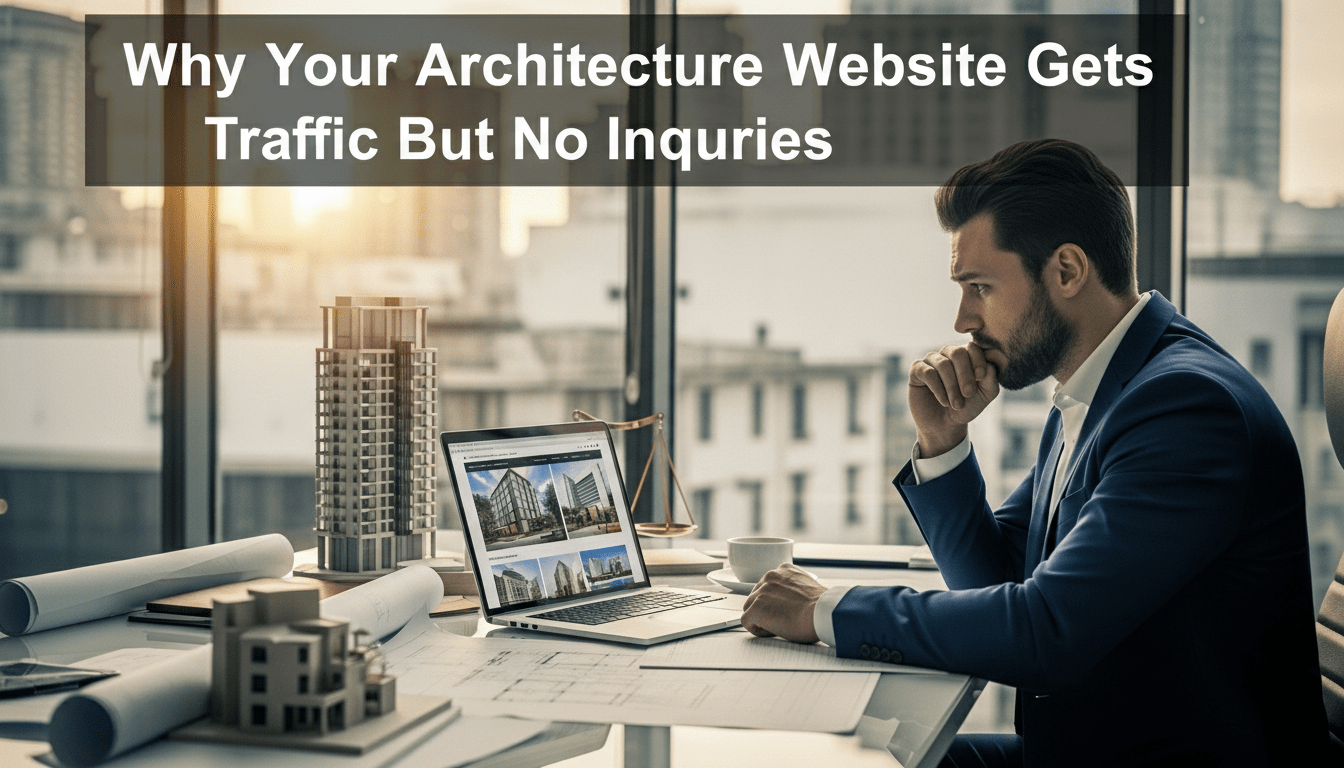
You’ve invested in a beautiful portfolio website. Google Analytics shows hundreds of monthly visitors. But your inbox? Crickets. Your phone? Silent.
If this sounds familiar, you are not alone. According to Nielsen Norman Group, the average website conversion rate across industries is just 2–3%. For architecture firms — where trust is paramount and projects are high-value decisions — the gap between traffic and inquiry is often even wider. The reasons are specific, fixable, and almost never about design talent.
Understanding the Conversion Gap
The journey from anonymous visitor to paying client has multiple failure points. Most architecture websites fail at several of them simultaneously.
The Architecture Website Conversion Funnel
Website Visitors (100%)
1,000
⚠ Many bounce immediately due to unclear messaging
~380
⚠ Buried nav, no urgency, no CTA above fold
~80
⚠ Long forms, no clarity on next steps
~30
Only 0.6–1.5% of visitors
6–15
With proper conversion optimization, this number can reach 40–60+ inquiries from the same traffic
You Have No Clear Call-to-Action — Or the Wrong One
Conversion Killer #1
This is the single most common mistake on architecture websites. A visitor lands on your beautiful homepage — extraordinary photography, elegant typography — and then asks themselves: “What am I supposed to do next?”
Most architecture websites bury their contact links in the navigation footer, or use a timid “Get in Touch” link that lacks any sense of value or urgency. Your CTA must answer a visitor’s unspoken question: “What happens when I reach out, and is it worth my time?”
❌ Weak CTA (What Most Firms Use)
❌ No value offered. No next step clarity. No urgency.
✅ Strong CTA (What Converts)
✅ Clear value, specific outcome, low commitment barrier.
Quick Fix: Place a high-value, specific CTA above the fold on your homepage, on every project page, and at the end of every blog post. According to Unbounce’s CRO research, pages with a single focused CTA convert up to 371% better than those with multiple competing options.
You Are Attracting the Wrong Traffic
Conversion Killer #2
High traffic means nothing if those visitors can never become your clients. Many architecture firm websites rank for keywords that attract architecture students, competitors researching you, or design enthusiasts — not potential clients with projects to commission.
The question to ask about every page on your site is: Who is searching for this, and do they have a project to hire me for? Search intent — understanding what users actually want when they type a query — is the foundation of converting traffic.
| Keyword Type | Example | Buyer Intent | Conversion Potential |
|---|---|---|---|
| Informational | “what does an architect do” | ❌ None | Very Low |
| Inspiration-Seeking | “modern house architecture ideas” | ⚠ Low | Low |
| Research Phase | “how to find a good architect” | ◑ Medium | Medium |
| Commercial Intent | “residential architect in Austin” | ✅ High | High |
| Transactional | “hire architect home extension London” | 🎯 Very High | Highest |
Quick Fix: Audit your top 10 traffic-driving pages using Google Search Console (free). For each page, identify the keyword driving traffic and ask: does this person have a project to commission? If not, don’t optimize for it. Instead, create new pages targeting high-intent, location-specific terms.
Your Value Proposition Is Invisible
Conversion Killer #3
A prospective client lands on your homepage and has one question that must be answered within 5 seconds: “Is this the right firm for my project?” Most architecture websites completely fail this test.
Phrases like “We create spaces that inspire” or “Architecture with passion” communicate absolutely nothing. They are the same vague promise made by thousands of firms worldwide. Your visitors cannot self-identify as your ideal client because you have never told them who that is.
The Value Proposition Formula for Architecture Firms
WHO you help
“For [client type]”
+
WHAT you do
“who need [outcome]”
+
HOW you differ
“without [pain point]”
Example Result
“We help growing families in Melbourne create bespoke modern homes — without the stress of managing a complex build.”
Quick Fix: Rewrite your homepage headline using this formula. Test multiple versions using Google Optimize or VWO to find which resonates most with your audience.
Your Portfolio Looks Stunning But Says Nothing
Conversion Killer #4
Your portfolio is your most visited section — but for most architecture websites, it is just a grid of beautiful images with cryptic one-word titles like “Residence 04” or “Commercial Project, 2022.” This tells a client virtually nothing that helps them decide to hire you.
Every portfolio project is an opportunity to tell a story that resonates with a potential client who has a similar challenge. According to the Content Marketing Institute, case study-style content is the highest-converting content format for professional services.
Transform a Portfolio Entry Into a Client Magnet
“The Woodside Residence — 2023 | Photography: John Smith”
“How We Helped a Growing Family Gain 40% More Living Space Without Moving”
Challenge: A family of four needed more space but loved their neighbourhood. Budget: £380K. Timeline: 14 months. Our solution: a double-storey rear extension that transformed their Victorian terrace without compromising its character. Result: 3 new bedrooms, an open-plan kitchen-diner, and a home the family now plans to stay in for life.
Each project page should include:
You Have No Trust Signals — Or They Are Hidden
Conversion Killer #5
Hiring an architect is a significant financial and emotional commitment. A prospective client is essentially trusting you with their home or business. Before they pick up the phone, they need to feel confident you are credible, experienced, and safe to work with.
According to BrightLocal’s Consumer Review Survey, 98% of consumers read online reviews before making a purchasing decision for local services. If your website lacks social proof, you are creating unnecessary hesitation.
| Trust Signal | Impact on Conversion | Where to Display It |
|---|---|---|
| Client Testimonials (Named) | ⭐⭐⭐⭐⭐ | Homepage, project pages, contact page |
| Awards & Press Mentions | ⭐⭐⭐⭐⭐ | Homepage hero, About page |
| Professional Accreditations (RIBA, AIA) | ⭐⭐⭐⭐⭐ | Footer, About page, contact page |
| Named Team Members With Photos | ⭐⭐⭐⭐ | About page, homepage |
| Number of Projects Completed | ⭐⭐⭐⭐ | Homepage stats bar |
| Google / Houzz Reviews (with score) | ⭐⭐⭐⭐ | Homepage, contact page |
| Published in Architecture Media | ⭐⭐⭐ | Homepage “As Seen In” bar |
Your Site Is Slow, Broken on Mobile, or Both
Conversion Killer #6
Architecture websites are notorious for this. Stunning, image-heavy portfolios that take 8 seconds to load and look broken on a phone. In 2025, this is unforgivable — and enormously costly to your conversion rate.
53%
of mobile visitors abandon a site that takes longer than 3 seconds to load
Source: Google Research
67%
of architecture website traffic now comes from mobile devices
Source: Statista 2024
7%
conversion rate drop for every 1 second delay in page load time
Source: Portent Research
Quick Fix: Run your site through Google PageSpeed Insights today — it’s free and gives specific recommendations. Key areas: compress images using ShortPixel, upgrade your hosting, and use a performance-optimised theme. A mobile-first redesign may be necessary if your current site was built before 2020.
Your Contact Process Creates Anxiety and Friction
Conversion Killer #7
Even when a genuinely interested visitor decides to reach out, many architecture websites make the experience needlessly difficult. A contact page with a long form, no explanation of what happens next, and no phone number creates anxiety — and the visitor simply closes the tab.
❌ High Friction Contact Page
✅ Low Friction Contact Page
Quick Fix: Add a free Calendly booking widget to your contact page and header. Allowing prospects to book a call on their schedule removes the biggest barrier to initial contact. Firms that add direct booking typically see inquiry rates double within 60 days.
Fix Every Conversion Gap with a Complete Marketing System Built for Architects
The Marketing Course for Architectural Firms takes you through every element of a high-converting website and marketing funnel — from positioning and SEO to portfolio storytelling, CTA strategy, and lead nurturing. Built specifically for architects, by people who understand how clients hire design professionals.
✅ SEO for architecture firms
✅ Portfolio storytelling framework
✅ Referral & lead systems
Start Converting Your Traffic — Enroll Now →
Purpose-built for architectural practices looking to grow sustainably
The Architecture Website Conversion Checklist
Use this as your audit framework. Every item you can check off increases your conversion rate.
Messaging
Calls to Action
Trust & Proof
Technical
Portfolio
Contact & UX
Your Traffic Isn’t the Problem. Your Conversion Rate Is.
The architects who consistently win the best projects don’t always have the biggest marketing budgets or the most social media followers. They have websites that communicate clearly, build trust rapidly, and make it effortless to get in touch.
Every problem outlined in this article is fixable — and most fixes require zero budget, just clarity of thinking and a willingness to write copy that speaks directly to your ideal client’s anxieties and aspirations.
Start with just one change today. Rewrite your headline. Add a booking button. Reformat your top project as a case study. Small, consistent improvements compound into an inquiry pipeline that works around the clock — even while you’re focused on delivering exceptional architecture.