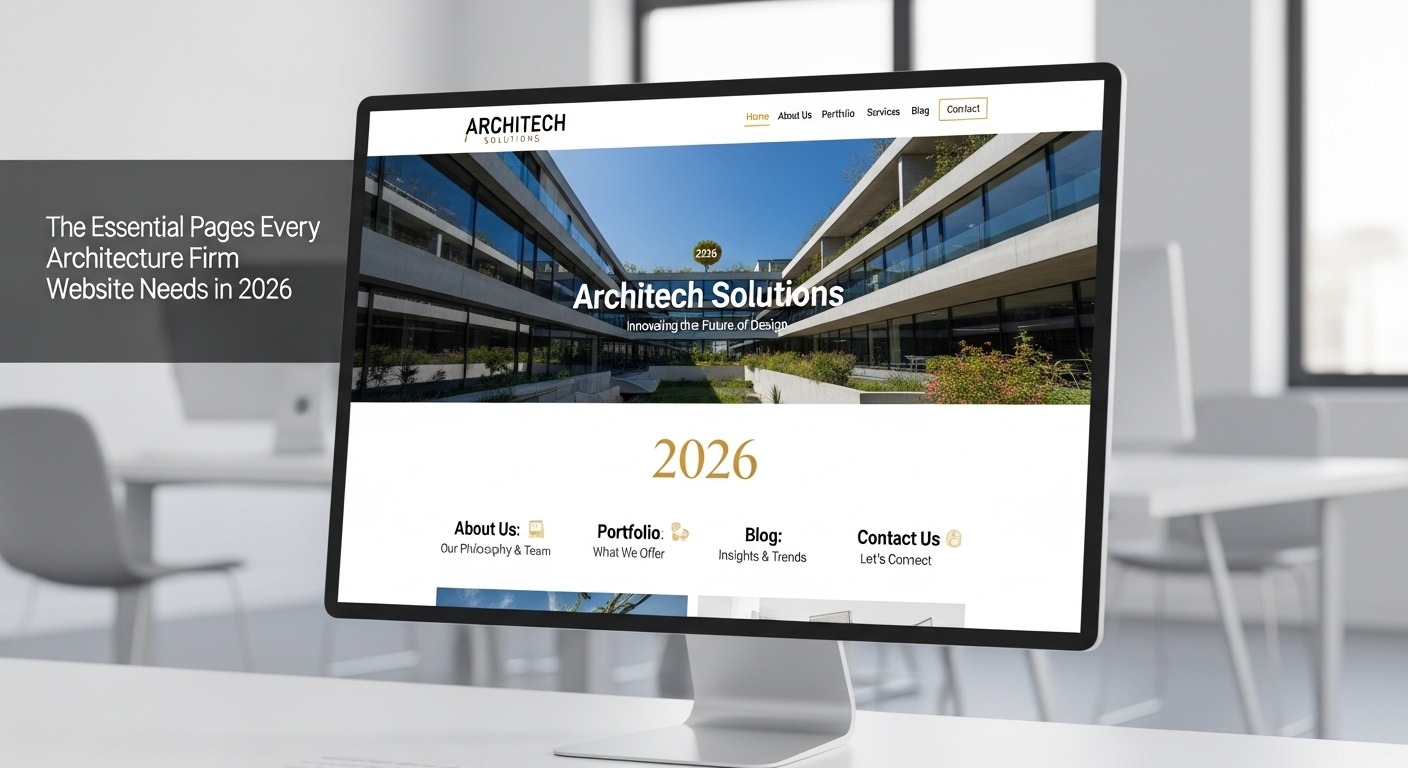
Your website shouldn’t be a dusty digital brochure. It should be your most productive employee.
Let’s be honest: most architecture websites are built for other architects, not for clients. We love our full-bleed minimalist renders and cryptic navigation menus, but in 2026, the “mysterious artist” vibe is losing out to the “trusted advisor” vibe.
If your website feels like a labyrinth where the “Contact” button is hidden like an Easter egg, you’re hemorrhaging leads. To rank on Google and—more importantly—to convert a visitor into a high-value inquiry, your site needs these six essential pages.
1. The Project Deep-Dive (Not Just a Gallery)
In 2026, a “Project Page” with five photos and a two-sentence caption is dead. High-value clients want to see the transformation. They want to know the “Why” behind the “What.”
As recommended by industry leaders like ArchDaily, your project pages should include a problem-solution narrative. Explain the zoning hurdle you cleared or the sustainable material choice that saved the client 20% on energy costs.
The Evolution of the Architecture Site
| Page Element | The “Old” Way | The 2026 Way |
|---|---|---|
| Navigation | Hidden “Hamburger” menus | Clear, descriptive labels |
| About Page | Founder’s Resume | Your Firm’s Values & Philosophy |
| Contact | Static info email | Project Inquiry Qualification Form |
2. The “Process” or “How We Work” Page
Architecture is a black box to most clients. They fear the unknown—the permits, the contractors, and the spiraling costs. A dedicated **Process Page** demystifies the experience. Break your workflow down into clear phases: Discovery, Schematic Design, Technical Documentation, and Construction Administration.
Are You Designing Buildings but Ignoring Your Business?
Even the most stunning website won’t work if no one finds it. To scale your studio, you need a marketing strategy that is as precise as your Revit models.
3. The “Insights” or Education Hub
If you want to rank for “Residential Architect in [Your City],” you need more than just a home page. You need keywords. A blog (or “Insights” section) allows you to answer the questions your clients are asking Google right now:
- “How much does a custom home build cost in 2026?”
- “The 5 biggest mistakes in commercial adaptive reuse.”
- “Do I need an architect for a minor interior renovation?”
The 2026 Web Checklist
The UVP statement
Case studies
Team & Values
Lead qualifying form