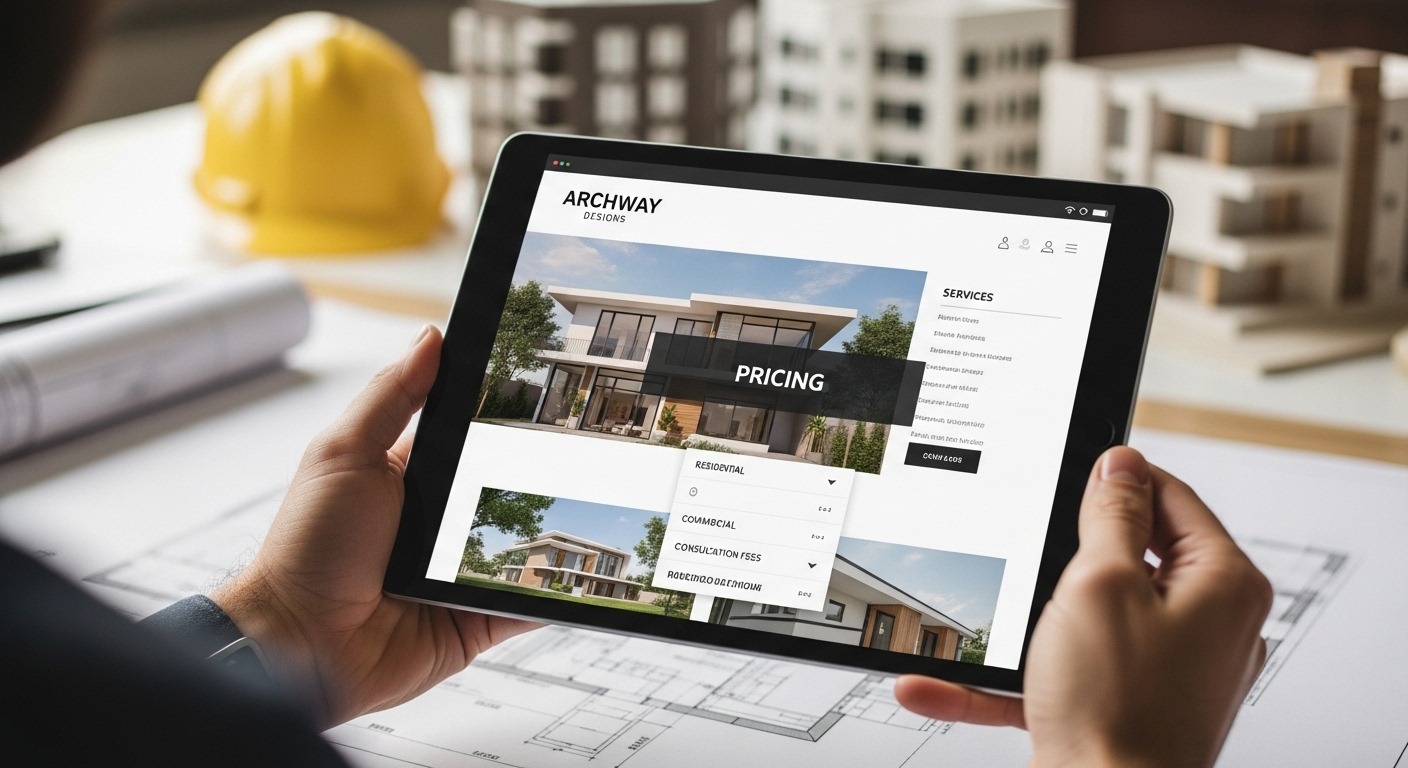
You’ve spent years perfecting your craft. Your portfolio is stunning. Your client testimonials are glowing. But there’s one burning question on every potential client’s mind when they land on your website — “How much does this actually cost?” It’s the question most architecture studios deliberately avoid answering online — and it may be costing you more clients than you realize. In this guide, we break down the real pros and cons of publishing pricing on your architecture firm’s website, what the data says about buyer behavior, and how leading studios are handling this strategically in 2025. Table of Contents Your website isn’t a brochure — it’s a 24/7 sales representative. Every page, every section, every word is either building trust or eroding it. And nowhere is this more acute than on the question of pricing transparency. Consider this: according to Nielsen Norman Group research, pricing ambiguity is one of the top three reasons visitors leave a professional services website without making contact. For architecture studios where a single project can range from $15,000 to $1.5 million, this ambiguity can be particularly damaging. 76% of B2B buyers say pricing transparency is a key factor when evaluating a professional services firm for the first time. Source: Gartner B2B Buyer Study Let’s start with the arguments in favor — and they’re stronger than most studio owners assume. 🎯 Clients who reach out already know your range. No wasted discovery calls with budgets that don’t match. Your time is protected. 📈 Transparency signals confidence. Studios that show pricing come across as established, honest, and confident in their value — all key emotional triggers for conversion. 🔍 Pages around “architecture firm pricing” and “how much does an architect cost” capture high-intent organic search traffic ready to hire. ⏳ When pricing expectations are set early, there’s less negotiation friction. Clients come in aligned, reducing the number of touchpoints needed to close. Beyond these practical benefits, there’s a psychological dimension at play. Research from the Harvard Business Review consistently shows that price transparency in service businesses increases perceived fairness — which is directly correlated with client satisfaction and referral rates. Now, the counterarguments — and these are also legitimate, especially for certain types of studios. Architecture is inherently bespoke. A residential extension in rural Wales is nothing like a commercial renovation in central London. Publishing a fixed price risks either underselling your value or creating sticker shock for simpler enquiries. Displaying your fees makes you an easy target for price-matching by competitors. Particularly in crowded markets, this can trigger a race to the bottom that erodes industry-wide fees. For luxury-tier architecture firms, showing price before value is like revealing the price tag before you’ve tried on the bespoke suit. The experience and story must come first. Projects can expand dramatically based on planning permission complications, structural issues, client changes of direction, and more. Publishing a clear fee invites misunderstanding. The science of buyer behavior gives us important clues. Understanding how your potential clients think can help you make a more strategic, rather than gut-instinct, decision. 📋 The Architecture Client’s Mental Journey Client has a project idea. They search Pinterest, Houzz, Instagram. They don’t think about money yet. Price is irrelevant here. They start Googling “architecture firms near me” and reading websites. Now they start thinking “can I afford this?” Price signals begin to matter. They shortlist 3–5 studios. Price, portfolio, and personality all factor in simultaneously. Absence of pricing creates anxiety. They contact 1–2 studios. Price is confirmed in the discovery call. Misalignment here = wasted time for everyone. The key insight here: price anxiety peaks at Stage 2 and 3. If your website doesn’t address it at all, many qualified prospects will simply move on to a competitor who does — even if that competitor is less talented. A 2024 survey of homeowners planning renovation projects found that 68% admitted to abandoning a professional services website when they couldn’t find any pricing information at all — not because the price was too high, but because the uncertainty felt like a red flag. Here’s the real answer that experienced architecture marketers know: it’s not a binary choice. The most successful architecture studios don’t publish a rigid price list, nor do they stay completely silent. They use a pricing context strategy — giving enough information to reassure qualified prospects, while leaving room for nuanced conversations. Phrases like “Our residential projects typically start from £25,000 in fees” set a floor, attract qualified clients, and still allow upward flexibility based on scope. Creating an educational resource titled “How Much Does an Architect Cost?” is an SEO goldmine AND a trust-builder. It answers the question in depth without committing you to specific numbers. Explaining that you charge a percentage of construction cost (typically 8–15%) vs a fixed fee vs hourly — along with what each stage includes — creates transparency without a price list. Within project case studies, include a line like “This project had an architect’s fee of £42,000 on a £380,000 build.” Real numbers in context are far more powerful than abstract ranges. Not all studios are the same. Here’s a breakdown of which approach tends to work best for different types of architecture practices. If you’ve decided to show some form of pricing — here’s how to do it in a way that converts, not repels. Never open a pricing page cold. Always begin by articulating what the client gets — the process, the expertise, the deliverables, the peace of mind. Then contextualize the investment. “Our fees typically range from 8–15% of the construction budget” is far more versatile and professionally accurate than a fixed number that will inevitably be wrong for some projects. A fee table that shows RIBA stages, what’s included at each, and what’s excluded is far more powerful than a lump sum number. It educates while it sells. Questions like “Why does architecture cost so much?” and “Is it worth hiring an architect vs a design-build contractor?” answer objections proactively and demonstrate authority. After pricing info, guide the visitor to the next step: a discovery call, a fee estimate form, or a case study. The goal is to keep qualified prospects moving forward, not thinking. “Architecture firms that treat their website as a passive portfolio miss the point entirely. Your website is your most hardworking marketing employee — and pricing context is the key part of its script.” — Architecture Marketing Expert A modern architecture firm’s digital presence can make or break client conversion rates. 📋 Quick-Reference Checklist Pricing strategy is just one piece of the puzzle. The Marketing Course for Architectural Firms gives you the complete, step-by-step framework to attract premium clients, position your studio powerfully online, and build a marketing system that works — even when you’re focused on design. Explore the Marketing Course → Designed specifically for architecture studios & principals After weighing both sides, the data points to a nuanced but clear answer: Most architecture studios should show some form of pricing context — not a rigid price list, but enough information to pre-qualify prospects, build trust, and support search engine visibility. The exception is ultra-premium studios whose positioning depends entirely on mystique, exclusivity, and referral-only pipelines. The worst strategy? Total silence. Blank inquiry forms with no pricing signals whatsoever drive away qualified clients who simply don’t have the confidence to reach out blind. The best strategy? A well-crafted pricing context page — possibly paired with an educational blog post — that educates, pre-qualifies, and builds trust simultaneously. Combined with a clear understanding of RIBA-standard fee structures, this approach turns your website from a passive portfolio into an active business development tool. Architecture is a people business. Your website’s job is to make the right people feel confident enough to start a conversation. Pricing transparency — done thoughtfully — is one of the most powerful ways to do exactly that.Why This Decision Matters More Than You Think
✅ The Case FOR Showing Pricing on Your Architecture Website
Pre-qualifies leads automatically
Builds immediate trust
Improves SEO & content strategy
Shortens the sales cycle
❌ The Case AGAINST Showing Pricing
⚠️ Every project is different
⚠️ Competitors can undercut you
⚠️ Premium studios need to anchor value first
⚠️ Scope complexity is hard to price publicly
📊 What the Data Says About Client Psychology
Dream Stage
Research Stage
Comparison Stage
Decision Stage
⚡ The Middle-Ground Strategy Most Studios Miss
Use “Starting From” pricing
Publish a pricing guide PDF / blog post
Explain your fee structure, not the fee
Use case study pricing as social proof
📋 Pricing Strategies Compared: Which Approach Is Right for You?
Studio Type Full Price List Starting From Fee Structure Only No Pricing Small / Solo Practice ✓ Recommended ✓ Recommended Neutral ✗ Avoid Mid-Size Residential Studio Neutral ✓ Recommended ✓ Recommended ✗ Avoid Commercial / Mixed-Use Firm ✗ Avoid Neutral ✓ Recommended Neutral Luxury / Ultra-Premium Studio ✗ Avoid Neutral ✓ Recommended ✓ Acceptable Public Sector / Tender-Focused ✗ Avoid ✗ Avoid ✓ Recommended ✓ Acceptable 💡 How to Present Pricing Without Scaring Clients Away
Lead with value, follow with price
Use ranges, not single numbers
Break down what’s included
Add a FAQ to handle objections
Always end with a clear CTA
Before You Update Your Pricing Page
Define your studio type & client persona first
Choose the right pricing transparency level
Lead with value before mentioning price
Use ranges rather than fixed amounts
Include case study pricing as real examples
Explain what’s included at each project stage
Add a compelling FAQ section
Close with a strong, clear call-to-actionTurn Your Website Into a Client-Generating Machine
🎯 Final Verdict: What Should You Do?
1
2
3
4
👉
📊
💬
👑
1
2
3
4
5

✅
✅
✅
✅
✅
✅
✅
✅
🌟 Ready to Go Further?
✓ Architect-specific marketing strategies
✓ SEO, social media & website positioning
✓ Proven frameworks for winning more enquiries