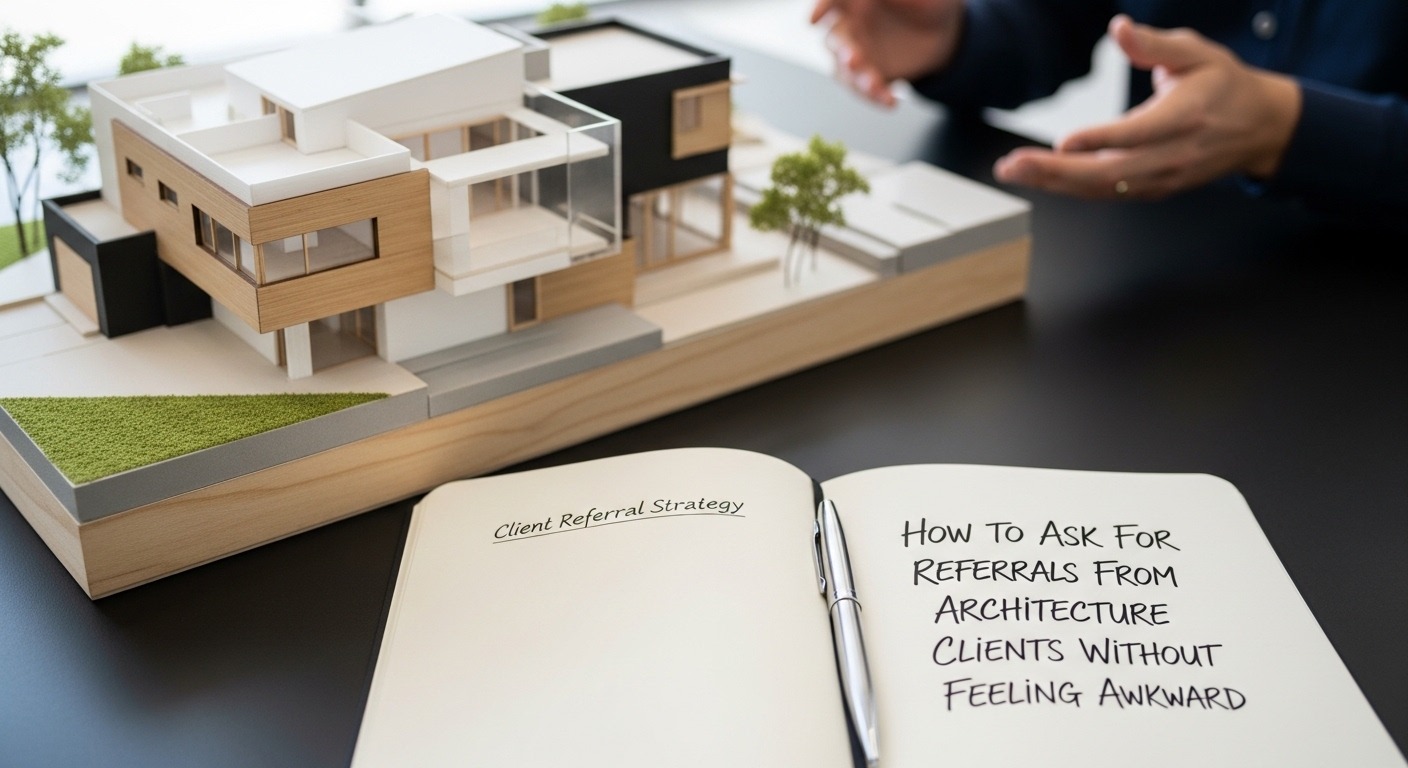
The project finished beautifully. Your client is ecstatic — posting photos on Instagram, showing friends around. You know they know other people who would love your work. But asking for a referral? The idea alone makes you squirm.
You’re not alone. A 2023 survey by the American Institute of Architects found that word-of-mouth and referrals account for over 60% of new project inquiries for small and mid-sized architecture firms — yet the vast majority of architects never proactively ask for them.
The result? A massive, untapped growth lever sitting quietly in your existing client relationships — while you spend money on ads, cold outreach, and awards submissions that yield a fraction of the returns.
This guide will show you exactly how to ask for referrals from architecture clients — confidently, gracefully, and in a way that actually works — without ever feeling pushy or transactional.
📋 In This Guide
- Why Architects Don’t Ask (And the Cost of That Silence)
- The Mindset Shift That Makes Referrals Feel Natural
- Timing Is Everything: When to Ask for a Referral
- Exactly How to Ask: Scripts That Don’t Sound Scripted
- The Four Best Referral Channels for Architecture Studios
- Building a Referral System That Works Without You
- How to Nurture Your Referral Network Long-Term
- 7 Referral Mistakes Architecture Studios Make
1. Why Architects Don’t Ask — And the Cost of That Silence
There are three recurring reasons architecture professionals avoid asking for referrals. Understanding them is the first step to getting past them.
Fear of Seeming Desperate
“If I ask, they’ll think my business isn’t doing well.” In reality, top professionals in every field ask for referrals — it signals confidence, not desperation.
Not Wanting to Impose
“They’re busy — I don’t want to put them on the spot.” But most happy clients want to help. They just never think to do it unprompted. Your ask gives them permission.
Simply Not Knowing How
Architecture school teaches design — not business development. Without a script or process, asking for referrals feels awkward because it is awkward when improvised.
The Hidden Cost of Never Asking
83%
of satisfied clients say they’d be happy to refer — but only 29% ever do
4×
higher conversion rate for referred leads vs. cold inquiries
16%
higher lifetime value for clients who came through referral
$0
cost to acquire a referral lead vs. avg. $800–$3,000 per digital lead
Sources: Nielsen Trust Report, Wharton School of Business, AIA Practice Reports
2. The Mindset Shift That Makes Referrals Feel Natural
The discomfort architects feel around referrals almost always comes from a single flawed belief: that asking for a referral is asking for a favour. It isn’t.
When your client’s friend mentions they’re thinking about renovating their home or commissioning a new build, your client now has two options:
Without your ask:
They say “Oh I worked with someone great, I’ll try to remember their name…” — and forget. Their friend hires someone random from Google.
With your ask:
They immediately say “You have to use my architect — here’s their card.” Their friend gets a brilliant result. Everyone wins.
“Asking for a referral isn’t asking for a favour. It’s giving your client the gift of being the person who introduced their friend to someone exceptional.”
— Core referral mindset for architecture studios
Reframe your ask as offering value to your client’s network — and the awkwardness largely disappears. You’re not begging. You’re enabling them to be the person who makes great introductions.
3. Timing Is Everything: When to Ask for a Referral
The when matters as much as the how. Ask at the wrong moment and even the happiest client will freeze. Ask at the right moment and it flows out of the conversation naturally.
There are five high-value “referral windows” in every architecture client relationship:
🌟 The “First Wow” Moment
When you present the first design concept and the client’s face lights up. This is peak emotional investment — they’re thrilled and you’re top of mind.
Best for: planting the seed — a light, forward-looking mention, not a formal ask.
🏗️ During Construction — When Things Go Right
When you solve a complex problem on-site, or the client visits and marvels at the progress. Satisfaction peaks in these moments of visible momentum.
Best for: casually mentioning you’d love introductions to similar project types.
🎉 Project Completion — The Golden Window BEST TIMING
The handover/walkthrough. The client is emotionally at their highest. They’re seeing the finished result for the first time. This is your single most powerful referral moment. Always ask here.
Primary referral ask — use the specific scripts in Section 4.
📸 When You Photograph the Project
Reaching out to share professional photos with your client is a natural touchpoint — and a great, non-pressured moment to ask if they know anyone who would benefit from your services.
Best for: email-based referral asks — see templates in Section 4.
📅 The 6-Month Check-In
A genuine follow-up call or email six months after completion (“How are you settling in? Any questions?”) rekindles the relationship and opens a natural referral conversation.
Best for: long-term relationship maintenance and re-engagement.
4. Exactly How to Ask: Scripts That Don’t Sound Scripted
The secret to referral scripts that work is that they never sound like referral scripts. They sound like a natural extension of a genuine relationship. Here are word-for-word approaches that have worked for real architecture studios.
At Project Handover (In Person)
“Working on this project with you has genuinely been one of the highlights of our year — thank you for trusting us with it. We do most of our best work through word of mouth, so if you ever find yourself talking to someone thinking about a project like this, we’d be honoured to help them too. No pressure at all — but if a name comes to mind, I’d love to meet them.”
✓ Zero pressure
✓ Specific & visual
When Sharing Project Photos (Email)
Subject: The photos from your project are ready ✦
Hi [Name],
I’m so excited to share these — [photographer’s name] captured your home beautifully. See the full gallery attached.
On a separate note: if you know anyone who’s been thinking about a similar project — a renovation, extension, or new build — I’d genuinely love to hear from them. You know better than most what the process looks like, and your recommendation would mean the world.
Thank you again for letting us do this work. It’s one we’re incredibly proud of.
Warmly,
[Your name]
✓ Natural segue
✓ Personal tone
The Specific Ask (When You Have Someone in Mind)
“I noticed you mentioned your colleague Sarah was thinking about redesigning her office space — would it be alright if I sent her a note? Or even better, would you be happy to make a quick intro? Only if you think it’s a good fit, of course.”
Specific asks convert at dramatically higher rates than vague ones. Listen carefully during your project relationship — clients often drop names that become referral goldmines.
✓ Ultra-targeted
✓ Feels natural
Six-Month Check-In (Referral Woven In)
Subject: Checking in — how’s life in the new space?
Hi [Name],
It’s hard to believe it’s been six months since we finished! I’d love to hear how you’re finding the space — is everything working as you’d hoped?
If there’s anything that needs attention, please don’t hesitate to reach out. And if you’ve been sharing photos with friends or family and anyone’s had questions about working with us — please feel free to send them my way.
Hope you’re loving every square foot.
[Your name]
✓ Subtle & warm
✓ Builds loyalty
5. The Four Best Referral Channels for Architecture Studios
Not all referrals come from past clients directly. Architecture studios that build robust referral networks tap into four distinct channels:
| Channel | Who They Are | How to Activate Them | Quality |
|---|---|---|---|
| Past Clients | People who’ve experienced your work firsthand & trust you completely | Scripts above + annual touch-points + photo sharing | ⭐⭐⭐⭐⭐ |
| Trade Partners | Builders, interior designers, structural engineers, landscape architects | Reciprocal referral agreements, co-marketing, joint project showcases | ⭐⭐⭐⭐ |
| Professional Network | Lawyers, accountants, real estate agents, wealth managers serving HNW clients | Relationship-building lunches, LinkedIn content, industry events | ⭐⭐⭐⭐ |
| Online Presence | Instagram followers, Houzz/Architizer profiles, Google reviews | Ask clients to leave reviews and tag you in social posts | ⭐⭐⭐ |
The Trade Partner Advantage
Your best builders, interior designers and structural engineers are in front of potential architecture clients every day. A formal reciprocal referral relationship — where you both actively recommend each other — can become your most consistent lead source. Consider a quarterly dinner with your key trade partners to keep these relationships warm. For tips on building these connections, see ArchDaily’s Business section.
6. Building a Referral System That Works Without You
One referral ask is an event. A referral system is a machine. The goal is to embed referral touchpoints so naturally into your studio’s client journey that they happen consistently — whether you remember to ask or not.
Map Your Client Journey Touchpoints
Write down every moment of client contact from first inquiry to one year post-completion. Mark the three highest-satisfaction moments. These are your referral windows — and where you’ll embed prompts.
Create Email Templates for Each Touchpoint
Using the scripts above as a base, create saved email templates in Gmail or your CRM. A template doesn’t mean robotic — it means you never miss the moment because you’re scrambling for words.
Set Calendar Reminders for Every Client
At project close, set a recurring 6-month and 12-month reminder in your calendar to check in. This single habit, when done consistently, generates more referrals than any marketing campaign. Tools like HubSpot CRM (free) can automate these reminders.
Build a “Referral Kit” for Happy Clients
Make it easy for clients to refer you. Create a simple one-pager or digital card they can forward: a brief “What it’s like to work with us” document with your contact info, specialisms, and a testimonial or two. The easier you make it, the more they’ll do it.
Track Every Referral — and Thank Generously
Every time someone refers a client to you, acknowledge it immediately and thank them meaningfully — a handwritten note, a fine bottle of wine, or simply a genuinely warm email. This reinforces the behaviour and makes them want to do it again. Track referral sources in your CRM to know who your champions are.
7. How to Nurture Your Referral Network Long-Term
The studios with the strongest referral pipelines don’t just ask — they consistently give. They stay top of mind by being genuinely useful and memorable between projects. Here’s what that looks like in practice:
| Frequency | Action | Why It Works |
|---|---|---|
| Monthly | Share a project update, behind-the-scenes post or industry article on LinkedIn or Instagram | Keeps your studio visible to your entire network passively — no direct outreach required |
| Quarterly | Send a short “Studio Dispatch” newsletter to past clients and trade partners | Reinforces your expertise, showcases new work, and creates natural “reply and refer” opportunities |
| Bi-annually | Host a small client appreciation event or open house at a completed project | Puts your best work in front of your clients’ networks in a social, low-pressure setting — organic referrals happen naturally |
| Annually | Send a handwritten card at year’s end to your top 20 past clients | Profoundly personal in a digital age — almost guaranteed to be remembered and appreciated |
| On Milestone | Send a “one year in your home” note with a project photo on the anniversary | Delightfully unexpected — virtually no one does this, so it’s completely memorable |
8. Seven Referral Mistakes Architecture Studios Make
Even with the best intentions, it’s easy to undermine your referral efforts. Here are the most common pitfalls — and exactly how to avoid them:
Asking too early in the project
Referral asks before value has been delivered feel transactional. Wait for genuine satisfaction moments — especially project completion.
Using vague language (“anyone you know”)
Vague asks produce vague results. Be specific about the type of project or client you’re looking for. “If you know anyone thinking about a heritage renovation in the next 12 months…” outperforms “anyone who needs an architect” every time.
Failing to follow up on referred leads quickly
When someone refers a client, that client is pre-warmed — they’re expecting to be impressed. A slow or generic response destroys both the opportunity and your referrer’s trust in recommending you.
Not thanking referrers properly
Forgetting to acknowledge a referral — especially one that converted — is the fastest way to ensure it never happens again. A handwritten thank-you note is worth more than most gifts.
Only asking once per client
Client circumstances change. The person who couldn’t think of anyone at project completion may have three perfect referrals 18 months later. Stay in touch and the ask becomes natural over time.
Neglecting your trade partner network
Focusing only on past clients misses your second-highest referral source. Builders, developers, and interior designers can become your most consistent stream of warm leads if the relationship is cultivated intentionally.
Making the referral about you, not them
“We need more projects” is not compelling. “Your friend would get the same experience you did — and I’d make sure of it” puts the client’s network at the centre. Always frame it as an opportunity for them to give a gift, not for you to grow your business.
Take the Next Step
Ready to Turn Your Clients Into
Your Best Marketers?
Referrals are just one piece of the puzzle. The Marketing Course for Architectural Firms gives you the complete marketing system built specifically for architecture studios: how to attract, convert, and retain high-value clients — month after month, project after project.
✓ Full marketing system for studios
✓ Client acquisition frameworks
✓ Built by & for architects
Join architecture studio owners who are growing their practice through smarter marketing
Your Referral Action Plan: Start This Week
You don’t need to overhaul your entire business. Start with these five actions this week:
List your top 10 past clients and note when you last contacted each one
Send one check-in email today using Script 04 above — no project requirement needed
Identify one trade partner (builder, interior designer) to have lunch with this month
Add a referral ask to your project completion checklist so it never gets skipped again
Set 6-month calendar reminders for every active client right now — and every future project from here on
Referrals aren’t luck. They’re the natural result of great work, genuine relationships, and a little bit of systematic intention. The architects who grow the most enviable practices are rarely the loudest marketers — they’re the ones whose past clients can’t stop talking about them.
Start building that reputation today — one thoughtful ask at a time.
📚 Further Reading
- AIA Practice Management Resources — business development tools for architecture firms
- ArchDaily Business — real-world architecture studio business strategies
- Dezeen Architecture — industry trends and successful studio profiles
- Houzz Pro — client management and referral tools for design professionals
Tags: architecture referrals, how to ask for referrals architect, architecture client referrals, referral marketing architecture studio, architecture business development, word of mouth marketing architects, architecture firm growth, referral scripts architects, architecture marketing strategy