Marketing budget is not the same thing as marketing effectiveness. Some of the most loyal retail customer bases in the world were built with nothing more than consistency, creativity, and an obsession with making customers feel something memorable.
If you’re an independent retailer operating on a tight budget, you’re not at a disadvantage — you’re freed from the lazy shortcut of throwing money at a problem. When money isn’t the answer, strategy becomes your currency. And strategy, applied consistently, out-performs budget every single time over the long run.
In this guide we break down 12 practical, zero-to-low-cost marketing strategies that independent retail stores can start implementing this week — no ad agency, no media buy, and no marketing degree required. Each strategy is followed by a specific first action you can take before the weekend.
Master Your Google Business Profile — It’s Your Most Powerful Free Tool

Your Google Business Profile is the single highest-ROI marketing asset available to any independent retailer — and it costs absolutely nothing. When someone searches “gift shop near me” or “independent bookshop [your town]”, your profile determines whether they find you or your competitor. According to Google’s own retail research, businesses with complete, active profiles receive 7× more clicks than businesses with incomplete profiles.
✅ Google Business Profile Optimisation Checklist
Complete every field — hours, phone, website, category, description
Add 10+ real photos — storefront, interior, products, team
Reply to every review — positive and negative, within 48 hours
Post weekly updates — new stock, events, offers, behind the scenes
Enable messaging so customers can contact you directly from search
Ask for reviews — verbally at checkout, via email, QR code on receipt
Systematically Turn Customers Into a Word-of-Mouth Engine
Word of mouth is the most trusted, highest-converting, and completely free marketing channel in retail. Nielsen research consistently shows that 92% of consumers trust recommendations from people they know above every other form of marketing. The difference between stores that get organic word-of-mouth and those that don’t isn’t luck — it’s whether the experience was memorable enough to be worth mentioning.
| Trigger | How to Create It | Cost |
|---|---|---|
| Surprise & delight | Unexpected small gift, handwritten note, or sample with every purchase | £0–£1 |
| Staff knowledge | Genuinely expert recommendation that solves a specific problem | £0 |
| Shareable moment | Beautiful packaging, in-store photo spot, or visual display worth photographing | £0–£5 |
| Ask directly | “If you loved it, please tell a friend” — simple, personal, effective | £0 |
| Referral reward | “Bring a friend and both get 10% off” — makes sharing feel generous, not pushy | Margin only |
Build an Email List From Day One — Your Most Valuable Free Asset
An email list is the only marketing audience you fully own. You don’t pay an algorithm to reach them. You don’t lose them when a platform changes its rules. Email delivers an average ROI of £36–£42 for every £1 spent — the highest of any marketing channel. And building it starts with a clipboard, a conversation, and a compelling reason to sign up.
📧 The 5-Step Retail Email List Builder
Create a compelling sign-up reason
“Join our list for first access to new stock + 10% off your next visit.” Benefit must be immediate and specific.
Place a sign-up point at checkout
A paper clipboard works. A QR code linking to Mailchimp’s free sign-up page works better. Set a target: 3 new subscribers per day.
Send one email per month minimum
New arrivals, a staff pick, an upcoming event, a behind-the-scenes story. Value first, offer second. Mailchimp is free up to 500 contacts.
Segment as you grow
Once you have 100+ subscribers, create basic segments: new buyers, frequent buyers, gift buyers. Targeted emails convert at 3× the rate of generic blasts.
Measure open rates, not just list size
An engaged list of 200 outperforms an unengaged list of 2,000. Aim for a 30%+ open rate. Retail industry average is 22%.
Create a Window Display That Makes People Stop Walking
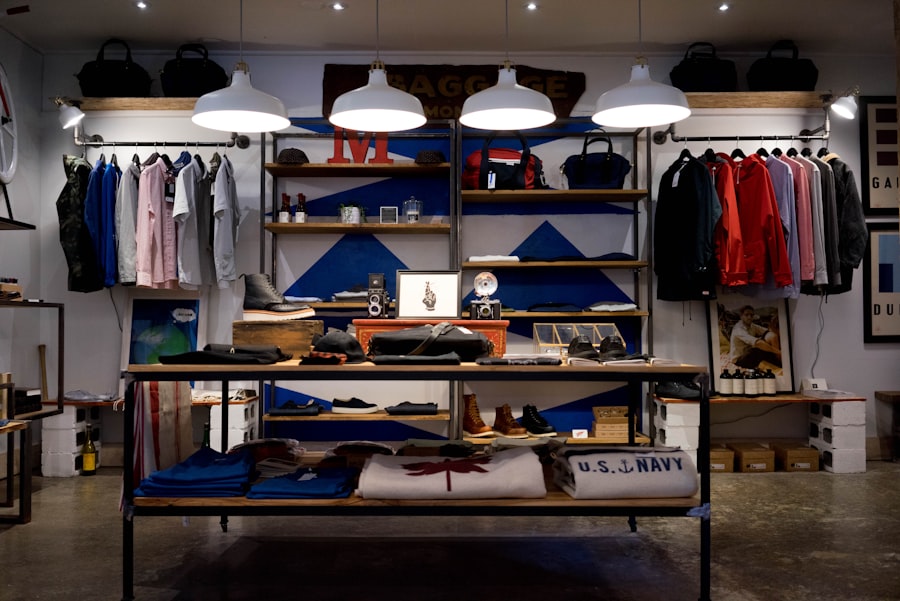
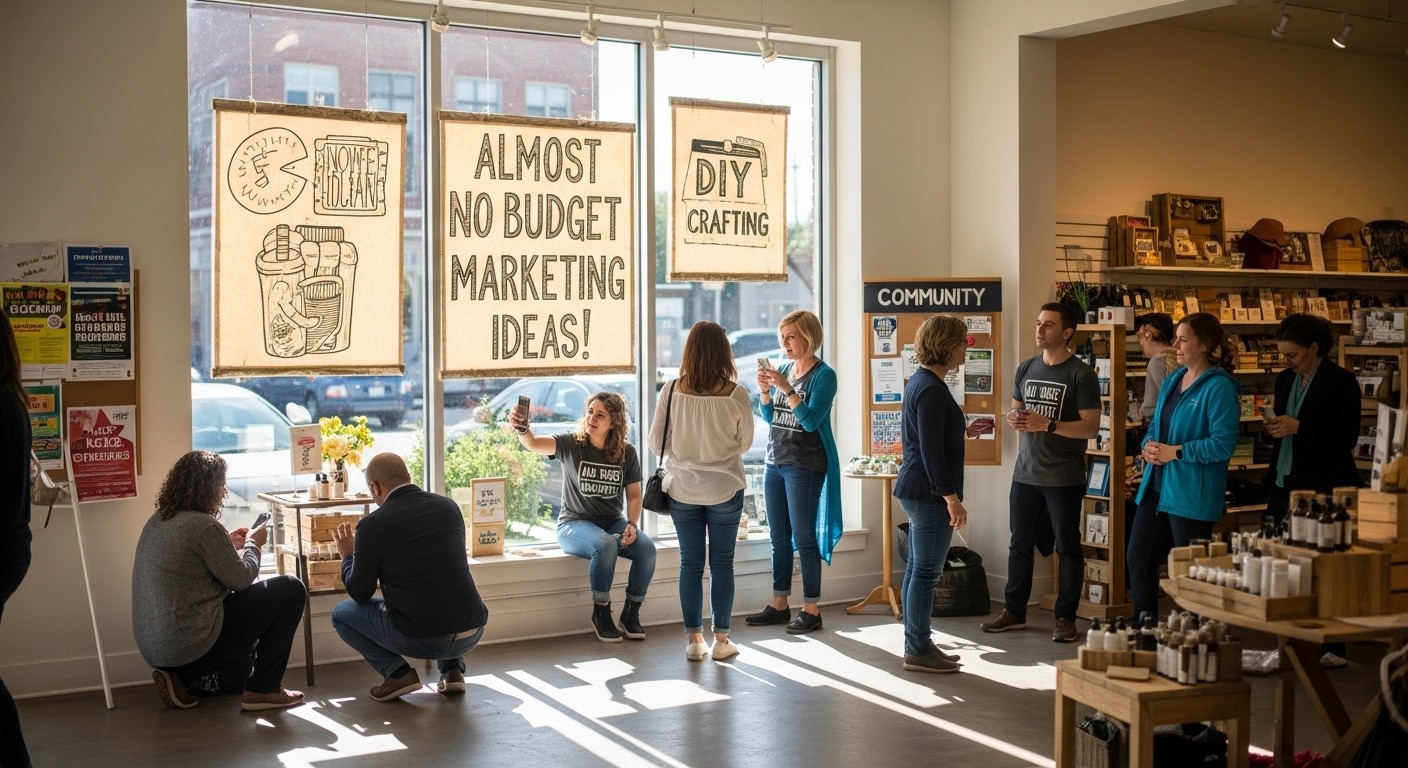
Your window is your highest-footfall marketing space — and it doesn’t cost a penny to use. According to retail psychologist Paco Underhill’s research, a compelling window display can increase walk-in traffic by up to 30% without a single paid promotion. The principles are simple and free to implement.
| Principle | What It Means | Common Mistake |
|---|---|---|
| One clear message | Feature one product, one theme, or one story per display | Cramming in 20 products — confuses passers-by |
| Eye-level hero | Place your most compelling product at pedestrian eye level (120–150cm) | Best products displayed too high or low |
| Seasonal relevance | Refresh monthly — a static window signals a static business | Same display for 3 months |
| Night lighting | Leave your window lit after closing — 6–9pm is when walkers look in | Lights off at 5:30pm |
| Social media hook | Add your Instagram handle or a QR code — convert walking traffic to followers | No digital bridge from window to online |
Use Social Media as a Community Builder, Not a Free Billboard
The number-one mistake retailers make on social media is posting product photos with prices and calling it marketing. Algorithms punish pure promotional content. Audiences ignore it. The stores that build real organic followings use social media the way a local community notice board was meant to be used — to share stories, spark conversations, and make people feel like insiders.
📱 The Zero-Budget Social Media Content Formula
40%
Behind the Scenes
Unpacking deliveries, rearranging the shop, staff moments, the early morning before opening
25%
Education & Tips
How to use or style the products you sell, expert knowledge only you have
20%
Customer Stories
Repost customer photos, share their stories (with permission), celebrate regulars
15%
Products & Offers
Only after you’ve earned attention — product posts land after relationship-building
For tactical guidance on which platforms suit different retail types, see Sprout Social’s Retail Social Media Playbook and Shopify’s guide to social commerce.
Four More High-Impact, Low-Cost Strategies
Partner With Complementary Local Businesses
Find 2–3 local businesses that serve the same customer but don’t compete with you. A florist, a coffee shop, a bookstore. Cross-promote each other’s businesses in your windows, on your social channels, and at your checkouts. This instantly doubles your reach without spending a penny.
The Federation of Small Businesses has resources on local partnership frameworks that make this simple to structure.
A free in-store event — a tasting, a demonstration, a “meet the maker” evening, a community workshop — transforms your store from a transactional space into a destination. Eventbrite’s research on in-person retail events shows that attendees are 3× more likely to become loyal customers than regular first-time visitors.
Stamp cards are not outdated — they’re underutilised. A physical loyalty card in someone’s wallet is a constant, passive reminder of your store. It creates a psychological commitment that influences future behaviour. Loyalty Lion research shows customers in a loyalty programme spend 12–18% more per visit and visit 20% more frequently than non-members.
Leverage User-Generated Content as Free Marketing
Every photo a customer takes of your products and shares online is free advertising reaching their personal network — people who already trust them. The key is to create a reason to photograph: beautiful packaging, a photo-worthy display, a “tag us and we’ll repost” sign near a visually striking area of your store. Shopify’s UGC research shows UGC converts at 4.5× the rate of brand-created content.
The Final Three: Press, Packaging & Referrals
Get Into Local Press and Community Groups
Local journalists and community editors are constantly looking for stories. Your new product range, an event you’re running, a community initiative you’re supporting, a milestone anniversary — all of these are stories. A well-written 200-word press release sent to your local paper, community newsletter, and neighbourhood Facebook group costs nothing and can reach thousands of people who would never have found you through a paid ad. For guidance on writing effective press releases, see Journalism.co.uk’s guide to press releases for small businesses.
Turn Your Packaging Into a Marketing Channel
Every bag, box, or wrap that leaves your store is a moving advertisement. A distinctive, reusable bag with your name on it gets carried through your local area by real customers — essentially a free, mobile billboard. A small printed insert inside every purchase can carry your Instagram handle, a QR code to your email sign-up, and your loyalty card. The marginal cost is pennies; the brand awareness compounds over hundreds of transactions.
Build a Referral System That Runs on Its Own
Word of mouth is powerful on its own. A structured referral system makes it reliable and measurable. The mechanism is simple: reward both the referrer and the new customer to remove all friction from the act of recommending. “Give a friend £5 off their first visit, get £5 off yours” — a completely self-funding system that can double your new customer acquisition without spending on ads. ReferralCandy’s research shows referred customers have a 16% higher lifetime value than non-referred customers.
Your 90-Day No-Budget Retail Marketing Plan
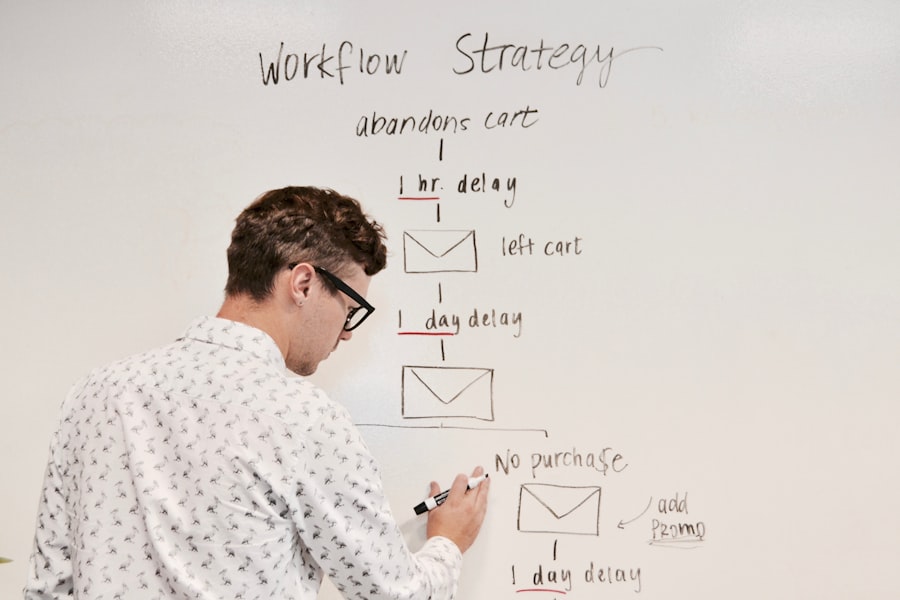
Twelve strategies is a lot to absorb. This 90-day sprint breaks them into a manageable sequence — building your foundation first, then adding layers. Each month adds new habits on top of the last, so by day 90 you have a complete organic marketing system running without a marketing budget.
Total Budget Required for All 12 Strategies
| Strategy | One-off Cost | Monthly Cost | Time / Week |
|---|---|---|---|
| Google Business Profile | £0 | £0 | 20 min |
| Word-of-mouth system | £0 | £0–£5 | 0 (embedded) |
| Email list (Mailchimp free) | £0 | £0 | 45 min/mo |
| Window display refresh | £0–£20 | £0 | 1 hr/mo |
| Social media content | £0 | £0 | 1.5 hrs |
| Local partnerships | £0 | £0 | 30 min setup |
| In-store event | £0–£50 | £0 | 2 hrs setup |
| Loyalty cards (100) | ~£10 | £0 | 0 (embedded) |
| Packaging insert cards (250) | ~£12 | £0 | 0 (embedded) |
| Total 90-day investment | £22–£82 | £0–£5 | ~4 hrs/wk |
Budget Is Not the Bottleneck — Consistency Is
The most successful independent retailers in the world aren’t the ones with the biggest advertising budgets. They’re the ones who show up — in their window, on their Google profile, in their community, in their customers’ inboxes — consistently and with genuine value. That consistency is free. It just requires intention, a system, and the discipline to execute even when it doesn’t feel like it’s working immediately.
Start with two of the twelve strategies this week. Do them properly. Measure what changes. Add a third next month. By month three, you’ll have more organic reach, more email contacts, and more returning customers than most retailers achieve with a £500/month advertising budget.
Written by
Easy Marketing School
Practical retail marketing education for independent store owners. No jargon, no agencies, just strategies that work.
easymarketingschool.org
Local Retail Strategy
Word of Mouth
Independent Retail