
“The stores that win these seasons aren’t the ones with the biggest budgets. They’re the ones with the clearest plan, the most compelling in-store experience, and the discipline to start preparing before their competitors even think about it.“
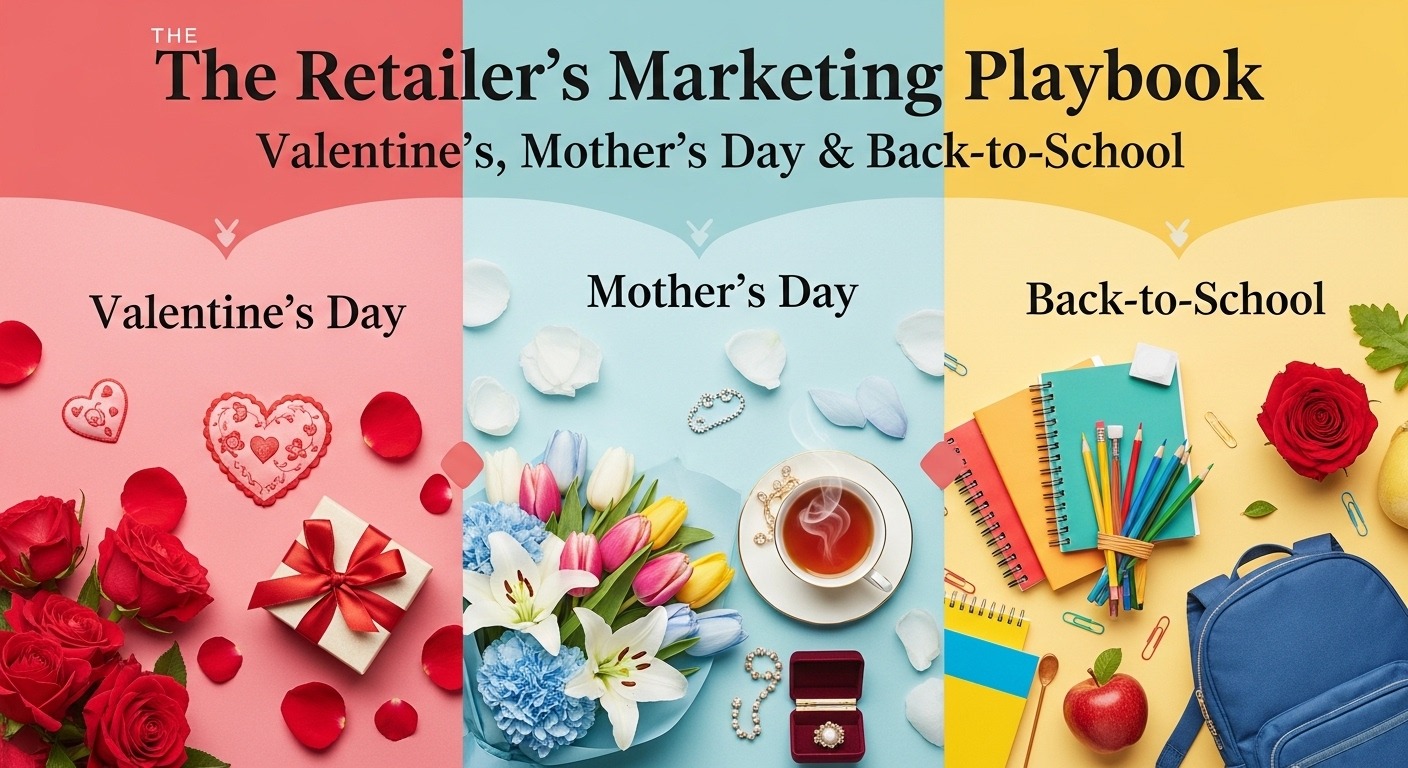
According to the National Retail Federation, Americans spend over $24 billion on Valentine’s Day, more than $35 billion on Mother’s Day, and more than $41 billion on Back-to-School shopping every year. That’s over $100 billion across three seasons — and independent retailers are positioned to capture a meaningful share of every dollar if they execute with intention.
This is your complete, practical guide to all three. Each chapter covers the key consumer behaviors, the optimal marketing timeline, visual merchandising principles, email and social media strategy, and campaign ideas you can run with a small team and a modest budget.
Use the navigation below to jump directly to the season you’re preparing for — or read through all three to build your complete seasonal marketing calendar for the year.
The Revenue Opportunity at a Glance
annual U.S. spend
annual U.S. spend
annual U.S. spend
spending — your window
Contents
I. Valentine’s Day
II. Mother’s Day
Part One
Valentine’s Day Marketing
for Retail Stores

Why Valentine’s Day Is a Bigger Retail Opportunity Than Most Stores Realise
The average American spends $188 on Valentine’s Day gifts according to NRF’s annual survey. Top categories include jewelry, experiential gifts, flowers, clothing, and specialty food. But here’s the insight most retailers miss: Valentine’s shoppers are highly time-pressed and decision-fatigued. They want the store to do the curation for them.
Your advantage as an independent retailer is that you can deliver precisely the thoughtful, curated, wrapped-and-ready gifting experience that no big-box store or Amazon click can replicate. Lean into this — hard.
Key insight: Valentine’s Day buyers are shopping for someone else under emotional pressure. Remove every decision barrier — use clearly labeled price-point tables, pre-made bundles, and complimentary gift wrapping — and you become their hero. That’s how a single February week can account for a month’s revenue.
Valentine’s Day Marketing Timeline
| When | Key Actions | Channels |
|---|---|---|
| Jan 2 – 7 | Plan inventory & pricing · Curate gift selections · Brief staff on upsells | Internal |
| Jan 8 – 20 | Install Valentine’s window display · Post social teaser: “Something special is coming…” | In-store + Social |
| Jan 21 – 31 | Email #1: Valentine’s Gift Guide · Announce free gift wrapping · Product spotlight posts | Email + Social |
| Feb 1 – 7 | Email #2: “Gifts Under $X” · Galentine’s event invite · Double loyalty points | Email + Social + In-store |
| Feb 8 – 13 | Email #3: Last chance + procrastinator’s guide · Urgency countdown posts | Email + Social |
| Feb 15 – 17 | Post-Valentine “Treat Yourself” push · Thank-you email · Clear seasonal inventory | Email + Social |
Valentine’s Visual Merchandising That Drives Basket Size
According to Shopify’s retail merchandising research, stores using seasonal product groupings see 30–45% higher basket sizes on gift-giving occasions compared to standard shelf layouts. Here are the four highest-impact moves:
Price-Point Gift Tables
Create clearly labeled tables: “Under $25,” “Under $50,” “Under $100.” Removes decision fatigue — the #1 reason gift shoppers leave empty-handed.
Pre-Made Gift Bundles
Bundle 3–5 complementary products in branded packaging. Positions your store as a one-stop solution and significantly increases average transaction value.
Handwritten Gift Tags
Offer free handwritten gift tags at checkout. Costs 30 seconds per transaction; creates an unforgettable experience that shoppers photograph and share online.
Instagrammable Focal Point
Install one striking visual element — a heart arch, floral wall, neon sign — that people photograph and share. User-generated content from your store is free advertising reaching thousands.
Valentine’s Day Campaign Ideas for Retail Stores
Partner with a florist, café, and bakery for a joint “Shop Local This Valentine’s” campaign. Each business promotes the others; combined reach far exceeds anything a single store can achieve alone.
Host a February 13th “Galentine’s Day” shopping evening for female customers celebrating friendships. Refreshments, exclusive discounts, gift wrapping station. Drives major pre-Valentine sales.
Launch a “You Deserve It” campaign on February 15th, targeting self-gifters with a 20–25% off flash sale. Clears seasonal stock and converts the post-holiday lull into a second revenue peak.
Offer “Buy $50 gift card, receive a $10 bonus card.” Immediate cash in hand, guaranteed future visit, and a perfect last-resort option for procrastinating shoppers who can’t find the right gift.
Part Two
Mother’s Day Marketing
for Retail Stores

The Biggest Gift-Giving Occasion of Spring
Mother’s Day spending reached $35.7 billion in the most recent NRF data, with the average consumer spending $274 — making it the second-largest gift occasion after the winter holidays. The top gift categories are flowers, special outings, jewelry, spa and personal care, clothing, and gift cards.
The key psychographic insight: Mother’s Day buyers are husbands, children, and family members who feel significant pressure to get it right. They want to be guided, not left to browse. Your store’s job is to remove the guesswork and make the selection feel thoughtful and special — that’s a role independent retailers are uniquely positioned to play.
Key insight: Segment your Mother’s Day marketing by who is buying, not just what they’re buying. A message that speaks directly to a husband, a teenage child, or an adult daughter will dramatically outperform a generic “Mother’s Day gifts” email. Personalization at this level requires no technology — just thoughtful copywriting.
Mother’s Day Marketing Timeline
| When | Key Actions | Channels |
|---|---|---|
| ~3 Weeks Before | Plan gift guide themes · Curate bundles by buyer type · Confirm stock | Internal |
| ~2.5 Weeks Before | Install spring/Mother’s Day display · Email #1: “Gifts she’ll actually love” | In-store + Email |
| ~2 Weeks Before | Publish gift guide by buyer type on social · Daily product content | Social |
| ~1 Week Before | Email #2: Bundle deals + free wrapping · Announce extended hours | Email + Social |
| 3–4 Days Before | Email #3: Procrastinator’s guide — “Still time!” · Urgency countdown posts | Email + Social |
| Post–Mother’s Day | Thank-you email with summer preview · “Treat yourself” offer for mums |
The Gift Guide Strategy That Wins Every Mother’s Day
The most powerful Mother’s Day marketing asset is a curated gift guide organized by who’s buying and for what kind of mum. Distribute via email, social media posts, and a printed in-store card. Here’s how to structure it:
| Guide Theme | Who’s Buying | Core Message | Best Format |
|---|---|---|---|
| For the Mum Who Has Everything | Adult children, husbands | Unique, experience-adjacent, memorable | Email hero + Reels |
| From the Kids (Under $30) | Parents shopping for/with children | Affordable, heartfelt, easy to choose | In-store table + Email |
| The Self-Care Collection | Anyone buying for a wellness mum | Relaxation, pampering, indulgence | Social + Pinterest |
| Premium Picks (Over $75) | Higher-budget shoppers | Quality, lasting, special occasion | Email + In-store display |
Mother’s Day Campaign Ideas for Retail Stores
Free Flower with Purchase
Partner with a local florist: one free stem with every purchase over a threshold. Near-zero cost; the gesture is immensely memorable and creates organic social sharing every time.
“Celebrate Local Mums” Campaign
Ask customers to share photos of their mums with a short caption. Feature the best stories on your social all week before Mother’s Day. Deep community connection; zero ad spend required.
Mother’s Day Morning Event
Host a “Mums Morning” — coffee or prosecco, exclusive 20% off, live music or artisan demo. Bring-your-mum shopping drives the highest transaction values of the entire spring season.
“What Mum Really Wants” Contest
Ask followers to tag a product from your store they’d give their mum. The most-liked entry wins a hamper. Drives massive organic reach; your products are the star of every submission.
Part Three
Back-to-School Marketing
for Retail Stores

The Multi-Week Revenue Window Every Retailer Should Be Planning For
Back-to-School (BTS) spending consistently exceeds $41 billion annually in the U.S. according to NRF’s Back-to-School report. What makes this season uniquely valuable is its extended 10–12 week window — serious shoppers begin in late June, the main wave hits in August, and a final surge arrives in early September for college students.
Unlike Valentine’s Day or Mother’s Day — which are primarily about gifting — BTS is driven by practical necessity combined with self-expression. Parents want durability and value. Teens want individuality and trends. College students want practicality for their first independent spaces. Independent retailers who speak directly to each of these motivations — rather than running generic “BTS sale” promotions — consistently outperform their local competition.
Key insight: Start your Back-to-School campaign earlier than feels comfortable — late June at the latest. Research by Deloitte’s Back-to-School study shows that over 50% of BTS spending happens before August even begins. The stores that wait until the first week of August have already missed half the season.
Targeting Your Three Buyer Segments
| Buyer Segment | Primary Motivation | Peak Window | Best Marketing Angle |
|---|---|---|---|
| 👨👩👧 K–12 Parents | Value, practicality, durability | Late July – mid-August | Bundle deals, “school checklist” content, loyalty rewards |
| 🧒 Teen Students | Self-expression, trends, standing out | August – early September | Trend-forward social content, TikTok, “new year new look” messaging |
| 🎓 College Students | Practicality, dorm/apartment essentials | Late July – September | “Dorm essentials,” “first apartment” guides, emails to parent lists |
Back-to-School Marketing Timeline
| When | Key Actions | Channels |
|---|---|---|
| Early – Mid July | Plan product selection · Create branded BTS checklist content · Brief staff | Internal + Social |
| Late July | Install BTS window display · Email #1: Early bird “Get ready for school” guide | In-store + Email |
| First 2 Weeks Aug | Email #2: Bundle deals + checklist · Peak daily social content · In-store events | Email + Social + In-store |
| Late August | Email #3: “Last chance before school starts” · Teacher discount launch | Email + Social |
| September | College student push · “What did you miss?” restock · Teacher appreciation week | Email + Social + In-store |
Back-to-School Campaign Ideas for Retail Stores
The Branded BTS Checklist
Create a printable and digital checklist featuring products from your store, organized by grade level. Distribute in-store, via email, and as a downloadable PDF. Parents keep it; every use reinforces your store as the BTS destination.
Grade-Level Bundle Packs
Pre-assemble bundles by grade or student type: “Year 7 Starter Pack,” “College Dorm Essentials,” “Creative Student Bundle.” Removes parental decision fatigue and dramatically increases average basket size.
Teacher Appreciation Discount
Offer teachers and school staff 15–20% off throughout August and September. They actively promote your store to every parent in their network — through newsletters, parent groups, and word of mouth.
School Supply Donation Tie-In
Partner with a local school to collect supplies for underprivileged students. For every purchase, donate one supply item. Drives traffic, earns press coverage, and builds community loyalty during one of the year’s highest-spend periods.
Planning All Three Seasons as One Calendar
The most successful independent retailers don’t plan these seasons in isolation. They maintain a rolling 90-day marketing calendar that keeps every campaign in preparation while the current one is running at peak. Here’s how all three fit into your annual retail marketing plan:
| Month | Active Season | Primary Focus | Also Prepare |
|---|---|---|---|
| January | 💝 Valentine’s Prep | Inventory, display install, Email #1 (gift guide) | Start Mother’s Day product research |
| February | 💝 Valentine’s Peak | Full campaign · Galentine’s event · Post-Val self-gifting push | Confirm Mother’s Day stock orders |
| Mar – Apr | 💐 Mother’s Day Prep | Spring refresh · Gift guide creation · Email #1 launched | Start BTS trend and inventory research |
| May | 💐 Mother’s Day Peak | Full campaign · Mums Morning event · Post-day summer preview | BTS inventory planning begins |
| Jun – Jul | 🎒 BTS Early Bird | Display up · Checklist content distributed · Email #1 (early bird) | Holiday season early planning starts |
| August | 🎒 BTS Peak | Maximum social · Bundle deals · Teacher discount · In-store events | Begin Q4 / Holiday campaign planning |
| Sep – Dec | 🎄 Holiday Season | Autumn refresh + full Q4 holiday campaign execution | January Valentine’s planning begins again |
You Have the Seasonal Playbook. Now Get the Full System.
Build a Complete Year-Round
Retail Marketing Machine
This guide covers three powerful seasons — but winning at retail marketing means having a proven system working for you every week of the year. The Retail Marketing Course at Easy Marketing School is the step-by-step framework built specifically for independent store owners. Seasonal campaigns, email marketing, loyalty programs, local SEO, and a year-round revenue strategy — all in one practical course designed for real store owners with real constraints.
✓ Mother’s Day Gift Guide Blueprints
✓ Back-to-School Strategy Playbook
✓ Email Marketing Sequences
✓ Local SEO Masterclass
✓ Year-Round Revenue Planner
Enroll in the Retail Marketing Course →
Built for independent retail store owners · Practical · Zero fluff
Your Seasonal Marketing Master Checklist
Work through the relevant column before each season begins:
💝 Valentine’s Day
- ☐ Price-point gift tables installed by Jan 10
- ☐ Pre-made gift bundles with branded packaging
- ☐ 3-part email sequence scheduled and ready
- ☐ Galentine’s Day (Feb 13) event planned
- ☐ Post-Val “Treat Yourself” campaign live Feb 15
💐 Mother’s Day
- ☐ Gift guides created by buyer type + price point
- ☐ Florist partner arranged for free flower offer
- ☐ 3-part email sequence scheduled
- ☐ “Mums Morning” event confirmed and promoted
- ☐ “Celebrate Local Mums” social campaign live
🎒 Back-to-School
- ☐ Branded BTS checklist created (print + digital)
- ☐ Grade-level bundle packs assembled
- ☐ 3-part email sequence starting late July
- ☐ Teacher appreciation discount active Aug–Sep
- ☐ School supply donation tie-in partnership live
The Bottom Line
Valentine’s Day, Mother’s Day, and Back-to-School together represent over $100 billion in annual U.S. consumer spending. The retailers who capture disproportionate shares of these seasons do not have bigger budgets — they have better plans, earlier starts, and a genuine commitment to creating experiences that online retailers simply cannot replicate.
The frameworks in this guide give you everything you need to compete: clear timelines, campaign blueprints, visual merchandising principles, email sequences, and the year-round calendar view that turns three isolated seasons into one coherent, revenue-generating machine.
Begin with the next season on your calendar. Build the plan. Execute it with discipline. And watch these three occasions transform the shape of your year. 🛍️