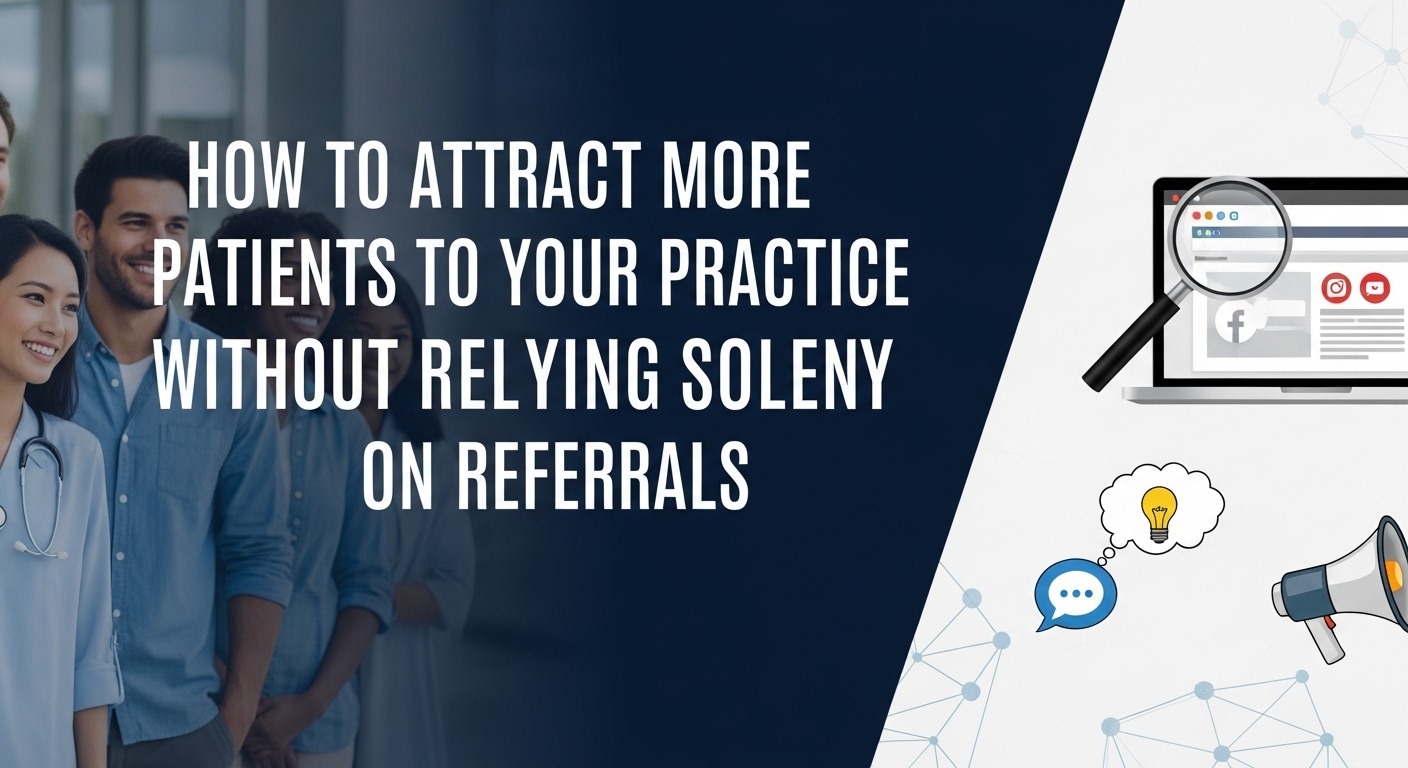
Physician referrals built the medical profession. They remain valuable today. But the practices that grow fastest, fill their schedules most reliably, and weather market changes most effectively have one thing in common: they never let physician referrals be their only patient acquisition channel.
Referral dependency is one of the most dangerous vulnerabilities a medical practice can have. When your primary referring physician retires, joins a competing group, or simply starts sending patients to a colleague who wined and dined them more recently — your patient volume can drop 30–40% in a single quarter. This happens to excellent practices every year, across every specialty.
According to a study by Accenture’s Digital Health research, more than 77% of patients now use digital channels to research and select healthcare providers — independent of any referral. Google searches, online reviews, healthcare directories, social media, and practice websites are actively driving patient decisions that previously required a physician’s word-of-mouth recommendation.
This guide gives you a complete, actionable framework for attracting new patients through every channel available to a modern practice — from local search optimization and content marketing to community presence, paid digital advertising, and patient experience strategies that generate organic word-of-mouth. By the end, you’ll have a roadmap for building a practice that grows on its own terms, not solely on referral dependency.
The Modern Patient Acquisition Reality
How today’s patients are actually finding and choosing their healthcare providers
Sources: Accenture Digital Health · Software Advice · Semrush · Bain & Company
Your Complete Patient Acquisition Playbook
Chapter One
The Referral Dependency Risk — Why One Pillar Is Never Enough
For decades, physician referrals were the primary engine of specialist growth. A solid relationship with three or four primary care physicians could sustain a full specialty practice almost indefinitely. But that era has fundamentally changed — and the practices that haven’t adapted are feeling the consequences.
Today’s patients are empowered consumers. They research providers independently, compare alternatives online, check reviews before accepting a referral recommendation, and will actively switch to a provider who is easier to find, easier to book, and better represented in digital channels — regardless of what their PCP recommended. The patient-physician referral relationship has become bidirectional: patients validate referrals with their own research, and they also initiate provider selection completely independently.
The Single-Channel Risk Scenario
Today
Your top 3 referring PCPs send 65% of your new patients. Practice is fully booked. Growth feels effortless.
The Trigger
One key PCP retires. Another joins a hospital group that has exclusive specialist relationships. A third starts preferring a colleague who invested in the referral relationship more deliberately.
The Consequence
Patient volume drops 35–50% within 6 months. With no alternative acquisition channels, recovery takes 12–18 months and may never fully occur.
The solution: Build a patient acquisition ecosystem with at least 5 independent channels. When no single channel represents more than 30% of new patient volume, your practice becomes resilient to disruption from any single source.
Chapter Two
Local SEO — Own the “Near Me” Searches Your Ideal Patients Are Making
Every day, thousands of patients in your market are typing “cardiologist near me,” “pediatrician accepting new patients [city],” “urgent care open now,” and similar searches into Google. According to Semrush’s healthcare SEO research, the top 3 Google results capture 75% of all clicks from these high-intent searches. These are patients who are ready to book — not just browsing.
Local SEO — the discipline of optimising your practice’s visibility in location-based searches — is the single highest-ROI patient acquisition investment available to most healthcare providers. And the most powerful tool within local SEO is completely free: your Google Business Profile (GBP).
Google Business Profile Optimization Checklist
| GBP Element | Why It Matters | Optimization Action |
|---|---|---|
| Business Description | Signals relevance to Google’s local algorithm | Include specialty, city, and patient care philosophy |
| Photos & Videos | GBP profiles with 20+ photos get 35% more clicks | Add interior, team, equipment, and exterior shots |
| Weekly Posts | Signals active, engaged practice to Google ranking signals | Post health tips, updates, offers every 7 days |
| Q&A Section | Answers common patient questions before they ask | Proactively add 8–10 FAQs with keyword-rich answers |
| Service Categories | Determines which speciality searches you appear for | List every service with full descriptions |
| Review Responses | Responding to all reviews is a verified local ranking factor | Respond to every review within 48 hours |
Beyond GBP: Ensure your practice name, address, and phone number (NAP) are identical across Healthgrades, Zocdoc, Vitals, WebMD, and Yelp. NAP inconsistency directly suppresses local search rankings.
Chapter Three
Your Website — Turn Your Digital Front Door Into a 24/7 Patient Conversion Machine
Your website is the hub of your entire patient acquisition ecosystem. Every channel — Google searches, social media posts, review site profiles, paid ads — eventually directs prospective patients to your website. If that destination fails to convert visitors into booked appointments, all your other marketing efforts are leaking potential revenue at the final hurdle.
According to Google’s Think with Google mobile research, 53% of mobile visitors abandon websites that take more than 3 seconds to load. Given that over 60% of healthcare searches now happen on smartphones, speed and mobile optimisation are non-negotiable conversion factors.

Speed & Mobile Performance
Use Google PageSpeed Insights to check your score. Under 2.5s load time on mobile is the benchmark. A score below 50 is costing you new patients every day.
Prominent Online Booking
“Book Now” in your hero section, navigation bar, and footer. 24/7 scheduling removes the friction that costs you 57% of motivated patients who hit a booking wall.
Human Provider Bios
Real photos, warm personal statements, care philosophies — not just credentials. Patients choose providers they feel they know. Your bio is your first introduction.
Social Proof on Every Page
Patient testimonials, star ratings, and a live Google review feed on service pages. Visitors looking for reassurance will find it immediately rather than searching elsewhere.
Localised Service Pages
Dedicated pages for each service and location mentioning city names and neighbourhoods. This is how you rank for specific condition + location search queries your patients type.
Trust Signals Visible Above the Fold
Certifications, hospital affiliations, insurance accepted, years in practice — display these prominently. Patients need rapid reassurance before they’ll read further.
Chapter Four
Online Reputation — Your Most Powerful and Most Neglected Patient Acquisition Asset
Online reviews are the digital equivalent of physician referrals — except they operate at scale, 24 hours a day, and they are consulted by 94% of prospective patients according to Software Advice’s patient research. A practice with 200+ reviews at 4.7 stars generates patient inquiries continuously — from patients who have never received a referral and never heard of the practice through any traditional channel.
The critical insight that most practices miss: the volume of your reviews matters as much as the rating. A practice with 4.9 stars and 15 reviews will lose new patients to a competitor with 4.6 stars and 240 reviews. Volume signals trust, recency, and active patient engagement. A single outstanding review from 2019 does almost nothing for today’s searcher.
A Simple HIPAA-Compliant Review Generation System
Train front-desk staff to ask every satisfied patient: “If you had a great experience today, we’d really appreciate a Google review — it helps other patients find us.” Simple, personal, highly effective.
Send a warm, general message: “We hope your visit went well. If you’d like to share your experience, here’s our Google review link.” Never mention specific treatments or conditions — HIPAA compliance is non-negotiable.
A printed card or display with a QR code linking directly to your Google review page. Zero friction — patients scan and review in under 60 seconds while waiting to check out.
Responding to reviews is both a Google ranking signal and a trust signal for prospective patients reading those reviews. A thoughtful, professional response to a negative review often convinces new patients more powerfully than the positive ones.
HIPAA Reminder: All review request communications must comply with HIPAA. Never reference a patient’s condition, treatment, or visit details in any outreach. Review responses must never confirm someone is a patient.
Chapter Five
Content Marketing — Become the Authority Patients Search For Before They Need Care
Every day, millions of people search for answers to health questions: “what are the symptoms of [condition],” “how is [procedure] performed,” “is [medication] right for me,” “when should I see a [specialist].” These searches represent patients who are not yet ready to book — but who are in a research phase that will ultimately lead them to a provider.
The practice whose educational content appears at the top of these searches becomes the trusted authority in that patient’s mind. When they’re ready to act, they return to the provider they’ve already come to trust — without any referral needed. This is the compounding power of healthcare content marketing.
| Content Type | Patient Stage | Example Topics | Best Distribution |
|---|---|---|---|
| Condition Explainer Articles | Symptom researching | “What is [condition]?” “Signs you need to see a [specialist]” | Blog + GBP posts |
| Procedure Guides | Evaluating options | “What to expect during [procedure]” “Recovery from [surgery]” | Website pages + YouTube |
| Seasonal Health Tips | Existing patients + general public | “Cold & flu season guide” “Heart health tips for winter” | Email + Social + GBP |
| FAQ Video Content | Pre-decision researching | “Your top 5 questions about [specialty] answered” | YouTube + Instagram Reels + Facebook |
| Patient Success Stories | Validation stage (with written consent) | “How [patient first name] managed [condition] with us” | Website + Social + Email |
Chapter Six
Social Media — Build the Trust That Turns Strangers into Patients
Pew Research data shows that 72% of U.S. adults actively use social media, and healthcare content consistently ranks among the most engaged categories on Facebook, Instagram, and YouTube. When a healthcare provider posts consistent, genuinely helpful content, they become a trusted voice in patients’ daily lives — not just a name on a building they pass twice a year.

| Post Type | Frequency | Best Platform | New Patient Goal |
|---|---|---|---|
| 🩺 Health Tip / Fact | 3× per week | Facebook + Instagram | Awareness + shareability |
| 👥 Staff Introduction | Bi-weekly | All platforms | Humanise; build connection |
| ❓ Patient FAQ Answer | Weekly | Facebook + YouTube Shorts | Trust + direct inquiries |
| 🏆 Practice Milestone/News | Monthly | Facebook + LinkedIn | Credibility + referral trust |
| 📞 “Booking Open” Post | 2× per month | Facebook + Instagram | Direct appointment bookings |
Chapter Seven
Healthcare Directories & Telehealth — Get Found Where Patients Are Actively Searching
Healthcare-specific directories are not just passive listing sites — they are active patient acquisition platforms. Millions of patients use Zocdoc, Healthgrades, Vitals, and WebMD Doctor Finder to find providers every single day — entirely independently of Google searches or physician referrals.
| Directory | Monthly Users | Key Feature | Priority Action |
|---|---|---|---|
| Google Business Profile | Billions | Local pack + Maps + Search | Full optimisation — #1 priority |
| Healthgrades | 11M+ | Reviews + insurance check | Claim, complete, collect reviews |
| Zocdoc | 6M+ | Real-time scheduling + insurance filter | Enable online booking, keep availability current |
| WebMD / Vitals | 30M+ | Condition-linked provider search | Complete bio, add speciality keywords |
| Telehealth Platforms | Rapidly growing | National patient reach; low barrier | Add to patient acquisition mix where clinically appropriate |
Chapter Eight
Patient Experience — Transform Satisfied Patients into Your Most Powerful Marketing Channel
Word-of-mouth referrals from satisfied patients — distinct from physician referrals — are arguably the most powerful patient acquisition channel available. When a delighted patient tells three friends about your practice, those referrals come pre-loaded with trust, warmth, and a personal endorsement that no advertisement can replicate.
The key insight is that word-of-mouth is not accidental — it’s engineered. It happens when practices invest deliberately in the experiences that patients talk about: waiting room comfort, staff warmth, communication clarity, booking ease, follow-up quality, and the small personal touches that signal genuine care.
🚀 Frictionless First Appointment
Digital intake forms sent before the visit. Name used from first moment. Minimal wait time. A clear, unhurried explanation. The first appointment sets all future expectations.
📩 Post-Visit Follow-Up
A personal, HIPAA-compliant check-in 48 hours after each visit. Asks how the patient is feeling; offers to answer questions. Creates the “wow” moment that leads directly to referrals and reviews.
💬 Prompt Communication
Returning calls and messages within 2–4 hours. Using patient portal messages proactively. Patients who feel heard become the most vocal advocates your practice will ever have.
Chapter Nine
Paid Digital Advertising — Accelerate Growth When Organic Channels Need Time to Build
Organic channels — SEO, reviews, content marketing, social media — are the foundation of sustainable patient acquisition. But they take 3–6 months to build meaningful momentum. When you need faster results — a new practice location, a new provider joining, filling a schedule gap — paid digital advertising delivers immediate, measurable patient inquiries.
| Channel | Best Use Case | Approx. Budget Range | Key Advantage |
|---|---|---|---|
| Google Search Ads | High-intent “need now” searches | $500–$3,000/mo | Captures ready-to-book patients |
| Facebook/Instagram Ads | Demographic targeting; awareness | $300–$1,500/mo | Precise local audience targeting |
| Google Maps (LSAs) | Local service discovery | Pay-per-lead | Shows above organic results with “Google Verified” badge |
| Retargeting Ads | Re-engage website visitors who didn’t book | $150–$600/mo | Converts warm prospects at low cost |
Important: Paid advertising for healthcare must comply with FTC guidelines and platform healthcare advertising policies. Avoid unsubstantiated health claims, guarantee language, or before/after representations. Work with a healthcare-specialist digital agency when running paid campaigns at significant budget.
Your Multi-Channel Patient Acquisition Ecosystem at a Glance
Here’s how all nine channels work together — and the priority order for a practice building its acquisition system from the ground up:
| Priority | Channel | Time to Results | Cost | Long-Term ROI |
|---|---|---|---|---|
| P1 | Google Business Profile Optimisation | 2–4 weeks | Free | ⭐⭐⭐⭐⭐ |
| P2 | Online Reputation / Review Generation | 1–3 months | Free – Low | ⭐⭐⭐⭐⭐ |
| P3 | Website Conversion Optimisation | Immediate | Medium (one-time) | ⭐⭐⭐⭐⭐ |
| P4 | Healthcare Directories | 1–6 weeks | Free – Low | ⭐⭐⭐⭐ |
| P5 | Social Media (Consistent Posting) | 3–6 months | Free (time investment) | ⭐⭐⭐⭐ |
| P6 | Content Marketing / Blog | 3–9 months | Low (time + writing) | ⭐⭐⭐⭐⭐ (compounding) |
| P7 | Paid Digital Advertising | Days – weeks | Medium – High | ⭐⭐⭐ (stops when spend stops) |
Stop Waiting for the Phone to Ring.
Build a Practice That Grows on Its Own Terms.
Everything covered in this guide — local SEO, reputation management, content marketing, social media, healthcare directories, patient experience, and paid advertising — is taught in depth inside the Healthcare Marketing Course at Easy Marketing School. This is the complete, step-by-step, HIPAA-aware marketing system built specifically for medical practices, clinics, and healthcare providers who want to build a full schedule — independently and sustainably.
✓ Local SEO & GBP Masterclass
✓ HIPAA-Compliant Reputation Strategy
✓ Healthcare Content Marketing
✓ Patient Retention Framework
✓ Paid Advertising for Healthcare
→ Enroll in the Healthcare Marketing Course
Built for medical practices, clinics & healthcare providers · HIPAA-aware · No fluff
Your 90-Day Patient Acquisition Action Plan
Start with the high-priority foundations, then build outward:
Month 1 — Digital Foundation
- ☐ Claim & fully optimise Google Business Profile
- ☐ Audit and fix website speed + mobile experience
- ☐ Add online booking to website prominently
- ☐ Complete Healthgrades, Zocdoc, Vitals profiles
- ☐ Implement HIPAA-compliant review request system
Months 2–3 — Visibility & Trust
- ☐ Begin 3× weekly social media posting
- ☐ Write and publish 2 condition/service blog posts
- ☐ Post weekly to Google Business Profile
- ☐ Launch post-visit follow-up email sequence
- ☐ Set up Google Analytics 4 and track booking conversions
The Prescriptive Summary
Building a practice that attracts patients independently of referrals is not about choosing between digital marketing and clinical excellence — it is about both operating at their full potential simultaneously. Your clinical expertise is the product. Marketing is how patients find, choose, and stay with the product they need.
The nine channels covered in this guide — local SEO, website optimisation, reputation management, content marketing, social media, healthcare directories, patient experience, paid advertising, and a resilient channel mix — work together as an ecosystem. No single channel is sufficient. Together, they create a practice that grows predictably, sustainably, and independently.
Start with Month 1 of the action plan above. Build one system at a time. The compounding effect of consistent, multi-channel marketing will transform your patient volumes within 90 days — and keep transforming them for years to come.
Tags:
medical practice patient acquisition
healthcare marketing without referrals
healthcare local SEO
grow medical practice
digital marketing for doctors
healthcare content marketing
physician referral alternatives