“LinkedIn is the only platform where a single article can generate more qualified referrals than six months of paid advertising.” — a reality quietly discovered by the healthcare executives who are already there.
LinkedIn is no longer a platform for job seekers. It is the world’s largest professional network, with over 1 billion members — including hospital administrators, corporate HR directors, insurance executives, physicians, and the affluent, educated patient demographic that most premium medical practices want to attract. According to LinkedIn’s own research, 4 in 5 LinkedIn members drive business decisions.
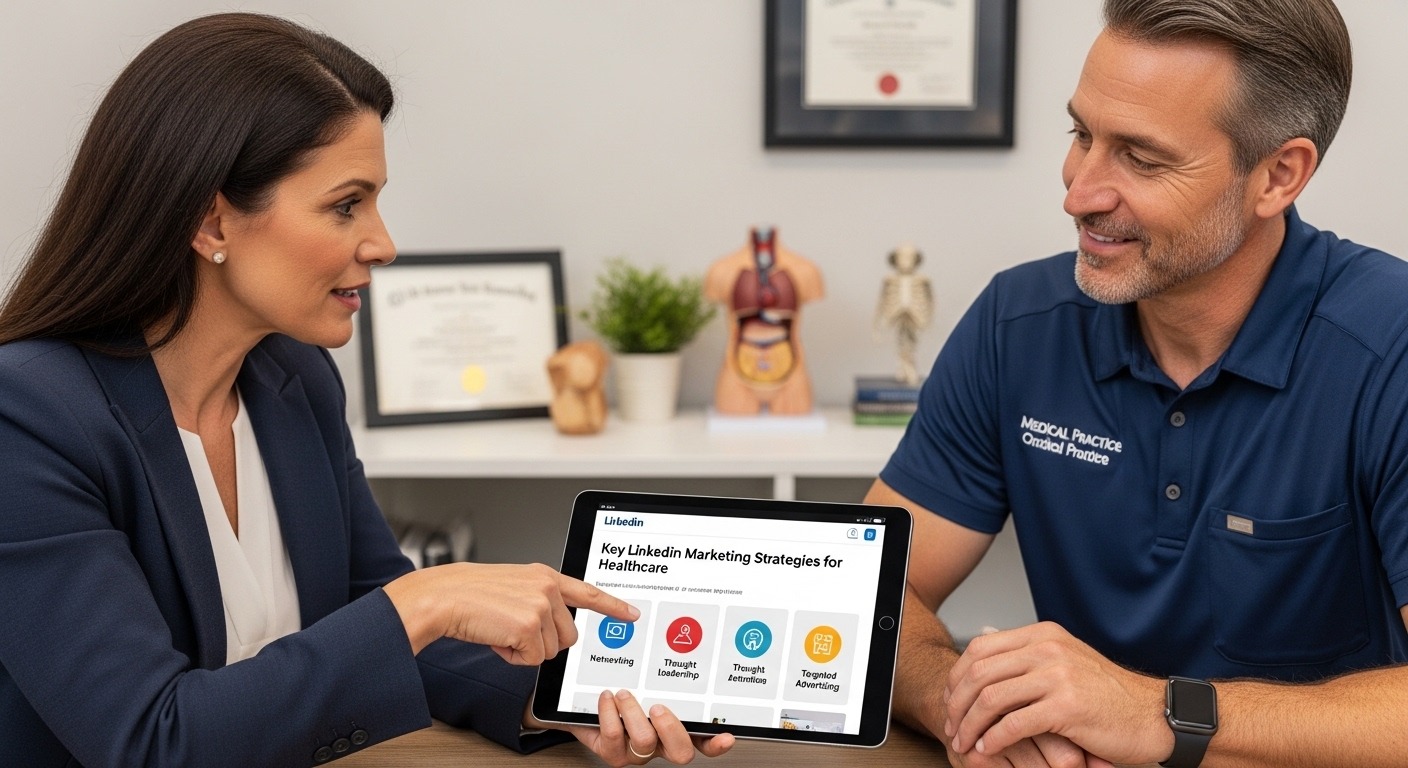
For healthcare executives and medical practice owners, LinkedIn operates on a different strategic level than Instagram or Facebook. It’s not primarily about patient acquisition — it’s about building the authority, referral networks, and professional reputation that generates patient acquisition as a downstream result. Used correctly, LinkedIn transforms a physician from a local practitioner into a recognized regional or national expert whose name carries weight.
This guide delivers the complete LinkedIn strategy framework for healthcare leaders — from profile optimization to content architecture to relationship-building protocols that convert connections into referrals, partnerships, and tangible practice growth.
Strategic Contents
- The LinkedIn Opportunity Most Healthcare Executives Are Missing
- Building an Executive-Grade LinkedIn Profile
- The Healthcare Thought Leadership Content Framework
- LinkedIn Articles: Your Long-Form Authority Engine
- Strategic Connection & Network-Building Protocol
- LinkedIn for Referral Generation: The Physician Network Strategy
- Practice Page vs. Personal Profile: Using Both Strategically
- LinkedIn Analytics: Measuring Executive Brand Growth
- The Complete Healthcare Marketing System
The LinkedIn Opportunity Most Healthcare Executives Are Missing
Here is the uncomfortable reality: most physicians and practice owners who are on LinkedIn are invisible. They set up a profile five years ago, connected with a few colleagues, and have posted nothing since. Meanwhile, a small cohort of healthcare executives who understood the platform’s power are quietly building authority, attracting media opportunities, generating referral pipelines, and positioning their practices as regional centers of excellence.

What an Active LinkedIn Presence Generates for Healthcare Leaders
Physician Referral Networks
Other physicians who see your expertise consistently in their feed refer patients they can’t treat. This is the highest-converting referral source in medicine — and LinkedIn is where it now begins.
Media & Speaking Opportunities
Journalists, podcast hosts, and conference organizers search LinkedIn for expert sources. An active, authoritative profile means media comes to you rather than you pitching it.
Corporate & Employer Contracts
HR directors and benefits managers at local companies use LinkedIn to find occupational health, corporate wellness, and employee health program partners. This is an underutilized B2B revenue stream.
Legal & Expert Witness Work
Attorneys searching for medical expert witnesses search LinkedIn by specialty. A well-positioned profile generates consistent expert witness inquiries — a significant supplemental revenue opportunity.
never create content on LinkedIn — which means the 3% who do receive 97% of all organic visibility on the platform. In healthcare, this means that one active physician thought leader in any given specialty can own the professional conversation in their entire region. The barrier to entry is simply showing up.
Building an Executive-Grade LinkedIn Profile
Your LinkedIn profile is not a digital CV. For healthcare executives, it is a sophisticated positioning document that answers one question in the mind of every visitor: “Should I trust this person’s expertise enough to refer a patient, invite them to speak, or form a professional relationship?” Every profile element must answer yes.
| Profile Element | Executive Standard for Healthcare | Impact |
|---|---|---|
| Profile Photo | Professional headshot with neutral background, clinical attire or executive business attire. High resolution, direct eye contact. This is your first impression for every connection. | 🔑 Critical |
| Banner / Background | Branded banner showing your practice, specialty, or a professional speaking/event photo. The banner reinforces your visual brand authority before anyone reads a word. | 🔑 Critical |
| Headline (220 chars) | NOT your job title. Your value proposition: “Cardiologist & Practice Owner | Helping patients prevent heart disease before it happens | Chicago, IL | 20+ years clinical experience” | 🔑 Critical |
| About Section (2,000 chars) | Write in first person. Begin with your mission statement, not your credentials. Include: clinical philosophy, key expertise, who you help, how to engage you. End with a direct call to action. | 🔑 Critical |
| Featured Section | Pin your 3 best articles, media appearances, or case study posts. This section tells a new visitor immediately: “This person creates substantive content.” | ⬆ High |
| Skills & Endorsements | Pin 3 specialty-specific skills to the top. LinkedIn’s algorithm uses skills to match your profile to relevant searches. Generic skills are wasted profile real estate. | ⬆ High |
| Recommendations | Request written recommendations from colleagues, hospital chiefs, or referring physicians. 5+ quality recommendations signal a validated professional reputation to any visitor. | ⬆ High |
Paragraph 2: Who you serve & what makes your approach unique
Paragraph 3: Clinical expertise, specializations, and conditions you treat
Paragraph 4: Credentials, affiliations, academic contributions, media appearances
Closing Line: “I write here weekly on [topic]. Follow for evidence-based insights on [specialty]. To inquire about [referrals/speaking/partnerships]: [email or Calendly link]”
The Healthcare Thought Leadership Content Framework
Thought leadership on LinkedIn is not about being the most prolific poster. It’s about being the most insightful voice in your professional niche. Healthcare executives who build genuine authority post with a specific content architecture — distributing their time and energy across content types that serve different strategic purposes.

The 5-Type Healthcare Thought Leadership Content Architecture
01
Clinical Insight Posts — Your Frontline Intelligence
35% of content
Share what you’re seeing clinically that the broader medical community should know. What disease presentation surprised you this month? What treatment approach is showing better outcomes than the literature predicted? What patient question changed how you explain something? This positions you as someone on the front lines with unique, valuable intelligence.
02
Healthcare System Commentary — Your Executive Perspective
25% of content
Comment on healthcare policy, industry trends, and systemic issues from an expert insider’s perspective. When Medicare policy changes, when a major study is published, when a healthcare company makes news — your commentary contextualizes it for a professional audience who cannot interpret it as well as you can. This is the content that earns journalist calls and speaking invitations.
03
Practice Leadership & Business Insights
20% of content
Share the business and leadership insights you’ve developed as a practice owner. What have you learned about hiring, team culture, patient experience, or scaling a medical business that other physicians need to hear? This content performs exceptionally well on LinkedIn because clinical executives rarely speak openly about the business of medicine.
04
Patient Education — Professional Audience Edition
12% of content
LinkedIn’s audience includes educated, health-conscious professionals who are patients with above-average health literacy. Write patient education posts at a professional register — not dumbed-down consumer content. These posts often get reshared by corporate HR departments and employee wellness programs, dramatically expanding your reach.
05
Personal Story & Mission Content
8% of content
Periodic authentic personal stories — why you chose medicine, a patient interaction that changed you, a leadership challenge you overcame — outperform all other content types for engagement. Healthcare executives who show the human behind the credentials build trust that no volume of clinical content can replicate. These posts are the ones that make people want to refer their friends to you specifically.
LinkedIn Articles: Your Long-Form Authority Engine
LinkedIn Articles — the platform’s native long-form publishing tool — are one of the most underutilized authority-building features in professional social media. Unlike standard posts (which disappear from feeds within 48–72 hours), LinkedIn Articles are indexed by Google, permanently linked from your profile, and continue generating profile visits and connection requests for months or years after publication.
Why Articles Outperform Posts for Healthcare Authority
High-Performing Article Topics for Healthcare Executives
| Article Category | Example Title | Primary Audience |
|---|---|---|
| Clinical Deep-Dives | “What 20 Years of Managing Hypertension Has Taught Me That the Guidelines Don’t” | Physicians, Specialists |
| Practice Business | “Why I Left a $600K Hospital Position to Build My Own Practice — And Would Do It Again” | Physicians, Residents |
| Policy & Industry | “The Hidden Cost of Prior Authorization: A Practice Owner’s Case for Reform” | Healthcare System, Policy |
| Patient Advocacy | “What I Wish Every Patient Knew Before Their First Cardiology Appointment” | Broad Professional, Patients |
| Leadership & Culture | “How I Built a Practice Team With 4% Annual Turnover — The System That Changed Everything” | Practice Owners, HR |
Strategic Connection & Network-Building Protocol
On LinkedIn, who you connect with determines what content you see and what opportunities find you. For healthcare executives, connection strategy is not about maximizing your connection count — it’s about building a precisely calibrated professional network that generates referrals, opportunities, and visibility in the right circles.
Your Strategic Connection Priority List
- PCPs in your metro area (for specialists)
- Specialists in adjacent fields
- Hospital department chiefs
- Urgent care & ED physicians
- HR directors at local employers
- Corporate benefits managers
- Health insurance medical directors
- Corporate wellness consultants
- Healthcare journalists & editors
- Podcast hosts in health/wellness
- Conference organizers
- Medical association executives
Never send a blank connection request. Every request should include a brief, specific note. Template:
This three-sentence formula has a 60–70% acceptance rate vs. under 20% for blank requests. The specificity signals genuine professional interest rather than bulk networking.
LinkedIn for Referral Generation: The Physician Network Strategy
Physician-to-physician referrals have a conversion rate of over 70% — far higher than any other patient source. LinkedIn is where the relationships that generate those referrals are now built and maintained. Here is the specific protocol that turns LinkedIn connections into a reliable referral pipeline.
Practice Page vs. Personal Profile: Using Both Strategically
Most healthcare organizations make the mistake of investing all their LinkedIn effort into a company/practice page — and then wonder why it generates minimal engagement. The fundamental truth of LinkedIn is that people engage with people, not companies. Personal profiles receive dramatically more organic reach. But both serve essential strategic purposes.
| Dimension | Personal Profile | Practice Page |
|---|---|---|
| Organic Reach | ★★★★★ Excellent | ★★☆☆☆ Limited |
| Engagement Rate | 6× Higher | Lower (unless paid) |
| Trust Building | ★★★★★ Primary driver | ★★★☆☆ Supports |
| Job Recruitment | Limited | ★★★★★ Primary tool |
| Paid Advertising | Not available | Full LinkedIn Ads platform |
| Best Strategy | Weekly thought leadership + article publishing | Amplify personal profile posts + job listings + ads |
The Cross-Amplification Strategy
When you publish a personal post, reshare it from your Practice Page. When you publish a Practice Page update, mention it in your personal feed. Encourage staff to engage with both — their interactions amplify reach to their own networks. This cross-amplification creates a multiplier effect without requiring additional content creation.
LinkedIn Analytics: Measuring Executive Brand Growth
The LinkedIn metrics that matter for healthcare executives are fundamentally different from the vanity metrics that dominate social media conversations. You’re not optimizing for likes — you’re building an authority brand that generates referrals, media opportunities, and speaking engagements. Measure accordingly.

| Metric | What It Measures | Healthy Benchmark |
|---|---|---|
| Profile Views (weekly) | Who is discovering you and evaluating your expertise | Growing 10–20% month-over-month after consistent posting |
| Search Appearances | How often your profile appears in LinkedIn search results (LinkedIn Premium feature) | Increasing — indicates growing keyword authority in your specialty |
| Post Impressions | Total reach of your content beyond your existing connections | 1,000+ per post = strong; 5,000+ = excellent thought leadership reach |
| Comment Quality | Whether conversations are substantive vs. generic (“Great post!”) | Physician/executive commenters discussing clinical nuance = authority signal |
| New Connection Source | Whether you’re attracting your target audience types | Physicians, executives, journalists = strategy working; track inbound requests by role |
| Offline Opportunity Attribution | Referrals, media calls, speaking invites that mention LinkedIn | At least 1–2 LinkedIn-attributed opportunities per quarter by month 6 |
📅 The Executive Posting Schedule
The optimal level is achievable by batching content creation (2 hours on Sunday mornings) and scheduling posts via Buffer or Hootsuite.
Authority Is Not Assigned — It’s Demonstrated. LinkedIn Is Where You Demonstrate It.
The healthcare executives who dominate their professional communities in 2025 and beyond will not be those with the largest practices or the most impressive hospital affiliations. They will be the ones who showed up consistently, shared their genuine expertise openly, and built networks that recognized them as the go-to voice in their specialty.
LinkedIn is where that recognition is built. The investment is modest — a few hours per week. The compounding return — referrals, media coverage, speaking opportunities, and a professional reputation that extends far beyond your local market — is extraordinary.
Your LinkedIn Executive Launch Checklist
- Update your profile photo with a current professional headshot
- Rewrite your Headline as a value proposition (not just your title)
- Rewrite your About section using the 5-paragraph executive formula
- Pin 3 items in your Featured section
- Connect with your top 20 existing referral relationships this week
- Publish your first post using the “Clinical Insight” format
- Commit to a minimum schedule: 2 posts per week for 90 days
- Write your first LinkedIn Article within 30 days
Further reading: LinkedIn Marketing Solutions Blog · AMA Digital Resources for Physicians · Health Leaders Media
Healthcare Marketing Insights
Executive marketing strategy and professional authority-building guides for healthcare leaders, medical practice owners, and physicians who want to grow beyond clinical excellence.
X / Twitter