Hospitality marketing courses range from a two-month Cornell certificate to a free two-hour introduction to tourism promotion, with professional certifications, university courses and practical owner-level courses in between. The trouble is that they are usually listed together, as if a revenue-focused hotel marketer, a guest house owner and a hospitality student all needed the same thing. They do not. This guide compares seven real options for hotel and tourism marketing on format, time, price and certificate, using what each provider’s public page showed as of October 2026, and says plainly who each one is for, including our own course and where it stops.
Who is looking for hotel and tourism marketing training
- Owners of small hotels, guest houses, B&Bs and hostels. You want more direct bookings and less dependence on booking platforms, better reviews and a steadier off-season, and you are doing the marketing yourself.
- Tour operators, experience providers and travel agencies. Your products sell on content, reviews and trust, and you need a plan that turns enquiries into bookings.
- Marketing, sales and revenue staff at hotels and brands. You need deeper digital skills and a credential that employers in the industry recognise.
- Students and career changers. You want academic grounding in hospitality and tourism marketing that looks credible on a CV.
Hospitality marketing courses compared
| Option | Type | Format and length | Price shown (October 2026) | Certificate | Best for |
|---|---|---|---|---|---|
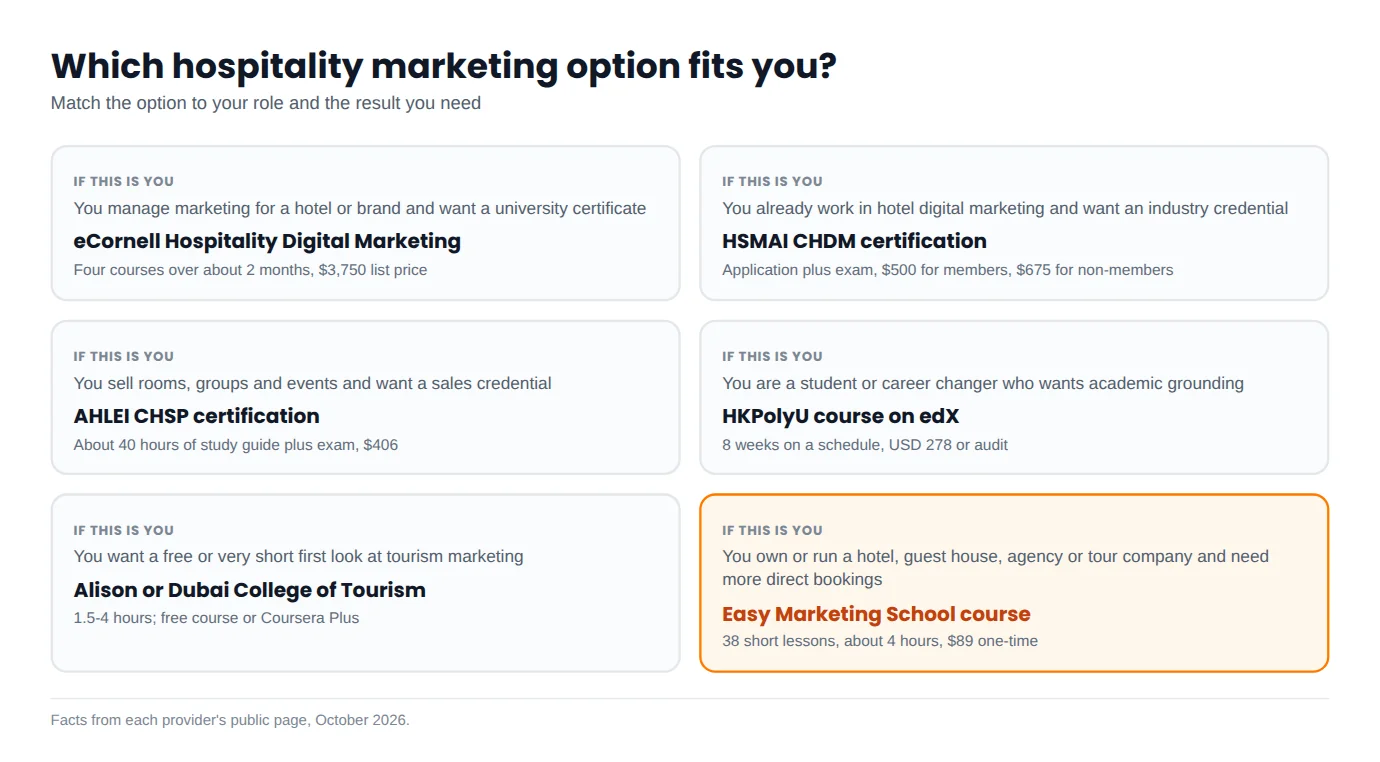
| eCornell: Hospitality Digital Marketing | University certificate programme | Four online courses; 2 months at 7 to 9 hours a week | $3,750 list price (a promotional code price was also shown) | Cornell certificate; page lists 72 professional development hours (7.2 CEUs) | Hotel and brand marketers who want a recognised university credential |
| HSMAI: Certified Hospitality Digital Marketer (CHDM) | Industry certification | Application, then a study guide and an online exam | $500 for HSMAI members, $675 for non-members | CHDM certification, renewed every two years | Established hotel digital marketing, sales and revenue professionals |
| AHLEI: Certified Hospitality Sales Professional (CHSP) | Industry certification | Application, online study guide (about 40 hours) and exam | $406 | CHSP certification | Hotel sales staff selling to groups, meetings and travel agents |
| HKPolyU on edX: Managing Marketing in the Hospitality and Tourism Industry | University course | Instructor-paced, 8 weeks at 6 to 8 hours a week | USD 278; audit option shown | Verified certificate | Students, career changers and new managers |
| Dubai College of Tourism on Coursera: Dubai Hospitality Marketing | Short course on a learning platform | 2 modules, about 4 hours | Included with Coursera Plus | Shareable certificate | A beginner’s overview of hospitality marketing |
| Alison: Tourism – Marketing and Promotion | Free online course | 3 modules, 1.5 to 3 hours | Free course; certificate offered separately | Alison certificate via “Certify Now” | A first look at tourism promotion and advertising |
| Easy Marketing School: Hospitality and Tourism Marketing Course | Self-paced practical course | 38 short video lessons, about 4 hours; lifetime access | $89 one-time | Certificate of completion | Owners and managers of hotels, guest houses, agencies and tour companies |
Details come from each provider’s public page as of October 2026. Prices, schedules and promotions change, so check the provider’s site before you enrol.
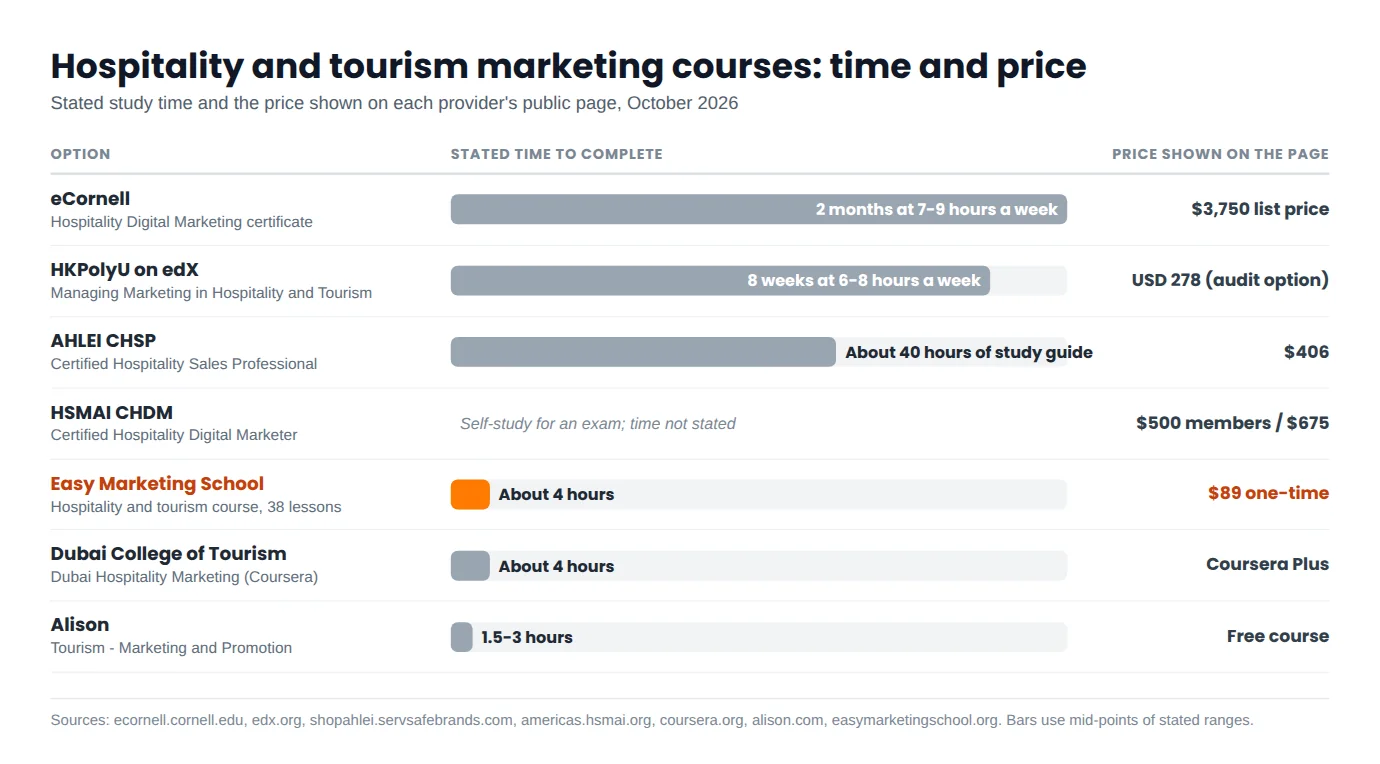
Each option: what it is good for, and what it is not
eCornell Hospitality Digital Marketing
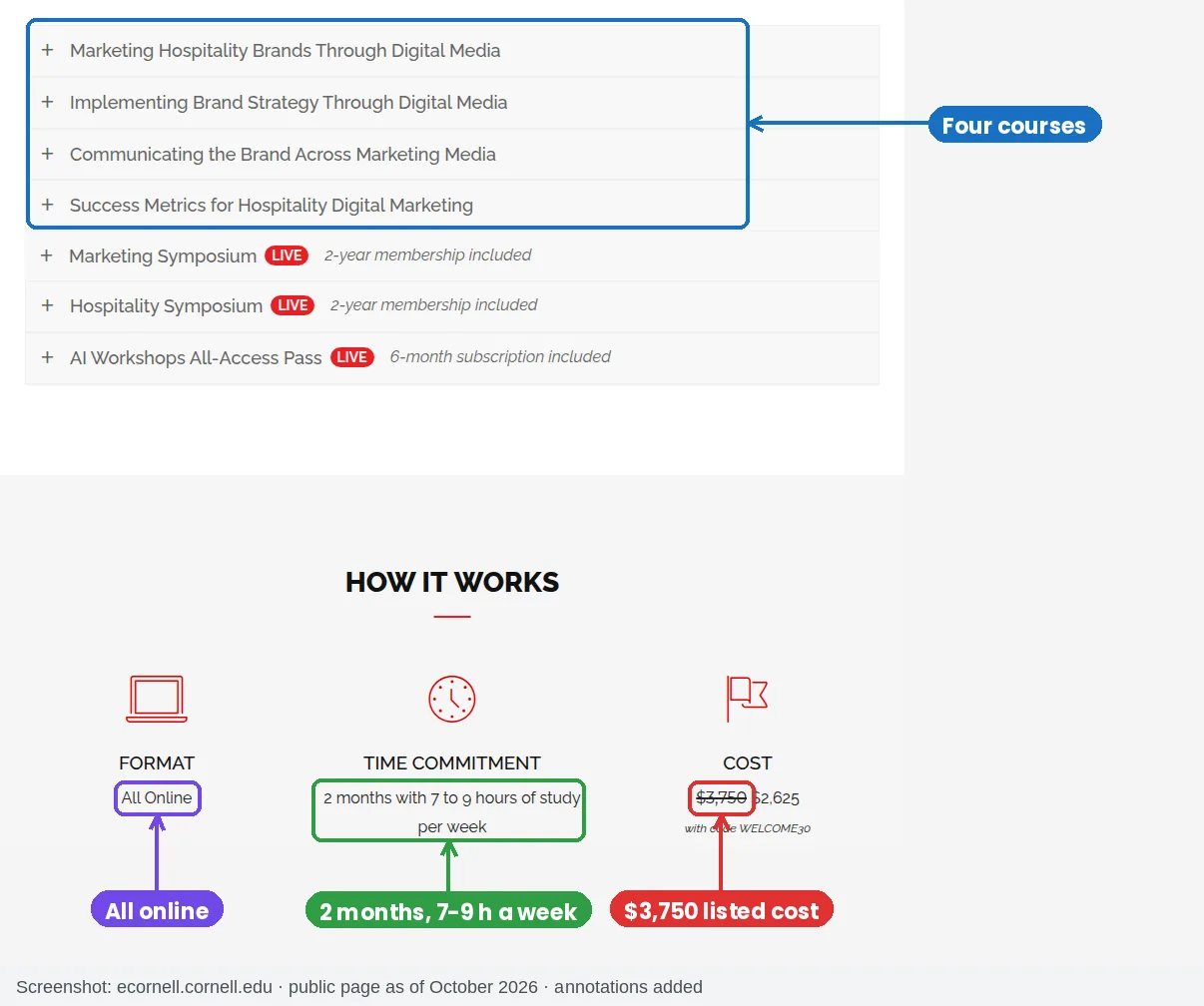
Developed by faculty from Cornell’s Nolan School of Hotel Administration, this certificate has four courses taken in order: marketing hospitality brands through digital media, implementing brand strategy through digital media, communicating the brand across marketing media, and success metrics for hospitality digital marketing. You work through a case study to build an integrated marketing communications strategy for a hospitality brand, covering search engine marketing, social media, user-generated content and performance data. The page lists $3,750, all online, two months at seven to nine hours a week, small-class discussion with feedback from facilitators, and 7.2 CEUs. If you want the strategy side rather than digital, eCornell’s Strategic Hospitality Marketing certificate is listed at the same $3,750 over three months.
Good for: marketers at hotels, resorts and hospitality brands who want a respected credential and structured feedback. Less suited to: the owner of a 12-room guest house. The time commitment and price make most sense with an employer paying and a marketing role to apply it to.
HSMAI Certified Hospitality Digital Marketer (CHDM)
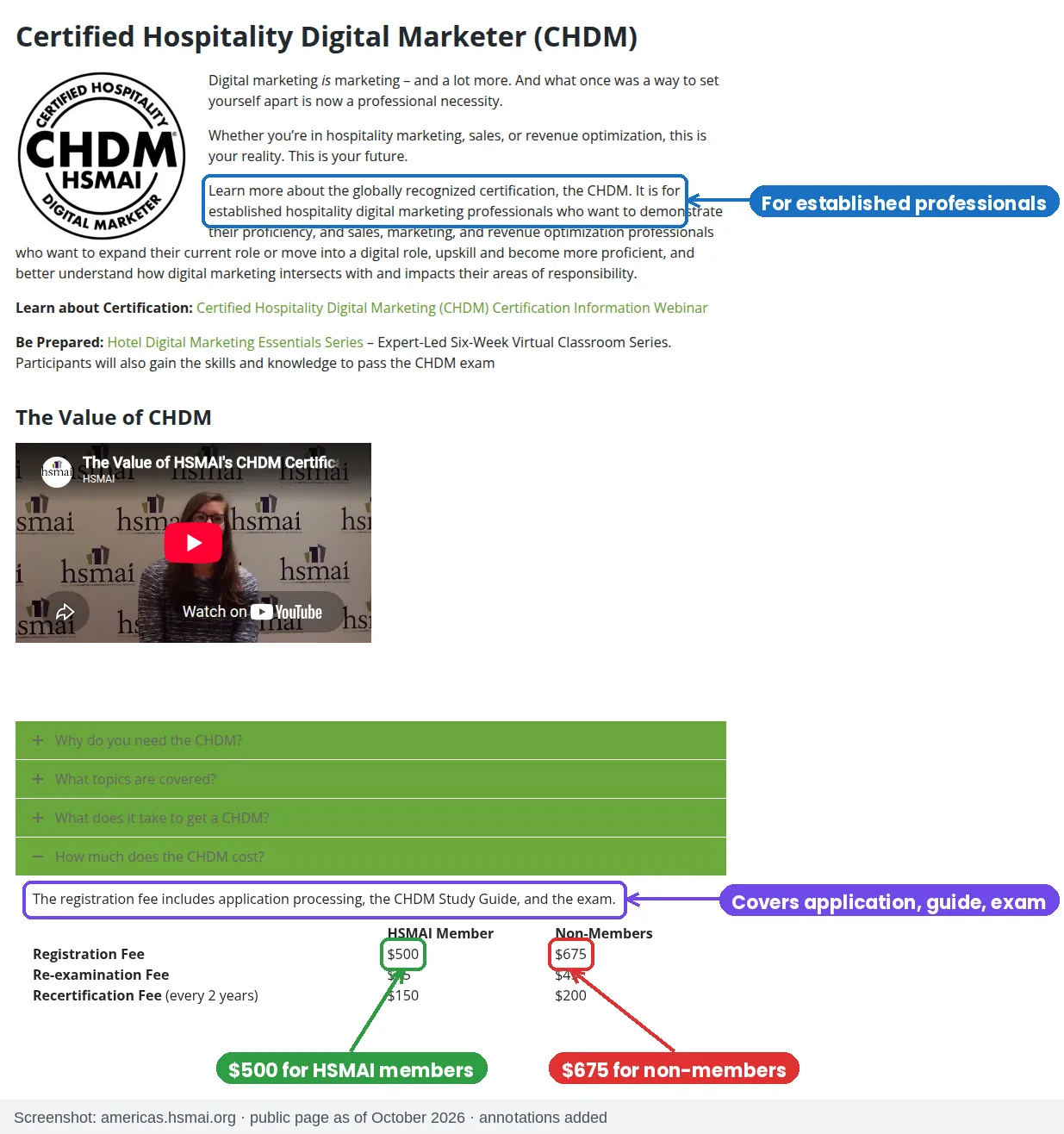
The CHDM is a certification rather than a course. HSMAI describes it as being for established hospitality digital marketing professionals, and for sales and revenue staff moving into digital roles. You apply first: the application is scored on your work profile (experience, responsibilities, industry involvement and education) with a minimum of 50 points. Once approved, you study the CHDM study guide at your own pace and take the online exam within twelve months. The guide covers owned, earned and paid media, digital intermediaries, trending topics, and measuring and managing digital performance. The registration fee is $500 for members and $675 for non-members and includes the study guide and the exam. Recertification is every two years.
Good for: people already doing hotel digital marketing who want proof of it. Less suited to: beginners and owners. Because of the eligibility points, it is not a way to learn marketing from scratch.
AHLEI Certified Hospitality Sales Professional (CHSP)
The American Hotel & Lodging Educational Institute lists the CHSP package (application, online study guide and exam) at $406. The online study guide has about 40 hours of self-paced review material, and the exam covers market segments, the marketing plan, marketing to business and leisure travellers, travel agents and meeting planners, managing the sales office, reservations, revenue management, personal and telephone sales, and catered events.
Good for: hotel sales staff and managers who sell rooms, groups and events. Less suited to: digital marketing for small properties. The emphasis is on sales functions and market segments rather than websites, reviews and social media.
Hong Kong Polytechnic University on edX
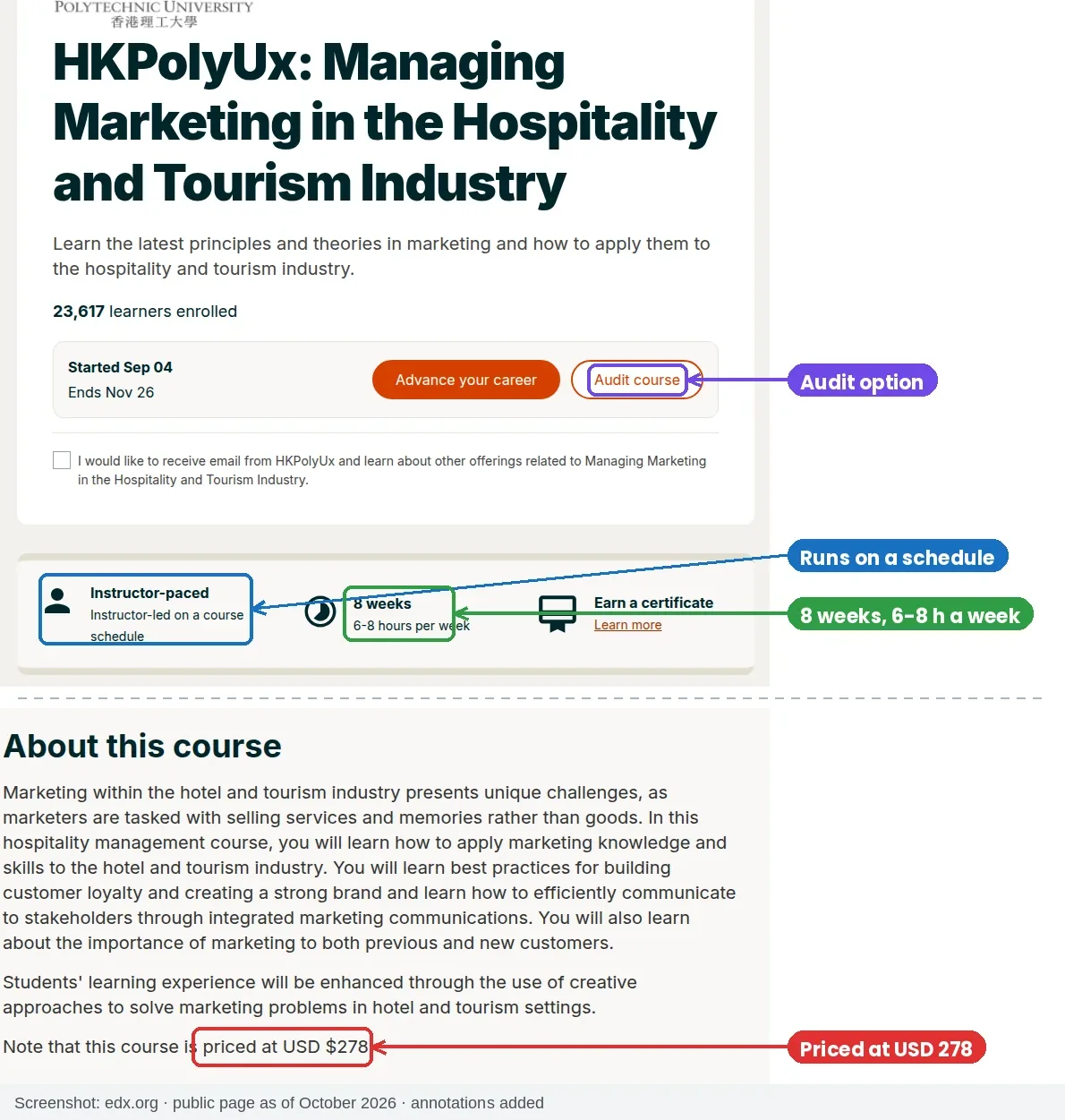
Managing Marketing in the Hospitality and Tourism Industry applies marketing theory to hotels and tourism: customer loyalty, brand, integrated marketing communications and stakeholder communication. edX shows it as instructor-paced, eight weeks at six to eight hours a week, with an audit option and a verified certificate. The course description notes it is priced at USD 278. The current run started on 4 September and ends on 26 November.
Good for: students, career changers and new managers who want academic grounding at a moderate price. Less suited to: anyone who needs to start this week or wants a step-by-step plan for a single property. It runs on a schedule and is theory-led.
Dubai College of Tourism: Dubai Hospitality Marketing (Coursera)
A beginner course in two modules (hospitality marketing essentials and integrated marketing channels), about four hours in total, with a shareable certificate and five assignments. It is included with Coursera Plus. Good for: a quick overview of customer-centric and digital hospitality marketing. Less suited to: depth. Four hours is an introduction rather than a working plan.
Alison: Tourism – Marketing and Promotion
A free course published by Global Text Project, listed at 1.5 to 3 hours across three modules. It covers the main challenges of promoting tourism, target audiences, advertising methods and the customer buying process. The course is free to study, and the page offers a certificate through its “Certify Now” option. Good for: a no-cost first look at tourism promotion. Less suited to: online bookings. It focuses on advertising and promotional campaigns rather than websites, reviews and booking platforms.
How to choose hospitality marketing training
- Decide whether you need a credential or more bookings. eCornell, HSMAI and AHLEI give you a recognised name. If the goal is occupancy and direct bookings, judge every option on how practical it is.
- Check the eligibility. The CHDM requires an application scored on experience. If you are new to marketing, start with a course and look at the certification later.
- Match the time to your season. Eight weeks on a fixed schedule is hard to fit into peak season. A self-paced course fits around changeovers and check-ins.
- Look for hospitality-specific content. Direct bookings, reviews, booking platforms, seasonality and guest loyalty should appear in the syllabus.
- Compare total cost. Include membership, recertification fees and any subscription you will keep paying.
- Try before you pay. Free courses, audit options and free preview lessons show you whether the teaching suits you.
Where our course fits, and its limits
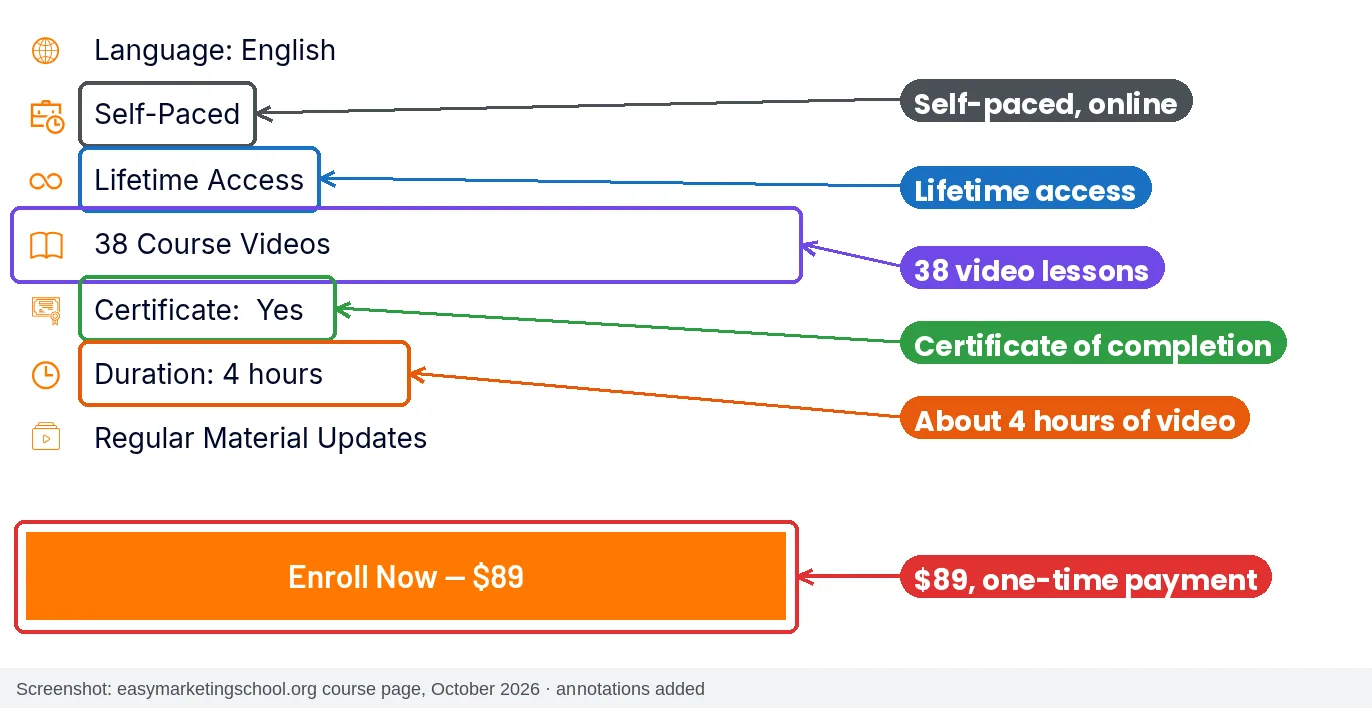
Our hospitality marketing course is built for people who market a property or tourism business themselves: owners and managers of small hotels, guest houses, hostels, travel agencies and tour companies. It has 38 short video lessons, about four hours in total. Many topics begin with a warm-up story about a boutique hotel, hostel, motel or travel agency facing a specific problem, followed by the lesson. The topics cover target audience and market research, unique selling proposition, brand identity and positioning, the marketing mix, integrated marketing communications, CRM, data-driven marketing and customer segmentation, the customer journey, content, social media and influencer marketing, customer retention, ethical marketing, testing and optimisation, measuring return on investment, and adapting to change. It costs $89 as a one-time payment with lifetime access and a certificate of completion. Five lessons are free to watch without signing up.
What it does not do:
- It is not accredited and carries no CEU or continuing-education credits. For a recognised credential, look at eCornell, the HSMAI CHDM or the AHLEI CHSP.
- It is self-paced video only, without live sessions, graded assignments or individual feedback.
- It is taught in English.
- It does not teach revenue management, pricing systems or channel-manager and booking-platform setup in any depth; those need specialist training.
- It is a fundamentals course for small operators, not an advanced programme for brand marketing teams.
To see the style first, read our free guides on a 90-day marketing plan for tourism businesses and reducing dependence on booking platforms and growing direct bookings.
What good hospitality marketing training should cover
- Knowing which guests you want and which channels bring them, not just “travellers”.
- Direct bookings: your website, booking engine and the reasons to book direct.
- Working with booking platforms and travel agents without handing them all your margin.
- Reviews and reputation on Google and travel sites, including replies to negative reviews.
- Content that sells the experience: photos, video, local guides and guest stories.
- Seasonality: filling shoulder and low seasons with packages, events and partnerships.
- Guest loyalty and repeat stays through email and post-stay follow-up.
- Measurement: bookings and revenue by channel rather than likes and visits.
If a syllabus has nothing on direct bookings, reviews or seasonality, it was written for marketing in general rather than for hotels and tourism.
Frequently asked questions
Are there free hospitality or tourism marketing courses?
Yes. Alison’s Tourism – Marketing and Promotion course is free to study, and the HKPolyU course on edX shows an audit option. Free courses are good for orientation; certificates and structured feedback usually cost money.
What hospitality marketing certifications are there?
Two industry examples: HSMAI’s CHDM covers digital marketing and AHLEI’s CHSP covers hotel sales. Both are certifications based on an exam rather than full courses, and the CHDM requires an approved application before you can sit the exam.
How long does hotel marketing training take?
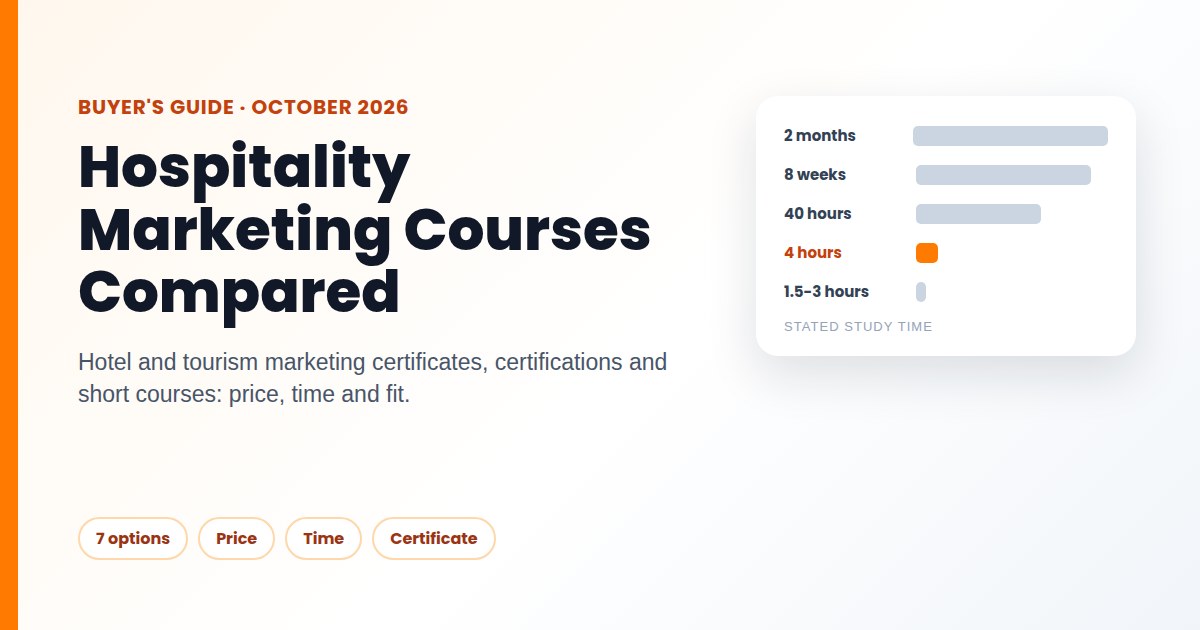
Among these options: 1.5 to 3 hours for Alison, about four hours for our course and the Dubai College of Tourism course, about 40 hours of study guide for the CHSP, eight weeks for the edX course and about two months for the eCornell certificate.
Do I need a certificate to market my own guest house or tour company?
No. Guests never ask to see one. A certificate matters if you are building a career with hotel groups; if you market your own business, choose the option that gets you to more direct bookings fastest.