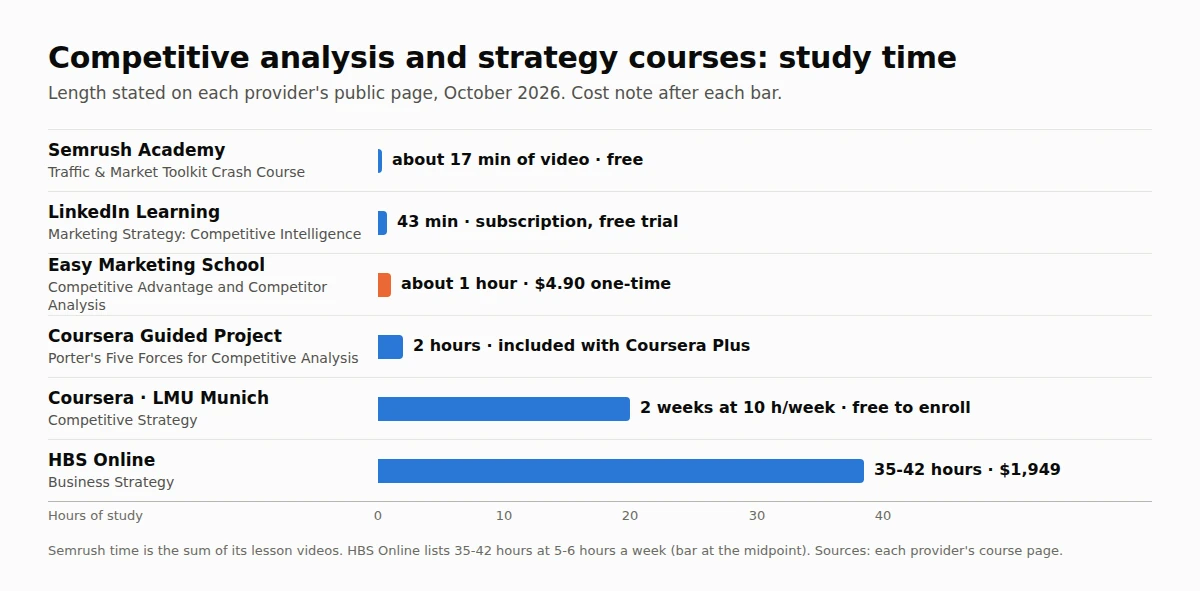
“Competitive analysis course” covers two quite different skills. One is strategy: understanding what a competitive advantage is, how industries compete and why some firms earn more than others. The other is research: finding out what specific competitors do, which channels bring them customers and where they are weak. Courses range from a free 17-minute tool course to a $1,949 Harvard Business School Online programme, and few cover both sides. This guide compares the main options as of October 2026 on length, price and certificate, explains which skill each one teaches, and is honest about where our own short course fits.
Who is looking for a competitive analysis course
- Small-business owners: you are losing customers to someone and want to understand why, then decide what you can do better or differently.
- Marketers: you need a repeatable way to research competitors, benchmark them and turn what you find into positioning and campaigns.
- Managers and strategy learners: you want the frameworks (Porter’s Five Forces, value creation, competitive dynamics) and a credential that shows it.
Competitive analysis and competitive advantage courses compared
| Option | Type | Format and length | Price (as of October 2026) | Certificate | Best for |
|---|---|---|---|---|---|
| Business Strategy (Harvard Business School Online) | Cohort-based online business school course | 35 to 42 hours at 5 to 6 hours a week; fixed start dates | $1,949 | Certificate of Completion from HBS Online | Managers who want a rigorous strategy framework and a Harvard credential |
| Competitive Strategy (LMU Munich, on Coursera) | University course on a MOOC platform | 6 modules; “2 weeks at 10 hours a week”; 25 assignments | Free to enroll | Shareable certificate listed | Learners who want the economics of competition, including game theory |
| Using Porter’s Five Forces Model for Competitive Analysis (Coursera Guided Project) | Hands-on guided project | 2 hours; intermediate; desktop only | Included with Coursera Plus; price shown on Coursera | Shareable certificate listed | Anyone who wants to apply the Five Forces to a real industry in one sitting |
| Marketing Strategy: Competitive Intelligence (LinkedIn Learning) | Video course in a subscription library | 43 min; intermediate; released November 2024 | Subscription; the page offers a 1-month free trial | Certificate of completion | Marketers who want a recent competitor-research process, including AI tools |
| Traffic & Market Toolkit Crash Course (Semrush Academy) | Free tool course | 9 short videos, about 17 minutes in total; quiz | Free | Certificate from Semrush Academy after the quiz | Marketers who want to benchmark competitors’ web traffic with Semrush |
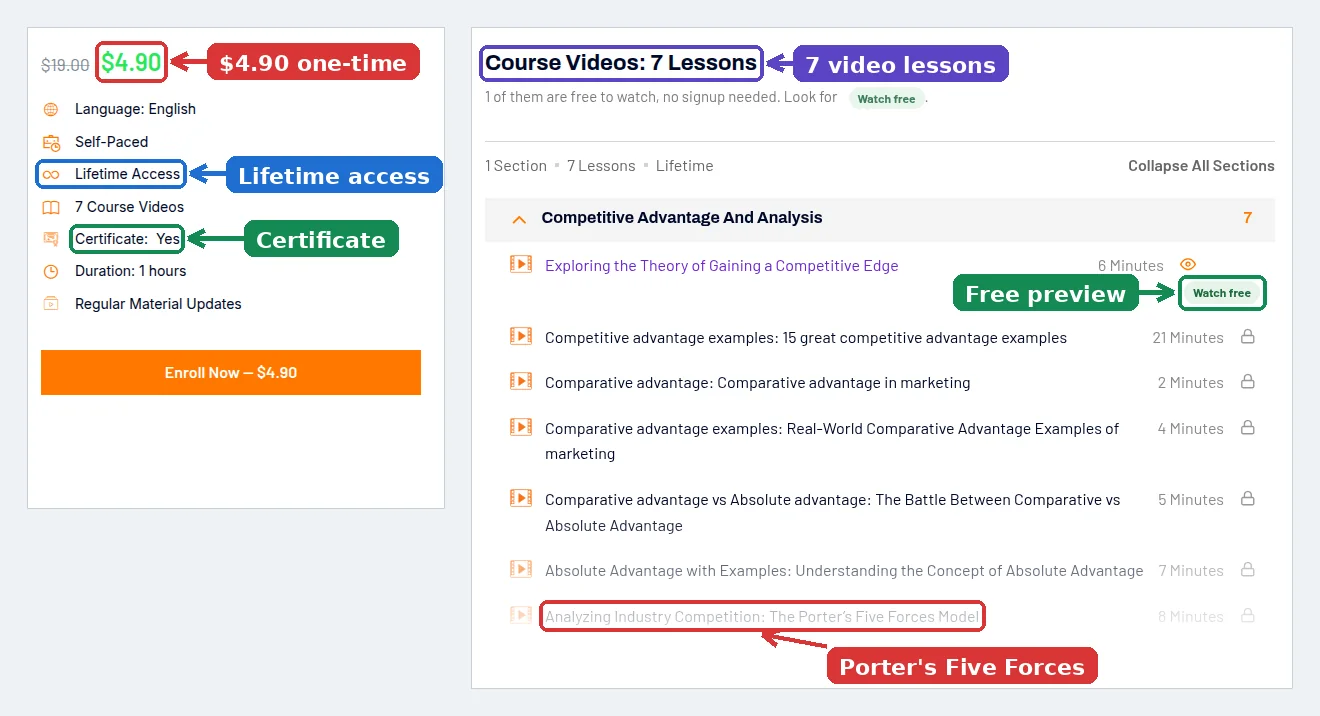
| Competitive Advantage and Competitor Analysis Course (Easy Marketing School) | Short self-paced video course | 7 video lessons, about 1 hour; lifetime access | $4.90 one-time | Certificate of completion | Owners and beginners who want the core ideas of competitive advantage and the Five Forces, fast |
All details come from each provider’s public page as of October 2026. Prices, dates and plans change; confirm on the provider’s page before you enroll.
Each option: what it is good for, and what it is not
Harvard Business School Online: Business Strategy
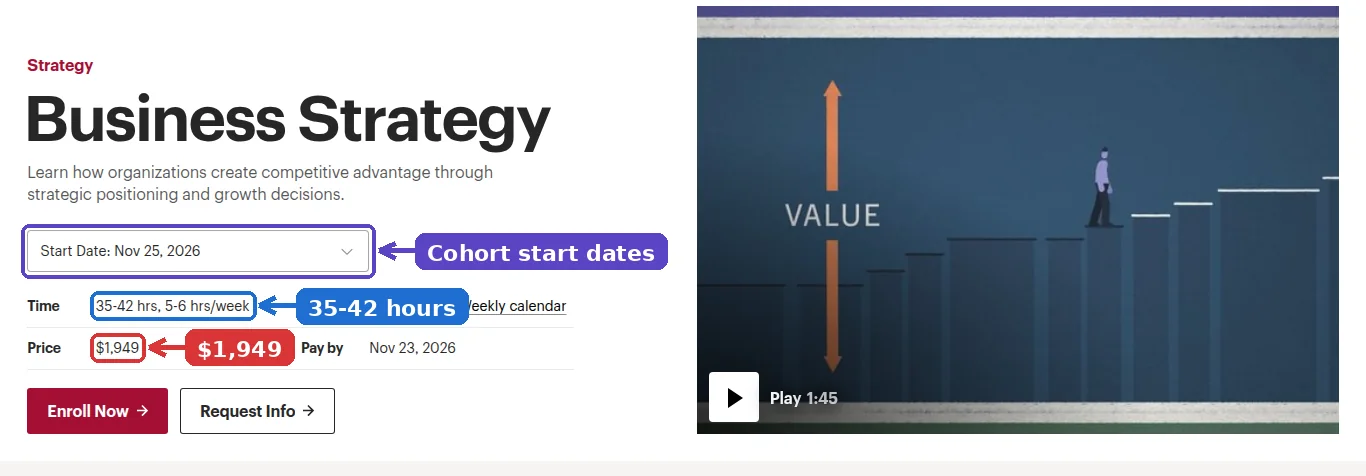
The premium option. The course teaches how organisations create competitive advantage through strategic positioning and growth decisions, built around the “value stick”, a research-based framework for creating value for customers, employees and suppliers. It runs in cohorts (the page lists start dates of 25 November 2026, 20 January 2027 and 24 March 2027), takes 35 to 42 hours at five to six hours a week, costs $1,949, and ends with a Certificate of Completion from HBS Online; three courses in the subject area earn a Certificate of Specialization.
Good for: managers who will shape strategy and want a credential employers recognise. Less suited to: a small business that needs a quick, low-cost answer about one competitor.
LMU Munich: Competitive Strategy (Coursera)
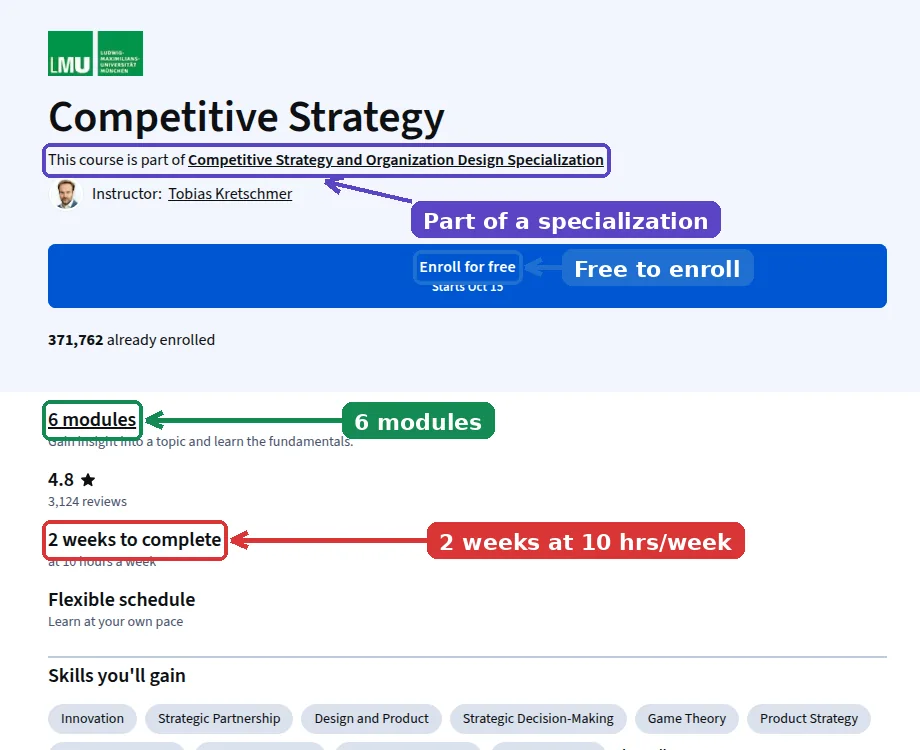
A six-module course by Tobias Kretschmer on how firms behave when their decisions affect each other, using the basic tools of game theory to analyse how businesses choose strategies to gain competitive advantage. It is free to enroll, with 25 assignments and a shareable certificate, and the page estimates two weeks at ten hours a week. It is part of LMU’s Competitive Strategy and Organization Design Specialization.
Good for: a rigorous, free understanding of competitive dynamics, with modules on taking care of competitors, why firms cooperate, strategic partnerships, entering a new market, R&D and product design. Less suited to: practical competitor research; it is economics, not a research method.
Coursera Guided Project: Porter’s Five Forces for Competitive Analysis
A two-hour, hands-on project on Coursera’s desktop workspace. You analyse an industry you want to enter, identify the external factors that set its profitability, and work out strategies to shape that environment to your advantage. It is intermediate level, included with Coursera Plus, and lists a shareable certificate.
Good for: applying one classic framework to your own market in an afternoon. Less suited to: anything beyond the Five Forces.
LinkedIn Learning: Marketing Strategy: Competitive Intelligence
A 43-minute intermediate course by marketing expert Deirdre Breakenridge, released in November 2024. It covers conducting a competitive analysis, researching competitors, identifying your own strengths and weaknesses, analysing competitors’ strategies, and using AI tools to handle common competitive-intelligence problems.
Good for: a short, recent research process for marketers. Less suited to: anyone without LinkedIn Learning access who does not want a subscription.
Semrush Academy: Traffic & Market Toolkit Crash Course
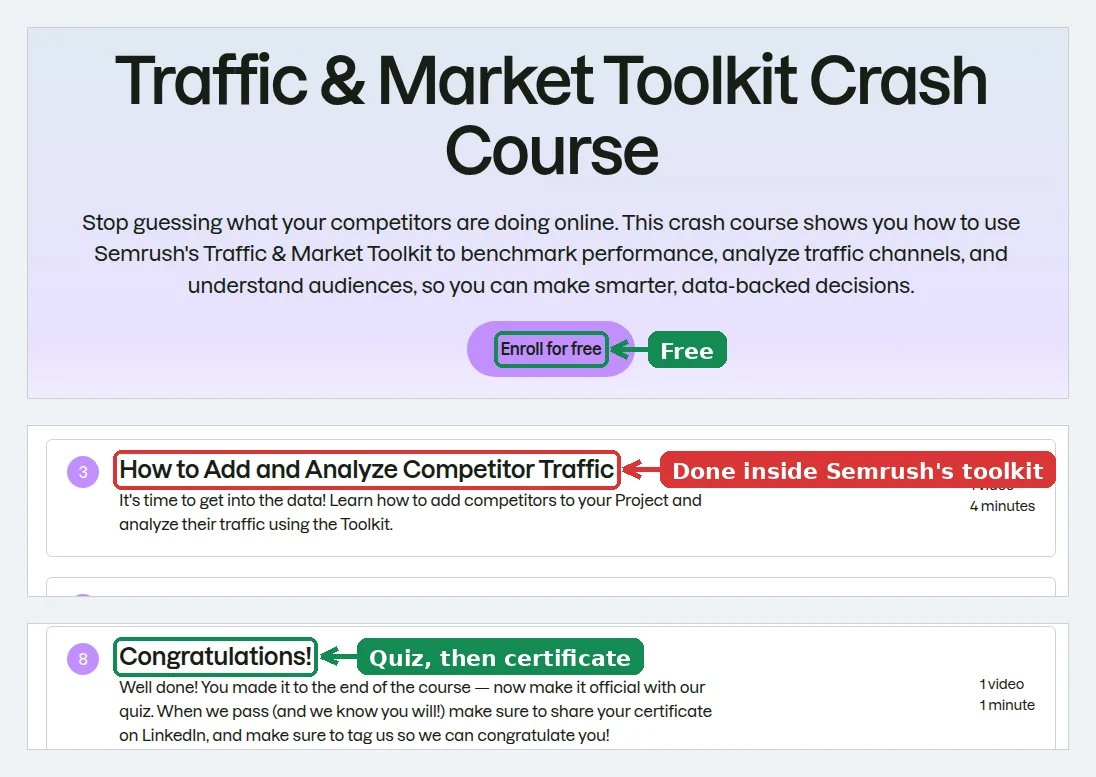
A free course for “marketers and business owners at any level” on analysing competitor traffic, benchmarking domains, seeing which channels drive results, finding competitors’ top content and understanding their audiences. It is nine short videos (about 17 minutes in total, by the page’s own lesson times), ends with a quiz and a Semrush Academy certificate, and is done inside Semrush’s Traffic & Market Toolkit; the page also offers a seven-day Semrush free trial.
Good for: the research half, with real data on competitors’ websites. Less suited to: strategy, or anyone who does not plan to use Semrush.
How to choose: a short checklist
- Decide which skill you need. Understanding advantage and industry structure is strategy; finding out what named competitors do is research. Pick a course for the one you lack, or combine one of each.
- Check whether a tool is required. Research courses from software companies teach their own tools. That is useful if you will use the tool and less useful if you will not.
- Match the depth to the decision. A pricing or positioning choice for a small business needs an hour or two; a strategy role may justify a 40-hour course.
- Look for a framework you will reuse. The Five Forces, a value-based view of advantage, and a simple competitor table are worth more than one-off tips.
- Check the date. Strategy frameworks age slowly; tool and channel courses date quickly.
- Finish with a one-page competitor summary. Whatever you take, write down your three closest competitors, what each does better than you, and the one thing you will do differently.
Where our course fits, and its limits
Our competitive advantage and competitor analysis course is a short course on the ideas behind competing: the theory of gaining a competitive edge, fifteen competitive advantage examples, comparative and absolute advantage with examples, and analysing industry competition with Porter’s Five Forces. It has seven video lessons, about an hour in total, and costs $4.90 as a one-time payment, with lifetime access and a certificate of completion; the first lesson can be watched free without signing up.
What it is not: it teaches concepts and frameworks, not a competitor-research workflow. It does not show you how to pull competitors’ traffic, keyword or advertising data with tools (Semrush’s free course does), and it does not go into game theory (LMU) or a full strategy method (HBS Online). It has no assignments, and it is not accredited and carries no CEUs or college credit. It suits an owner or beginner who wants to understand why some businesses win before doing the research. For applied examples, see our articles on why firms lose work to less talented competitors and how a small retailer competes with online giants.
Frequently asked questions
What is the difference between competitive advantage and competitive analysis?
Competitive advantage is what makes customers choose you over the alternatives and lets you earn more doing it. Competitive analysis is the research you do on competitors and your industry to find, build or defend that advantage.
Is there a free competitive analysis course?
Yes. Semrush Academy’s Traffic & Market Toolkit Crash Course is free, with a certificate after a quiz, and LMU Munich’s Competitive Strategy is free to enroll on Coursera; check Coursera’s page for its certificate terms.
Is Porter’s Five Forces still useful for a small business?
Yes, as a checklist. Looking at rivals, new entrants, substitutes, suppliers and buyers in turn helps a small business see where pressure on its prices comes from, even if the full model was built for whole industries.
How long does it take to learn competitive analysis?
From under an hour for a tool course or a short course to 35 to 42 hours for HBS Online’s Business Strategy, according to the providers’ pages. Doing the analysis for your own market takes a few more hours either way.