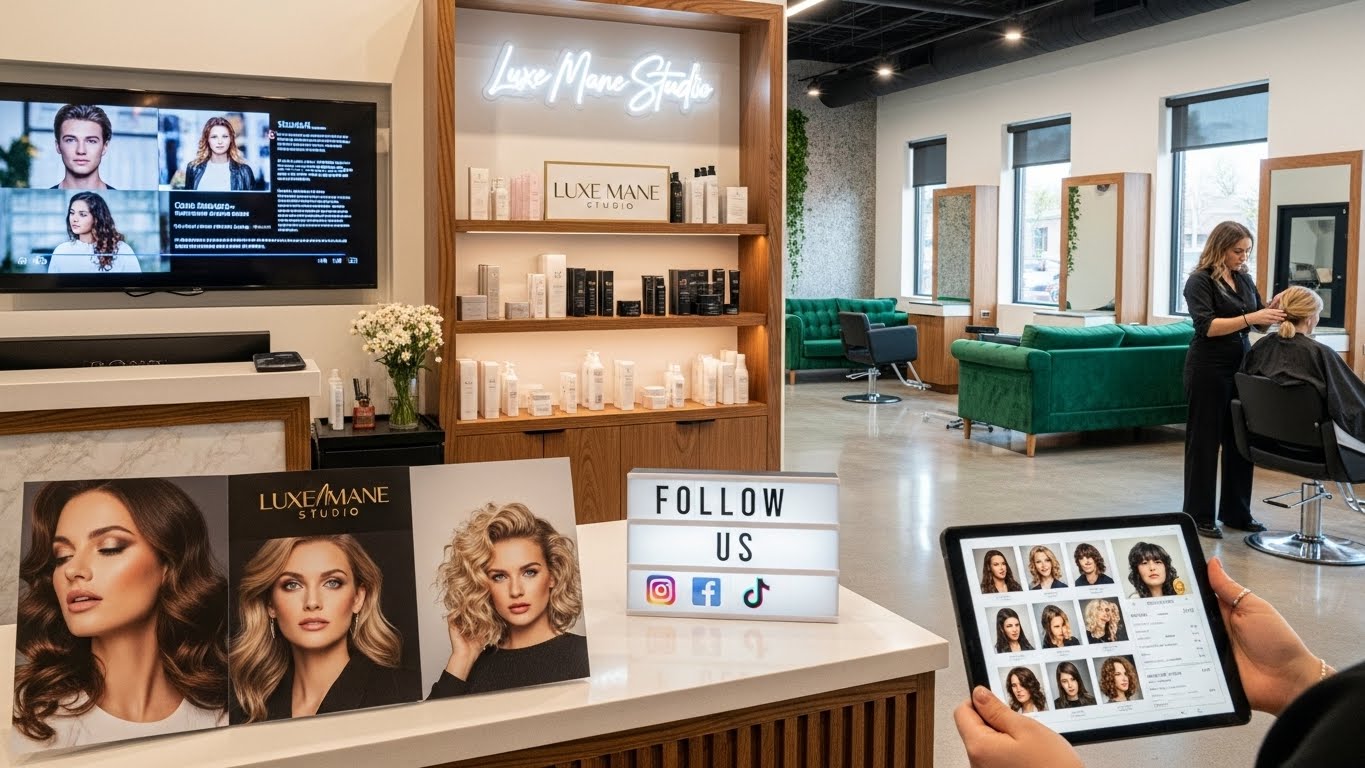
Running a successful salon requires more than just technical skill with scissors and color. The difference between a salon that barely survives and one that thrives often comes down to marketing strategy. Yet many salon owners feel overwhelmed by marketing concepts that seem designed for retail stores or tech companies.
The good news? There’s a proven framework that works beautifully for salon businesses: the 4Ps of marketing. This classic model—Product, Price, Place, and Promotion—provides a roadmap for creating a marketing strategy that fills your appointment book and builds lasting client relationships.
Let’s break down exactly how to apply each of these elements to your salon business in practical, actionable ways.
Understanding the 4Ps Marketing Framework for Salons
The 4Ps of marketing represent the four key decisions you need to make to position your salon successfully in the marketplace. Originally developed for product-based businesses, this framework adapts perfectly to service businesses like salons when you understand how to translate each element.
Want to go further than the 4Ps? Our beauty and salon marketing course builds on this framework with lessons on rebooking, client relationships, social proof and pricing psychology for salon owners.
Product becomes your service offerings and the complete client experience. Price reflects your service menu and pricing strategy. Place involves your salon location and how clients access your services. Promotion encompasses all the ways you communicate with potential and existing clients.
Together, these four elements form a cohesive marketing mix that should work in harmony to attract your ideal clients and grow your salon business profitably.
Product: Defining Your Salon Services and Experience
In the salon industry, your “product” is actually the combination of services you offer and the entire experience clients have from the moment they book an appointment to when they leave your salon.
Defining Your Service Menu
Start by clarifying exactly what services you offer and what makes them distinctive. Are you a full-service salon offering hair, nails, and skin treatments, or do you specialize in specific services like color correction or extensions? Trying to offer everything dilutes your expertise and makes marketing harder.
The most successful salons often focus on becoming known for particular services. A salon that positions itself as “the balayage experts in downtown” will attract more of those high-value clients than one that simply lists “hair coloring” among twenty other services.
Consider the service packages and experiences you create. Do you offer bridal packages, transformation makeovers, or maintenance memberships? These bundled offerings not only increase average ticket prices but also give you compelling marketing angles.
Crafting the Client Experience
Your product extends far beyond the technical service. It includes the ambiance of your salon, the consultation process, the products you use, how staff interact with clients, and even the follow-up care instructions you provide.
Think about every touchpoint: Is your booking process smooth and convenient? Does your salon environment reflect your brand positioning—whether that’s luxury, edgy and creative, eco-friendly, or family-oriented? Are your stylists trained not just in technical skills but in client communication?
The salons that command premium prices and loyal followings are those that have designed an intentional, consistent experience that clients can’t get anywhere else.
Price: Developing Your Salon Pricing Strategy
Pricing is where many salon owners struggle, often undercharging because they’re uncomfortable with their value or fear losing clients to competitors. But strategic pricing is essential for profitability and positioning.
Understanding Value-Based Pricing
Your prices should reflect the value you deliver, not just your costs or competitor rates. If your stylists have advanced training, if you use premium products, if your salon offers exceptional ambiance and service, your prices should reflect that investment.
Consider creating tiered pricing based on stylist experience levels. This allows you to serve different market segments while retaining talented stylists as they grow their skills and clientele. It also gives clients room to move up as they build trust with your team.
Strategic Pricing for Different Services
Not all services need the same markup or pricing strategy. Some services might be priced competitively to attract new clients, while signature services command premium rates. Your color correction services might be priced significantly higher than basic cuts because of the time, expertise, and products required.
Think about your pricing structure holistically. Can you create service packages that offer value while increasing average ticket prices? Would a membership model providing monthly services at a slight discount improve cash flow and client retention?
Communicating Your Pricing
How you present your prices matters as much as the prices themselves. Are your prices clearly displayed on your website and social media, or do clients have to call to find out? Transparency builds trust, though some high-end salons successfully maintain “consultation required” pricing for custom services.
If you’re positioned as a premium salon, trying to hide higher prices often backfires. Own your value and communicate what makes your services worth the investment.
Place: Optimizing Your Salon Location and Accessibility
In salon marketing, “place” refers both to your physical location and how easily clients can access and book your services.
Maximizing Your Physical Location
Your salon’s location significantly impacts your marketing strategy. A salon in a busy downtown area needs different marketing than one in a suburban strip mall or a suite rental situation.
Make the most of your location through strategic signage, window displays that attract walk-by traffic, and partnerships with neighboring businesses. If you’re in a high-traffic area, your storefront is constant advertising—use it strategically.
For salons in less visible locations, you’ll rely more heavily on digital marketing and word-of-mouth to drive traffic. This isn’t a disadvantage if your pricing accounts for lower rent and you excel at online marketing.
Digital Place: Your Online Presence
Today, “place” extends to your digital locations. Your website, social media profiles, and presence on booking platforms like StyleSeat or Vagaro are where many clients first discover and access your salon.
Is your website mobile-friendly and does it clearly show your location, services, and booking options? Are your Google Business Profile and social media pages optimized with current information, photos, and reviews? These digital touchpoints are often more important than physical location for attracting new clients.
Booking Accessibility
How easy is it for clients to book appointments? Online booking systems that allow 24/7 scheduling remove friction from the client journey. Text reminders reduce no-shows. Waitlist features help fill last-minute cancellations.
Every barrier you remove from the booking process increases conversion rates. If potential clients have to call during specific hours or wait days for a response to a DM, you’re losing business to salons with streamlined booking.
Promotion: Marketing Your Salon Effectively
Promotion encompasses all the ways you communicate with potential and existing clients to drive bookings and build your salon brand.
Building Your Salon’s Brand Identity
Before diving into promotional tactics, establish clear brand positioning. What does your salon stand for? Who is your ideal client? What makes you different from the ten other salons in your area?
Your promotional messages should consistently reflect this brand identity across all channels. A salon targeting busy professionals needs different messaging and imagery than one serving creative millennials or mature women seeking age-appropriate styles.
Leveraging Social Media for Salons
Instagram and TikTok are powerful promotional tools for salons because your work is inherently visual. Before-and-after transformations, behind-the-scenes content, styling tips, and client testimonials all perform well on these platforms.
The key is consistency and strategy. Posting randomly when you remember doesn’t build an audience. Create a content calendar that showcases your best work, educates your audience, and gives potential clients reasons to choose your salon.
Encourage clients to share their results and tag your salon. User-generated content is some of the most effective promotion because it provides social proof and reaches new audiences.
Email and SMS Marketing
While social media gets attention, email and SMS marketing often drive more direct bookings. Build your client list and send regular communications about new services, special offers, seasonal tips, and booking reminders.
Segment your list based on client preferences and service history. Someone who regularly gets balayage wants different content than someone who comes for basic cuts. Personalized promotions convert better than generic blasts to your entire list.
Referral Programs and Partnerships
Word-of-mouth remains the most powerful salon marketing. Formalize this with a referral program that rewards clients for bringing in new business. Make it easy—provide referral cards, create a simple process, and offer incentives that motivate sharing.
Partner with complementary businesses like bridal boutiques, photographers, or clothing stores for cross-promotion. These partnerships put your salon in front of new audiences who match your ideal client profile.
Paid Advertising
Strategic paid advertising on Google, Facebook, or Instagram can be cost-effective for salons, especially when targeting specific services or promotions. Focus on geographic targeting since salons serve local markets.
Track which advertising channels drive actual bookings, not just likes or clicks. The goal is revenue, not vanity metrics.
Bringing the 4Ps Together: Creating Your Salon Marketing Mix
The real power of the 4Ps framework comes from how these elements work together. Your pricing should align with your brand positioning and service offerings. Your promotional messages should reflect your unique services and ideal client. Your location and accessibility should match your target market’s preferences.
For example, a luxury salon in an upscale area would offer premium services with expert stylists (Product), charge higher prices that reflect this positioning (Price), create an elegant physical space with seamless online booking (Place), and promote through sophisticated imagery and partnerships with high-end brands (Promotion).
A trendy salon targeting younger clients might focus on Instagram-worthy styles and edgy techniques (Product), offer moderate pricing with package deals (Price), create a vibrant, social media-friendly space (Place), and promote heavily through TikTok, influencer partnerships, and user-generated content (Promotion).
When all four elements align and support each other, your marketing becomes significantly more effective. When they conflict—like luxury services with budget pricing, or premium positioning with inconsistent promotion—you confuse potential clients and weaken your market position.
Taking Your Salon Marketing to the Next Level
Understanding and implementing the 4Ps gives you a solid foundation, but salon marketing goes deeper. From developing client retention strategies to mastering digital marketing channels specific to the beauty industry, there’s always more to learn.
If you want comprehensive training on marketing strategies designed specifically for beauty businesses, including salons, the Beauty Marketing Course offers detailed frameworks and actionable tactics you can implement immediately to grow your salon business.
Implementing Your 4Ps Strategy: Action Steps
Start by auditing your current marketing mix. For each of the 4Ps, evaluate what you’re doing now and identify gaps or misalignments.
Product audit: List all your services and honestly assess which ones you execute exceptionally well versus which ones you offer just because other salons do. Consider eliminating services that don’t fit your brand or that you can’t deliver at a high level. Document your current client experience and identify opportunities to elevate it.
Price evaluation: Compare your pricing to competitors, but more importantly, ensure your prices reflect the value you deliver. If you’ve significantly improved your skills, upgraded your products, or enhanced your salon environment, your pricing should reflect these investments.
Place optimization: Assess both your physical space and digital presence. Is your salon easy to find and welcoming? Is your online booking process seamless? Are your social media profiles professional and current? Make a list of improvements needed.
Promotion review: Document all your current promotional activities and evaluate their effectiveness. Which efforts actually drive bookings? Which are consuming time without results? Develop a 90-day promotional plan that focuses on your most effective channels.
The Ongoing Nature of Marketing
The 4Ps aren’t something you set once and forget. Your marketing mix should evolve as your business grows, market conditions change, and you learn what resonates with your ideal clients.
Schedule quarterly reviews of your marketing strategy. What’s working? What’s not? What new opportunities have emerged? Which services are most profitable and should be promoted more heavily? This regular evaluation keeps your marketing effective and efficient.
Your Next Steps to Salon Success
The salons that struggle are often those without a clear marketing strategy. They offer whatever services clients request, price based on what they think people will pay, promote inconsistently when they remember, and wonder why their appointment book has gaps.
The salons that thrive understand that marketing isn’t an afterthought—it’s a strategic function that requires the same attention and expertise as the technical services they provide.
By implementing the 4Ps framework, you create clarity in your marketing efforts. You know what you offer and why it matters, how to price for profitability, where and how to reach your ideal clients, and how to promote your salon effectively.
Start with one area where you see the biggest opportunity for improvement. Maybe it’s refining your service menu to better reflect your expertise, adjusting pricing to align with the value you deliver, improving your online presence and booking process, or developing a more consistent promotional strategy.
Small, strategic improvements in each of these areas compound over time, transforming your salon from just another option in a crowded market to the go-to destination for your ideal clients. That’s the power of thoughtful marketing—and it starts with understanding and implementing the 4Ps.