There is a cheese counter in a certain market town that people drive forty minutes to visit. A guitar shop that touring musicians detour through specifically because the owner’s recommendations are trusted implicitly. A children’s bookshop where parents believe the staff know their child’s reading level better than the school does.
These are not the biggest stores in their markets. They are not the cheapest. But they have achieved something that no amount of advertising budget can manufacture overnight: they are the recognised local authority in their product category.
This designation — earned over time through consistent demonstration of expertise — is perhaps the most durable competitive advantage available to an independent retailer. It insulates you from price wars, makes you largely immune to online competition, and generates the kind of word-of-mouth that no paid channel can replicate.
This guide is the complete playbook for building that authority. Deliberately. Systematically. Starting today.
What “Local Expert” Really Means — And Why It Matters
“Local expert” is not a self-declared label you put on your website. It is a social recognition — conferred by your community through their behaviour. You know you’ve achieved it when customers bring friends specifically for your recommendation, local journalists call you for comment, and people say unprompted: “You should ask [your store name] — they’ll know.”
According to the Edelman Trust Barometer, expert credibility is one of the three primary purchase trust signals — alongside peer recommendations and institutional trust. For local retail, it is the most achievable of the three.
Claim Your Niche: The Expert Category Framework
Expert positioning requires a focused category. You cannot be the local expert in everything — attempting to do so dilutes your credibility to zero. The first and most important step is defining, with precision, the specific territory you will own. The narrower the better: depth of expertise in a specific space is far more credible than surface-level knowledge across a broad one.
Start With Your Broadest Sector
What general retail category does your store occupy? “Sporting goods.” This is your starting point — not your positioning.
Identify Your Strongest Product Area
Where does your deepest knowledge genuinely live? Where do your best staff interactions happen? “Running footwear and gait analysis.”
Define Your Specific Customer
Who do you serve better than anyone else? The more precisely you name them, the more powerfully they self-select in. “Recreational runners over 35 with injury history or biomechanical concerns.”
Write Your Expert Positioning Statement ✦
“[City]’s specialist running store for injury-conscious runners — the only place in [region] offering certified gait analysis with every fitting.” This is your territory. Defend and demonstrate it relentlessly.
| Store Type | Generic Claim | Expert Position (Owned Territory) |
|---|---|---|
| Wine Shop | “Wines from around the world” | “Natural and biodynamic wines from small-production European estates — with free weekly tasting classes” |
| Kitchenware Store | “Everything for your kitchen” | “Professional-grade cookware and knife skills education for home cooks who take food seriously” |
| Toy Store | “Toys and games for all ages” | “Screen-free developmental toys and in-store play sessions led by a qualified early childhood educator” |
| Plant Nursery | “Plants for garden and home” | “Native plant specialists helping [City] gardens become wildlife sanctuaries that thrive without chemicals” |
| Camera Shop | “Cameras and accessories” | “Film photography specialists — the only shop in [City] that still processes and stocks analogue film in 8 formats” |
Build Visible Authority Through Content & Education

Content is how your expertise escapes the four walls of your shop and becomes visible to the entire market. Without a consistent public record of demonstrating knowledge — through articles, videos, classes, guides — your authority exists only for those who have already walked through your door.
HubSpot’s research shows businesses publishing educational content generate 3× more leads — and for retail, those leads arrive pre-sold on your expertise, dramatically increasing conversion and average order value.
| Content Format | Authority Signal | Example Topic | Frequency | Impact |
|---|---|---|---|---|
| Expert Blog Posts | SEO + depth of knowledge | “How to Choose Shoes If You Overpronate” | 2×/month | HIGH |
| Short-form Video | Visual expertise, personality | “Gait Analysis in 60 Seconds” | 2×/week | HIGH |
| In-Store Events/Workshops | Community + hands-on proof | “Injury Prevention for Runners” | Monthly | HIGH |
| Expert Email Newsletter | Ongoing advice relationship | “Weekly Training Tip + New Arrivals” | Weekly | MED |
| Comprehensive Buying Guides | SEO + pre-purchase trust | “The Complete Trail Running Shoe Guide 2026” | Quarterly | HIGH |
| FAQ & Q&A Content | Answers exactly what customers search | “How do I know if I need stability shoes?” | Ongoing | HIGH |
🔧 Find What Your Customers Are Actually Asking
Use AnswerThePublic to see every question people are asking about your category on Google. Each question is a content brief waiting to be written — and a chance to demonstrate your expertise before the customer ever walks through your door. Every article you write that answers a real question is a 24/7 authority signal that compounds over time.
Engineer the In-Store Expert Experience
Every impression of authority you create online evaporates the moment a customer walks in and encounters a member of staff who can’t answer their question. The in-store experience is the proving ground — where expert positioning either becomes real, or is exposed as hollow.
Staff Training as a Competitive Moat
Your team’s depth of knowledge is a direct competitive advantage no online competitor can replicate. Build a structured training programme: product knowledge, customer needs assessment, category history, and the skill of explaining technical concepts to novices. Minimum 2 hours/week dedicated to team education. Tools like Lessonly make this scalable.
Design the Consultation, Not the Sale
Expert retailers don’t sell products — they solve problems. Script your customer journey around discovery: What brings you in? What’s your experience level? What have you tried? What challenge are you solving? This approach raises basket size, reduces returns, and generates the kind of reviews that say “the staff really listened.”
Make the Store an Education Environment
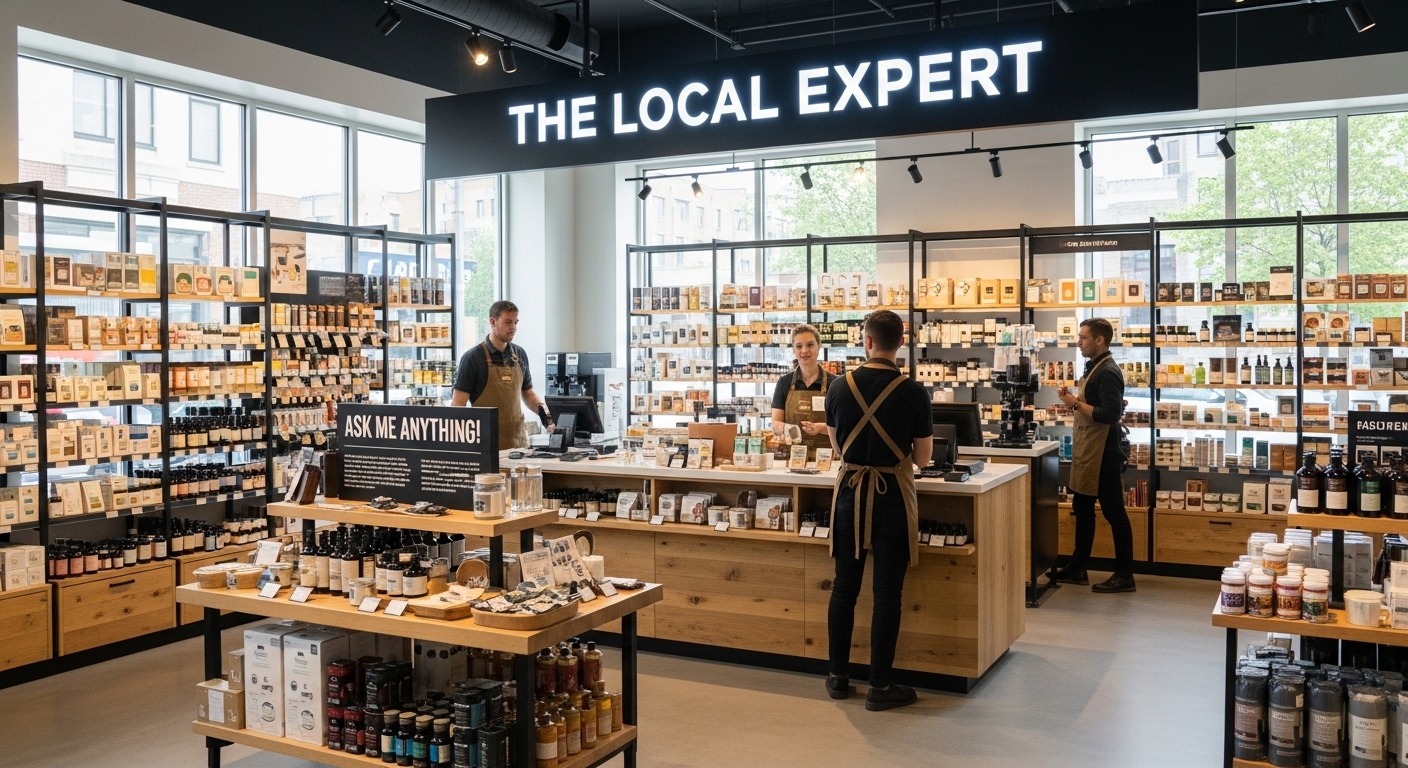
Visual displays explaining product differences, staff-pick cards with handwritten rationale, educational shelf-edge tags, and a dedicated advice area all signal: this place teaches, it doesn’t just sell. Customers linger longer and spend more in stores they find genuinely informative.
Certify Your Team — Then Display It
Official certifications from recognised bodies (WSET for wine, NASM for fitness, MCI for cheese) are instant visible proof of expertise. Display credentials at the point of sale, on your website, and on staff profiles. Even a single certified team member elevates the entire store’s perceived authority.
Curate Intentionally — And Explain Why
Stocking fewer products than competitors but explaining precisely why you chose each one is a powerful authority signal. It says: we tested everything and chose the best. A curated range with deep rationale always outperforms a wall of choice with no guidance in terms of trust and conversion.
Host Regular In-Store Events
Tastings, demonstrations, product launches, Q&A evenings, and mini-workshops transform your store from a shop into a venue. Each event creates social media content, generates press mentions, builds your email list, and — crucially — deepens your community’s sense that you are the category hub.
Become the Community’s Category Hub
Local expert positioning is ultimately a community project. Your standing is built not only by what you say about yourself, but by how visibly you contribute to your community’s knowledge, wellbeing, and experience of your category.
Retailers embedded in their local community — sponsoring events, partnering with complementary businesses, supporting local clubs — become part of the landscape in a way that no advertising budget can replicate. According to BrightLocal’s consumer survey, 87% of consumers read reviews to determine local expert status — and community involvement is among the top drivers of positive reviews.

| Community Tactic | How It Builds Authority | Real-World Example |
|---|---|---|
| Speak at Local Events | Places you visibly in the expert role in front of your ideal customer | Running store owner presents on injury prevention at local health fair |
| Partner With Related Professionals | Third-party professional endorsement carries exceptional credibility weight | Wine shop partners with local chefs for pairing recommendations |
| Sponsor Local Clubs & Teams | Consistent visibility in front of your precise target audience | Running store sponsors local running club, provides member discount |
| Create a Local Resource Guide | Positions you as the community hub for your category — earns backlinks and shares | “The [City] Runner’s Complete Guide to Trails, Events and Recovery” |
| Build a Community Group/Forum | Ongoing platform for demonstrating expertise in every answer | Facebook group “Running in [City]” moderated with expert tips from the store |
PR, Media & Third-Party Credibility
The fastest route to elevated expert status is through validation you didn’t pay for and don’t control — press coverage, professional endorsements, industry awards, and guest publishing. Earned authority carries a weight that self-promotion can never match, because it comes from sources your customers trust independently of you.
Pitch Local Journalists Proactively
Local journalists need expert sources for consumer stories. A single quote in a local paper or city magazine citing you as “[category] specialist” is worth more than months of paid ads. Build a contact list of local journalists covering lifestyle, health, and consumer topics. Make yourself easy to reach — and easy to quote.
Use HARO to respond to national media requests in your niche.
Pursue Industry Awards & Recognition
Research awards in your sector — best independent retailer, specialist of the year, most trusted local business. Even a nomination carries credibility; a win provides 12 months of marketing material. Check your Chamber of Commerce and trade associations for award programmes.
Display awards on website hero, GBP photos, and in-store window.
Collect Professional Endorsements
A running store endorsed by a local sports physiotherapist is perceived as expert by every runner in the area. Cultivate relationships with relevant professionals — doctors, nutritionists, coaches, educators — and ask for formal endorsements. Display with photos and credentials: never anonymous quotes.
Write for Local Publications
Local magazines, city guides, community newsletters, and neighbourhood websites are always seeking quality expert content. Offer a monthly column or a one-off guide. Each published piece is a credibility asset, a backlink to your website, and a reason for local readers to visit your store.
Always repurpose guest content on your own blog and social channels.
7 Expert Positioning Mistakes That Destroy Credibility
⚠
Claiming Expertise Without Proving It
Calling yourself “the experts” without credentials, content, or testimonials to back it up reads as empty marketing. Authority must be consistently demonstrated — not simply declared.
⚠
Trying to Be Expert in Too Many Categories
Breadth dilutes authority. A store claiming expertise in cycling, running, swimming, and yoga is expert in none. Narrow your claim completely, dominate that territory, then expand only from a position of established authority.
⚠
Publishing Generic Surface-Level Content
Content that covers the obvious basics anyone could Google in 30 seconds undermines rather than builds authority. Your content must be genuinely more useful, more specific, and more honest than anything a customer could find elsewhere in your market.
⚠
Mixed Messages: Authority + Heavy Discounting
Running “50% OFF EVERYTHING” promotions while positioning as a premium expert creates a fundamental contradiction that erodes trust. Expert positioning and price-led promotion are largely incompatible — choose your strategy and commit to it.
⚠
Neglecting Staff as the Primary Authority Vehicle
You cannot personally deliver expert advice in every customer interaction. Stores that invest only in the owner’s personal brand but neglect team training create a single point of failure — and disappoint customers the moment the owner isn’t there.
⚠
Expecting Results in Weeks
Expert positioning is a 12–24 month project with compounding returns. Most retailers who abandon it do so in month three — right before the breakthrough that comes from consistent effort. The advantage grows with every piece of content, every event, every review.
⚠
Forgetting to Convert Authority Into SEO
Every expert article must be SEO-optimised — targeting real search queries with the depth that Google’s E-E-A-T framework rewards. Expert content that no one finds is wasted effort. Use Google Search Console to track which content is performing and double down on it.
The 90-Day Local Expert Blueprint
Expert positioning compounds — and the compounding starts with the first deliberate action. Here is the prioritised 90-day sequence to establish visible, credible authority in your market, ordered by speed of impact:
| Phase | Focus | Key Actions |
|---|---|---|
| Month 1 Foundation | Define, Declare, Begin | ◆ Write your expert positioning statement ◆ Update homepage to lead with expertise — not products/price ◆ Rewrite GBP description to declare category authority ◆ Publish first expert blog post answering #1 customer question ◆ Launch expert-format email newsletter (tips, not promotions) ◆ Identify one local speaking opportunity |
| Month 2 Demonstrate | Content & Community | ◆ Host first in-store workshop or event — film it for social content ◆ Publish 2 expert blog posts targeting specific search queries ◆ Email all supplier brands requesting a stockist listing + backlink ◆ Shift social media to 70% education / 30% product promotion ◆ Identify 3 local professionals for cross-endorsement relationships ◆ Sign up for HARO and respond to first relevant journalist queries |
| Month 3 Amplify | Authority & Compounding | ◆ Publish first comprehensive buying guide (2,000+ words, SEO-optimised) ◆ Pitch 3 local publications with guest article or expert quote offer ◆ Film and publish 3 short expert videos for YouTube + social ◆ Research and apply for one relevant industry award ◆ Update in-store — credentials displayed, educational signage refreshed ◆ Review Google Search Console data — identify new ranking content and double down |
Authority Is the Most Defensible Position in Retail
Price can be matched overnight. A competitor can open next door. A national chain can outspend your marketing budget by a thousand to one. But genuine, community-recognised, professionally demonstrated expertise — built through consistent content, authentic staff knowledge, and visible community presence — cannot be bought and cannot be quickly replicated.
The retailer who starts building expert authority today has a 12-month head start over every competitor who waits. That gap grows every month. Every blog post, every event, every media mention, every review that says “they really know their stuff” — it all compounds into a position of extraordinary durability.
Start with one article. Then one event. Then one journalist email. The authority you build today will still be working for your store in five years — quietly attracting the right customers, justifying premium prices, and generating referrals you never had to ask for.
#RetailAuthority
#RetailMarketing
#ExpertPositioning