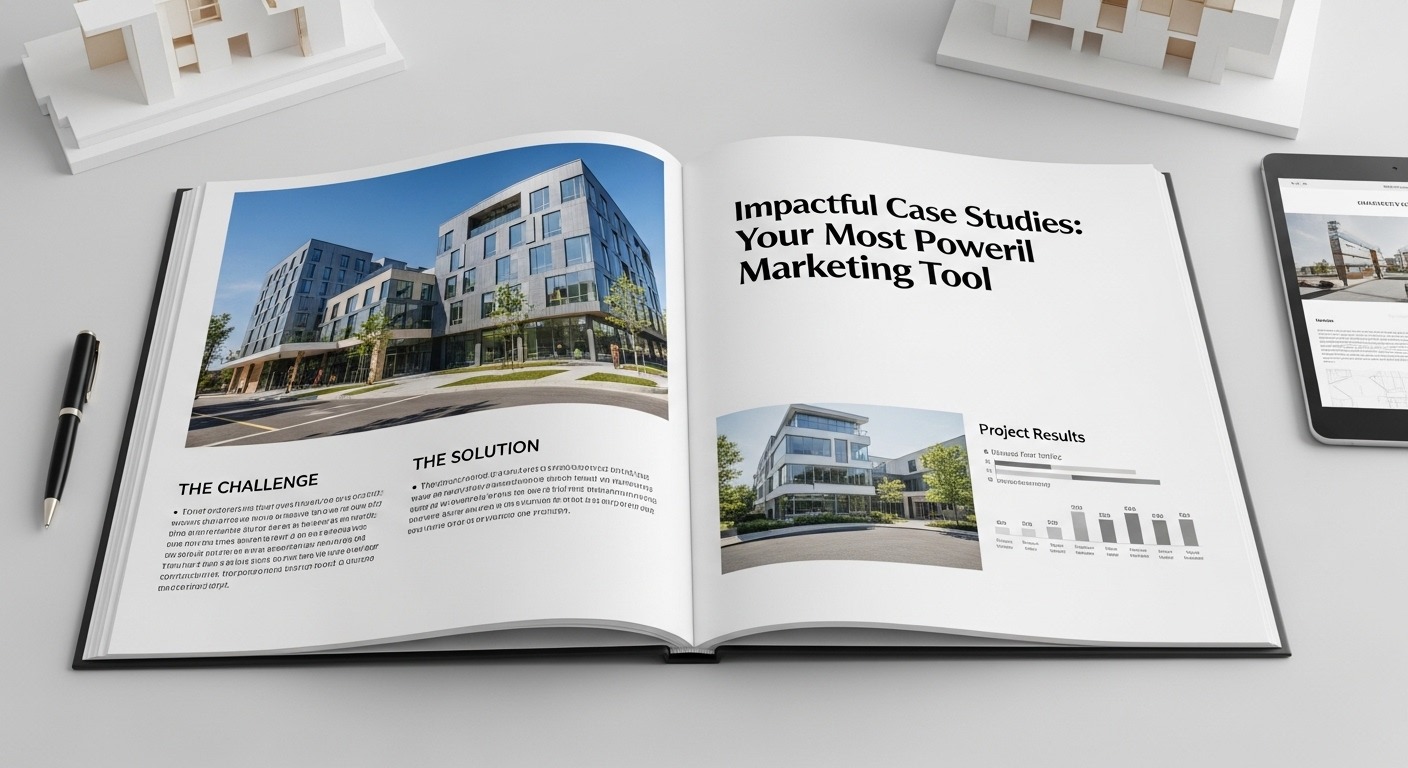
Imagine a prospective client sits down with two architectural firms. The first hands over a glossy portfolio — stunning renderings, polished photos, a long list of completed projects. The second opens with a story: “Our client had a 6,000 sq ft commercial space hemorrhaging foot traffic. Here’s exactly what we diagnosed, what we designed, and how we turned it into the highest-converting retail block in their city.”
Which firm gets the project?
Case studies are the single most underused yet highest-converting marketing asset in the architecture industry. While your competitors compete on aesthetics, you can compete on outcomes — and that changes everything.
In this guide, you’ll learn exactly how to build, structure, and deploy case studies that attract premium clients, shorten your sales cycle, and position your firm as the obvious choice.
📋 In This Article
- Why Case Studies Outperform Every Other Marketing Tool
- The Anatomy of a High-Converting Architecture Case Study
- How to Write a Case Study That Wins Clients
- Visuals, Infographics & Data That Build Trust
- Where & How to Distribute Your Case Studies
- 5 Critical Mistakes Architects Make with Case Studies
- SEO-Optimizing Your Architecture Case Studies
- Take Your Marketing to the Next Level
Why Case Studies Outperform Every Other Architecture Marketing Tool
Architecture is a high-stakes, high-trust industry. Clients aren’t buying a product they can return — they’re committing hundreds of thousands or millions of dollars to a vision that doesn’t yet exist. That requires an extraordinary level of confidence in you.
According to Demand Gen Report, 97% of B2B buyers cite case studies as the most trusted form of content when making purchasing decisions. Architecture clients — whether residential, commercial, or institutional — share the same psychology.
Why Case Studies Work: The Numbers
Sources: Demand Gen Report, Content Marketing Institute, HubSpot Research
Portfolios Show Work. Case Studies Prove Value.
The critical difference between a portfolio and a case study is narrative purpose. A portfolio answers: “What have you built?” A case study answers: “How did you solve my exact problem?”
Prospects don’t hire architects for beautiful buildings — they hire architects to solve complex human, spatial, budgetary, and regulatory challenges. Case studies speak directly to that need.
Table 1: Portfolio vs. Case Study — Marketing Impact Comparison
The Anatomy of a High-Converting Architecture Case Study
Not all case studies are created equal. A wall of text with before/after photos is not a case study — it’s a project description. A true high-converting case study follows a specific narrative structure, borrowed from the world’s best content marketers and adapted for the architecture industry.
The 7-Part Architecture Case Study Framework
How to Write a Case Study That Actually Wins Architecture Clients
Writing a case study that converts requires a mindset shift: you are not the hero of this story — your client is. Your firm is the guide that helped them achieve a transformation. This framing, inspired by the StoryBrand framework, is the most powerful shift you can make.
Step 1: Choose the Right Project
Not every project deserves a case study. Prioritize projects that:
Had a clear, measurable problem that you solved
Represent your ideal future client type
Have a client willing to provide a testimonial
Showcase a specific skill or niche you want more of
Step 2: Interview Your Client Strategically
The raw material for your best case study lives inside your client’s head. Schedule a 30-minute interview and ask questions like:
“What were you most worried about before we started working together?”
“What specific result surprised you most about the final design?”
“What would you tell a colleague who is considering hiring our firm?”
“How has the completed project affected your business/family/community?”
Step 3: Lead With Outcomes, Not Process
Most architects make the mistake of leading with process (“First, we developed three concept directions…”). Instead, lead with the transformation. Consider this headline formula:
Case Study Headline Formula
How We Helped [Client Type] Achieve [Specific Result] Despite [Key Challenge]
Example: “How We Helped a London Retail Group Increase Store Dwell-Time by 34% Despite a Grade II Listed Building Constraint”
Visuals, Infographics & Data That Build Trust
Architects already understand the power of visual communication — so use it in your marketing. According to Content Marketing Institute, content with relevant images receives 94% more views than content without. Here’s what to include in every case study:
Pro Tip: The “Results Snapshot” Box
Create a visual box near the top of every case study with 3–5 key stats (e.g., “34% increase in foot traffic | Delivered 3 weeks early | 12% under budget | 4.9/5 client satisfaction”). This is the most-shared element on social media and the fastest way to communicate value to a skimming executive.
Where & How to Distribute Your Architecture Case Studies
Creating a great case study is only half the work. Distribution determines whether it generates revenue or gathers digital dust. Here’s the full distribution map:
Website
- Dedicated case study section
- Link from related service pages
- Homepage “featured project” slot
- Filterable by project type
- Native article format
- Document carousel posts
- Company page updates
- Direct messages to prospects
Email Marketing
- Monthly newsletter feature
- Lead nurture sequences
- Post-proposal follow-ups
- Cold outreach attachment
Sales Process
- Leave-behind in pitches
- Embedded in proposals
- Shared in first discovery call
- PDF for referral partners
Instagram/Houzz
- Carousel: mini case study
- Reels: project transformation
- Stories: “Behind the Build”
- Houzz project posts
Google / SEO
- Long-form blog case study
- Schema markup for reviews
- Google Business post
- Local SEO targeting
1 Case Study → 8 Pieces of Content
📊 LinkedIn Carousel
📧 Email Feature
📄 PDF Leave-Behind
🎬 Instagram Reel
📌 Pinterest Infographic
🎙 Podcast Story
🏅 Award Submission
5 Critical Mistakes Architects Make With Case Studies
Even well-intentioned case studies can undermine trust if they fall into these common traps. Avoid these to ensure yours converts:
Mistake #1: Writing It Like a Project Description
“We designed a 3,000 sq ft commercial space…” is a description. A case study answers: why the client needed it, what problem it solved, and how it changed their outcomes. Add narrative tension.
Mistake #2: No Measurable Results
“The client was very happy” is not a result. Quantify outcomes wherever possible: budget variance, timeline performance, energy efficiency gains, occupancy rates, client revenue impact. If you don’t have hard numbers, use qualitative before/after statements from the client directly.
Mistake #3: Hiding Your Case Studies
Many firms bury case studies in a “Projects” tab with no SEO optimization, no calls to action, and no internal links. Your case studies should be prominently featured, linked from service pages, and actively promoted.
Mistake #4: Targeting Everyone, Resonating with No One
Generic case studies appeal to no one. The most powerful case studies speak laser-specifically to one type of client in one type of situation. Write different case studies for retail clients, residential clients, healthcare clients, and institutional clients.
Mistake #5: No Call to Action
After reading a compelling case study, a motivated prospect has nowhere to go. Always end with a clear, relevant next step. “Have a similar challenge? Let’s talk.” with a booking link or contact form is all you need.
SEO-Optimizing Your Architecture Case Studies for Google
A well-written case study is also a powerful long-tail SEO asset. Prospects searching Google for “commercial architect [city]” or “sustainable residential architect case study” can find you through strategically optimized case study pages. Here’s how to optimize them:
🔑 High-Value Keyword Categories for Architecture Case Studies
sustainable architecture case study
commercial renovation architect
listed building architect project
hospitality interior architecture results
school building design case study
passive house architect transformation
architecture firm portfolio [niche]
A Real-World Mini Case Study Example
See what a high-converting architecture case study introduction looks like in practice:
Notice: The hook leads with the client’s pain. The results box provides immediate credibility. The testimonial is specific and emotionally resonant. The intro ends with a promise that compels reading further.
The Bottom Line: Case Studies Are Your Most Valuable Sales Asset
Architecture is a relationship business built on trust. Case studies are the fastest, most scalable way to build that trust with strangers at scale — people who have never met you, but who are searching for exactly what you do.
The firms winning the best projects in 2025 and beyond won’t be the most talented — they’ll be the ones who communicate their talent most effectively. A single well-crafted case study can generate leads for years, strengthen your proposals, reduce price objections, and attract referrals from people who have never even been your clients.
Start with one project. Apply the 7-part framework. Measure the response. Then build your library one story at a time. Your next best client is already searching for a firm exactly like yours — make sure your case studies are there to greet them.
📌 Key Takeaways
- Case studies convert 3× better than generic portfolios because they answer the client’s real question: “Can you solve my problem?”
- Always follow the 7-part framework: Hook → Diagnosis → Process → Solution → Results → Testimonial → CTA
- Lead with outcomes and quantified results — numbers build trust faster than any description
- One case study = 8+ pieces of repurposed content across all marketing channels
- Optimize every case study page for SEO with location-based, project-type keywords
- Avoid the 5 critical mistakes: especially missing results data and no call to action
About This Post
Architecture Marketing Strategy Series
Published by Easy Marketing School · Updated 2025 · For Architects & Design Firms
#CaseStudies
#ArchitectBusiness