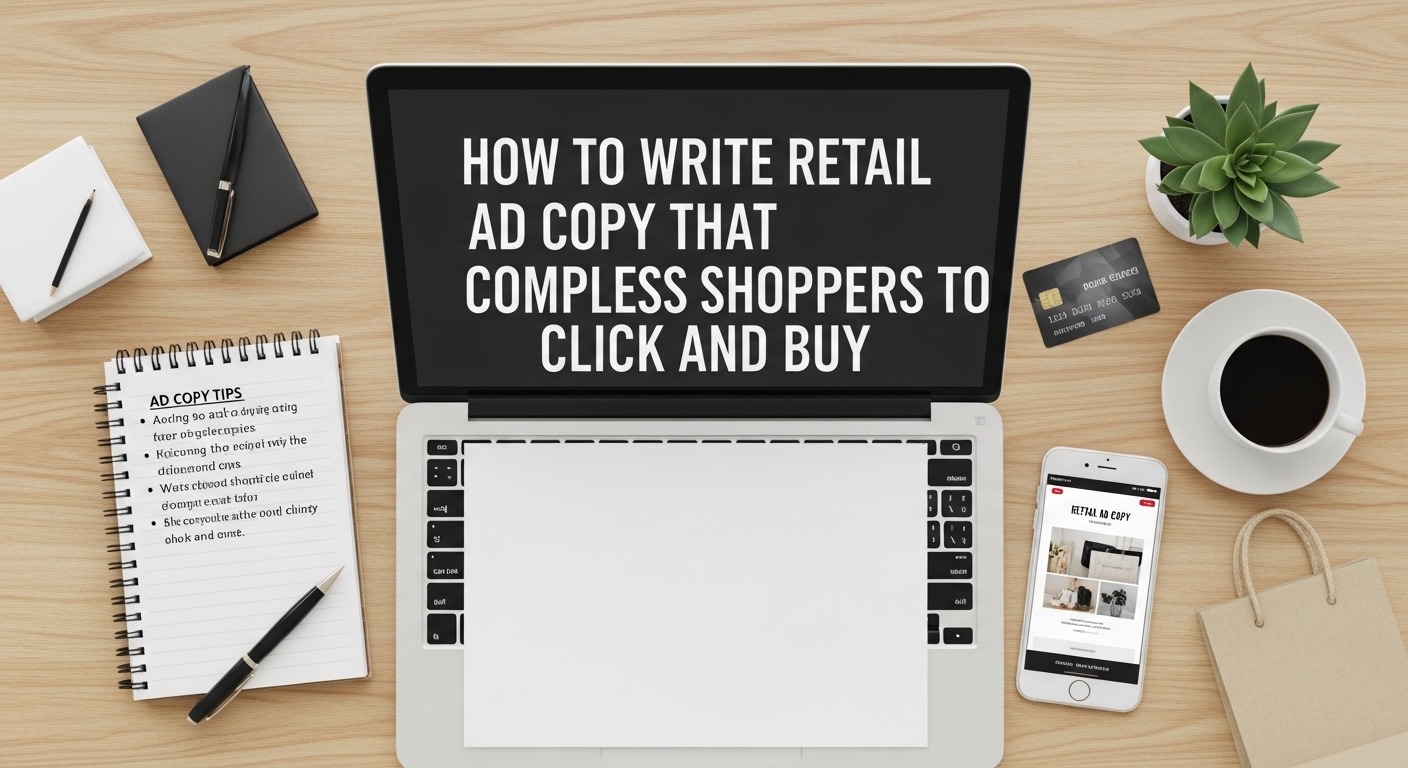

Every second, millions of shoppers scroll past ads without a second glance. They’re bombarded by banners, sponsored posts, and search results — and most get ignored. But a handful of ads stop them cold. They click. They read. They buy.
The difference? Retail ad copy that speaks directly to what shoppers want, need, and feel. This guide breaks down exactly how to write that kind of copy — step by step — whether you’re running Google Shopping ads, Facebook campaigns, or in-store promotions.
1. What Is Retail Ad Copy (and Why It Matters)
Retail ad copy is the written content in any advertisement — online or offline — designed to persuade shoppers to take a specific action: click a link, visit a store, or complete a purchase. It includes headlines, body text, product descriptions, and calls-to-action (CTAs) across Google Ads, Facebook, Instagram, email campaigns, and physical signage.
Why does it matter so much? Consider this: personalized ad copy can deliver up to a 35% lift in marketing performance, and 96% of consumers say they’re more likely to purchase from brands that send personalized messages. In a crowded marketplace, words are your most powerful competitive weapon.
2. Know Your Shopper Before Writing a Word
Effective retail copy starts before you open a blank document. You need to understand your buyer so deeply that your copy feels like it was written specifically for them — because it was.
🎯 Shopper Research Checklist
- What problem are they trying to solve? (Not what they want to buy, but why)
- What words do they use in reviews, forums, and social media?
- What objections stop them from clicking “Buy Now”?
- Where are they in the buying journey? Awareness → Consideration → Decision
- What competitors are they also considering?
A practical shortcut: mine your product page reviews and customer testimonials. The exact phrases customers use to describe their experience are copywriting gold — they reflect how real people think and talk about what you sell.
3. The Headline Formula That Gets Clicks
Your headline is the most critical line of copy you’ll ever write. Studies consistently show that 8 out of 10 people read a headline, but only 2 out of 10 read the rest. A weak headline means everything else is wasted.
Great retail headlines follow one of these proven frameworks:
| Formula | Structure | Example |
|---|---|---|
| Number + Benefit | [#] Ways to [Achieve Desired Outcome] | “5 Sneakers That Actually Last All Season” |
| Pain Point | Tired of [Problem]? Here’s [Solution] | “Tired of Fading Colors? Our Dye-Lock Tech Changes Everything” |
| Curiosity Gap | The [Unexpected Thing] That [Outcome] | “The $29 Gadget That Replaced Our $200 Blender” |
| How To | How to [Achieve Goal] Without [Fear/Pain] | “How to Look Polished Without Spending Hours Getting Ready” |
| Direct Offer | [Specific Discount/Offer] on [Product] | “30% Off Premium Skincare — Today Only” |
Use power words like exclusive, guaranteed, proven, free, new, and limited in your headlines — they trigger emotional responses and encourage clicks. But never mislead. Clickbait destroys brand trust faster than any bad product review.
4. Features vs. Benefits: Stop Listing, Start Selling
This is the most common mistake in retail copywriting. When you’re invested in a product, it’s tempting to list every technical feature — but shoppers don’t buy features. They buy outcomes, feelings, and transformations.
The simple formula: Feature → “which means” → Benefit → “so you can” → Outcome. Work through this chain for every product claim, and your copy will instantly become more compelling.
5. Power Words & Emotional Triggers
Certain words carry disproportionate persuasive weight. Used correctly, they tap into the core emotions driving purchase behavior: desire, fear of missing out, pride, trust, and curiosity.
Guaranteed
Free
Limited
Proven
New
Instantly
You
Discover
Secret
Save
Today Only
Trusted
Award-Winning
Effortless
Including specific numbers and data also dramatically boosts credibility. “Boost Sales by 30%” outperforms “Boost Sales Significantly” every single time — because specificity signals truth.
6. Creating Urgency and Scarcity Without Lying

Urgency and scarcity are two of the most powerful conversion tools in retail copywriting — but they must be genuine. Amazon’s approach — showing “Only 3 left in stock” alongside countdown timers — works because it reflects real inventory conditions.
Time Urgency
“Sale ends midnight tonight.” “Order in the next 2 hours for same-day delivery.”
Stock Scarcity
“Only 7 left at this price.” “Back in stock — but selling fast.”
Access Exclusivity
“For loyalty members only.” “Early access — limited spots available.”
Event Urgency
“Flash Sale — next 24 hours only.” “Weekend-exclusive pricing.”
7. Social Proof: Let Customers Sell for You
Shoppers don’t like to feel like they’re the first to try something. Social proof neutralizes that fear instantly. Weaving it into your ad copy makes your claims credible without you having to work as hard.
Types of Social Proof in Retail Ad Copy
Star Ratings
“4.8/5 from 2,400 buyers”
Quotes
“Game-changer” — Sarah M.
Media Mentions
“As seen in Forbes”
Awards
“Best in Category 2024”
Volume
“50,000+ happy customers”
8. CTA Mastery: Turning Readers into Buyers
The most common mistake in ad copywriting is a weak or missing call-to-action. Your CTA is the bridge between interest and conversion. It should be specific, action-oriented, and communicate clear value.
| ❌ Weak CTA | ✅ Strong CTA |
|---|---|
| Click here | Shop the Collection → |
| Learn more | See How It Works — Free Demo |
| Submit | Claim Your 20% Off |
| Buy now | Get Yours Before It Sells Out |
| Sign up | Start My Free Trial Today |
Your CTA should tell shoppers exactly what they get when they click — not just what action they’re taking. The best CTAs reduce friction by making the next step feel obvious and rewarding.
9. Platform-Specific Copy Tips
Different platforms have different character limits, audiences, and consumption habits. People interact with ads differently on mobile vs. desktop, and differently on Google vs. Instagram. Here’s how to tailor your retail copy for each major channel:
| Platform | Tone | Key Focus | Headline Limit |
|---|---|---|---|
| Google Search Ads | Direct, keyword-rich | Match search intent, show price/offer | 30 characters |
| Google Shopping | Descriptive, factual | Product attributes, brand, key features | 150 characters |
| Facebook/Instagram | Conversational, story-led | Hook in line 1, emotion & social proof | 40 characters (primary) |
| Email Subject Line | Personal, curiosity-driven | Personalization + benefit or curiosity | 40–50 characters |
| In-Store Signage | Bold, scannable | One message, massive benefit | 5–7 words max |
10. A/B Testing Your Retail Ad Copy
A/B testing is one of the best approaches to evaluating ad performance. You run two versions of copy, change one variable at a time, and let the data tell you what resonates with your actual audience — not what you think will work.
🧪 What to A/B Test First
Headline: Benefit-led vs. question format
CTA Text: “Shop Now” vs. “Get Yours Today”
Offer: % discount vs. $ amount off
Tone: Urgent vs. aspirational
Length: Short punchy copy vs. longer story
Social Proof: With vs. without a review snippet
Track your key metrics: click-through rate (CTR), conversion rate, cost per acquisition (CPA), and return on ad spend (ROAS). Let campaigns run long enough to reach statistical significance before declaring a winner — typically 500+ clicks per variant.
Quick Reference
The 10-Point Retail Ad Copy Checklist
Headline grabs attention in under 3 seconds
Copy speaks to benefits, not just features
Uses “you” language to speak to the shopper
Includes at least one power word
Has a genuine urgency or scarcity element
Includes social proof (rating, reviews, sales count)
CTA is specific and value-focused
Matches the tone/format of the platform
Zero misleading claims or clickbait
A/B test version planned and in queue
Master Retail Marketing from the Ground Up
Ad copy is just one piece of the puzzle. If you want to build a complete, revenue-generating retail marketing strategy — from shopper psychology to multi-channel campaigns — the Easy Marketing School Retail Marketing Course gives you everything you need.
- ✅ Proven retail copywriting frameworks
- ✅ In-store & eCommerce campaign strategy
- ✅ Customer psychology & buying triggers
- ✅ Hands-on exercises with real-world scenarios
- ✅ Self-paced — learn on your schedule
Enroll in the Retail Marketing Course →
Self-paced · Beginner to Advanced · Certificate on Completion
Final Thoughts: Words That Sell
Writing retail ad copy that compels shoppers to click and buy isn’t about being clever for cleverness’ sake. It’s about understanding your shopper so deeply — their problems, desires, language, and hesitations — that your words feel like they were written just for them.
The best retail copywriters are part strategist, part psychologist, and part storyteller. They start with research, build headlines around clear benefits, layer in urgency and social proof, and close with a CTA that makes clicking feel like the obvious next step.
Start applying even one or two of these techniques to your next campaign, test the results, and iterate. That’s how great retail copy — and great retail businesses — are built.
Practical marketing education for retail professionals and entrepreneurs. Updated regularly with the latest strategies and data.
Copywriting
Ad Strategy