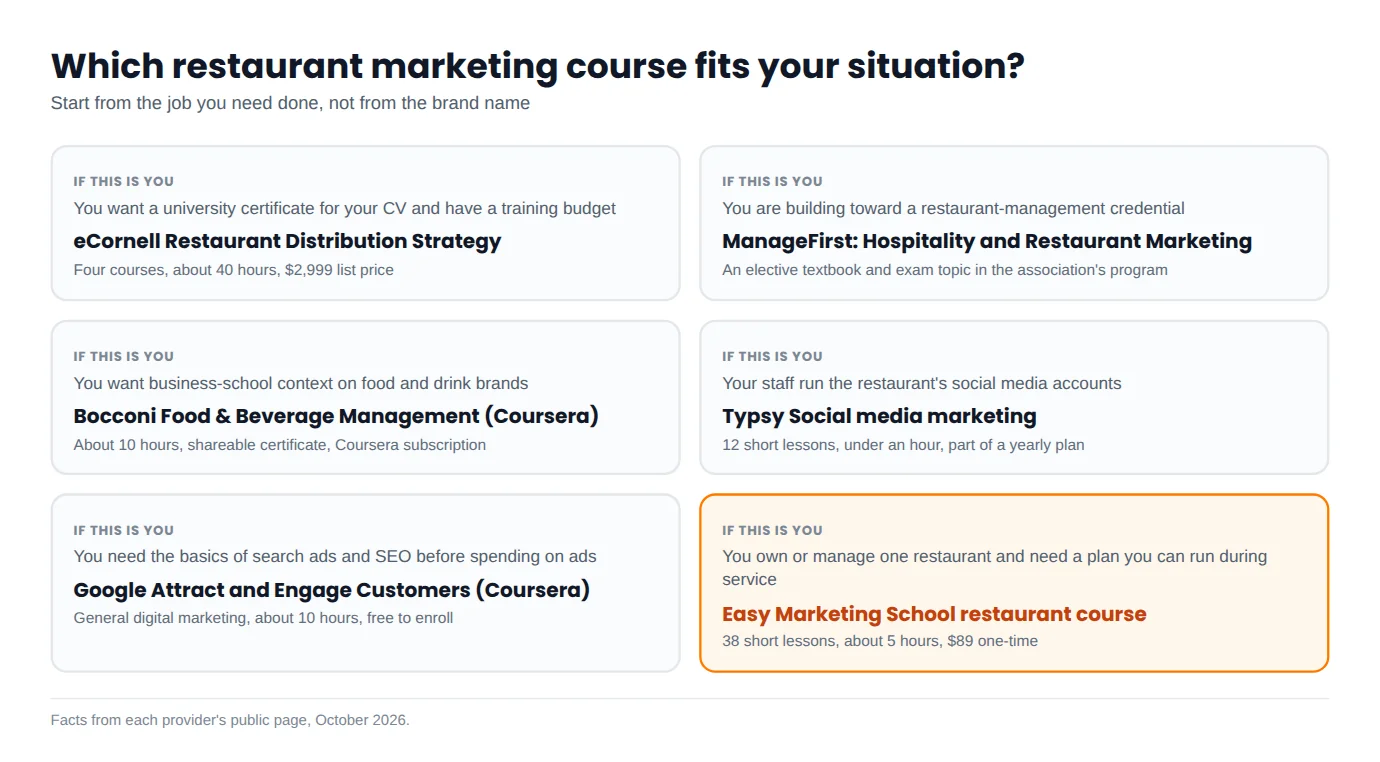
Search for restaurant marketing courses and you get a mix of things that are not really comparable: a university certificate built for managers with a training budget, an industry-association exam topic, a business-school course on food and drink brands, short video lessons for front-of-house staff, a free digital marketing course from Google, and practical courses for the person who actually decides what goes on the specials board. All of them use the word “marketing”. Very few of them will tell an owner what to do on a quiet Tuesday. This guide puts six real options side by side, compares them on format, time, price and certificate as shown on each provider’s public page as of October 2026, and says honestly who each one suits, including our own course and what it does not do.
Who is looking for a restaurant marketing course
Before comparing anything, it helps to be clear about which of these buyers you are, because the right answer is different for each:
- Owners and general managers of independent restaurants. You need more covers on slow nights, more regulars, better reviews and a local reputation, and you need it in a form you can run between lunch and dinner service without a marketing department.
- Managers building a hospitality career. You want a credential an employer recognises, and you have time (and often an employer budget) for a structured programme with assignments.
- Marketing staff at a restaurant group or brand. You need strategy, distribution channels and measurement at a scale above one dining room.
- Team members who run the social accounts. You need short, specific training on content, posting and engagement, not a business degree.
Restaurant marketing courses compared
| Option | Type | Format and length | Price shown (October 2026) | Certificate | Best for |
|---|---|---|---|---|---|
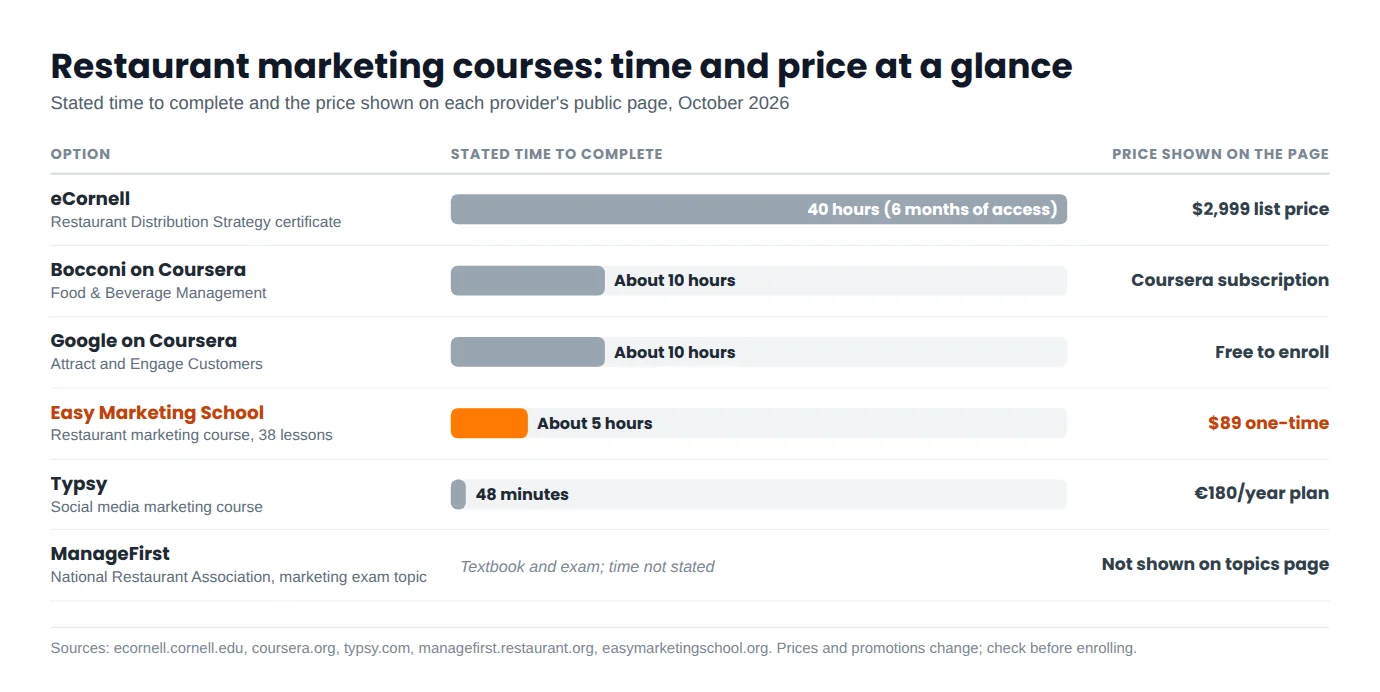
| eCornell: Restaurant Distribution Strategy | University certificate programme | Four online courses; 40 hours with 6 months of access, self-paced with facilitation | $2,999 list price (a promotional code price was also shown) | Cornell certificate; page lists 40 professional development hours (4 CEUs) | Managers and operators planning delivery, online ordering and direct bookings |
| ManageFirst (National Restaurant Association): Hospitality and Restaurant Marketing | Industry-association textbook and exam topic | One elective topic in a programme of ten textbooks | Not shown on the topics page | Part of the ManageFirst credential path | Students and managers working toward a restaurant-management credential |
| Università Bocconi on Coursera: Food & Beverage Management | University course on a learning platform | 5 modules; about 1 week at 10 hours a week; flexible schedule | Included with Coursera Plus | Shareable certificate | Strategy and brand thinking for food and drink businesses |
| Typsy: Social media marketing | Short hospitality video course | 12 lessons, 47 minutes in total | Included in Typsy plans; Individual plan €180 a year | Certificate | Staff and owner-operators who run social media |
| Google on Coursera: Attract and Engage Customers with Digital Marketing | General digital marketing course | 4 modules; about 1 week at 10 hours a week | Free to enroll | Shareable certificate | Learning search, SEO and display advertising basics |
| Easy Marketing School: Restaurant Marketing Course | Self-paced practical course for restaurants | 38 short video lessons, about 5 hours; lifetime access | $89 one-time | Certificate of completion | Independent owners and managers who want fuller tables and more regulars |
Details come from each provider’s public page as of October 2026. Prices, promotions and course contents change, so confirm on the provider’s site before you enrol.
Each option: what it is good for, and what it is not
eCornell Restaurant Distribution Strategy
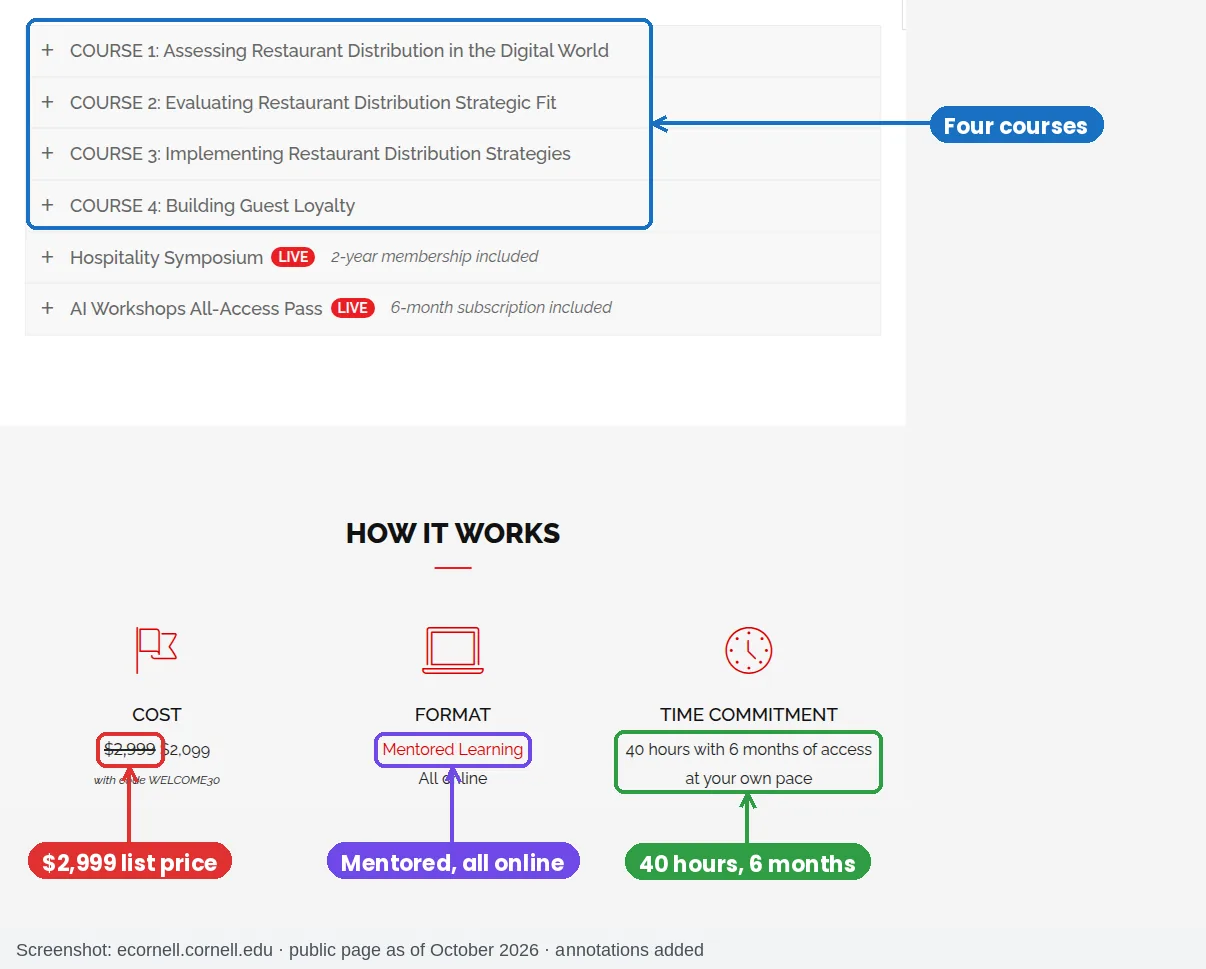
This is the most substantial programme in the comparison. The page lists four courses: assessing restaurant distribution in the digital world, evaluating strategic fit, implementing distribution strategies, and building guest loyalty. It covers online ordering and delivery platforms, ghost kitchens, online reservation systems and user-generated review sites. The listed cost is $2,999 for 40 hours of study with six months of access, delivered as mentored, online learning, and the certificate comes from Cornell’s Nolan School of Hotel Administration with 4 CEUs listed.
Good for: a manager or operator who needs a recognised name on the CV and is deciding how far to go with delivery apps and direct channels. Less suited to: an owner who mainly needs this month’s local marketing done. It is a strategy programme, and the price reflects a university credential.
ManageFirst: Hospitality and Restaurant Marketing
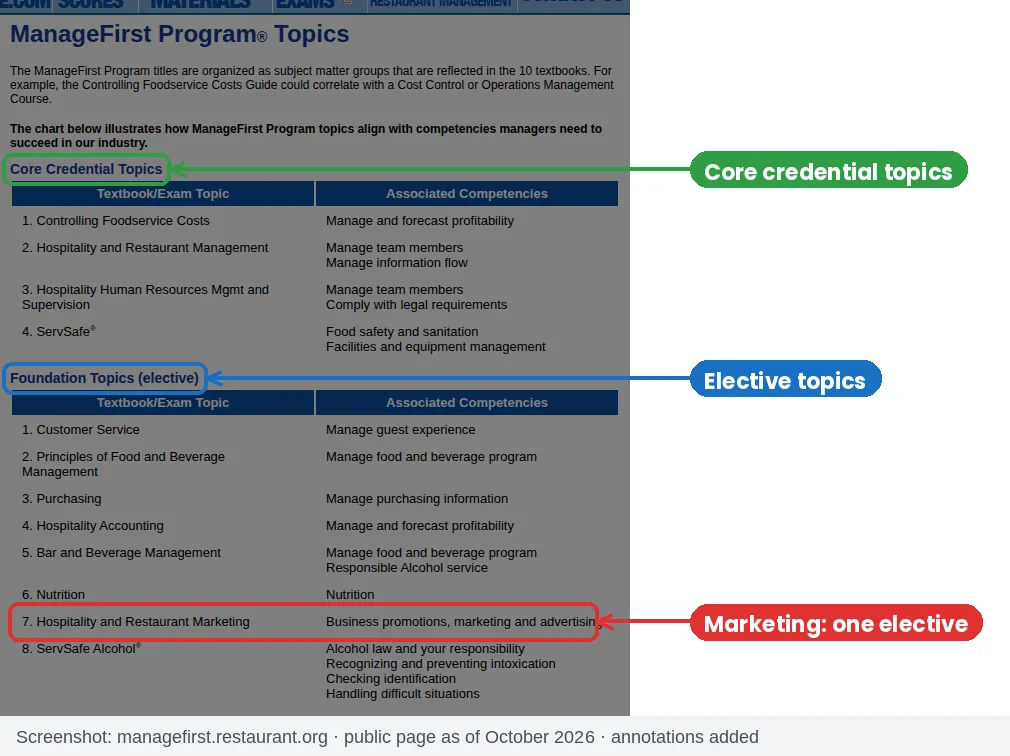
The National Restaurant Association’s ManageFirst Program organises its subjects into ten textbooks with matching exams. Its topics page lists four core credential topics (cost control, restaurant management, human resources and ServSafe food safety) and several elective foundation topics. Hospitality and Restaurant Marketing is one of the electives, mapped to the competency “business promotions, marketing and advertising”. The topics page does not show a price; the same site lists instructor and proctor resources and an option to take exams online.
Good for: anyone already on the ManageFirst path or studying hospitality, where marketing sits alongside cost control and food safety. Less suited to: an owner who wants a quick, self-contained marketing course rather than a textbook and an exam.
Università Bocconi: Food & Beverage Management (Coursera)
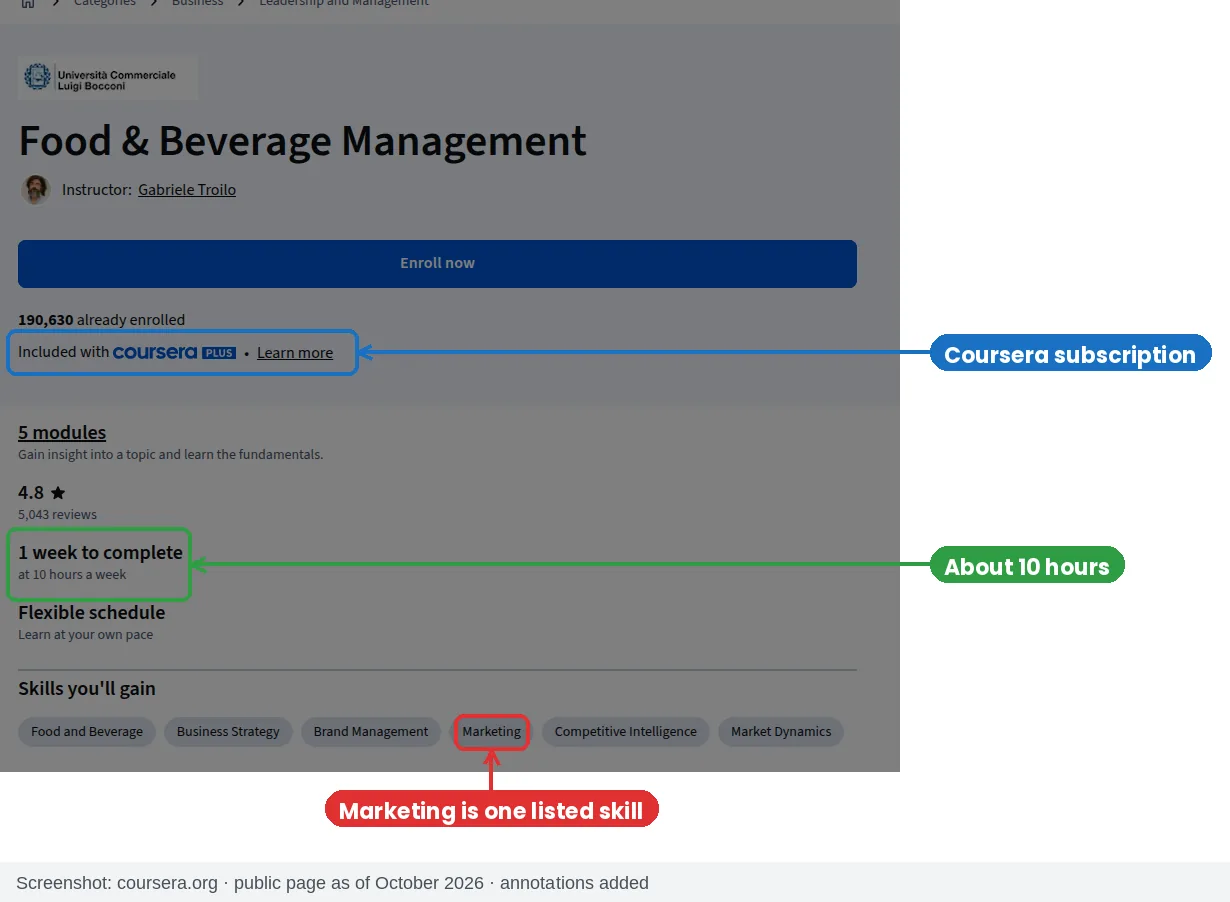
A university course taught by Gabriele Troilo, built around the dilemmas food and beverage companies face, with guest speakers from businesses such as Eataly, Barilla and Heineken. Coursera lists five modules, about one week at ten hours a week, a shareable certificate, and skills that include marketing and brand management. It is included with Coursera Plus.
Good for: owners and managers who want to think more clearly about brand, positioning and the wider food market, and who enjoy case-style learning. Less suited to: someone who needs restaurant-floor tactics such as reviews, local search and slow-night promotions. Much of the material is about food and drink companies in general rather than single restaurants.
Typsy: Social media marketing
Typsy is a hospitality training library. Its social media marketing course has 12 lessons and 47 minutes of video, covering a social media review, goals, a customer profile, choosing channels, brand voice, content, posting consistently, engagement, influencers and measuring results. The page says it is aimed at marketing professionals and owner-operators in hospitality and tourism. It is included in Typsy plans, and the pricing page lists an Individual plan at €180 a year, billed annually.
Good for: a team member who runs the restaurant’s accounts and needs a short, focused grounding. Less suited to: a complete marketing plan. Social media is one channel, and the subscription makes most sense if you will also use Typsy’s other hospitality courses.
Google: Attract and Engage Customers with Digital Marketing (Coursera)
Part of Google’s Digital Marketing & E-commerce Professional Certificate. It covers search engine optimisation, search engine marketing, display advertising and the marketing funnel across four modules, at about one week at ten hours a week. Coursera shows it as free to enroll, with a shareable certificate.
Good for: understanding how search ads and SEO work before you spend money on them. Less suited to: restaurant-specific problems. Nothing in it is about covers, menus, reservations or regulars, so you will be translating every lesson to your dining room yourself.
How to choose a restaurant marketing course
Work through these questions in order. Most people can rule out half the list by question three.
- Do you need a credential or a result? If a recognised certificate matters to an employer, look at eCornell or the ManageFirst path. If what matters is fuller tables, choose by how practical the lessons are.
- How many hours do you really have? Count honestly. Forty hours over six months is realistic for a salaried manager. Five hours over two weeks is realistic for an owner who also closes.
- Is it written for restaurants? General marketing courses teach real skills, but you will need to translate funnels and personas into covers, average spend and repeat visits.
- Does the syllabus cover reviews, local search and repeat guests? For a single restaurant these usually matter more than brand theory.
- What does it cost over a year? A subscription can be good value if you use the whole library and poor value if you watch one course.
- Can you try before paying? Free preview lessons or a free enrolment option show you whether the teaching style suits you.
Where our course fits, and its limits
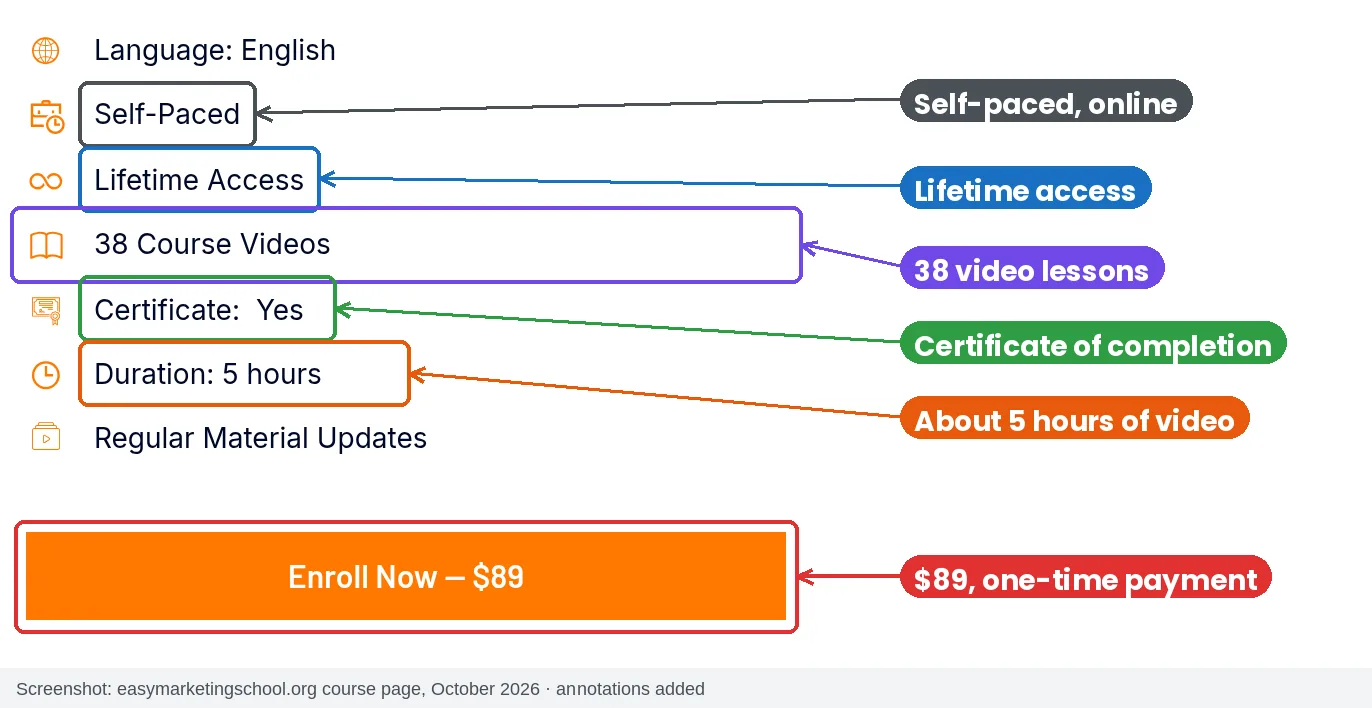
Our restaurant marketing course is written for the first buyer on the list: the owner or manager of an independent restaurant. It has 38 short video lessons, about five hours in total. Most topics open with a short warm-up story about a fictional restaurant with a problem, followed by the lesson itself. The topics run from target audience, market research, unique selling proposition, branding and positioning through the marketing mix, CRM, data-driven marketing and customer segmentation to influencer, content and social media marketing, local partnerships, customer retention and loyalty, sustainability, online reservations, special events and promotions, and online reviews and reputation management. It costs $89 as a one-time payment, with lifetime access and a certificate of completion, and seven of the lessons are free to watch without signing up, so you can judge the style before buying.
What it is not, so you can decide fairly:
- It is not accredited and carries no CEU or continuing-education credits. If you need those, eCornell lists CEUs and ManageFirst is an industry credential path.
- It is self-paced video only, with no live sessions, graded assignments or individual feedback.
- It is taught in English.
- It is a marketing course, not a food-safety, cost-control or restaurant-operations course.
- It does not go deep on delivery-platform strategy or multi-site brand management, which the eCornell programme covers in more depth.
If you want to see the approach before deciding, two free guides use the same practical style: the 12-month restaurant marketing plan template and the walkthrough of Google Business Profile for restaurants.
What any restaurant marketing course should cover
Whichever option you choose, check the syllabus against this list. A course built for restaurants should include most of it:
- Who your guests are and which nights or dayparts need help, because a restaurant is busy at some hours and empty at others.
- Your Google listing, menu and photos, which is where many first-time guests decide.
- Reviews: how to ask for them, how to answer them, and how to use what they tell you.
- Bringing guests back: loyalty, birthdays, email or messaging, and events.
- Promotions that fill quiet periods without training regulars to wait for discounts.
- Local partnerships with businesses, venues and organisations near you.
- Simple measurement: covers, average spend and repeat visits by source, not just likes and clicks.
If a syllabus has none of these and is mostly funnels, personas and platform features, it was written for marketers in general and you will need to adapt it yourself.
Frequently asked questions
Are there free restaurant marketing courses?
Yes, with limits. Google’s Attract and Engage Customers course on Coursera is free to enroll and teaches search and advertising basics, though not specifically for restaurants. The National Restaurant Association’s Marketing & Sales learning centre publishes free articles on topics such as loyalty programmes and influencer marketing. Free material is a good start; a structured course saves time when you want everything in order.
Is a restaurant marketing certificate worth it?
It depends on who the certificate is for. For a career in restaurant or hospitality management, a recognised credential such as a Cornell certificate or ManageFirst can carry weight with employers. For an owner, the certificate matters less than whether the course changes what happens on a slow Tuesday; a short practical course can pay for itself with a handful of extra tables.
How long does a restaurant marketing course take?
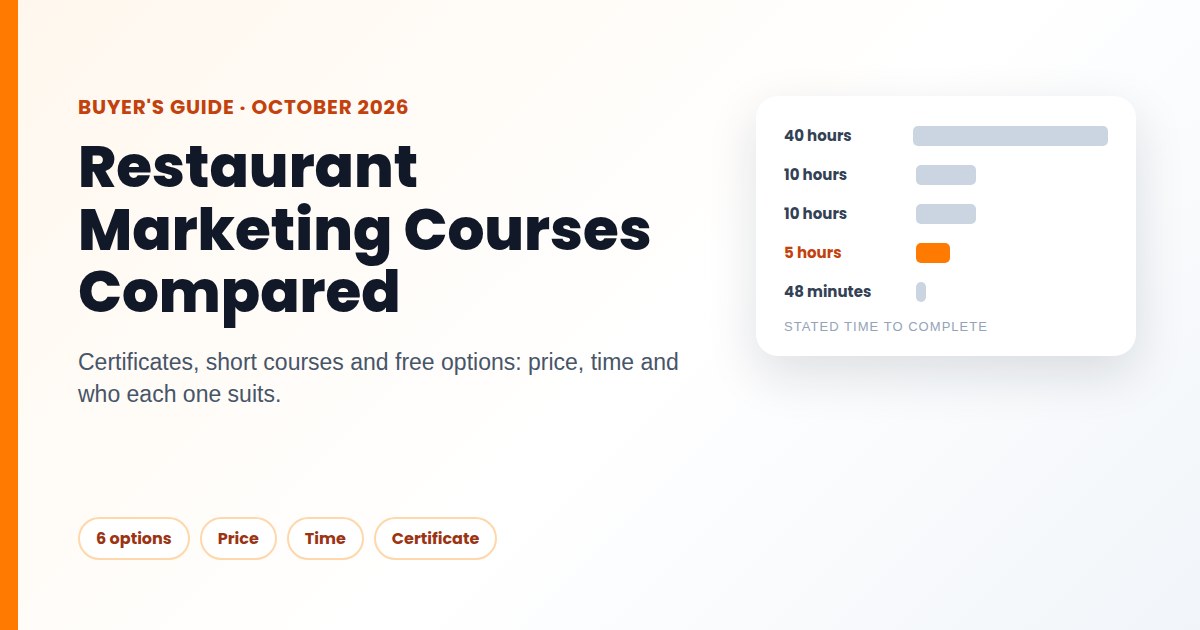
Among the options here: under an hour for Typsy’s social media course, about five hours for ours, roughly ten hours for the Bocconi and Google courses on Coursera, and 40 hours over up to six months for the eCornell certificate.
Should I take a marketing course or a restaurant management course?
If your problem is empty tables, start with marketing. If the problems are costs, staffing or food safety, a management programme such as eCornell’s Food and Beverage Management certificate or the ManageFirst core topics is the better first step, and marketing can follow.