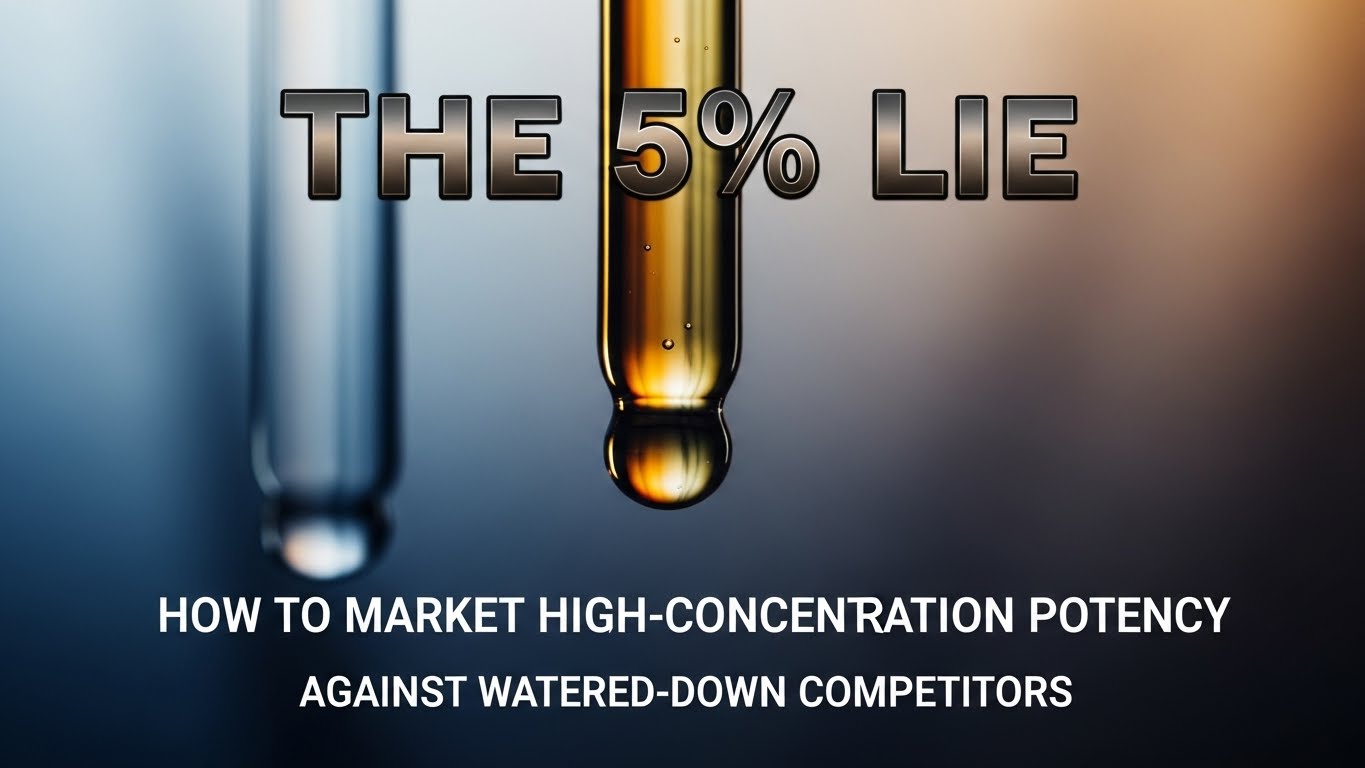
Winning through transparency: teaching customers to value ingredients over marketing She’s comparing two vitamin C serums. Yours: $48, 20% L-ascorbic acid. Competitor: $28, “Powerful Vitamin C Complex.” She chooses the cheaper one. Three months later, she’s back complaining it didn’t work. You check the competitor’s label: water, glycerin, silicones… and buried at position 12, after six preservatives and three thickeners: “ascorbic acid.” Estimated concentration: less than 1%. They marketed “vitamin C” without disclosing they barely included any. This is the 5% lie—a beauty industry epidemic where brands claim active ingredients on the front label while delivering homeopathic doses in actual formula. “Retinol serum” with 0.01% retinol (10x below clinical efficacy). “Hyaluronic acid moisturizer” with more water-soluble fillers than actual hyaluronic acid. “Peptide complex” where peptides appear after fragrance in ingredient list (meaning less than 0.1% concentration). Customers buy based on ingredient marketing, receive watered-down formulas, and blame the ingredients—not the deceptive concentration—when products fail. Welcome to the transparency revolution—where brands like The Ordinary, Paula’s Choice, and Timeless Skin Care have built empires by doing the opposite: publishing exact concentrations, educating customers on meaningful dosage, and proving that ingredient honesty beats marketing deception. They’ve shown that customers WILL pay premium prices for real concentrations when they understand the difference between 20% active formula and 0.5% filler-heavy imitation. According to research, 89% of consumers say they want ingredient concentration transparency, but only 23% of brands provide it. This information gap creates opportunity: brands that educate customers on reading labels, understanding concentrations, and valuing real ingredients over fillers build fierce loyalty. The Ordinary reached $460M revenue by 2021 specifically through radical transparency—listing exact percentages, refusing to hide behind marketing claims, making customers literate about formulation. The challenge: how do you market high-concentration products against competitors who claim same ingredients at lower prices (but don’t disclose their watered-down formulas)? How do you educate customers to “flip the label” and read ingredient lists critically without overwhelming them? How do you prove your 20% vitamin C justifies $48 when competitor’s “vitamin C serum” costs $28 (without revealing it contains 0.8% until after purchase)? And critically—how do you build transparency positioning that converts price-sensitive customers into informed buyers who understand concentration determines results? This article will show you how to market high-concentration potency products—exposing the 5% lie without attacking competitors directly, teaching customers to value raw ingredients over cheap fillers, and building brand authority through radical formulation transparency that makes concentration your competitive advantage. Before building transparency strategy, understand the industry deception tactics customers face: According to cosmetic ingredient research, the average “active ingredient serum” contains 85-92% base ingredients (water, glycerin, silicones, thickeners) and only 8-15% active compounds—yet rarely discloses these percentages. The key insight: watered-down formulas aren’t illegal (INCI requires listing all ingredients but not concentrations), but they’re deceptive. Customers can’t make informed choices without concentration data. Your transparency becomes competitive weapon. Strategy: Educate on common watered-down tactics—”proprietary blends,” ingredient list tricks, derivative substitution. Name practices, not competitors. Goal: Make customers aware deception exists, not paranoid about all products Strategy: Simple framework for reading ingredient lists—position on list = approximate concentration, what appears after fragrance = negligible, how to spot derivatives vs. actives. Goal: Create informed customers who can evaluate ANY product critically Strategy: List every active ingredient with exact percentage on product page, packaging, marketing. “20% L-ascorbic acid, 5% niacinamide, 1% retinol.” Be radically transparent. Goal: Differentiate through honesty—competitors can’t match without revealing their low concentrations Strategy: Cite clinical studies showing efficacy thresholds—20% vitamin C effective, 0.5% not. Your price reflects therapeutic dosage, not marketing fluff. Goal: Position higher price as investment in results, not markup on hype Strategy: Ongoing education content—ingredient glossaries, concentration guides, formulation science. Create customers who understand WHY your products work. Goal: Transform customers into ingredient-literate advocates who spread truth Core Principle: The concentration transparency framework wins customers by exposing industry deception (without naming names), teaching label reading, publishing exact percentages, justifying pricing through clinical dosage science, and building long-term literacy. Transparency becomes unbeatable competitive advantage—competitors must either match disclosure or be revealed as watered-down. Same active ingredients, opposite disclosure philosophies. One hides concentrations; one makes them the selling point: Once customers become concentration-literate, they can’t unsee watered-down formulas. Your transparency educates them out of competitors’ market forever. They become your customers not just for one product, but for philosophy—because you treated them like intelligent adults capable of understanding formulation science. This is the transparency marketing revolution: most brands want customers to focus on front label claims and never flip to ingredient list. They invest millions in packaging design, celebrity endorsements, emotional marketing—anything to distract from actual formula. Your competitive advantage is teaching customers to ignore all that noise and flip to the back label, where truth lives in INCI-required ingredient disclosure. The opportunity: ingredient lists follow regulatory order (highest concentration to lowest), which means position reveals approximate concentration even without explicit percentages. When customers learn to read this positioning, they gain X-ray vision through marketing deception. Your job is making this complex regulatory document accessible, empowering customers to evaluate ANY skincare product—including your competitors’—critically. The Strategy: Teach the simple INCI (International Nomenclature Cosmetic Ingredient) ordering rule—ingredients listed high-to-low by concentration. The Ingredient List Decoding Guide: Top 5 Ingredients = 70-90% of Formula: “If ‘water, glycerin, dimethicone, propanediol, phenoxyethanol’ are first five, your product is 70-90% these base ingredients. Everything else—including actives—fits in remaining 10-30%. If actives aren’t in top 5, they’re minority ingredients.” Ingredients 6-10 = 5-15% of Formula: “Actives appearing in this range = moderate concentration. ‘10% niacinamide’ would appear here. ‘1% retinol’ would appear here. Good products have key actives in positions 6-10.” After Position 10 (Especially After Fragrance) = Less Than 1%: “Fragrances typically used at 0.5-1%. Anything listed AFTER fragrance = less than fragrance concentration = below 1%, often below 0.5%. If your ‘star ingredient’ appears after fragrance, it’s homeopathic dose—marketing not efficacy.” Example Exercise: “Look at your current vitamin C serum. Find ‘ascorbic acid’ or ‘vitamin C’ on ingredient list. Is it in top 5? Positions 6-10? After fragrance? This tells you approximate concentration without explicit disclosure.” Why this works: Position-based concentration is verifiable by customer immediately, applies to ALL products universally, reveals watered-down formulas without needing chemistry degree, empowers customers to audit any brand’s claims through simple observation. The Strategy: Teach customers which ingredients are low-cost fillers vs. expensive actives—enables cost-benefit analysis. The Filler vs. Active Ingredient Guide: Cheap Fillers (Pennies per Bottle): Moderate-Cost Actives ($1-5 per Bottle): Expensive Actives ($5-15+ per Bottle): Cost Analysis Example: “Watered-down serum: 85% fillers ($0.15) + 15% mixed actives ($2) = $2.17 formula cost at $28 retail. High-concentration serum: 60% fillers ($0.12) + 40% expensive actives ($14) = $14.12 formula cost at $48 retail. Price difference reflects actual ingredient investment.” Why this works: Raw material cost education justifies premium pricing objectively, reveals that cheap products use cheap formulas not just “affordable” pricing, teaches customers to evaluate ingredient VALUE not just presence, builds appreciation for expensive actives your brand includes. The Strategy: Teach difference between expensive bioavailable actives vs. cheap derivatives marketed identically. Common Derivative Substitution Tricks: VITAMIN C Substitution: RETINOL Substitution: HYALURONIC ACID “Molecular Weight” Trick: Educational Tagline: “Not all ‘vitamin C serums’ are created equal. L-Ascorbic Acid = pure, proven, expensive. Derivatives = cheaper alternatives, less research. We always specify which form you’re getting. Check your current products—are you paying for pure actives or cheap substitutes?” Why this works: Derivative education exposes how “same ingredient” claims hide quality differences, empowers customers to demand specific forms not just vague categories, validates your premium pricing (pure L-ascorbic acid DOES cost 7x more than derivative), creates informed buyers who choose based on efficacy not just marketing. The Strategy: Teach customers to be skeptical of “proprietary blends” that hide individual ingredient concentrations. The Proprietary Blend Warning Signs: What “Proprietary Blend” Often Means: Your Transparency Promise: “We NEVER use proprietary blends. Every active ingredient listed individually with exact concentration. Nothing to hide. If we claim vitamin C, you see ‘20% L-Ascorbic Acid’ explicitly. No mystery blends, no concentration hiding. Full transparency, always.” Why this works: Proprietary blends are legal concentration-hiding tactic, teaching customers to flag them creates immediate differentiation for your transparent formulas, positions “proprietary” as suspicious rather than sophisticated, builds trust through explicit disclosure vs. mystery marketing. The Strategy: Provide interactive tool where customers can compare their current products to yours through label analysis. The Label Comparison Web Tool: Social Sharing: “I analyzed my ‘vitamin C serum’—turns out it has less than 1% actual vitamin C. [BRAND] has 20%. Finally understand why my old one didn’t work! #FlipTheLabel” Why this works: Interactive tool converts abstract education into personal revelation, customers discover their own products are watered-down through self-analysis (more powerful than you claiming it), shareable tool creates viral word-of-mouth, builds massive goodwill by genuinely helping customers evaluate ALL products not just selling yours. The Strategy: Invite customers to compare their current products to yours—confidence in superiority removes sales defensiveness. The Comparison Challenge Campaign: The Message: In-Store/Event Execution: Set up “Label Reading Station” with magnifying glasses, ingredient glossaries, comparison guides. Staff trained to help customers analyze ANY brand’s products (including competitors). Builds trust through genuine education, not just sales pitch. Why this works: Inviting comparison signals extreme confidence in formula superiority, helping customers analyze competitors’ products builds advisory relationship not transactional, creates “aha moments” when customers discover their current products fail comparison, positions your brand as educator-ally not just seller. The Ordinary reached $460M revenue by 2021 through uncompromising concentration transparency. Their strategy: (1) Every product name = exact concentration—”Niacinamide 10% + Zinc 1%,” “Retinol 1% in Squalane,” “Vitamin C Suspension 23%”—impossible to hide formula, (2) Simple packaging eliminates marketing fluff—just ingredient name, concentration, price. No lifestyle imagery, no celebrity endorsements, pure science, (3) Educational guides explaining ingredient efficacy thresholds—”Niacinamide effective at 2-10%, our 10% delivers clinical dosage,” teaching customers to evaluate competitors, (4) Aggressively low pricing proving concentration doesn’t require luxury markup—$7 for 10% niacinamide exposed $80 competitors as overpriced filler-heavy formulas, (5) “Flip the label” culture created by founder’s Reddit AMAs teaching formulation science—empowered customers to read ALL product labels critically, and (6) Zero proprietary blends—every ingredient listed individually with exact percentage. Result: cult following of ingredient-literate customers who abandoned watered-down competitors permanently. Customers learned that $80 “luxury serum” with vitamin C appearing after fragrance = worse than $12 The Ordinary serum with 23% concentration explicitly disclosed. Transparency didn’t just differentiate brand—it educated entire generation of consumers out of deceptive competitors’ market. Average customer buys 8+ products because they trust transparency philosophy across entire line. When you teach position-based concentration reading, identify cheap fillers vs. expensive actives through raw material costs, expose derivative substitutions (ascorbyl palmitate vs. L-ascorbic acid), flag proprietary blend hiding tactics, create interactive label comparison tools, and confidently invite customers to challenge their current routines against yours—you transform ingredient lists from confusing regulatory documents into powerful evaluation tools. Customers become concentration-literate advocates who choose your brand based on formula substance, not marketing style. Learn the proven strategies successful brands use to market high-concentration potency products, educate customers on label reading and ingredient valuation, and build sustainable revenue through radical transparency that makes concentration your unbeatable competitive advantage. Explore the Beauty Marketing Course → Build brands where transparency equals trust Beyond individual education moments, create systematic content that establishes formulation expertise: Weekly breakdowns of key actives with concentration context: Example: “Vitamin C Week: Pure L-ascorbic acid vs. derivatives. Efficacy studies showing 20% threshold. Raw material costs ($200/kg vs. $30/kg). Why cheaper ‘vitamin C serums’ use derivatives. How to spot on labels.” Science-backed, transparent, educational—builds authority. Interactive sessions teaching customers to analyze products: Example: “Bring your current skincare. We’ll analyze ingredient lists together. Learn position-based concentration, spot derivatives, identify fillers. Free workshop, no purchase required—we’re genuinely helping you become informed consumer.” Builds trust through service, not sales pressure. Show exactly what goes into your products and why: Example: “Our vitamin C serum: 20% L-ascorbic acid ($8), 5% niacinamide ($1), 2% hyaluronic acid ($2), ferulic acid, vitamin E, base ingredients ($2). Total raw materials: $13. Retail $48. Margin covers manufacturing, testing, small-batch production. Transparency in formula = transparency in pricing.” Builds trust through complete openness. Invite direct concentration comparisons: Example: “Screenshot your current retinol serum’s ingredient list. Tag us. We’ll analyze concentration vs. ours for free. No obligation to buy—we just want you making informed choices. If yours is better, we’ll say so.” Confidence in superiority enables this bold strategy. High-concentration products command premium pricing when concentration-cost relationship is transparent: “Our 20% vitamin C serum contains $10 of pure L-ascorbic acid per bottle. Competitor’s 0.5% derivative serum contains $0.30 of ascorbyl palmitate. Our higher price reflects 30x more active ingredient investment—not marketing markup.” “Studies show 20% vitamin C reduces hyperpigmentation 52% over 12 weeks. 0.5-2% concentrations show minimal results. We formulate at clinically proven dosages. Pay for results-backed concentration, not hopes-and-prayers homeopathy.” “$48 serum, 30ml, 60 applications = $0.80 per use. Competitor $28 serum, 50ml, 100 applications = $0.28 per use BUT 20x less active ingredient = $0.28 for nothing vs. $0.80 for clinical dose. Real value = concentration × efficacy.” The 5% lie has persisted for decades because the beauty industry counted on consumer ignorance. Brands could claim “retinol” while delivering 0.01% homeopathic doses. Market “vitamin C” using cheap derivatives. Hide behind proprietary blends and marketing imagery. Customers bought based on front label promises, received watered-down formulas, and blamed themselves when products didn’t work. The transparency revolution changes everything. When customers learn to flip labels, read ingredient positions, calculate approximate concentrations, distinguish pure actives from cheap derivatives, and evaluate raw material costs—watered-down formulas can’t hide anymore. The competition isn’t about who markets better; it’s about who formulates honestly. “The future of skincare marketing is concentration transparency. Teach customers that ingredient list position reveals concentration—top 5 = 70-90% of formula, after fragrance = less than 1%. Educate on cheap fillers (water, glycerin, silicones cost pennies) vs. expensive actives (20% L-ascorbic acid costs $10 per bottle). Expose derivative substitutions where ‘vitamin C’ actually means ascorbyl palmitate at $30/kg not pure L-ascorbic acid at $200/kg. Flag proprietary blends as concentration-hiding tactics. Create interactive label comparison tools letting customers analyze their current products vs. yours. Invite direct challenges: ‘Bring your serum, we’ll compare formulas, may the best concentration win.’ When you publish exact percentages (20% L-Ascorbic Acid, 1% Retinol, 10% Niacinamide) while competitors hide behind vague claims, educated customers choose you every time. Justify premium pricing through raw material costs ($13 ingredients vs. competitor’s $2), clinical efficacy thresholds (20% vitamin C proven effective, 0.5% not), per-use value calculations (concentration × efficacy = real cost). Build ingredient literacy through weekly deep-dives, live label-reading workshops, complete formulation breakdowns showing every ingredient and cost. The Ordinary proved radical transparency wins—$460M revenue by naming products after concentrations, eliminating marketing fluff, teaching customers to read ALL labels critically. Once concentration-literate, customers can’t unsee watered-down competitors. Your transparency educates them out of deceptive brands’ market permanently.” So expose the 5% lie. Teach label reading. Publish concentrations boldly. Justify pricing through ingredient costs. Empower customers with formulation literacy. Because transparency isn’t just marketing strategy—it’s competitive moat. Competitors must either match your disclosure or be revealed as watered-down frauds. Market with radical honesty. Educate relentlessly. Win through concentration. 💎✨ Share this guide with ingredient-focused beauty brands! Keywords: high-concentration skincare marketing, ingredient transparency, label reading education, watered-down formulas exposed, active ingredient concentration, beauty industry transparency, flip the label, cheap fillers vs real ingredients, clinical dosage marketingUnderstanding the 5% Lie: How Watered-Down Formulas Deceive Customers
The Seven Watered-Down Formula Tactics
“Proprietary blend” hiding: List “vitamin C complex” without disclosing it’s 95% filler, 5% actual vitamin C
Front label deception: Claim “retinol serum” while formula contains 0.01% (clinical efficacy starts 0.1%+)
Ingredient list burial: Active appears after fragrance/preservatives = less than 1% concentration guaranteed
Derivative substitution: Use cheap vitamin C derivative (ascorbyl palmitate) while marketing as “vitamin C” (implying L-ascorbic acid)
Multi-ingredient padding: List 5 types of hyaluronic acid separately to make it appear higher on label, each at 0.2% = 1% total
Extract vs. active confusion: “Bakuchiol from babchi extract” sounds potent but extract might be 2% bakuchiol concentration = 0.06% actual active in final product
Fragrance filler dominance: Formula that’s 60% water, 20% silicones, 10% thickeners, 5% fragrance, 5% everything else including activesThe Concentration Transparency Framework
EXPOSE: Show the Industry Reality (Without Attacking)
EDUCATE: Teach Label Reading (“Flip the Label”)
DISCLOSE: Publish Exact Concentrations (Radical Transparency)
JUSTIFY: Explain Clinical Dosage (Science-Backed Pricing)
EMPOWER: Build Customer Literacy (Long-Term Loyalty)
Watered-Down Marketing vs. Concentration Transparency
The Transparency Advantage
Educating Customers to “Flip the Label” to Value Raw Ingredients Over Cheap Fillers
The “Flip the Label” Education Framework
1. The Position = Concentration Rule (Foundation Knowledge)
2. Identify Cheap Fillers vs. Functional Ingredients (Quality Discernment)
3. Spot Derivative Substitutions (Active vs. Cheap Alternative)
Premium Active: L-Ascorbic Acid (pure vitamin C, $200/kg, clinically proven, unstable requires careful formulation)
Cheap Derivative: Ascorbyl Palmitate or Magnesium Ascorbyl Phosphate ($30/kg, marketed as “vitamin C,” less research, more stable = weaker)
Label Check: If “vitamin C” claim but ingredient list shows derivatives not “ascorbic acid,” you’re getting cheaper version.
Premium Active: Retinol (pure vitamin A, $3,000/kg, requires conversion to retinoic acid but proven efficacy)
Cheap Derivative: Retinyl Palmitate ($200/kg, requires TWO conversions to work, much weaker, marketed as “retinol”)
Label Check: “Retinol” on front, but “retinyl palmitate” on back = derivative substitution, 10x cheaper, much less effective.
High Quality: Multiple molecular weights (high, medium, low) for penetration at different skin depths, costs $120-150/kg
Budget Formula: Single high-molecular weight HA (sits on surface, can’t penetrate), costs $40/kg
Label Check: Good products specify molecular weight range or list “sodium hyaluronate” (low MW) + “hyaluronic acid” (high MW) = multi-depth hydration.4. The “Proprietary Blend” Red Flag (Concentration Hiding)
Instead of listing: “20% vitamin C, 5% niacinamide, 2% hyaluronic acid”
They list: “Brightening Complex (vitamin C, niacinamide, hyaluronic acid)” at unknown concentrations
Reality: Could be 0.5% vitamin C, 0.2% niacinamide, 0.1% HA = 0.8% total “complex” = homeopathic doses hidden behind fancy name.5. Create “Flip the Label” Comparison Tool (Interactive Education)
6. The “Challenge Your Current Routine” Campaign (Confident Comparison)
“Bring your current vitamin C serum. Flip to ingredient list. Find vitamin C. Check its position. If it’s after fragrance, it’s less than 1%. If it’s ascorbyl palmitate not L-ascorbic acid, it’s cheap derivative. Compare to ours: position #2 on ingredient list, ‘20% L-Ascorbic Acid’ printed right on label. We WANT you to compare. Confidence in our formula = transparency in our marketing.”Real Example: The Ordinary’s Radical Transparency Empire
Ready to Master Transparency Marketing?
Content Strategy: Building Ingredient Literacy Authority
“Ingredient Deep-Dive” Educational Series
“Label Reading Workshops” (Live Events)
“Formulation Breakdown” Transparency Content
“Compare to Ours” Challenge Campaign
Pricing Transparency: Justifying Premium Through Concentration
The Concentration-Pricing Transparency Model
Raw Material Cost Disclosure
Clinical Efficacy Justification
Per-Use Cost Comparison
The Future Is Transparent: Building Beauty Brands on Honest Formulation
Resources for Transparency-Focused Brands