Building profitable brands by embracing minimalism when everyone else sells complexity She has seventeen skincare products on her bathroom counter. She uses maybe five of them regularly. The rest sit there, expensive witnesses to her failure to maintain the “perfect routine” Instagram promised would change her life. She’s exhausted, guilty, and secretly wondering: Does skincare have to be this complicated? This is the paradox of modern skincare: the industry has convinced consumers that more is better—more steps, more products, more time invested—while simultaneously overwhelming them to the point of paralysis. The 10-step Korean skincare routine became aspirational, then overwhelming, then a source of guilt for everyone who couldn’t sustain it. But there’s a counter-movement gaining momentum: minimalist skincare brands that succeed by selling LESS. Brands like Glossier (4 essential products), Drunk Elephant (small, focused line), and Versed (effective simplicity) have built eight-figure businesses by rejecting complexity. They’ve proven that in a world drowning in options, simplification is the ultimate luxury. According to market research, 63% of skincare consumers report feeling “overwhelmed” by the number of products and steps recommended, and 71% would prefer a simpler routine if they believed it would be equally effective. The demand for simplicity is real—but most brands are too busy launching new products to notice. This article will show you how to build the “Anti-Overwhelm Funnel”—a marketing framework that positions simplicity as premium, sells efficiency as the primary benefit, and builds profitable brands by doing less when everyone else does more. The overwhelmed consumer isn’t lazy—they’re realistic. They want effective skincare that fits into actual lives, not aspirational routines that require 45 minutes twice daily. Understanding their pain points is essential to marketing simplified routines. According to NPD Group research, the average woman owns 40 beauty products but uses only 5 regularly. That’s 35 products generating guilt, not results. The opportunity? Brands that acknowledge this reality and offer relief through intentional minimalism. The key insight: complexity has become a barrier, not a benefit. The brand that removes that barrier—while maintaining efficacy—wins the overwhelmed consumer. Strategy: “Drowning in products? You’re not alone.” Name the pain before offering the solution. Make overwhelm feel normal, not shameful. Goal: Relief through recognition—they feel seen and understood Strategy: “3 steps is enough. More isn’t better—better is better.” Give explicit permission to reject complexity guilt. Goal: Liberation from the tyranny of 10-step routines Strategy: “Your skin can only absorb so much. 3 effective products > 10 mediocre ones.” Back simplicity with science. Goal: Intellectual validation—minimalism isn’t laziness, it’s smart Strategy: “5 minutes, twice daily. That’s it.” Position time-saving as primary benefit, equal to skin improvement. Goal: Make efficiency aspirational—time is the new luxury Strategy: “The best routine is the one you’ll actually do—consistently.” Simple = sustainable = results. Goal: Position 3 steps as the realistic path to lasting results Core Principle: In the anti-overwhelm funnel, you’re not just selling skincare—you’re selling relief from complexity, permission to do less, and validation that simple can be sophisticated. The overwhelmed consumer doesn’t need another product; they need someone to tell them it’s okay to stop accumulating. Selling fewer products seems counterintuitive in an industry built on product proliferation. But the right language transforms minimalism from “budget option” to “premium choice.” Here’s how: Never apologize for offering less. Instead: “We’ve done the hard work of formulation so you don’t have to do the hard work of 10 steps.” Position minimalism as premium curation—you’re offering relief, expertise, and efficacy in concentrated form. Fewer products = more thought per product. Most skincare marketing focuses on results: smoother skin, reduced wrinkles, brighter complexion. But for the overwhelmed consumer, TIME is equally valuable. Marketing efficiency—not just as a bonus, but as a primary benefit equal to skin improvement—is how minimalist brands differentiate. The challenge: making “saves you time” feel as compelling as “reduces wrinkles 40%.” The solution? Treat time as a measurable, valuable outcome and position efficiency as sophisticated, not lazy. Instead of: “Our routine is quick and easy.” Specific Time Quantification: The Time Math: 10-step routine: 20 minutes morning + 25 minutes evening = 45 minutes daily Our 3-step routine: 3 minutes morning + 4 minutes evening = 7 minutes daily = 38 minutes saved daily = 4.5 hours saved weekly = 234 hours saved yearly That’s nearly 10 full days of your life back. What would you do with an extra 234 hours? Read 47 books. Sleep 29 more full nights. Spend 234 extra hours with people you love. Our routine doesn’t just save time—it gives you back your life. Why this works: Abstract “saves time” becomes concrete “234 hours yearly.” That’s compelling. People can visualize what they’d do with 10 extra days. Instead of: “For people who don’t have time for long routines.” Sophisticated Efficiency Messaging: “Smart skincare isn’t about doing more—it’s about optimizing impact per minute invested. We’ve concentrated what works into three high-performance formulas. This isn’t cutting corners; it’s eliminating redundancy.” The Reframe: Why this works: You’ve elevated efficiency from necessity to aspiration. Minimalism becomes a status symbol—”I’m too smart to waste time on unnecessary steps.” Instead of: Only tracking skin improvement metrics. Dual Metric System: Product Claim Format: ✓ 78% saw smoother skin in 4 weeks ✓ 92% completed routine consistently (vs. 34% with 10-step routines) Customer Testimonial Template: “Not only did my skin improve, but I actually stick with this routine. With my old 10-step regimen, I’d skip it half the time because it felt overwhelming. Now it’s automatic. Better results because it’s actually sustainable.” Why this works: Compliance rates ARE results metrics. A routine you don’t do = 0% efficacy. Consistency is the ultimate performance measure. Instead of: Showing skincare in isolation. Real Life Context Examples: Morning Scenario: “6:45 AM. You have a 7:30 meeting. Kids need breakfast. Dog needs walking. Coffee’s brewing. With a 10-step routine? You’re choosing between skincare and sanity. With our 3-step routine? You do both. 3 minutes. That’s it. You’re out the door with great skin and zero stress.” Evening Scenario: “10 PM. You’re exhausted. Netflix is calling. The thought of 10 steps? You’ll ‘skip tonight and do it tomorrow.’ With 3 steps? You do it even when you’re tired. 4 minutes between you and bed. Consistency wins. Always.” Travel Scenario: “3 products = 3 TSA-approved bottles. Your entire routine fits in a quart bag. No ‘travel routine’ vs. ‘home routine’ compromise. Consistent skin anywhere.” Why this works: You’re showing efficiency solving REAL problems in REAL moments. This is relatable, not theoretical. Instead of: Only comparing product costs. Total Value Calculation: The Math That Matters: 10-step routine cost: $450 for all products Our 3-step routine cost: $135 for all products Savings: $315 BUT ALSO: Time saved yearly: 234 hours If your time is worth $20/hour: $4,680 worth of time saved Total value = $315 product savings + $4,680 time savings = $4,995/year Why this works: You’ve made time savings financially tangible. Efficiency isn’t soft benefit—it’s hard ROI. Glossier built a billion-dollar brand by marketing efficiency as sophistication. Their messaging: “Get ready in 5 minutes and look like yourself, but better.” They don’t sell comprehensive routines—they sell your “4 essentials.” Their marketing focuses heavily on how fast their routine is, how easy it is to maintain while traveling, how it fits into real mornings. They quantify time: “60 seconds to great skin.” They show real people getting ready in real apartments with real time constraints. They’ve positioned minimalism as aspirational—”I’m too busy living my life to spend 45 minutes on skincare.” Result? Sky-high customer loyalty because customers actually USE the products consistently. Efficiency = sustainable results = brand success. When you market efficiency as a primary benefit—quantified, valued, and positioned as sophisticated choice—you transform “simple routine” from “budget option” into “luxury through time-wealth.” The overwhelmed consumer doesn’t want to spend less because they’re cheap; they want to spend less time because their time is valuable. Learn the proven strategies successful minimalist brands use to position simplicity as premium, market efficiency as a primary benefit, and build profitable businesses by doing less when everyone else does more. Explore the Beauty Marketing Course → Build brands the overwhelmed consumer will actually use Minimalist brands need content that demonstrates simplicity in action—real people with real constraints choosing 3 steps over 10. Make efficiency visible, relatable, and aspirational. Show actual mornings, timed: Example: 60-second video: alarm goes off, person applies 3 products while coffee brews, out the door. On-screen timer shows 3:12. No voiceover needed—the simplicity speaks for itself. Let customers share their simplification stories: Example: “I had 23 products. Used maybe 4 regularly. The rest just made me feel guilty. I switched to this 3-step routine and my skin actually looks better because I DO IT EVERY DAY. Consistency > complexity.” Let people calculate their personal time savings: Example: “How many steps is your current routine? [Input] Our 3-step saves you [calculated hours] yearly. That’s time for [personalized suggestions: reading, sleeping, hobbies].” Help customers transition to minimalism: Example: “Take a photo of your current product collection. Try our 3-step routine for 30 days. Take another photo. Share the difference. Most customers eliminate 15+ products and keep skin quality.” Minimalist brands face predictable objections. Address them proactively: Response: “Our 3 products are multi-functional by design. The serum targets fine lines + hydration + brightening. One product, three benefits. Targeted doesn’t mean single-purpose—it means effectively addressing multiple concerns simultaneously.” Response: “Skincare isn’t entertainment—it’s maintenance. You don’t get ‘bored’ brushing your teeth with the same toothpaste. Consistency creates results. Variety creates confusion. Choose which you value more.” Response: “3 products you use religiously > 10 products you use sporadically. We’ve seen it repeatedly: customers who maintain our 3-step routine get better results than those who inconsistently use elaborate routines. Sustainability = efficacy.” In a beauty industry that profits from complexity, selling simplicity seems counterintuitive. But the data is clear: consumers are drowning in options, paralyzed by choices, and guilt-ridden by unused products accumulating on their shelves. The brands winning aren’t those adding more SKUs or launching longer routines. They’re the ones offering relief through intentional minimalism—3 products that work, 5 minutes that matter, results you can sustain. “The future of skincare isn’t about who can create the most elaborate routine or launch the most products. It’s about who can edit ruthlessly, concentrate efficacy, and give time-starved consumers permission to do less without guilt. The anti-overwhelm funnel recognizes that in 2025, simplicity is the ultimate luxury. Time is the new status symbol. And the brand that helps customers reclaim 234 hours yearly while maintaining great skin? That’s the brand they’ll be loyal to forever.” So validate the overwhelm. Give permission to do less. Quantify the time saved. Position efficiency as intelligence. Market your 3-step routine as the sophisticated choice in a world addicted to complexity. Because the overwhelmed consumer doesn’t need another product. They need someone to tell them it’s okay to stop accumulating and start simplifying. Build brands through subtraction. Win by doing less. Profit from simplicity. ✨ Share this guide with minimalist skincare founders! Keywords: minimalist skincare marketing, simplified beauty routine, 3-step skincare, anti-overwhelm funnel, efficiency marketing, skincare minimalism, time-saving skincare, streamlined routine marketing, simple skincare brands, intentional minimalism beautyUnderstanding the Overwhelmed Consumer: Why Less Is the New More
Why Consumers Crave Simplicity
Decision fatigue is real: Too many choices = paralysis, not empowerment
Time scarcity: 10-step routines assume unlimited bathroom time—most people have 5 minutes max
Complexity guilt: Not maintaining elaborate routines creates shame—they want permission to do less
Product waste anxiety: Half-used bottles accumulating = financial and environmental guilt
Information overload: Contradictory advice everywhere—they want clear, simple direction
Sustainability concerns: Minimalism feels more environmentally responsible than accumulationThe Anti-Overwhelm Funnel: Simplicity as Strategy
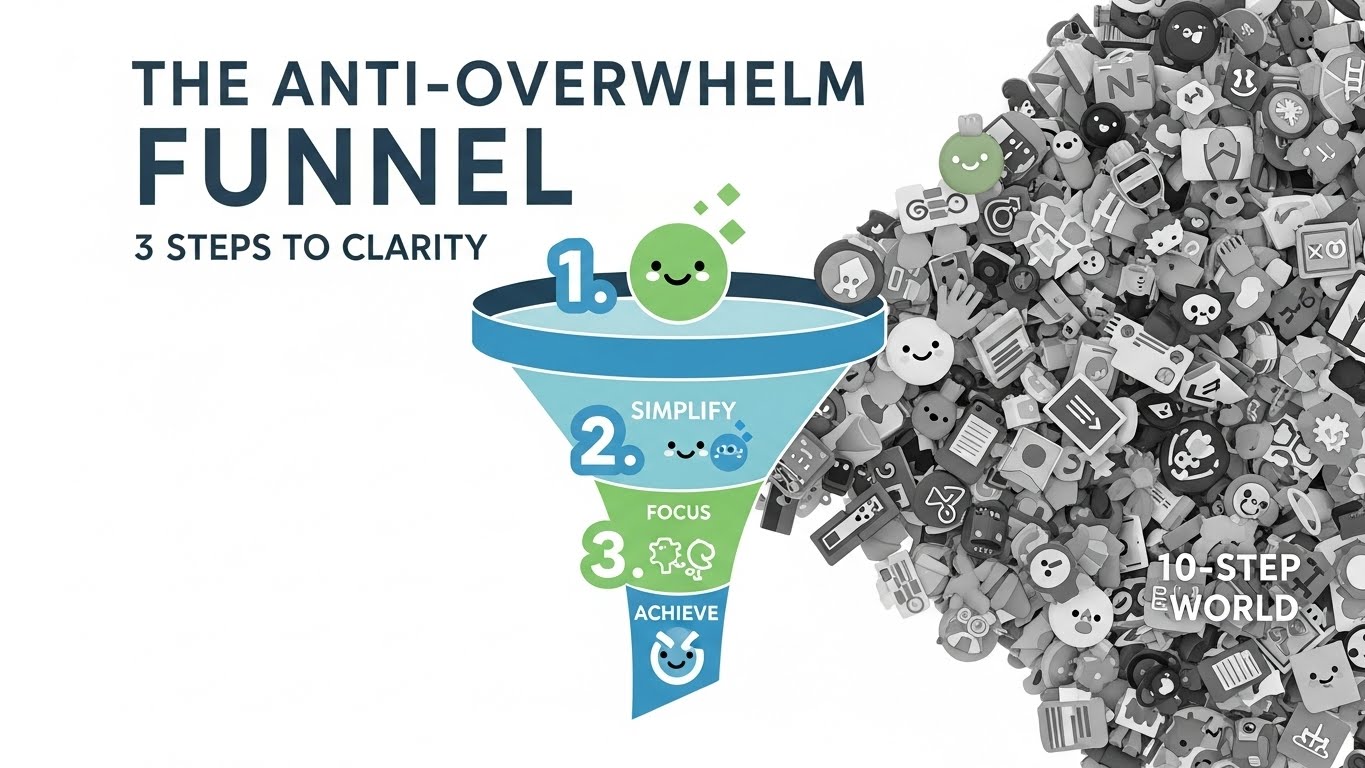
Awareness: Validate the Overwhelm
Permission: It’s Okay to Do Less
Education: Why Simple Works
Efficiency: Save Time, Get Results
Sustainability: Build Long-Term Habits
The Language of Less: How to Make Minimalism Aspirational
The Minimalism Messaging Framework
Marketing ‘Efficiency’ as a Primary Skincare Benefit
The Efficiency Marketing Framework
1. Quantify the Time Saved (Make It Tangible)
2. Position Efficiency as Intelligence, Not Laziness
3. Create Efficiency Metrics (Like Results Metrics)
4. The “Life Integration” Messaging (Efficiency in Context)
5. The Economic Value of Time Saved
Real Example: Glossier’s “Skin First, Makeup Second” Minimalism
Ready to Master Minimalist Skincare Marketing?
Content Strategy: Showing Less, Not Selling Less
“Real Morning Routine” Series
“The Overwhelm Confessional” Content
“Time Saved Calculator” Interactive Tool
“Declutter Your Shelf” Challenge
Overcoming the “But What About…” Objections
The Objection-Handling Framework
Objection: “But I have specific concerns—don’t I need targeted products?”
Objection: “Won’t I get bored with only 3 products?”
Objection: “How can 3 products compete with comprehensive systems?”
The Anti-Overwhelm Revolution: Winning Through Subtraction
Resources for Minimalist Skincare Brands