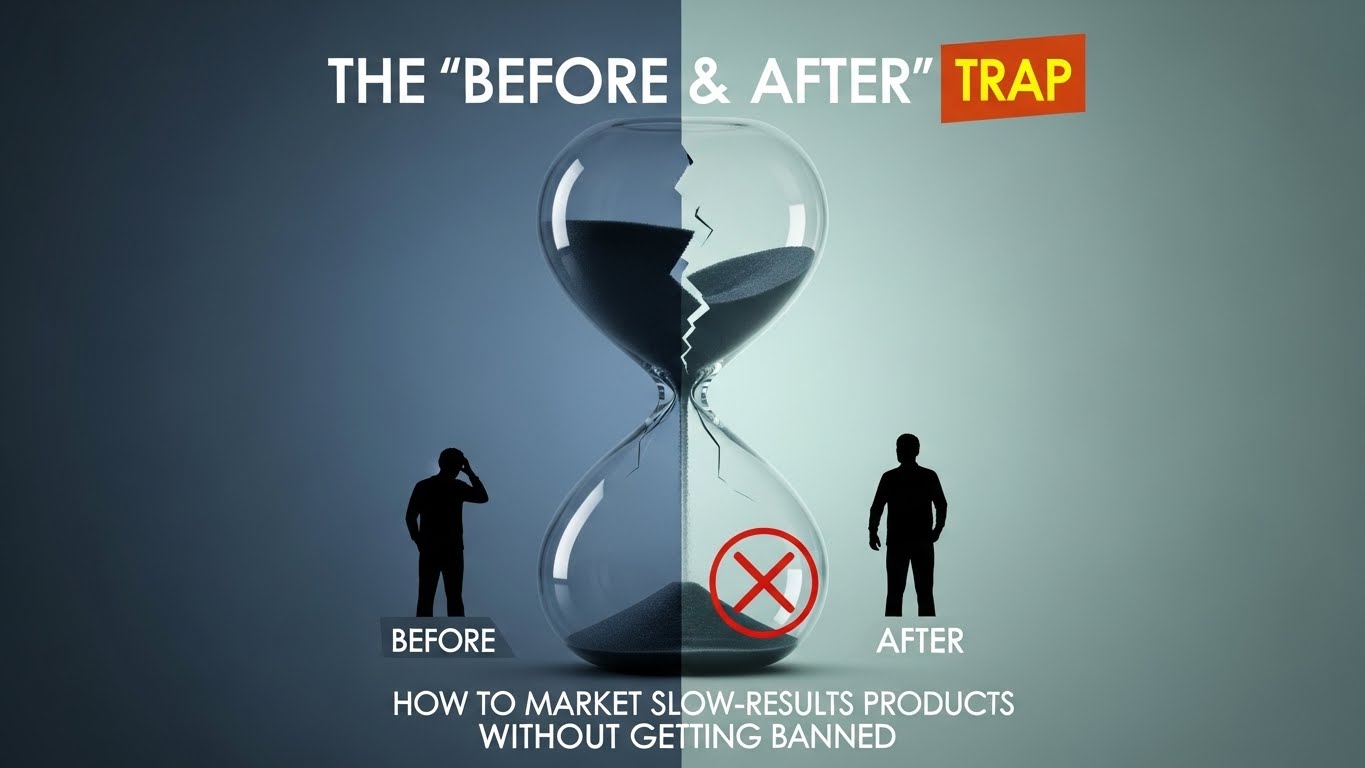
Building trust in gradual transformation and invisible results through honest, compliant marketing She posts the before/after: dramatic transformation, 2 weeks, glowing testimonial. 50,000 likes. 12,000 saves. Then the DM from the platform: “Your account has been restricted for misleading health claims. Appeal denied.” This is the before-and-after trap: your product works—retinol, peptides, barrier-repair formulas genuinely deliver results. But those results take 8-12 weeks, not 8-12 days. They’re subtle improvements in texture and tone, not miraculous overnight transformations. And you’re competing against brands posting heavily filtered, lighting-manipulated, possibly-not-even-the-same-person comparisons that get massive engagement despite being essentially fraud. The regulatory landscape has tightened dramatically. The FTC is cracking down on misleading before/after photos. Instagram and TikTok are removing content that makes unsubstantiated claims. Class-action lawsuits target brands whose products don’t deliver advertised results. Meanwhile, consumer skepticism has never been higher—78% of people distrust before/after photos, suspecting manipulation or cherry-picked best cases. But here’s the bigger challenge: how do you market products where results happen slowly or invisibly? Transdermal patches delivering actives beneath the skin’s surface. Prevention-focused treatments where “success” means aging you DON’T see. Barrier-repair serums where improvement is reduction in sensitivity, not visible transformation. The best results are often the hardest to photograph. This article will show you how to escape the before-and-after trap—marketing slow-results products through honest, compliant strategies that build trust rather than trigger bans, creating content that converts skeptics without manipulating them, and proving efficacy for invisible improvements like transdermal delivery where the magic happens underneath the visible surface. Before-and-after photos seem like the obvious marketing tool—visual proof that products work. But they’ve become the fastest way to lose credibility, violate platform rules, and attract regulatory scrutiny. Understanding why is essential to avoiding the trap. According to FTC guidelines, testimonials must reflect typical consumer experiences. If your before/after shows a best-case result, you must disclose that AND show what typical results look like. Most brands don’t—which is why regulatory enforcement is increasing. The key insight: before/after marketing fails because it optimizes for short-term engagement (dramatic transformations get clicks) at the expense of long-term trust and compliance. You need a different playbook. Strategy: “Most people see results in 8-12 weeks” in product description, not hidden fine print. Transparency builds trust; overpromising destroys it. Goal: Attract patient customers, not impatient complainers Strategy: Weekly or bi-weekly check-ins showing gradual improvement. “Week 0, Week 4, Week 8, Week 12” progression educates realistic timelines. Goal: Show transformation is gradual, building trust through honesty Strategy: “78% reduction in breakouts over 10 weeks” with tracking charts. Numbers are harder to fake, easier to verify, more credible than photos. Goal: Proof through measurement, not manipulation Strategy: Curate range of results—great, good, modest. “Results vary, here’s the spectrum.” FTC-compliant, builds realistic expectations. Goal: Honesty that protects from regulatory action and customer disappointment Strategy: For results that don’t photograph (prevention, transdermal, barrier-repair), use tech tools—VISIA scans, moisture meters, tracking apps showing improvement. Goal: Prove results that cameras miss through alternative visualization Core Principle: Honest results marketing isn’t about hiding transformation—it’s about showing it realistically. Set truthful timelines, document gradual progress, quantify with data, show typical outcomes, and find creative ways to prove invisible improvements. When you stop optimizing for dramatic before/afters and start optimizing for authentic documentation, you build sustainable trust that competitors’ fraudulent photos can’t match. Every results claim can be either manipulative or trustworthy depending on how you present it. Here’s the critical difference: Standardized conditions + Realistic timelines + Typical results distribution + Quantified measurements + Verification methods = Credible results marketing. The more transparent you are about process, the more trustworthy your outcomes become. Transdermal patches represent the ultimate marketing challenge: the most effective action happens invisibly beneath the skin’s surface. You’re asking customers to trust that something is working when they can’t see it, feel it, or photograph it. The delivery is subdermal—active ingredients penetrating through the stratum corneum into deeper layers where cellular repair actually occurs. This creates a paradox: the better your patch works (deeper penetration, sustained release, no surface irritation), the less obvious the immediate effects. Customers expect to “see” results, but true transdermal efficacy happens where cameras can’t reach. How do you prove invisible effectiveness without resorting to manipulated before/afters? The Challenge: “How do I know this patch is actually delivering anything?” The Visualization Strategy: Skin Layer Animation: Layer 1: Stratum Corneum (The Barrier) Show patch adhering to surface. “This is where most topical products stop—your skin’s protective barrier.” Layer 2: Epidermis (Active Penetration) Animate actives crossing barrier via occlusion + penetration enhancers. “The patch creates conditions that allow active molecules through.” Layer 3: Dermis (Target Zone) Show ingredients reaching fibroblasts, collagen structures. “This is where collagen production happens—where aging is actually reversed.” The Reveal: “You can’t SEE this happening because it’s happening millimeters beneath the surface. That’s not a flaw—that’s precision targeting. Surface changes take weeks. Deep cellular repair starts immediately.” Why this works: Makes invisible process visible through education, builds understanding of mechanism, reframes “no immediate results” as “working where it matters,” uses animation to show what photos can’t capture. The Challenge: Results happen deep—how to prove what cameras miss? The Measurement Arsenal: VISIA Skin Analysis Uses cross-polarized and UV light to reveal subsurface conditions—pigmentation, porphyrins, texture at dermal level. Shows changes invisible to naked eye. Example: “Week 0: 47 wrinkle score. Week 12: 32 wrinkle score. 32% improvement measured beneath the surface.” Ultrasound Imaging High-frequency ultrasound visualizes dermal density, collagen structure. Proves deep-layer changes over time. Example: “Dermal echo-density increased 18% over 16 weeks—that’s measurable collagen remodeling.” Corneometer & TEWL Meters Quantify barrier function improvements—moisture retention, water loss reduction. Numerical proof of effectiveness. Example: “Transepidermal water loss decreased 41%—barrier is measurably stronger.” Biomarker Testing For advanced claims: skin biopsy showing increased collagen type I/III ratio, reduced inflammatory markers (IL-6, IL-8), increased hyaluronic acid production. Example: “Clinical study: 34% increase in procollagen I synthesis at week 12.” Why this works: Technology measurement is objective, verifiable, impressive. “Our patch increased dermal density 18%” beats any before/after photo for credibility. Science-backed data converts skeptics. The Challenge: Not everyone has access to VISIA machines—what can regular users track? The Experiential Tracking: Track Non-Visual Improvements: The Reframe: “The best results aren’t always visible—they’re felt. When skin behaves better (less reactive, more resilient, better texture), that’s proof the patch is working where it matters: deep down.” Why this works: Gives customers trackable indicators they can monitor themselves, validates subtle improvements, teaches them to value non-visual results, builds experiential evidence beyond photos. The Challenge: Competitors promise instant results—how to make slow feel valuable? The Premium Positioning: The Messaging Shift: Instead of: “Results take 12 weeks (sorry)” The Luxury Brand Playbook: Luxury skincare (Augustinus Bader, La Mer) succeeds with slow-results products by positioning patience as sophistication. “Quick results fade quickly. Lasting results take patience.” They don’t apologize for timelines—they celebrate them as evidence of genuine efficacy. The Transdermal Application: “Our patches work at the dermal level—1-3mm beneath surface. That’s where collagen synthesis actually occurs. You won’t see change day-to-day, but at week 12, you’ll look back at week 0 photos and be shocked. Deep change is slow change. We don’t cut corners.” Why this works: Reframes delay as premium quality signal, attracts patient customers who value efficacy over instant gratification, positions brand as sophisticated rather than apologetic. The Strategy: Since transdermal results are gradual, document granularly. The Timeline Framework: Week 1-2: Barrier Optimization “You won’t see much, but patches are creating microenvironment for penetration. Skin may feel slightly smoother.” Week 3-4: Deep Delivery Phase “Actives reaching dermis. Fibroblasts beginning to respond. Plumpness may increase slightly.” Week 5-8: Cellular Remodeling “Collagen synthesis ramping up. Texture refinement becomes noticeable. Lines may appear softer.” Week 9-12: Visible Transformation “New collagen maturing. Dermal density increased. When you compare to week 0, difference is clear.” The Educational Benefit: This timeline teaches customers WHEN to expect WHAT, reducing frustration at week 2 when they “see nothing.” They understand they’re on schedule. Why this works: Granular timeline provides checkpoints customers can reference, teaches patience through understanding, validates that “not seeing results yet” doesn’t mean “not working.” The Strategy: Show why transdermal is superior to alternatives. Why this works: Positions transdermal as optimal delivery system, educates on penetration science, justifies premium positioning through superior mechanism. ZO Skin Health sells expensive serums with slow, invisible results (growth factors working at dermal level). They succeed by: (1) Setting 12-week expectation upfront, (2) Providing week-by-week timeline of what’s happening beneath surface, (3) Using VISIA scans to show subsurface improvements, (4) Positioning delay as sophistication (“real transformation takes patience”), (5) Educating on dermal vs. epidermal action, and (6) Showing comparative delivery method advantages. They never apologize for slow results—they celebrate them as proof of deep efficacy. Result? Customers who understand invisible results are the best results, and pay premium prices for products that don’t photograph dramatically but deliver genuine cellular change. Their education-first approach proves that when you teach WHY results take time, customers become advocates rather than complainers. When you build trust for transdermal patches through visualizing the invisible journey, using technology-assisted measurement, tracking non-visual improvements, positioning patience as premium, documenting micro-progress granularly, and comparing delivery superiority—you transform “I can’t see it working” into “I understand it’s working where it matters.” The magic happening underneath becomes your marketing advantage, not your obstacle. Learn the proven strategies successful brands use to market slow-results products without misleading claims, build trust in invisible improvements, and create compliant content that converts skeptics—all while avoiding the before/after trap that gets competitors banned. Explore the Beauty Marketing Course → Build trust through honesty—the only sustainable marketing Honest results marketing requires content formats that maintain engagement during the wait. Here’s how to keep audiences invested in gradual transformation: Weekly or bi-weekly check-ins showing gradual progression: Example: “Sarah’s 12-Week Transformation: Week 4 update—texture improving, no dramatic visible change yet but plumpness increasing. Here’s what’s happening beneath the surface…” Makes the wait part of the story. Quantified metrics visualized over time: Example: Line graph showing hydration measurements rising week-over-week, or acne count decreasing progressively. “Numbers don’t lie—see the improvement trend.” Data makes slow visible. Teach the science during treatment period: Example: “Week 6 of your patch journey? Here’s what’s happening in your dermis right now—fibroblast activation, collagen synthesis beginning…” Content that fills the waiting period educationally. Turn the timeline into community event: Example: “Starting your journey? Take week 0 photo. Set reminder for week 12. Compare then. Tag us with #12WeekGlow” Creates anticipation, validates timeline, builds community of patient users. Beyond honest marketing, you need legal protection from claims violations. Here’s what to document: Document methodology, sample size, control group, measurement methods. Link to full study or provide summary with statistical significance. “Results not typical” disclaimer if showing exceptional case. Better: show range of results with percentages (“67% saw significant improvement”). Document: same camera, lighting setup, angle, distance, time of day, no makeup policy. Proves photos aren’t manipulated through conditions. Clearly state expected timeframe. “Typical results seen within 8-12 weeks of consistent use.” Protects from “didn’t work in 2 weeks” complaints. Prevention is cheaper than litigation. Document everything, disclose everything, standardize everything. Honest marketing isn’t just ethical—it’s legal protection. The before-and-after era is ending—not because transformation doesn’t sell, but because fraudulent transformation has destroyed trust. Platforms are cracking down. Regulators are watching. Consumers are skeptical. And honest brands are stuck competing against manipulated photos that get engagement despite being essentially lies. But this isn’t a crisis—it’s an opportunity. When competitors get banned for misleading content, when lawsuits shut down brands making unsubstantiated claims, when consumers learn to distrust dramatic transformations… the brands that survive will be those that built trust through honesty from the beginning. “The future of results marketing isn’t about better before/after photos—it’s about proving efficacy beyond photos. Setting realistic timelines upfront. Documenting gradual transformation honestly. Using data over drama. Showing typical results, not cherry-picked miracles. Making invisible improvements visible through technology and education. Building trust in transdermal delivery by visualizing the journey beneath the surface. Positioning patience as premium. When you optimize for truth rather than engagement, you attract customers who value efficacy over miracles—and those customers become lifelong advocates. The before/after trap closes when you realize the best marketing doesn’t manipulate expectations; it manages them honestly.” So escape the before-and-after trap. Set 12-week expectations in product descriptions. Create journey series showing gradual improvement. Use moisture meters, VISIA scans, and texture measurements instead of filtered photos. Show range of results, not just best cases. Visualize transdermal delivery through animation. Track non-visual improvements like plumpness and sensitivity reduction. Position slow results as sophisticated. Because honest marketing isn’t just ethical—it’s the only marketing that lasts. Market slow results honestly. Build trust in invisible improvements. Win through transparency. ⏳✨ Share this guide with skincare brand founders! Keywords: before after marketing compliance, slow results skincare, transdermal patch marketing, honest results documentation, FTC advertising guidelines, invisible skincare results, gradual transformation marketing, clinical claims compliance, patient-driven marketingWhy Before/After Marketing Fails (And Gets You Banned)
The Six Fatal Flaws of Before/After Marketing
Impossible to verify authenticity: Lighting, angles, makeup, filters—consumers assume manipulation even when photos are genuine
Platform violations: Instagram/TikTok/Facebook increasingly flag health transformation claims as misleading
FTC scrutiny: Testimonials must be “typical” results—cherry-picked best cases violate truth-in-advertising standards
Slow results don’t photograph well: 12-week improvements are subtle—legitimate photos look underwhelming compared to competitors’ fraudulent ones
Invisible results can’t be photographed: Prevention, barrier-strengthening, transdermal delivery—real benefits that don’t show visually
Creates unrealistic expectations: Customer sees dramatic 2-week transformation, tries product, gets realistic 12-week gradual improvement, feels deceived, leaves bad reviewThe Honest Results Marketing Framework
Set Realistic Timelines Upfront (Manage Expectations)
Document the Journey, Not Just Endpoints (Process Over Perfect)
Use Quantified Metrics, Not Just Photos (Data Over Drama)
Show “Typical” Results, Not Cherry-Picked Best (Compliance First)
Visualize the Invisible (Creative Proof Methods)
Deceptive vs. Honest Results Documentation
The Honesty Formula
How to Build Trust for Transdermal Patches (Where the Magic Happens Underneath)
The Transdermal Trust Framework: Proving the Invisible
1. Visualize the Journey (Animation & Cross-Section Diagrams)
2. Technology-Assisted Proof (Beyond Visual Assessment)
3. The “Feeling Evidence” Strategy (Qualitative Markers)
4. The Delayed Gratification Narrative (Patience as Premium)
Say: “True cellular transformation takes 12 weeks. Quick fixes are surface-level. We’re targeting the dermis—where real aging reversal happens. That takes time. It’s worth it.”5. Micro-Progress Documentation (The Week-by-Week Journey)
6. Comparison to Alternative Delivery Methods
Method
Penetration Depth
Why Transdermal Wins
Standard Serum
Surface only (stratum corneum)
Patches occlude + enhance penetration
Microneedling
Creates channels (traumatic)
No trauma, sustained release vs. one-time
Injection (Botox/filler)
Deep but invasive
Non-invasive, at-home, gradual
Oral Supplements
Systemic (not targeted)
Localized to treatment area, higher concentration
Real Example: ZO Skin Health’s Growth Factor Serum Approach
Ready to Master Honest Results Marketing?
Content Strategy: Making Slow Results Engaging
“Journey Series” Documentation
“Data Over Drama” Tracking Charts
“Education While You Wait” Series
“Compare at 12 Weeks” Challenge
Legal Protection: CYA Documentation
The Compliance Checklist
✓ Clinical Study Results (If Making Claims)
✓ Consumer Testimonial Disclosures
✓ Photo Standardization Protocol
✓ Timeline Disclaimers
Beyond Before/After: The Trust-First Marketing Revolution
Resources for Compliant Marketing