Table of Contents
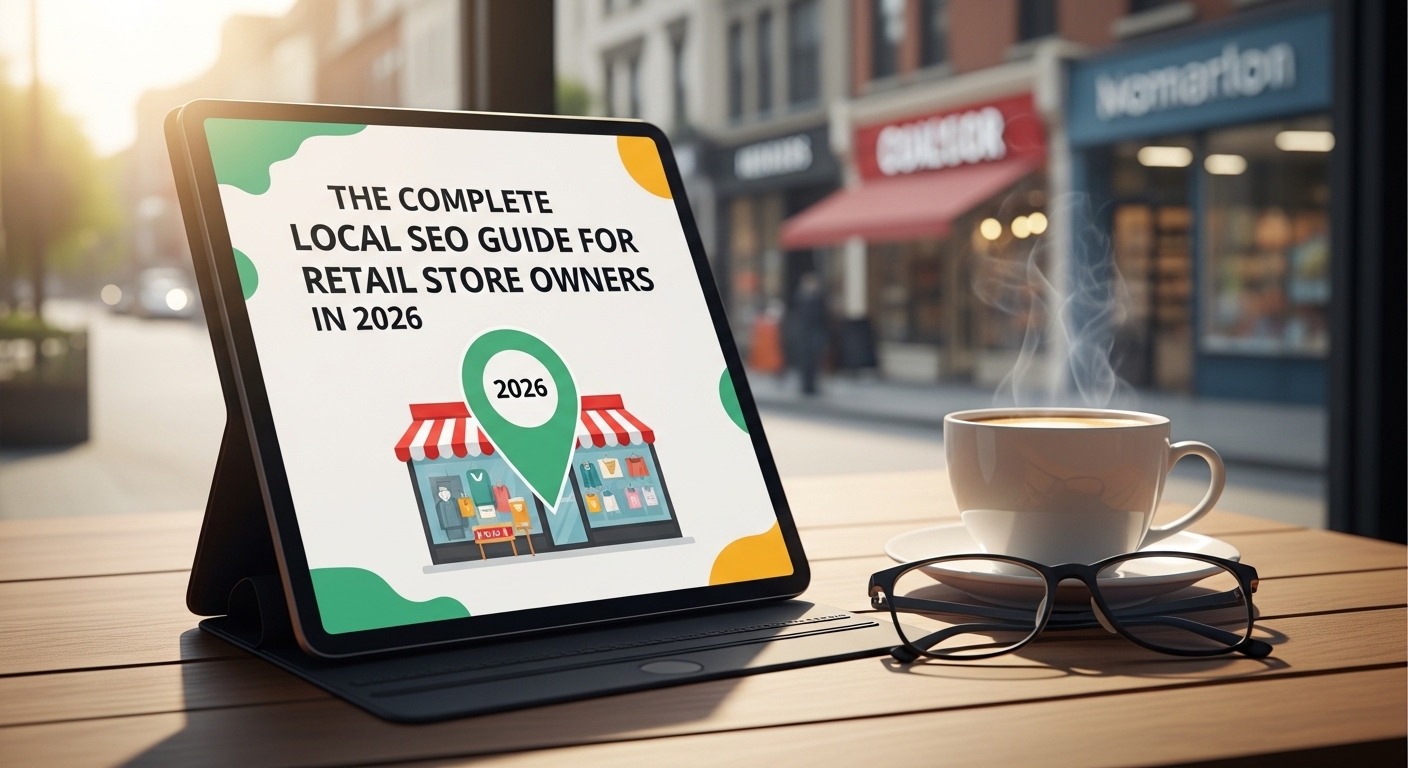
If you own a physical retail store in 2026, local SEO is no longer optional. It’s the difference between a full store and an empty one. It’s the difference between your business showing up when a customer types “[your product] near me” — or sending that customer directly to your competitor three blocks away.
The good news: local SEO for retail is learnable, actionable, and remarkably affordable when you understand what actually moves the needle. Agencies charge $1,500–$5,000 a month to implement strategies that, once mastered, take an hour a week to maintain.
This is the most complete, up-to-date local SEO guide written specifically for retail store owners — covering every ranking factor, every tool, and every tactic you need to get found on Google in 2026 and beyond.
What Is Local SEO — And Why It’s Your #1 Priority
Local SEO (Search Engine Optimization) is the practice of optimizing your online presence so your business appears prominently when people in your area search for products or services you offer.
Unlike traditional SEO — which focuses on ranking in standard search results globally — local SEO targets searches with geographical intent: “coffee shop downtown,” “hardware store open now,” “best running shoes near me.”
According to Think with Google, 4 in 5 consumers use search engines to find local information, and local intent searches convert at dramatically higher rates than generic searches.
How Google’s Local Algorithm Works in 2026
Google uses three primary factors to determine which businesses appear in the Local Pack (the map results) and local organic results. Understanding these factors is the foundation of everything else in this guide.
🆕 What’s Changed in 2026: Key Algorithm Updates
Google’s AI Overviews now summarise local options — businesses with comprehensive, well-structured GBP profiles are featured more often.
Reviews from the past 90 days now carry significantly more weight. Ongoing review generation is more important than ever.
Core Web Vitals, mobile speed, and HTTPS are now hard requirements for competitive local rankings.
Thin product pages no longer rank. Retailers with content that answers real local questions outperform those with catalogue-only sites.
Google Business Profile — The Foundation of Local SEO

Your Google Business Profile (GBP) is the most powerful free marketing tool available to a retail store. It controls what appears on Google Maps, in the Local Pack, and on your Knowledge Panel. Yet most retailers treat it as a one-time setup — a fatal mistake.
⚡ 2026 GBP Power Move: Google now surfaces GBP content directly in AI Overviews. Businesses that post regular GBP updates with keyword-rich captions and answer common questions via the Q&A feature are being featured in AI-generated local summaries — free, high-visibility placement that most retailers are completely ignoring.
Local Keyword Research for Retailers
Keyword research for local retail is different from national SEO. You’re not chasing the highest-volume terms — you’re targeting high-intent, location-specific phrases that your actual customers type when they’re ready to visit a store like yours.
The 4 Local Keyword Categories Every Retailer Needs
Category 1: “Near Me” Terms
High buying intent. Targets mobile searchers ready to visit now.
“pet store open now near me”
“shoe store near me open Sunday”
Category 2: City + Product
Core local SEO terms. Include on all key pages of your website.
“vintage clothing Portland”
“organic grocery store Denver”
Category 3: Neighbourhood Level
Ultra-low competition, hyper-local. Dominant for nearby searches.
“hardware store Capitol Hill Seattle”
“florist Williamsburg Brooklyn”
Category 4: Question Keywords
Blog content goldmine. Captures early-stage buyers researching options.
“where to buy vintage records [city]”
“how to find a good bike shop near me”
Free Keyword Research Tools for Retail
Free. Shows the exact queries people use to find your site today.
Compare keyword demand in your specific city or region over time.
Visualises all questions people ask around your keywords. Free (3/day).
Free with Google Ads account. Shows search volume by location.
On-Page SEO Essentials for Retail Websites

On-page SEO ensures Google can crawl your website, understand your location and what you sell, and decide your pages are relevant to local searches. Here’s the complete on-page checklist for 2026:
📄 Title Tags
Format: [Primary Keyword] in [City] | [Brand Name]
Keep under 60 characters. This is the #1 on-page ranking signal.
📝 Meta Descriptions
150–160 characters. Include your main keyword, a benefit, and a call to action. Affects click-through rate dramatically.
🏷️ H1 & Header Hierarchy
One H1 per page containing your primary keyword. Use H2–H3 for sections. Never use headers as decorative text — Google reads them as signals of page content.
📍 NAP Consistency
Name, Address, Phone in your website footer (sitewide) and Contact page. Must be identical to your GBP. Even “St.” vs “Street” inconsistencies weaken your local signals.
🗺️ Embedded Google Map
Embed your Google Maps listing on your Contact/About page. Creates a direct location signal linking your website to your physical address. Surprisingly underused.
🖼️ Image Alt Text
Every image needs descriptive alt text with relevant keywords. Google can’t see images — it reads the description you provide.
💡 Advanced: Create Location-Specific Landing Pages
If you serve multiple neighbourhoods or have more than one location, create a dedicated page for each area. Example: yourstore.com/lower-east-side-nyc. Each page should have unique, locally-relevant content — not duplicated text with just the city name swapped.
Reviews — Your Most Powerful Ranking Signal
Why Reviews Are Non-Negotiable in 2026
In 2026, review recency matters more than ever. Google’s algorithm now places significantly higher weight on reviews received in the past 90 days. This means review generation must be an ongoing system — not a one-time push.
Your Automated Review Generation System
In your GBP dashboard, click “Get more reviews” to get your unique short URL. Save it to your phone’s home screen.
After a positive interaction: “We’d love a Google review — it makes a huge difference for us.” Then text the link directly.
Print a card: “Love your visit? Scan to leave us a review.” Use QR Code Generator (free).
3 days post-purchase: “How did we do? A 60-second Google review means the world to our team.” Always include the direct link.
Google confirmed that responding to reviews is a ranking factor. For negative reviews: thank them, acknowledge the issue, invite offline resolution.
Also collect reviews on Yelp and TripAdvisor (for experience-based retail). Multi-platform review presence strengthens overall prominence.
Local Citations & Directory Authority
A local citation is any online mention of your business’s Name, Address, and Phone Number (NAP). Google uses citation volume and consistency as a trust signal. The more consistent your NAP data across the web, the more Google trusts that your business is legitimate and accurately located.
Use Moz Local or Whitespark’s Citation Finder to run a free audit showing which directories your competitors are listed in that you’re not.
Local Content Strategy That Attracts & Converts

Content is what earns you organic search rankings beyond the Local Pack. A retailer who publishes consistent, helpful, locally-relevant content captures customers at every stage of the buying journey — from “what should I buy?” all the way to “where should I buy it near me?”
In 2026, Google’s “Helpful Content” standards mean thin, keyword-stuffed pages no longer rank. Content must be genuinely useful, written with real expertise, and relevant to an actual local audience.
“The best local content answers the question your customer would ask a knowledgeable friend — not a search engine. Write that answer first. Then optimise.”
Technical SEO Checklist for 2026
Technical SEO ensures Google can efficiently crawl, index, and rank your website. In 2026, Core Web Vitals are a hard ranking requirement for competitive local markets — not just a nice-to-have.
Core Web Vitals
LCP, FID, CLS. Test free at PageSpeed Insights. Target: LCP under 2.5s, CLS under 0.1. Compress all images using TinyPNG.
Mobile-First Design
Google indexes mobile version first. Test at Google’s Mobile-Friendly Test. 63% of local searches happen on mobile.
HTTPS / SSL
Must have https:// — Google penalises http:// sites. Most hosts offer free SSL via Let’s Encrypt.
LocalBusiness Schema
Structured data that tells Google your business type, hours, address, and more. Generate free at Schema Generator. Paste in <script type="application/ld+json"> tags.
XML Sitemap
Submit your sitemap in Google Search Console. WordPress: use Yoast SEO (free). Shopify & Squarespace generate sitemaps automatically.
Internal Link Structure
Link blog posts to product/service pages with keyword-rich anchor text. Your homepage should link to 3–5 key category pages. This distributes “link equity” to your most important pages.
Tracking, Metrics & Your Monthly SEO Routine
Sustainable local SEO isn’t a one-time project — it’s a monthly maintenance routine. Here’s what to track, with which free tools, and how often:
🗓️ Your Monthly Local SEO Routine (Under 3 Hours)
You’ve Got the Map.
Now Get the Guided Tour.
This guide gives you the full picture of local SEO. The Retail Marketing Course at Easy Marketing School takes you further — with step-by-step video walkthroughs, done-for-you templates, and a complete marketing system built specifically for retail store owners ready to grow without guesswork.
🚀 Enroll in the Retail Marketing Course →
Join retail store owners across the country already growing with this system
The Local SEO Advantage Is Yours to Take
The retailers who rank at the top of Google in your market are not there by luck. They’ve built a system: a complete, consistent, and compounding local SEO presence that earns more visibility every month without increasing ad spend.
The good news is that most of your competitors have not done this yet. Local SEO remains one of the most underleveraged growth channels in retail — especially for independent stores and small chains. That means the window of opportunity is wide open.
✅ Your 90-Day Local SEO Action Plan
Start with Step 1 of Chapter 3 — your Google Business Profile. Do it today, not tomorrow. Every week you delay is a week your competitors have the advantage. Once you start, the momentum compounds. Six months from now, your visibility will look completely different.
#RetailMarketing
#GoogleBusiness
#SmallBusiness2026