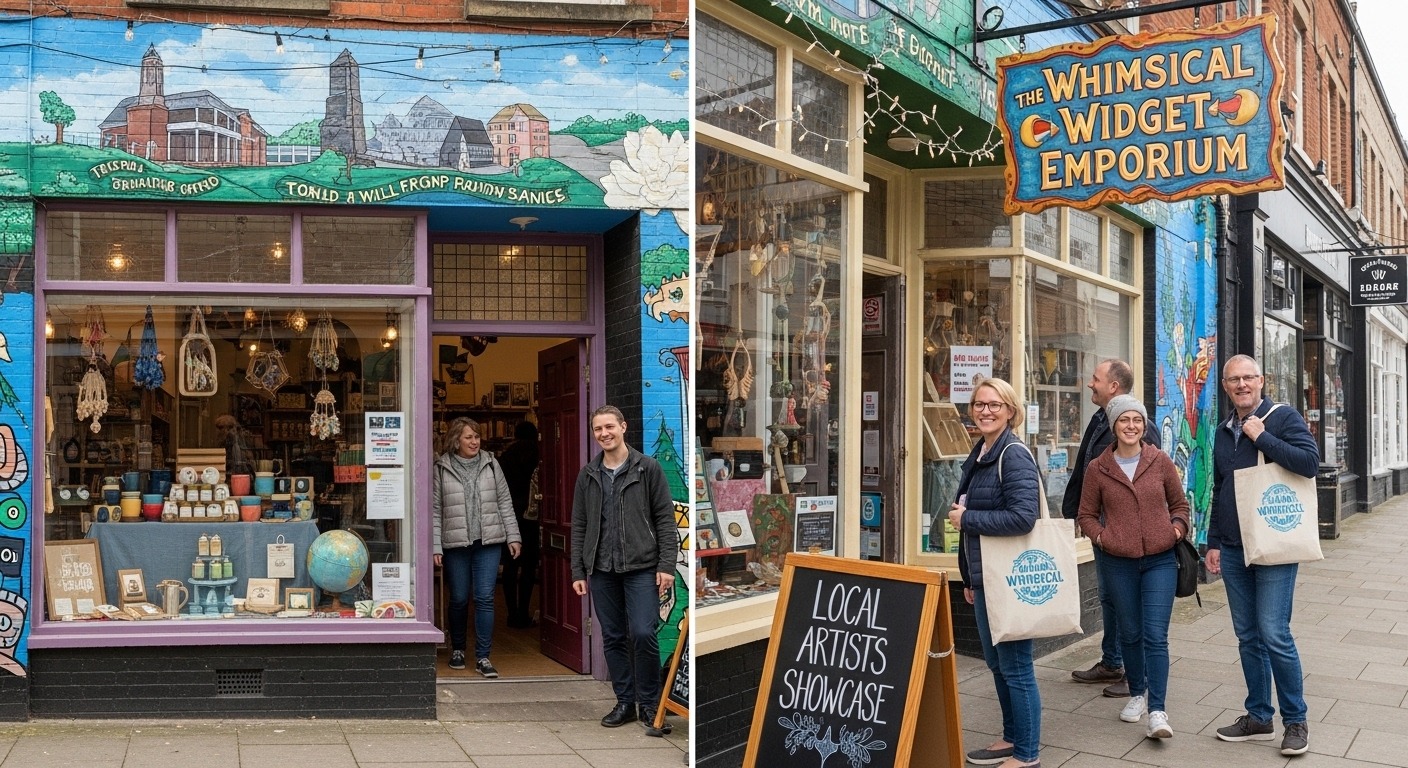
Every town has them — shops that feel like they belong, that carry a neighbourhood’s identity, that regulars defend with passion. And every town has the other kind: functional, adequate, forgettable. Open on the high street but invisible in people’s minds.
The commercial difference between these two types of stores is not subtle. According to McKinsey’s research on local retail performance, independent stores that achieve genuine brand recognition in their communities see 3–7× higher customer lifetime value and 40% lower customer acquisition costs. Their reputation does the acquisition work for them.
This guide unpacks exactly what separates forgettable from iconic — across seven concrete dimensions — and gives you the practical tools to close the gap in your own store.
The Gap That Separates
Forgettable from Iconic
The gap is not product quality. It’s not price. It’s not even location, though these things matter at the margins. The gap is almost entirely one of intentionality — the degree to which a store is deliberately built around a clear identity, a specific community, and consistent values, rather than simply stocking goods and waiting for footfall.
| The Forgettable Store | The Iconic Local Brand ★ |
|---|---|
| Defined by what it sells | Defined by what it stands for |
| Competes on price and range | Competes on identity, expertise, and belonging |
| Serves whoever happens to come in | Intentionally attracts a specific community |
| Easy to replace — alternatives exist nearby | Irreplaceable — no substitute delivers the same thing |
| Posts on social when there’s a sale | Creates content that builds anticipation and loyalty |
| Marketing is an expense | Marketing is an investment that compounds over time |
| Would be missed by few if it closed | Would be mourned as a genuine community loss |
If your store closed tomorrow, would your community feel a genuine loss — or just mild inconvenience? The honest answer is the most accurate diagnosis of where you sit on the forgettable-to-iconic spectrum. The better news: irreplaceability is built, not inherited.
Seven dimensions separate forgettable stores from iconic local brands. Each one is a deliberate choice — not a stroke of luck. Below we break them down one by one, with the research to back them up and the practical action to close each gap.
01
Identity vs. Inventory
The most fundamental difference
The most fundamental divide between forgettable and iconic is this: one is defined by what it sells, the other by what it believes. Inventory can be replicated by any competitor with a wholesale account. Identity cannot be replicated — because it is genuinely yours.
An iconic brand has a point of view. It has opinions about the right way to do things, the standards worth upholding, and — crucially — the things it will not do even if they’d be profitable. This clarity of identity is felt by customers instantly, and it creates a magnetic attraction that no promotional campaign can manufacture.
Ask: what would I refuse to sell even if it were profitable? What do my best customers believe about this category that most people don’t? The intersection of those answers is the core of your brand identity.
Your identity passes the test when a regular customer can complete this sentence without hesitation: “I shop there because they’re the kind of place that…” — and five different customers say the same thing.
Action: Write three belief statements that complete: “We are the store for people who believe that…” — then audit whether your product range, pricing, staff, and content actually reflect those beliefs. The gaps are your brand-building agenda.
02
Community vs. Customer Base
The self-sustaining growth engine
A customer base is a collection of individual buyers. A community is a group of people who feel connected to each other through a shared brand. The distinction is commercially enormous: communities are self-sustaining ecosystems that grow through peer recommendation and shared identity, while customer bases require constant acquisition spending just to maintain.
by community members
new customers
acquisition cost
Source: Harvard Business Review on Brand Communities & McKinsey Local Retail Research
Building a community requires your store to provide something beyond product — a context for belonging. This happens through events, shared rituals, consistent content that reflects community values, and staff who are genuine members of the community themselves, not just employees.
Action: Host one event per month — a tasting, workshop, maker showcase, or product launch. Invite regulars to bring one person. Create a reason to gather that is not primarily about selling. Measure what happens to your customer relationships within 90 days.
03
Story vs. Stock List
The medium through which meaning travels
Forgettable stores sell products. Iconic brands tell stories — about the products, about themselves, about their customers, and about the community they serve. Story is how meaning travels from brand to buyer, and meaning is the foundation of all genuine loyalty.
Founding Story
Why did you start this store? What gap were you filling? Your origin story is the most powerful piece of brand content you’ll ever publish.
Product Stories
Where does each product come from? Who made it? Why did you choose it over alternatives? These stories transform stock into curated selection.
Customer Stories
Who are the people who love your store? What have they made or done because of something they found here? Customer stories are your most credible endorsements.
Community Stories
How is your store embedded in the life of your neighbourhood? What local makers, events, and history are you connected to? These make you irreplaceable.
According to Content Marketing Institute research, brands with consistent editorial content see 6× higher conversion rates than those without — because the content builds expertise and trust before any sales conversation begins. Your stories are your most efficient sales tool.
04
Experience vs. Transaction
Visits that become stories
A transaction is when someone gives you money and you give them a product. An experience is when someone gives you money, receives a product, and leaves with a story to tell. Iconic local brands understand that their shop floor is a stage and every customer interaction is a chance to create a memory that gets retold.
When a first-time customer walks in, is the first thing they see, hear, and smell an intentional brand choice?
Is there anything in your store specifically designed to be photographed and shared on social media?
Do your staff have genuine conversations, or do they stick to “can I help you?” and “will that be all?”
Is there a specific moment in the visit designed to be delightful, surprising, or memorable?
Does your packaging make customers feel like they’re taking something special home — or just containing a product?
Does anything happen after a visit? A note, a follow-up, or a reason to return that isn’t a discount code?
Do your staff know regular customers by name — and do those customers know your staff by name?
Is there a specific story associated with your store that customers retell to others unprompted?
More than 4 “no” answers means your store is a transaction point, not an experience destination. Each “no” is a specific design opportunity.
PwC’s Future of Customer Experience survey found that 73% of consumers name experience as a key purchase factor, and 43% will pay more for a superior experience even when the product is identical elsewhere. Experience is a universal competitive advantage — not a premium-only luxury.
05
Consistency vs. Randomness
How brand recognition is built
Brand recognition — the mechanism through which iconic brands become iconic — is built through consistency over time. Not consistency of products (which can evolve), but consistency of voice, values, aesthetic, and quality of experience. Every consistent encounter compounds the customer’s confidence in you.
Same palette, typography, and photography style across every touchpoint — store, social, website, packaging, and signage. Every encounter should look unmistakably like you, before anyone reads a word.
A recognisable, consistent brand voice — whether warmly personal, wryly expert, or boldly opinionated. The same voice must appear in Instagram captions, emails, product labels, and staff conversation.
Reliably excellent on good days and bad days alike. Premium customers will forgive an occasional lapse; they will not forgive unpredictability. Inconsistency destroys the trust that consistency builds.
Every decision — suppliers chosen, products dropped, events hosted, causes supported — must be legible through the lens of stated brand values. Inconsistency between words and actions destroys brand equity faster than almost anything else.
According to Lucidpress research on brand consistency, businesses presenting a consistently expressed brand across all channels see an average 23% revenue increase compared to inconsistently presented brands.
06
Opinion vs. Neutrality
Brands worth talking about have a point of view
Forgettable stores are relentlessly neutral. They stock a range wide enough to appeal to everyone, communicate in language bland enough to offend no one, and avoid any position that might cause disagreement. The result: a brand that stands for nothing — and people don’t build loyalty to nothing.
Iconic local brands have opinions. They’ll tell you which product they’d buy themselves. They’ll explain why they don’t stock something even though it would sell. They’ll share a perspective on their category that isn’t universally agreed. This willingness to have a point of view is precisely what creates the magnetic pull for customers who share those views.
Independent bookshop: “We don’t discount. The full price of a book reflects the years a writer invested in creating it. That’s worth paying.”
Natural food store: “We won’t stock a product if we can’t verify where every ingredient comes from. That means a smaller shelf — and every product on it is something we genuinely believe in.”
Kitchen shop: “We stock 40 knives, not 400. Because we’ve used every single one — and we’d rather tell you which three will actually change how you cook.”
Coffee roaster: “We close Sundays. Because our staff deserve a proper day off, and our regulars can wait until Monday. The coffee tastes better on a Tuesday anyway.”
Notice each example will actively repel some potential customers. That’s the point. Seth Godin’s “Purple Cow” principle, validated by decades of brand research, shows that the brands most worth talking about are those most specific in their perspective — which necessarily means they are not for everyone. Fear of having an opinion is what keeps stores forgettable.
07
Long Game vs. Short Game
Different time horizons produce different brands
Forgettable stores optimise for this week’s revenue. Iconic local brands optimise for the next decade’s reputation. This time-horizon difference produces dramatically different decisions across pricing, staff investment, community engagement, and marketing.
| Decision Area | Short Game Thinking | Long Game Thinking ★ |
|---|---|---|
| Pricing | Discount to drive this weekend’s volume | Protect price integrity; compete on value and identity |
| Staffing | Hire cheap; minimise payroll | Hire for passion; invest in knowledge and ownership |
| Social media | Post when there’s a sale or new product | Publish consistently to build a loyal audience |
| Community | Only engage when there’s direct commercial benefit | Invest in presence as a long-term brand and goodwill asset |
| Complaints | Resolve quickly; minimise refund | Resolve generously; turn the complaint into a loyalty story |
| Success metric | This week’s revenue vs last week | Customer lifetime value, NPS, referral rate, reputation reach |
The long-game orientation doesn’t mean ignoring short-term financial reality — it means making short-term decisions within a long-term strategic framework. Every decision that erodes brand equity to fund present comfort is borrowing against future revenue at a very high interest rate.
🎓 Retail Marketing Course
KNOW THE SEVEN
DIMENSIONS.
NOW EXECUTE THEM.
The Retail Marketing Course at Easy Marketing School walks you through the complete system to build an iconic local brand — covering brand positioning, community strategy, content marketing, social media, local SEO, customer loyalty, and more. Designed specifically for independent retail store owners ready to become irreplaceable in their communities.
✦ Community Building
✦ Content & Social
✦ Local SEO
For store owners building brands their community can’t forget
Your 90-Day
Transformation Roadmap
Moving from forgettable to iconic is a staged, deliberate process. Here’s a 90-day roadmap that any independent retailer can execute without external agencies or significant budget:
01
Days 1–30
02
Days 31–60
03
Days 61–90
★ Your Iconic Brand
Action Checklist
Dimension 1 — Identity
Dimension 2 — Community
Dimensions 3 & 4 — Story & Experience
Dimensions 5 · 6 · 7 — Consistency, Opinion & Long Game
The Bottom Line
The gap between a forgettable store and an iconic local brand is not a gap of money, size, or luck. It is a gap of intentionality. Every dimension covered in this guide — identity, community, story, experience, consistency, opinion, and long-game thinking — is a deliberate choice, available to any store owner willing to do the work.
The iconic local brands we all know — the ones we’d genuinely mourn if they closed, recommend without being asked, and feel quietly proud to be regulars of — were not accidents. They were built with patience, conviction, and a relentlessly clear sense of who they were for and what they stood for.
The most powerful competitive advantage available to any independent retailer isn’t a larger budget, a better location, or a lower price. It’s a brand so authentically itself, so embedded in its community, and so consistent in its delivery of a distinct experience that no competitor — however well-funded — can simply replicate and deploy. That brand starts with a decision to stop being a store and start being a landmark.