Turning multi-generational expertise into competitive advantage when everyone else is “new and innovative” “Our family has been making this cream for three generations.” She reads the label. Her first thought: “Is this outdated, or is this trustworthy?” In a beauty industry obsessed with “breakthrough” and “revolutionary,” heritage brands face a paradox—decades of expertise can signal either unmatched credibility or irrelevant tradition. The skincare market is flooded with startups promising “game-changing innovation” and “never-before-seen formulas.” Meanwhile, heritage brands—with actual decades of formulation expertise, multi-generational clinical knowledge, and proven safety records—struggle to communicate why longevity matters when everyone’s chasing the next new thing. But here’s what the data shows: 68% of consumers report trusting heritage brands more than startups for sensitive skin concerns, and 72% say they’d pay premium prices for products with proven multi-generational track records—IF brands can communicate that heritage effectively. Brands like Kiehl’s (founded 1851), Weleda (founded 1921), and La Roche-Posay (pharmacy legacy since 1975) have built billion-dollar businesses by positioning heritage as reliability, not stagnation. This article will show you how to build the “Heritage Funnel”—a framework for marketing family legacy and clinical trust as competitive advantages, positioning gentle efficacy as sophisticated strength (not weakness), and winning in crowded markets by emphasizing what startups can’t fake: time-tested expertise. Modern consumers simultaneously want cutting-edge innovation AND time-tested reliability. Understanding this paradox—and how heritage brands can satisfy both desires—is essential to effective marketing. According to Nielsen research, heritage brands outperform startups in consumer trust by 43% for products addressing sensitive or medical skin concerns. Legacy matters when stakes are high. The key insight: heritage isn’t about living in the past—it’s about having a longer track record of doing something right. Time is your evidence. Strategy: “Started in Grandma’s kitchen, perfected in our lab over 40 years.” Bridge tradition with modern science. Goal: Heritage as foundation, not limitation Strategy: “Used safely for 3 generations” trumps “clinically tested for 12 weeks.” Time IS clinical data. Goal: Decades of use = ultimate validation Strategy: “Third-generation dermatologist” or “Family of pharmacists since 1950.” Expertise inherited, not just hired. Goal: Position family knowledge as advanced specialization Strategy: “Original formula, modern delivery system.” Show continuous improvement while honoring roots. Goal: Not stuck in past—building on proven foundation Strategy: “The cream your grandmother trusted, now in your daughter’s routine.” Foster generational loyalty. Goal: Customer lifetime value spanning decades, not years Core Principle: In a market chasing novelty, heritage brands win by positioning time as proof. Decades of safe, effective use across generations isn’t old-fashioned—it’s the most rigorous clinical validation possible. You’re not selling the past; you’re selling proven reliability that startups simply can’t claim yet. The wrong heritage language makes you sound outdated. The right language makes you sound time-tested. Here’s how to position legacy as strength: [Original creation date/generation] + [Continuous improvement action] + [Modern validation]. Example: “Developed by our founder in 1980, refined through decades of dermatological feedback, now backed by clinical testing.” Past + Present + Proof. Heritage brands often specialize in gentle formulations—decades of refinement have taught them to achieve results without aggression. But in a market where “powerful” and “intensive” sell, how do you position gentleness as sophistication rather than weakness? This is the gentle efficacy paradox. The challenge: consumers associate “gentle” with “less effective” because aggressive marketing has trained them to believe skincare should burn, tingle, or irritate to work. The solution? Reframe gentleness as advanced clinical skill, not compromised efficacy. Instead of: “Gentle formula for sensitive skin.” Sophisticated Gentleness Messaging: The Reframe: “Achieving results without irritation took us 40 years to perfect. Anyone can make formulas that burn—we’ve mastered efficacy that respects your skin. This is advanced dermatology, not compromise.” Key Language Shifts: Why this works: You’ve repositioned gentle from “weak” to “skillful.” Decades of refinement = expertise, not limitation. Instead of: Avoiding “strong” language entirely. Paradoxical Positioning: Example Messaging: “Powerful Results, Gentle Delivery” “The Strength to Be Gentle” Why this works: Paradox messaging makes people pause and reconsider assumptions. “Powerful” + “Gentle” challenges the false dichotomy. Instead of: Just claiming gentleness. Data-Driven Gentleness: Dual Metric Approach: ✓ Efficacy Results: “Reduced fine lines by 28% over 12 weeks (comparable to standard retinol formulas)” ✓ Tolerance Results: “Zero reported irritation in 87% of users (vs. 45% irritation with standard formulas)” Conclusion: Same results. Better experience. That’s sophisticated formulation. Why this works: Side-by-side data proves gentleness doesn’t sacrifice efficacy—it enhances usability, which drives consistency, which drives results. Instead of: Competing on concentration percentages. Long-Term Results Framing: The Math of Gentle Efficacy: Aggressive Formula: Week 1-2: Dramatic irritation, user stops applying daily Gentle Formula: Week 1-2: No irritation, comfortable daily use The formula you USE every day works better than the one you CAN’T tolerate. Gentleness = better long-term results. Why this works: Reframes gentleness from “less powerful” to “more sustainable.” Emphasizes real-world results over lab intensity. Instead of: “This is so gentle!” testimonials (which sound weak). Strategic Customer Stories: “Results Without the Reaction” Testimonials: “I’ve tried every retinol on the market. They all irritated my skin so badly I couldn’t keep using them. This is the first formula that gave me actual results because I could actually USE it every single night. My fine lines are fading—finally—because my skin isn’t constantly inflamed. This isn’t ‘gentle’ like weak. It’s gentle like smart.” “Everyone said I needed ‘powerful’ anti-aging products. But powerful products destroyed my skin barrier. This formula respected my skin while still delivering visible improvement. I finally understand: gentleness isn’t the opposite of effective—irritation is.” Why this works: Customers articulate the sophistication of gentleness in their own words. Peer validation beats brand claims. La Roche-Posay built a multi-billion dollar brand by positioning gentleness as clinical rigor, not weakness. Their messaging: “Tested on sensitive skin under dermatological control” reframes gentle as medical-grade validation. They show dual metrics in every study—efficacy results AND tolerance scores—proving you don’t sacrifice performance for gentleness. They use language like “high tolerance” (sounds advanced) instead of “won’t irritate” (sounds cautious). They position their thermal spring water as “uniquely soothing” (special ingredient) not just “gentle” (generic claim). Result? Premium pricing for gentle formulas because they’ve made tolerance a sophisticated selling point, not an apology. Dermatologists recommend them for post-procedure care—the ultimate validation that gentle = professional-grade. When you market gentle efficacy as sophisticated formulation skill—proven through dual metrics, sustained through consistency, validated by professionals, and articulated by customers who’ve experienced the difference—you transform “gentle” from weakness into competitive advantage. Heritage brands spent decades perfecting this balance. That’s not outdated—that’s expertise. Learn the proven strategies successful legacy brands use to position multi-generational expertise as competitive advantage, market gentle efficacy as sophisticated strength, and build lasting trust in crowded markets. Explore the Beauty Marketing Course → Turn family legacy into lasting loyalty Heritage isn’t just historical facts—it’s ongoing story. Show the living legacy, not just the founding date: Feature family members who continue the legacy: Example: “Dr. Sarah Chen, third-generation dermatologist: ‘My grandmother started this formula in 1960. I’m refining it with modern peptide technology. Same philosophy—gentleness + efficacy—just better delivery.'” Showcase multi-generational customer loyalty: Example: “Three generations, one trusted cream: Grandmother introduced us to this in the 1980s. Mom kept using it through my childhood. Now I’m introducing my daughter to the same formula that’s cared for our family for 40 years.” Show how you’ve improved while honoring roots: Example: “1975: Glass jars, hand-labeled. 2025: Airless pumps preserving active stability. The formula? Still based on founder’s original gentle-efficacy principle—just executed with modern science.” Explain decades of refinement: Example: “Why this cream took 30 years to perfect: We tested 200+ formulations across 3 decades. Each generation of our family added insights from clinical practice. This isn’t a formula—it’s accumulated wisdom.” Heritage brands have unique opportunity: customers who become families of customers. Here’s how to cultivate generational loyalty: Gift sets designed for mothers to introduce daughters (or any generational gifting). “Share the product that’s been in our family for 40 years—now it can be in yours.” Make legacy transfer intentional. Let long-term customers access historical archives: old packaging, original formulations, founder letters. Create sense of being part of ongoing story, not just transaction. Celebrate customers who’ve been with you for decades: “25-year customer spotlight” or “Family loyalty badges.” Acknowledge that their loyalty is part of your heritage too. In a beauty industry obsessed with “new” and “breakthrough,” heritage brands possess something no startup can manufacture: decades of proven safety, multi-generational expertise, and time-tested efficacy. The challenge isn’t having legacy—it’s communicating why legacy matters. Startups can hire consultants, license technologies, and manufacture origin stories. But they can’t fake 40 years of satisfied customers, three generations of family formulation knowledge, or decades of gentle-efficacy refinement. Time is your unfakeable competitive advantage. “The future of skincare marketing isn’t just about innovation—it’s about positioning reliability as luxury in an unreliable market. Heritage brands don’t need to apologize for decades of existence; they need to celebrate accumulated expertise that can only come from time. When you reframe ‘traditional’ as ‘time-tested,’ ‘gentle’ as ‘sophisticated,’ and ‘family legacy’ as ‘institutional knowledge,’ you transform history from liability into your greatest asset. Startups are chasing trends. You’ve been perfecting formulas since before those trends existed. That’s not outdated—that’s irreplaceable.” So honor your origin story while showing continuous evolution. Position gentleness as advanced formulation skill. Leverage multi-generational proof points. Build customers who become families of loyal users. Because in crowded markets full of overnight sensations, there’s profound power in being the brand that’s been there, done that, and perfected it over decades. Market your legacy. Own your expertise. Time is on your side. 🕰️✨ Share this guide with heritage skincare founders! Keywords: heritage skincare marketing, family legacy brands, clinical trust marketing, gentle efficacy positioning, multi-generational expertise, time-tested formulation, heritage brand strategy, sophisticated gentleness, pharmacy legacy skincare, traditional beauty brandsHeritage vs. Innovation: Understanding the Modern Consumer Paradox
What Heritage Brands Offer (That Startups Can’t)
Multi-generational clinical data: Decades of real-world use across ages, skin types, conditions
Proven safety records: Formulas refined through time, not rushed to market for quick returns
Institutional knowledge: Formulation expertise passed down, not just hired consultants
Customer loyalty spanning generations: Mothers, daughters, granddaughters using same products
Refined gentleness: Decades perfecting efficacy without irritation—not guesswork
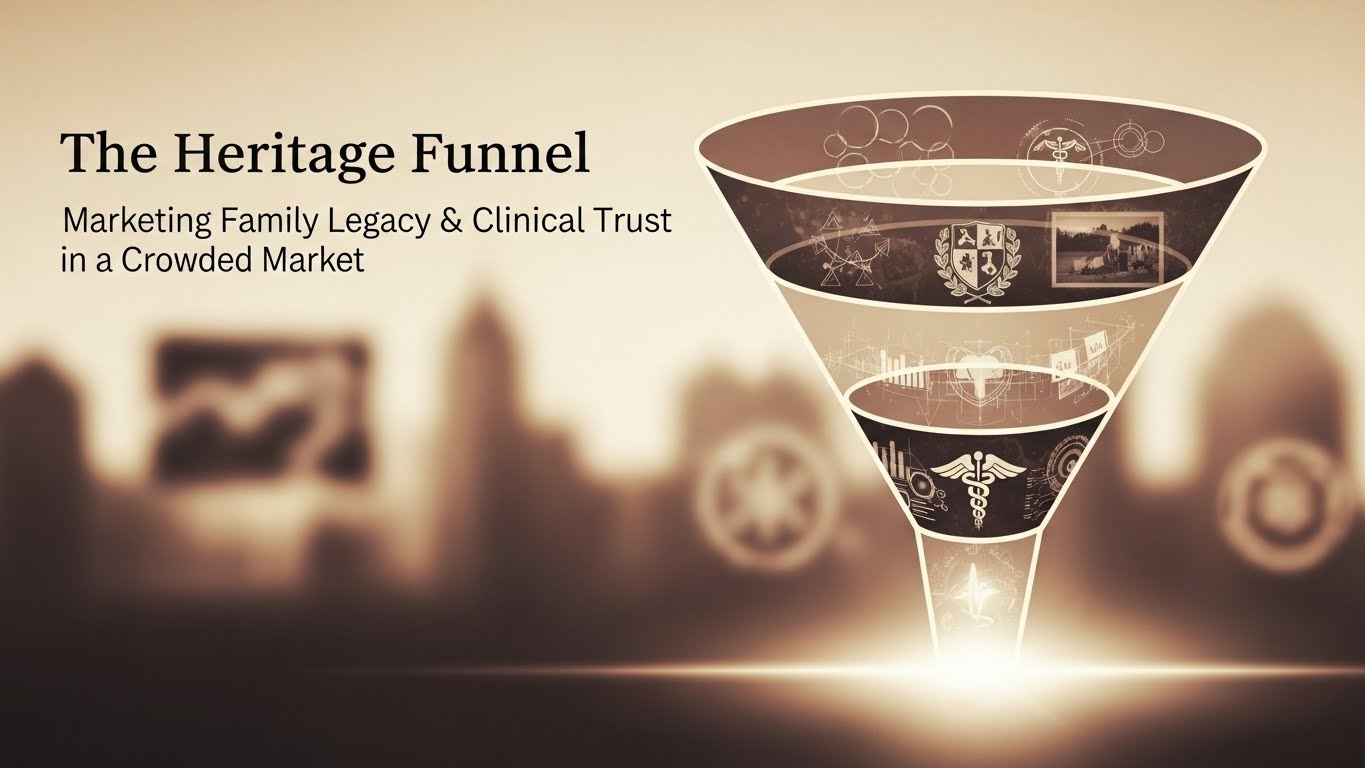
Authentic story: Real family legacy, not manufactured brand mythologyThe Heritage Funnel: Legacy as Competitive Advantage
Origin Story: From Family Recipe to Clinical Formula
Evidence: Multi-Generational Proof Points
Expertise: Family Knowledge as Credential
Evolution: Heritage Meets Innovation
Legacy: Creating Multi-Generational Customers
Heritage Language: Tradition Without Stagnation
The Heritage Messaging Formula
How to Market ‘Gentle Efficacy’ Without Sounding Weak or Ineffective
The Sophisticated Gentleness Framework
1. Position Gentleness as Advanced Formulation Skill
2. The “Strength Through Gentleness” Paradox
“Our retinol delivers the same collagen-boosting effects as higher concentrations—without the irritation. That’s not weakness. That’s precision formulation perfected over 30 years.”
“Most brands chase quick results through aggressive actives. We achieve the same outcomes through patient formulation. Your skin sees improvement. It doesn’t see inflammation. That takes confidence in our science.”3. Clinical Evidence for Gentle Efficacy
4. The “Consistency Over Intensity” Argument
Week 3-8: Inconsistent use due to sensitivity
Result after 12 weeks: Minimal improvement (50% compliance)
Week 3-12: Consistent application twice daily
Result after 12 weeks: Significant improvement (95% compliance)5. Testimonial Strategy for Gentle Efficacy
Real Example: La Roche-Posay’s “Tested on Sensitive Skin” Positioning
Ready to Master Heritage Brand Marketing?
Content Strategy: Bringing Heritage to Life
“Meet the Generation” Series
“Customer Legacy Stories”
“Then vs. Now” Evolution Content
“Behind the Formula” Deep Dives
Building Multi-Generational Customer Loyalty
The Generational Loyalty Strategy
“Pass It On” Programs
Archive Access
Loyalty Recognition
The Heritage Advantage: Time as Your Competitive Moat
Resources for Heritage Beauty Brands