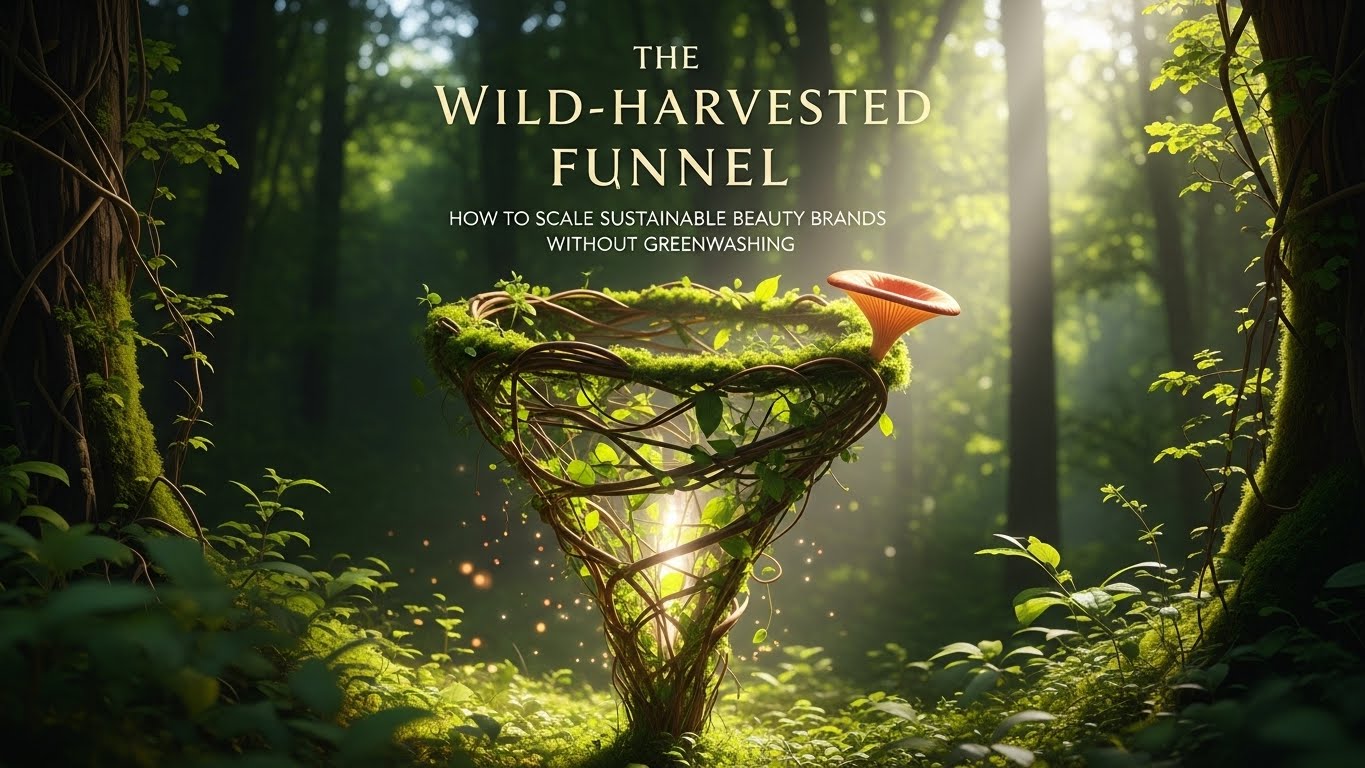
Growing your eco-conscious beauty brand authentically—without compromising your values or misleading your customers You started your beauty brand with pure intentions. Real ingredients. Honest sourcing. Genuine commitment to the planet. But now, as you plan to scale from 100 orders a month to 1,000—or 10,000—a nagging question keeps you up at night: Can I grow without becoming what I swore I’d never be? The beauty industry is drowning in greenwashing. Brands slap “natural” on petroleum-derived formulas. “Eco-friendly” packaging still ends up in landfills. “Sustainably sourced” ingredients come from suppliers with questionable practices. Conscious consumers are increasingly skeptical—and rightfully so. But scaling doesn’t have to mean selling out. The Wild-Harvested Funnel is a framework specifically designed for sustainable beauty brands that refuse to compromise their values while pursuing growth. It’s named after the most authentic sourcing practice in natural beauty—wild harvesting—where you take only what nature can regenerate, leaving ecosystems intact for future seasons. This approach to business growth mirrors that philosophy: take what the market offers sustainably, grow at a pace your values can support, and leave your integrity intact. Let’s explore exactly how to do it. Before we build your sustainable scaling strategy, you need to understand exactly what greenwashing is—and why it’s so tempting (and dangerous) for growing brands. Greenwashing is the practice of making misleading or unsubstantiated claims about the environmental benefits of a product, service, or company practice. It’s not just outright lying—it’s also: According to a TerraChoice study, over 95% of products claiming to be “green” committed at least one of the “Seven Sins of Greenwashing.” The beauty industry is particularly prone to these issues because ingredients can be complex, supply chains are long, and consumers desperately want to believe in sustainable alternatives. As you scale, the pressure intensifies: costs rise, margins shrink, competitors undercut your prices with cheaper (less sustainable) alternatives. It becomes tempting to stretch the truth about your ingredients, simplify complex supply chain issues, or highlight minor green initiatives while ignoring major environmental impacts. This is the slippery slope that has destroyed many well-intentioned brands’ reputations. Principle: Document everything. Know your supply chain intimately. Be honest about what you don’t know. Build trust through unprecedented openness. Key Actions: Supply chain mapping, third-party certifications, public sustainability reports Principle: Empower consumers to understand sustainability complexities. Set realistic expectations. Create informed advocates, not blind believers. Key Actions: Educational content, ingredient deep-dives, honest impact discussions Principle: Back every claim with evidence. Use third-party certifications. Make sustainability verifiable, not just marketable. Key Actions: Certifications (B Corp, EWG, Leaping Bunny), lab testing, carbon footprint analysis Principle: Invite your customers to hold you accountable. Co-create sustainability goals. Make progress transparent and measurable. Key Actions: Public sustainability roadmaps, customer advisory boards, progress updates Principle: Sustainability is a journey, not a destination. Regularly audit practices. Adapt as science and standards evolve. Never claim perfection. Key Actions: Annual audits, goal updates, transparent admissions of shortcomings Core Philosophy: Like wild harvesting, sustainable scaling means taking only what can regenerate—growing at a pace your values, supply chain, and environmental commitments can authentically support. Transparency isn’t just about being honest—it’s about being proactively open. Most brands share information only when asked. Truly sustainable brands lead with it, even when it’s uncomfortable. Don’t just make sustainability claims in marketing copy. Create a dedicated webpage (updated quarterly) that details every aspect of your operations. Include metrics, challenges, and progress toward goals. Brands like Patagonia and Tata Harper excel at this—their transparency becomes a competitive advantage. Natural, sustainable beauty products have an inherent visual advantage: they’re made from real things—plants, minerals, clays—that photograph beautifully and tell compelling stories. But most brands squander this opportunity with generic product shots against white backgrounds. When you’re scaling a sustainable brand, visual storytelling becomes critical for two reasons: First, it differentiates you from greenwashing competitors who can’t show authentic sourcing stories. Second, it justifies premium pricing by making the production process visible and valuable. Natural products are inherently textural. They have visible ingredients, natural color variations, organic imperfections. This is your visual goldmine. Here’s how to maximize it: Shoot extreme close-ups of your ingredients before they become products: These images prove you’re working with real, recognizable ingredients—not laboratory chemicals with natural-sounding names. Document the journey from raw ingredient to finished product through a visual timeline: This sequence builds narrative tension and shows the care invested in each product. It’s the antidote to “factory-made” associations. Show the human connection to nature-based products: Hands communicate craft, care, and human expertise that automated production can’t replicate. Place products in their natural element: These images create subconscious associations: “This product is as pure as the environment it comes from.” When photographing finished products, emphasize their natural texture: Perfect uniformity signals factory production. Natural variation signals authentic ingredients. Show realistic results without overselling: Honest visuals build more trust than miracle claims. Sustainable beauty works—but it works naturally, which takes time. Create short-form video content (30-60 seconds) showing: This end-to-end transparency is impossible for greenwashing brands to fake. It becomes your authenticity proof and your most compelling marketing content. The beauty of texture-rich, nature-based products is that they’re inherently photogenic when you stop trying to make them look like conventional cosmetics. Embrace the earthiness, the natural variations, the visible ingredients. These qualities don’t undermine perceived value—they justify it. Greenwashing relies on consumer ignorance. Authentic sustainable brands do the opposite: they educate so thoroughly that customers become skeptical of everyone else’s claims—and loyal to brands that teach truth. Create comprehensive guides for every ingredient you use. Not marketing copy—actual education: This level of detail signals expertise and builds trust faster than any “all-natural” marketing claim. Help customers understand what terms actually mean: When you educate customers to spot greenwashing, they recognize you as one of the rare authentic brands. Teach customers what to look for (and what to avoid) in ALL beauty products: Yes, this helps competitors too. But it primarily helps customers choose YOU because you’re the brand that taught them to be discerning. Don’t oversimplify sustainability. Address the nuances: Admitting complexity and trade-offs builds more credibility than claiming you’ve perfected sustainable beauty. Master the strategies that sustainable beauty brands use to scale authentically, communicate transparency effectively, and build unshakeable customer trust—without ever resorting to greenwashing. Explore the Beauty Marketing Course → Learn to market authenticity, not just sustainability claims Anyone can claim “eco-friendly” or “natural.” But certifications require proof. They’re expensive, time-consuming, and demand real commitment—which is exactly why they matter. Start Small, Build Up: Don’t wait until you can afford all certifications. Start with one that aligns most closely with your core values. Display it prominently and create content about what it took to earn it. Show Your Roadmap: Be transparent about which certifications you’re working toward and realistic timelines. “Currently pursuing B Corp certification—estimated completion Q3 2026” shows commitment. Explain the Process: Create content about what each certification requires. This educates customers and demonstrates that you’re not just paying for a logo—you’re meeting rigorous standards. According to Nielsen research, 81% of consumers feel strongly that companies should help improve the environment, but they need credible proof. Certifications provide that proof in a way that self-proclamations never can. One of the best defenses against greenwashing is inviting your customers to hold you accountable. When you give your community a voice in your sustainability journey, they become partners rather than passive consumers. Create a live dashboard on your website showing real-time metrics: carbon offset this month, percentage of organic ingredients, waste diverted from landfills, etc. Update monthly. Transparency this radical is impossible to fake. Invite 10-20 engaged customers to serve on a sustainability advisory board. Give them access to your practices, let them ask hard questions, and incorporate their feedback into your roadmap. Their involvement becomes social proof and advocacy. Once a year, publish a comprehensive report detailing: what you promised, what you achieved, what you fell short on, and why. Include specific metrics, not just nice-sounding statements. Make it downloadable and shareable. Host quarterly live Q&A sessions specifically about your environmental practices. Answer tough questions in real-time. Record and archive these sessions. The willingness to be interrogated signals authenticity. Brands like Allbirds and Ethique have built cult followings by making their sustainability journey completely transparent and inviting customers to be part of it. Their customers don’t just buy products—they become advocates for the brand’s mission. The final stage of the Wild-Harvested Funnel recognizes that sustainability is never “finished.” Science evolves. Standards improve. New challenges emerge. Authentic brands embrace this as an opportunity, not a weakness. Review every aspect of your operation yearly. What’s improved? What’s stagnated? What new information challenges previous assumptions? Document findings publicly. If something you thought was sustainable turns out not to be, admit it and change course. “We used to do X. Research showed Y. Here’s our new approach” builds credibility. Subscribe to sustainability journals, attend conferences, follow environmental scientists. Incorporate new findings into your practices and share that learning with customers. Share milestones: “We’ve reduced water usage by 40% since last year” or “We’re now sourcing 85% of ingredients within 500 miles.” Progress stories inspire more than perfection claims. Frame your brand as perpetually evolving: “We’re committed to doing better every year, even when it means admitting we got something wrong.” This positioning is greenwash-proof because you’re not claiming to have all the answers—you’re demonstrating commitment to finding them. Theory is beautiful, but let’s get practical. How do you actually grow from a small sustainable brand to a larger one without compromising your values? Don’t grow faster than your sustainability infrastructure can support. If you can’t maintain ethical sourcing, transparent operations, and verified claims at 2x your current size, you’re not ready for 2x growth. Scale your sustainability systems FIRST, then your marketing. Even well-intentioned brands can drift toward greenwashing under the pressure of growth. Here are warning signs to watch for in your own practices: If you’re promoting sustainability features you’re “working toward” rather than currently implementing, you’re in greenwashing territory. Market what you’ve achieved, not what you hope to achieve. “Where exactly do your ingredients come from?” “What’s the carbon footprint of your production?” If you don’t know or can’t answer, you shouldn’t be making environmental claims. “Eco-friendly,” “natural,” “green,” “clean”—without specific definitions or third-party verification. If you can’t quantify or certify a claim, rethink making it. Highlighting one green aspect while ignoring bigger environmental problems (e.g., “recyclable packaging” but ingredients shipped from across the globe). True sustainability requires holistic thinking. If customer inquiries about your sustainability practices make you uncomfortable or defensive, that’s a sign you’re not as transparent as you should be. Authentic brands welcome tough questions. If you don’t personally know and regularly communicate with your ingredient suppliers, you can’t truly vouch for their practices—no matter what their website claims. Wild harvesting is an ancient practice rooted in respect: take only what the ecosystem can regenerate, leave the root system intact, return to healthy populations. This same philosophy can guide your brand’s growth. Scale at a pace your supply chain can sustain. Grow as fast as your transparency systems can document. Expand when your certifications and practices justify it. This isn’t slower growth—it’s sustainable growth that won’t collapse under scrutiny or scandal. “The brands that will dominate sustainable beauty in the next decade aren’t those with the biggest marketing budgets or the most aggressive growth targets. They’re the brands that built transparency so deep into their DNA that greenwashing is literally impossible—not because they’re trying to be ethical, but because there’s no gap between what they say and what they do.” The Wild-Harvested Funnel isn’t a marketing strategy—it’s an operational philosophy. When you build transparency, education, verification, community, and evolution into every layer of your business, sustainability becomes unshakeable. Your customers become advocates. Your growth becomes regenerative rather than extractive. And when the inevitable greenwashing scandals rock the industry—because they will—your brand stands strong. Not because you claim to be perfect, but because you’ve been radically honest about your imperfections all along. This is how sustainable beauty brands scale without selling their souls. This is the future of conscious commerce. Welcome to the Wild-Harvested Funnel. May your growth be as regenerative as the ecosystems you protect. 🌿 Share this guide with sustainable beauty entrepreneurs committed to authentic growth! Keywords: sustainable beauty brands, greenwashing, wild-harvested ingredients, eco-friendly cosmetics, sustainable beauty marketing, ethical beauty business, transparent supply chain, green beauty certification, sustainable scaling, conscious beauty brands, natural beauty authenticity, environmental beauty claimsUnderstanding Greenwashing: The Enemy of Authentic Growth
What Greenwashing Actually Means
Vague Claims: “All-natural” or “eco-friendly” without specific definitions or certifications
Hidden Trade-offs: Highlighting one green attribute while ignoring larger environmental problems
Irrelevant Claims: “CFC-free” (when CFCs have been banned for decades anyway)
False Labels: Creating fake certifications or using misleading imagery
Lesser of Two Evils: “Organic cigarettes” or “eco-friendly fast fashion”Why Sustainable Brands Are Tempted to Greenwash
The Wild-Harvested Funnel: Sustainable Scaling Framework
Foundation: Radical Transparency
Education: Teaching Before Selling
Verification: Proof Over Promises
Community: Accountability Partners
Evolution: Continuous Improvement
Stage 1: Radical Transparency as Your Foundation
Create a Living “Sustainability Report”
Visual Storytelling for Texture-Rich, Nature-Based Products
The Texture-First Visual Strategy
1. Macro Photography of Raw Ingredients
2. The Transformation Sequence
3. Hands & Human Elements
4. Environmental Context Photography
5. Texture-Highlighting Product Shots
6. Before & After (The Honest Version)
The “Farm to Face” Video Series
Stage 2: Education That Empowers (Not Manipulates)
Ingredient Education Library
Sustainability Terminology Guide
“How to Read a Label” Content
The “It’s Complicated” Approach
Ready to Build a Truly Sustainable Beauty Brand?
Stage 3: Verification Through Third-Party Certifications
The Certification Strategy for Growing Brands
Stage 4: Building Accountable Community
Community Accountability Strategies
Public Sustainability Dashboard
Customer Advisory Board
Annual “State of Our Impact” Report
“Ask Us Anything” Sustainability Sessions
Stage 5: Continuous Evolution (Sustainability as Journey)
Annual Practice Audits
Sunset Practices That Don’t Work
Stay Current on Research
Celebrate Progress, Not Perfection
The “Always Learning” Positioning
Scaling Sustainably: The Practical Roadmap
The Growth Speed Principle
Red Flags: When You Might Be Slipping Into Greenwashing
🚩 Your Marketing Is Ahead of Your Practices
🚩 You Can’t Answer Specific Questions
🚩 You’re Using Vague Terminology
🚩 You’re Hiding Trade-offs
🚩 You’re Defensive About Questions
🚩 Your Suppliers Are a Mystery
The Wild-Harvested Approach: Growth That Regenerates
Essential Resources for Sustainable Beauty Brands