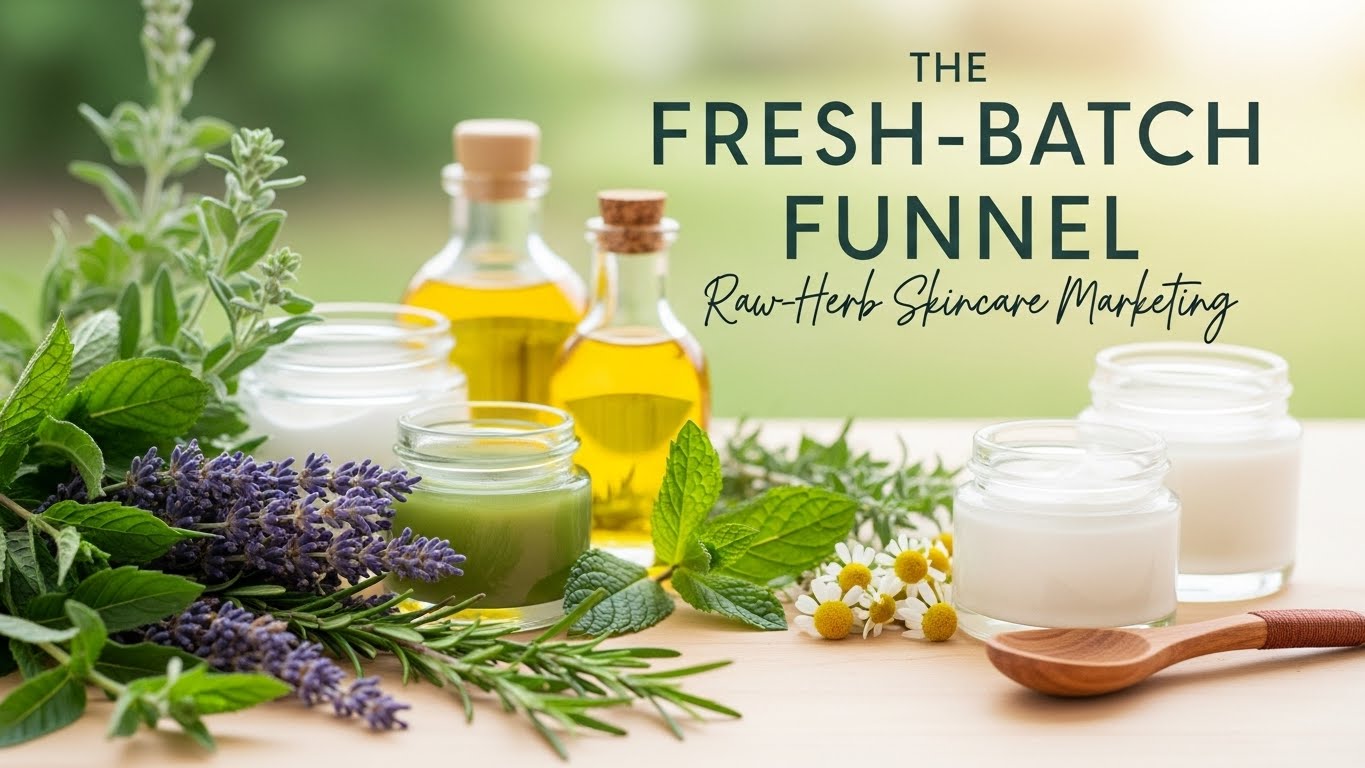
Building premium brands by showing your kitchen science—from whole plant to fresh formula There’s a jar of calendula oil on your counter. You made it yourself—organic flowers, cold-pressed olive oil, three weeks of patient maceration. You strained it this morning, and it’s golden, aromatic, alive with compounds that will be at their peak potency for maybe six months. This isn’t mass manufacturing. This is craft skincare. While beauty conglomerates optimize for shelf-stable formulas that can sit in warehouses for years, a growing segment of ingredient-savvy consumers is seeking the opposite: fresh-batch skincare made from whole herbs, extracted in-house, formulated in small batches, and sold at peak potency. They understand that a serum made last week with freshly extracted calendula is fundamentally different from one made eighteen months ago with year-old extracts. This is the fresh-batch movement—and it’s creating a new category of premium skincare brands that compete not on price or marketing budget, but on freshness, potency, and transparency about process. Brands like Living Libations, Vintner’s Daughter, and Captain Blankenship have built loyal followings by showing the unglamorous reality: this is what it actually takes to make potent plant medicine for your skin. But here’s the marketing challenge: How do you sell freshness when customers can’t smell or touch products through screens? How do you prove that your labor-intensive, small-batch process justifies 3x higher prices than competitors? How do you make grinding dried herbs in your apothecary look professional, not DIY amateur? This article will show you how to build the “Fresh-Batch Funnel”—a marketing framework that turns your artisanal process into your competitive advantage, demonstrates potency through transparency, and converts ingredient-educated shoppers who understand why fresher is genuinely better. The fresh-batch advantage isn’t just romantic storytelling—it’s biochemistry. When you extract whole herbs in small batches and formulate fresh, you preserve volatile compounds, maintain maximum potency, and avoid the degradation that happens in mass-manufactured products. But you must educate customers on why this matters. According to research published in the Journal of Medicinal Plants Research, fresh plant extracts retain significantly higher levels of bioactive compounds compared to extracts made from dried material stored for extended periods. The science backs your process—but only if you communicate it effectively. The key is reframing what most brands see as limitations (short shelf life, small batch sizes, higher costs) as premium features that educated consumers will pay more for. Freshness isn’t a logistical challenge—it’s your unique selling proposition. Strategy: “Made-to-order in small batches” not “limited supply.” Frame short shelf life as peak potency, not inconvenience. Goal: Attract customers who understand botanical potency degrades over time Strategy: Document extraction process—grinding herbs, macerating oils, straining batches. Make behind-the-scenes your main marketing content. Goal: Build trust through radical process transparency Strategy: Every product labeled with batch number and “extracted on” date. Let customers look up their specific batch’s extraction story. Goal: Prove freshness claims with verifiable batch tracking Strategy: Break down costs transparently—organic herbs, extraction time, batch size. Show why artisanal process costs more. Goal: Convert educated buyers who value quality over convenience Strategy: Customers who understand fresh-batch benefits become evangelists. Give them education resources to share with skeptics. Goal: Transform customers into herbalism educators who recruit others Core Principle: Fresh-batch skincare sells on education, not advertising. Your extraction process IS your marketing. The more you show how you make products, the more customers understand why they cost more—and why that’s worth it. Most skincare uses isolated compounds or standardized extracts. You’re using whole herbs—flowers, leaves, roots—with their full spectrum of phytochemicals intact. This is a major differentiator, but only if you explain it effectively. “When you extract whole calendula flowers—not just isolated compounds—you preserve the complete matrix of flavonoids, carotenoids, and resins that work together synergistically. Science calls this the ‘entourage effect.’ We call it respecting the plant’s intelligence.” This message positions whole-herb as more sophisticated, not less refined. This is where fresh-batch brands win or lose. Your extraction process—the unglamorous work of grinding herbs, measuring oils, monitoring maceration, straining batches—is your most valuable marketing asset. But most brands hide it, fearing it looks unprofessional or DIY. Big mistake. Ingredient-savvy shoppers WANT to see the messy, real process. They want proof you’re actually making small batches by hand, not just buying bulk extracts and rebottling them. The more you show, the more they trust. Here’s the complete visual framework for documenting your extraction process. Show what you’re starting with—this proves you’re not using pre-made extracts: This establishes credibility: you start with whole plants, not mystery powders or commercial extracts. Document the hands-on work that goes into each batch: This proves labor intensity—customers see why handcrafted costs more. Show the waiting period—this differentiates you from fast chemical extraction: This demonstrates that you can’t rush quality—slow extraction preserves delicate compounds. This is the satisfying “reveal” moment: This is your “transformation reveal”—whole plant became concentrated medicine. Show how individual extracts become finished formulas: This proves you’re a formulator, not just a bottler—expertise justifies premium pricing. Complete the journey with careful packaging: This closes the loop: from whole plant → to customer’s hands in weeks, not years on warehouse shelves. Living Libations, founded by master herbalist Nadine Artemis, built a cult following by extensively documenting their extraction processes. Their social media shows jars of herbs macerating, distillation equipment in action, founder’s hands blending formulas. They explain “botanical alchemy” in detail—showing 4-6 week maceration periods, careful straining, small-batch blending. They name specific farms supplying their herbs. They photograph batch numbers being applied to bottles. This transparency positions them as true craft herbalists, not cosmetics marketers. Result? $100+ face serums sell out despite (because of) showing the unglamorous reality of making them. Customers understand they’re buying freshly-extracted plant medicine, not mass-produced beauty products. When you document your extraction process comprehensively—from whole herb to finished formula—you create marketing content that does three things simultaneously: educates customers on quality, justifies premium pricing, and builds trust through radical transparency. Process visibility isn’t unprofessional—for fresh-batch brands, it’s your competitive moat. Learn the proven strategies successful artisanal skincare brands use to turn craft processes into compelling marketing, document extraction authentically, and build premium brands on freshness and transparency. Explore the Beauty Marketing Course → Build brands on botanical wisdom and batch-by-batch excellence Fresh-batch brands have built-in content advantage: every new batch is content opportunity. Here’s how to leverage your production cycle for ongoing marketing: Frame new batches like limited releases: Example: “Batch #47 of our Rose Face Oil drops Friday—made with June-harvested Bulgarian roses, extracted over 4 weeks, bottled yesterday. Only 30 bottles available. Fresh until June 2025.” Create urgency through genuine scarcity. Document production days in real-time: Example: Day-long Instagram story series: 8am grinding herbs → 10am beginning maceration → 2pm checking last week’s batch → 4pm straining & bottling. Followers experience the process live. Engagement gold + education + transparency. Deep-dive content on each botanical you work with: Example: “Calendula Chronicles”—blog post covering botanical history, traditional uses, modern science, sourcing story, extraction method, why it’s in your formula. One herb = weeks of content across platforms. Exclusive content for email subscribers: Example: Monthly “From the Apothecary” email with photos of current projects, challenges faced (batch that didn’t turn out right), seasonal ingredient changes, early access to new batches. Make subscribers feel like insiders. Fresh-batch skincare often costs 2-5x more than conventional products. Your transparent process justifies this premium—but you must connect the dots explicitly for customers. “$78 for 1oz face oil = 90 days of fresh botanical medicine extracted by hand from organic herbs. Compare that to $40 for mass-manufactured oil that sat in warehouses for 18 months before reaching you. You’re not paying for marketing—you’re paying for freshness, potency, and craft.” When you show the work, customers gladly pay more. Customers who understand fresh-batch value become fiercely loyal. They’ll wait for new batches to drop, educate skeptical friends, and pay premium prices happily. Here’s how to cultivate them: Let customers enter their batch number and see: extraction date, herbs used in that specific batch, formulator notes, when it was bottled. Personal connection to their specific product batch increases perceived value. Email list gets first access to new batches before public release. Creates VIP feeling + rewards loyalty. “Batch #48 available to subscribers now, public on Friday.” Free guides teaching extraction methods, herb identification, botanical medicine basics. Educate customers into herbalism enthusiasts who appreciate your work at deeper level. Fresh-batch, whole-herb skincare represents a fundamental rejection of industrialized beauty. It’s choosing freshness over shelf stability, potency over convenience, craft over scale. And there’s a growing market of ingredient-savvy consumers who understand why this matters—and will pay premium prices for it. But succeeding in this space requires abandoning conventional beauty marketing. You can’t hide your process behind glossy advertisements and vague claims. You must show the work. Every batch is content. Every extraction day is marketing. Your apothecary process IS your brand differentiation. “The future of artisanal skincare isn’t about hiding the messy reality of making products—it’s about celebrating it. Show your extraction jars. Show your stained apothecary counter. Show the batch that didn’t turn out right and what you learned. When customers understand the labor, knowledge, and patience required to create fresh botanical medicine, premium pricing isn’t a barrier—it’s validation that your work matters.” So document every batch. Tell the story of each herb. Show your maceration jars to your customers. Build transparency into every touchpoint. And watch as educated consumers who value botanical wisdom choose your fresh batches over factory-produced products every time. The fresh-batch funnel turns your greatest limitation—small scale, short shelf life—into your greatest strength. From whole plant to finished formula in weeks, not years. That’s not a constraint—that’s your competitive advantage. 🌿✨ Share this guide with artisanal skincare makers! Keywords: fresh-batch skincare, whole-herb extraction, artisanal skincare marketing, small-batch beauty, botanical extraction process, craft skincare brands, herbal infused oils, apothecary skincare, ingredient-savvy shoppers, handmade botanical skincareWhy Fresh-Batch Skincare Commands Premium Prices (When Marketed Right)
The Fresh-Batch Value Proposition
Peak potency: Volatile compounds (essential oils, antioxidants) degrade over time—fresh means maximum efficacy
Whole plant synergy: Using entire herbs (not isolated compounds) preserves complementary phytochemicals
Minimal processing: Less heat, less chemical extraction = more bioactive compounds intact
Traceability: Small batches = you know exactly when and how each product was made
Artisanal expertise: Hand-crafted by trained herbalists, not automated assembly lines
Shorter shelf life as feature: “Use within 6 months” proves freshness—not a bug, a selling pointThe Fresh-Batch Funnel: From Skeptic to Advocate
Awareness: Lead with Freshness as Premium Feature
Education: Show the Process, Not Just Products
Proof: Batch Numbers & Freshness Dating
Purchase: Premium Pricing with Process Justification
Advocacy: Create “Batch Believers”
The Whole-Herb Advantage: Why Full-Plant Extracts Matter
The Entourage Effect Marketing Message
Visual Storytelling for In-House Extraction: Showing the Process, Not Just the Result
The Extraction Process Visual Framework
1. The Whole Herbs: Start with the Raw Material
2. The Preparation: Grinding, Measuring, Beginning Extraction
3. The Maceration: Patience as Process
4. The Straining: Separating Medicine from Plant Material
5. The Formulation: Blending Extracts into Final Products
6. The Bottling & Labeling: From Batch to Customer
Real Example: Living Libations’ Radical Process Transparency
Ready to Master Fresh-Batch Marketing?
Content Strategy: Turning Each Batch Into a Story
Batch Announcements as Product Drops
Extraction Day Instagram Stories/Reels
Herb Spotlight Series
Behind-the-Scenes Email Series
Pricing Strategy: Justifying Premium Through Process Transparency
The Value Reframe
Building the Batch Believer Community
The Batch Believer Cultivation Strategy
Batch Tracking Portal
Early Batch Access for Subscribers
Herbalism Education Resources
The Fresh-Batch Revolution: Where Craft Becomes Commerce
Resources for Fresh-Batch Herbalists