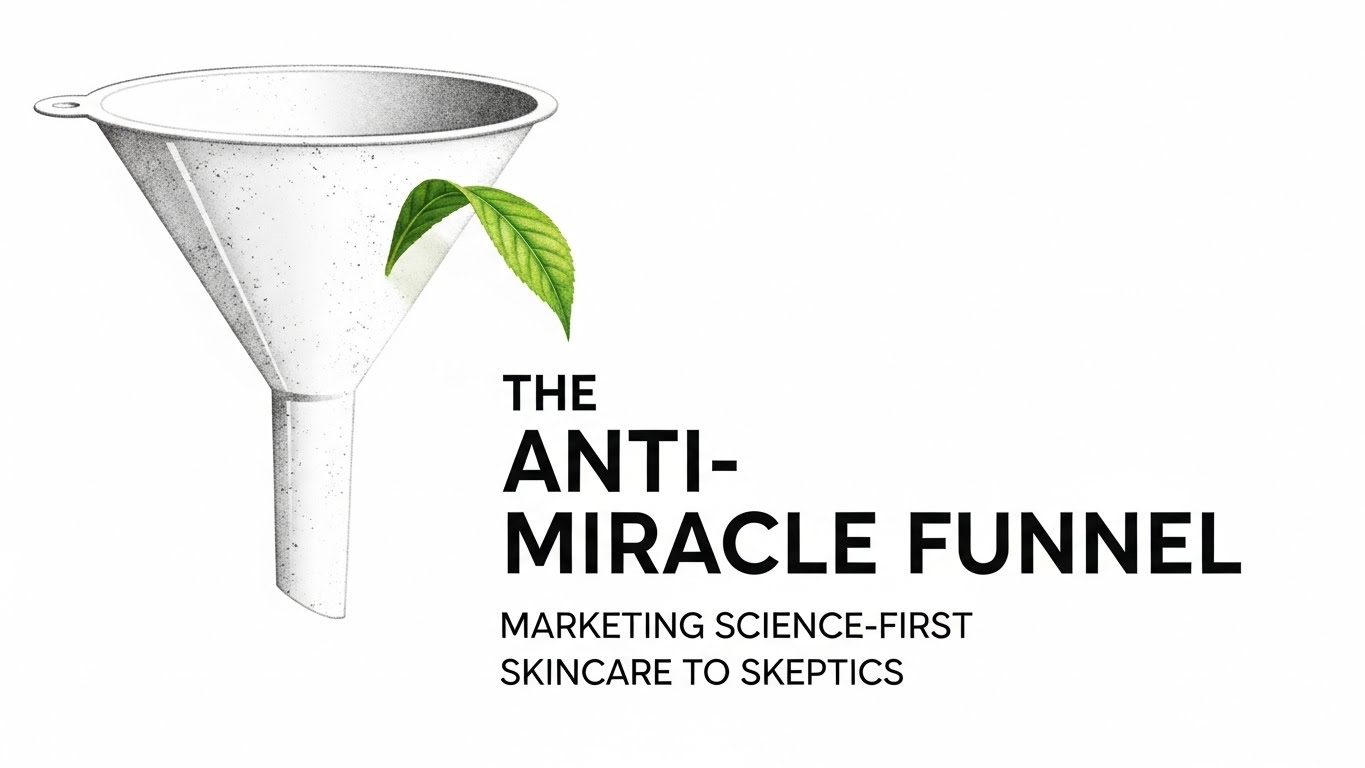
Building trust and revenue by saying what your product CAN’T do—and proving what it actually can “This serum will erase wrinkles overnight!” “Miracle cream reverses aging!” “One product to solve all your skin problems!” If you’ve spent any time in skincare marketing, you know these claims sell—until they don’t. Until the customer realizes it was a lie. Until they leave a one-star review. Until they never buy from you again and warn everyone they know. There’s a growing segment of skincare consumers who are exhausted by miracle promises. They’ve been burned too many times by products that claimed the impossible and delivered disappointment. They’re scientists, dermatology enthusiasts, ingredient nerds, educated skeptics who demand proof, not poetry. And paradoxically, they’re some of the most valuable customers in beauty—high lifetime value, low return rates, vocal brand advocates—if you can earn their trust. Enter the “Anti-Miracle Funnel”—a marketing framework built entirely on what traditional beauty marketing considers heresy: admitting limitations, emphasizing gradual results, showing your pricing math, explaining why certain ingredients WON’T work, and competing on honesty instead of hype. Brands like Deciem (The Ordinary), Paula’s Choice, and Geek & Gorgeous have built eight-figure businesses by telling skeptics exactly what they need to hear: the truth. But here’s the challenge: How do you make honesty compelling when lies sell faster? How do you explain complex formulations without losing people in jargon? How do you show price breakdowns without seeming defensive? How do you convert skeptics without miracle claims? This article will show you how to build the Anti-Miracle Funnel—turning radical honesty into your competitive advantage, transforming skeptics into believers through evidence, and building sustainable brands on the foundation of what actually works. Skeptical consumers aren’t difficult—they’re discerning. They’ve done their homework, they follow cosmetic chemists on social media, they understand the difference between marketing and science. And they’re exhausted by beauty industry nonsense. Understanding their frustrations is step one to earning their business. According to industry research, 78% of educated skincare consumers say they’ve lost trust in beauty brands due to misleading claims, and 82% are more likely to purchase from brands that provide scientific substantiation for their claims. The skeptic market isn’t niche—it’s growing rapidly. But here’s the opportunity: skeptics become the most loyal customers once you earn their trust. They have low return rates (they research before buying), high lifetime value (they stick with what works), and they become vocal advocates (they educate others about your science). The challenge is getting them to trust you in the first place. Strategy: “This serum won’t erase wrinkles. It WILL reduce fine line appearance by 20-30% over 12 weeks.” Start with what you CAN’T do—credibility through honesty. Goal: Skeptics notice you immediately—you’re not like other brands Strategy: Full ingredient percentages, clinical study links, pH levels, formulation rationale. Give skeptics everything they need to verify your claims independently. Goal: Transform curiosity into trust through radical transparency Strategy: Clinical data, peer-reviewed research, standardized before/afters with methodology disclosed. Science > celebrities. Goal: Overcome skepticism with independently verifiable evidence Strategy: Break down costs explicitly—formulation, testing, packaging, margins. Show exactly where money goes. Make transparency compelling, not boring. Goal: Justify pricing through openness—no hidden markup mystery Strategy: Skeptics who become believers are your strongest advocates. Give them resources to debunk competitors’ BS and educate others. Goal: Create science-literate customer base that recruits more skeptics Core Principle: The anti-miracle approach doesn’t avoid selling—it sells smarter. By admitting what products CAN’T do, you build credibility for what they CAN do. Skeptics trust honesty more than they trust hype. That trust converts. Most brands fear admitting limitations. But for science-first marketing, stating what you CAN’T do is your opening hook. It immediately differentiates you from miracle-claiming competitors and signals to skeptics: we’re different. “This product won’t [impossible claim]. It will [realistic benefit] through [mechanism] over [honest timeline].” Example: “This serum won’t erase wrinkles overnight. It will improve skin texture and reduce fine line appearance by 25% through retinol and peptides over 8-12 weeks.” Skeptics read this and think: Finally, someone telling the truth. This is the trickiest part of science-first marketing: you need to explain pricing breakdowns and formulation complexity to build credibility, but most people’s eyes glaze over at spreadsheets and chemistry. The solution? Make transparency compelling through strategic storytelling and visual design. The mistake most brands make: dumping all information at once in dense paragraphs or intimidating charts. The winning approach: layer complexity progressively, use visual hierarchy, and frame data as stories, not lectures. Don’t just list costs—visualize them with emotional context: Your $42 Serum Breakdown: The key: Use emojis for visual interest, show percentages visually with progress bars, add brief context for each line item. Make data scannable and emotionally engaging. Don’t just list ingredients—tell the formulation story layer by layer: The Anti-Aging Serum Formula Explained: Layer 1: The Active Delivery System 0.5% Encapsulated Retinol We use encapsulated retinol because bare retinol degrades in light and air. Encapsulation = stability = you get what you paid for. The 0.5% concentration is clinically proven effective while minimizing irritation. Higher isn’t always better—it’s about what your skin can actually use. Layer 2: The Support Squad 5% Niacinamide + 3% Peptide Complex Niacinamide strengthens skin barrier (so retinol doesn’t wreck it) and reduces inflammation. The peptide complex (Matrixyl 3000 + Argireline) signals collagen production. Together, they amplify retinol’s benefits while reducing side effects. This is called synergistic formulation—ingredients working smarter together. Layer 3: The Stability Protectors 2% Vitamin E + Ferulic Acid These aren’t just “antioxidants”—they’re retinol bodyguards. Vitamin E prevents oxidation, ferulic acid stabilizes the formula at optimal pH 5.5. Without these, your retinol would degrade before doing anything useful. Science, not marketing fluff. The key: Group ingredients by function, explain WHY each is there, use accessible language (“bodyguards” not “oxidative stress inhibitors”). Make complexity understandable through metaphor and structure. Instead of dense study summaries, visualize the results: Clinical Study Results (50 participants, 12 weeks): 7 out of 10 users saw visible improvement Study design: Double-blind, placebo-controlled, dermatologist-assessed. View full methodology → The key: Use visual representations (bars, percentages, comparisons) instead of paragraphs. Link to full studies for skeptics who want deep dives. Make data scannable for casual browsers, complete for researchers. Always provide a condensed version for people who want transparency without detail: TL;DR Version: The key: Offer both deep-dive AND summary. Respect different levels of interest. Skeptics appreciate that you accommodate both research-oriented and efficiency-oriented readers. Deciem (parent company of The Ordinary) built a billion-dollar brand by showing exactly where costs go. They publish formulation rationale, explain why products cost what they do, show markup percentages, and admit when they could charge more but don’t. Their “Pricing Integrity” page breaks down: formulation cost, packaging, testing, operations, and margin—typically keeping products at 2-3x cost when industry standard is 10-20x. This radical transparency became their differentiator. Skeptics became believers became evangelists. Their honesty about pricing made premium competitors look exploitative and justified their own margins when they charged more for complex formulations. Transparency = trust = sustainable revenue. When you make price transparency and complex formulations engaging through visual hierarchy, progressive disclosure, metaphorical language, and summary options, you turn potential boredom into compelling differentiation. Skeptics don’t tune out—they lean in, because finally someone is treating them like intelligent adults. Learn the proven strategies successful evidence-based brands use to convert skeptics through radical honesty, communicate complex science engagingly, and build sustainable brands on truth instead of hype. Explore the Beauty Marketing Course → Build brands skeptics actually trust Science-first brands have unlimited content opportunities—every clinical study, every formulation decision, every industry myth to debunk. The challenge is making evidence entertaining enough that people actually consume it. Debunk common skincare myths with evidence: Example: “Myth: Pores can ‘shrink.’ Truth: Pores don’t have muscles. What makes them look smaller? Oil control + exfoliation clearing debris. Here’s the science…” Skeptics love watching BS get destroyed with facts. Show results with complete transparency: Example: Customer before/after with caption: “Same lighting (3pm natural light), same angle, same camera, no filters, no makeup, 12 weeks apart. Used product 2x daily + SPF 50. Improvement: visible but not miraculous. This is what realistic progress looks like.” Real expert answers to customer questions: Example: Monthly video or blog where your formulator answers: “Why isn’t vitamin C working for me?” “What’s the difference between retinol and retinaldehyde?” “Is niacinamide really the miracle ingredient everyone says?” Real expertise builds unshakeable credibility. Directly compare your formulas to competitors: Example: “Our vitamin C serum vs. Brand X: Ours has 15% L-ascorbic acid at pH 3.5. Theirs has ‘vitamin C derivative’ (less effective) at unknown concentration. Price: $28 vs. their $89. You decide.” Skeptics love side-by-side evidence. Skeptics who become believers are your most powerful marketing asset. They actively recruit other skeptics, debunk competitor BS unprompted, and defend your brand fiercely. Here’s how to cultivate them: Create infographics, comparison charts, myth-busting guides that customers can share when friends ask for skincare advice. Make it easy for them to educate others using your evidence. Highlight reviews that demonstrate ingredient knowledge: “Finally, a brand that understands peptides need to be in specific concentrations to work!” These testimonials attract more skeptics while validating existing customers’ intelligence. Private group for ingredient-educated customers. Share early access to formulations, solicit feedback on new products, give them insider knowledge. Make being a skeptic who trusts you feel like an exclusive club. Science-first skincare marketing isn’t about dumbing down your formulations or hiding your expertise behind marketing fluff. It’s about respecting your customers’ intelligence enough to tell them the truth—what works, what doesn’t, what’s possible, what’s impossible, and exactly why you charge what you do. The beauty industry has conditioned consumers to expect lies. “Miracle” promises. Photoshopped before/afters. Proprietary blend nonsense. Celebrity endorsements from people who’ve never used the product. Skeptics are tired of it. They’re actively seeking brands brave enough to be honest. “The future of skincare marketing isn’t about who can make the boldest claims or hire the biggest celebrities. It’s about who can prove—with evidence, transparency, and radical honesty—that their products actually work as promised. The anti-miracle approach doesn’t mean underselling. It means earning trust through truth. And trust, once earned from skeptics, converts better than any miracle claim ever could.” So lead with limitations. Show your pricing math. Explain your formulations without dumbing them down. Admit when results take time. Compare yourself honestly to competitors. And watch as educated consumers who’ve been burned by miracle promises finally find a brand they can trust—and defend. The anti-miracle funnel doesn’t avoid selling—it sells smarter. To smarter customers. Who become your smartest marketers. Build brands on evidence, not miracles. Skeptics will thank you—with their wallets. 🔬✨ Share this guide with science-first skincare founders! Keywords: science-first skincare marketing, evidence-based beauty, price transparency skincare, complex formulation marketing, skeptical consumers, anti-miracle marketing, honest skincare brands, ingredient transparency, clinical skincare marketing, cosmetic chemistry educationWhy Skeptics Are Your Most Valuable Customers (And Why They Hate You Right Now)
What Skeptics Are Tired Of
Miracle claims: “Erase wrinkles,” “reverse aging,” “transformative results”—they know it’s impossible
“Proprietary blends”: Hiding ingredient percentages behind trade secret excuses
Before/after fraud: Different lighting, filters, clearly photoshopped results
Vague science-y language: “Powered by peptides” “enriched with botanicals”—meaningless fluff
Overpriced packaging: $200 creams where $150 goes to marketing and packaging
Celebrity/influencer nonsense: “This changed my life!”—paid testimonials with no credibilityThe Anti-Miracle Funnel: Honesty as Conversion Strategy
Awareness: Lead with Limitations
Education: Show Your Work (Literally)
Proof: Evidence, Not Testimonials
Purchase: Price Transparency Without Defensiveness
Advocacy: Turn Skeptics Into Evangelists
The Language of Limitations: How to Say What You DON’T Do
The Opening Line Formula
How to Market Price Transparency and Complex Formulations Without Boring Your Audience
The Engaging Transparency Framework
1. Price Transparency: The “Where Your Money Goes” Visual
$14
$8
$6
$7
$72. Complex Formulations: The “Why This Ingredient at This Percentage” Story
3. Clinical Data: The “Show Don’t Tell” Approach
28% average improvement
73% of users reported improvement4. The “Too Long; Didn’t Read” Summary Box
Real Example: Deciem’s Radical Pricing Transparency
Ready to Master Science-First Marketing?
Content Strategy: Making Evidence Engaging
“Myth-Busting Mondays” Series
“Before/After: Methodology Disclosed” Posts
“Ask a Cosmetic Chemist” Q&A
“Competitor Comparison” Series
Building the Skeptic-to-Evangelist Pipeline
The Evangelist Cultivation Strategy
Provide Shareable Debunking Resources
Feature Customer Science Literacy
Create a “Science Squad” Community
The Anti-Miracle Revolution: Where Honesty Becomes the Ultimate Advantage
Resources for Science-First Brands