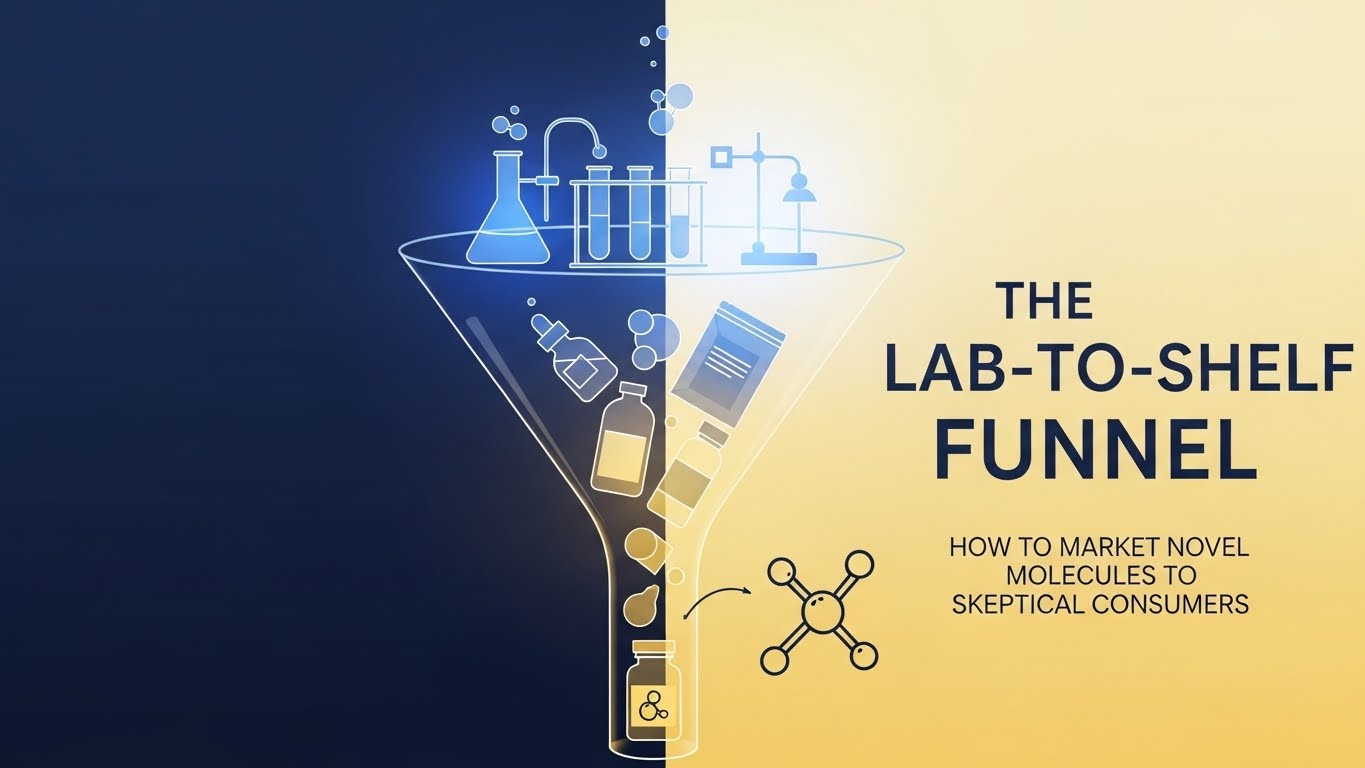
Building trust in biotech innovation through accessible science communication and transparent ingredient storytelling “We’ve developed a groundbreaking biomimetic peptide complex using recombinant DNA technology that modulates cellular signaling pathways.” She reads this on a skincare website. Her reaction? “Is this even legal? Sounds like something from a sci-fi movie. Hard pass.” This is the novel molecule paradox: your brand has spent millions developing genuinely revolutionary biotech ingredients—lab-grown collagen, synthesized growth factors, fermentation-derived actives that outperform anything nature makes alone—but consumers are terrified of them. They read “bioengineered” and think “Frankenstein skincare.” They see “novel molecule” and hear “untested guinea pig experiment.” The irony? These same consumers slather on “natural” essential oils that can cause severe reactions while rejecting lab-created molecules that are safer, more sustainable, and more effective. The clean beauty movement, despite its good intentions, has created a science-phobic culture where “synthetic” equals “toxic” and “novel” equals “scary”—even when the opposite is true. According to research, 67% of consumers say they’re interested in “innovative skincare ingredients,” but 73% express concern about ingredients they “don’t recognize.” That’s a massive trust gap—and it’s costing biotech beauty brands billions in unrealized potential. This article will show you how to bridge that gap—marketing novel molecules through the “Lab-to-Shelf Funnel,” explaining biotech innovation accessibly, and building trust with skeptical consumers who deserve to understand the science that’s actually safer than what they’re currently using. Consumer fear of novel ingredients isn’t irrational—it’s the result of decades of beauty industry deception, insufficient regulation, and the clean beauty movement’s (sometimes misleading) messaging. Understanding the roots of skepticism is essential to addressing it authentically. According to research in consumer psychology, the “naturalness bias” leads people to perceive identical ingredients as safer when labeled “natural” versus “synthetic,” even when chemically identical. This isn’t stupidity—it’s a cognitive shortcut in the face of overwhelming complexity. The key insight: you can’t logic people out of emotional fear. You must address the emotion first, then provide the logic. Novel molecule marketing requires empathy before education. Strategy: “We know ‘bioengineered’ sounds scary. Here’s why it’s actually safer…” Start by naming the elephant in the room. Goal: Build trust through empathy before attempting education Strategy: “We started with a plant compound, then made it work better for your skin through precision.” Humanize the science journey. Goal: Transform abstract “lab-created” into concrete “problem-solving” Strategy: “Lab-grown means no pesticides, no endangered plants, consistent quality.” Show benefits of controlled creation. Goal: Reframe “synthetic” as superior choice, not compromise Strategy: “5 years development, 12 clinical trials, 1,000+ subjects.” Novel isn’t untested—it’s rigorously proven. Goal: Counter “guinea pig” fear with evidence of extensive validation Strategy: “Real people tried it first. Here’s what happened…” Peer validation converts remaining skeptics. Goal: Social proof overcomes novelty resistance Core Principle: Novel molecule marketing isn’t about proving you’re right and consumers are wrong—it’s about meeting legitimate skepticism with transparency, making lab innovation relatable through storytelling, and demonstrating that “new” can mean “safer, more sustainable, more effective.” Fear dissipates when understanding replaces mystery. Every novel molecule has two narratives: the technical description (which scares people) and the compelling story (which engages them). Here’s how to shift from one to the other: [What problem were we solving?] + [How we solved it (in kitchen-table language)] + [Why this solution is better than alternatives] + [How thoroughly we tested it]. Example: “Retinol works but irritates. We created a molecule that delivers retinol benefits without irritation by [simple mechanism]. Tested on sensitive skin for 2 years before launch.” “Biotech” is simultaneously exciting and terrifying to consumers. It promises revolutionary results but triggers fears of genetic modification, unknown long-term effects, and “playing God.” The solution? Break down biotech innovation into digestible concepts using the progressive disclosure method—simple hook, accessible explanation, technical depth available for those who want it. The challenge: making biotechnology feel less like science fiction and more like logical evolution of skincare. Here’s the complete framework: Start here—the benefit without the science: “We’ve created a way to give your skin the collagen boost it needs—without needles, without irritation, with ingredients so pure they’re identical to what your body makes naturally.” Why this works: Focuses on outcome (collagen boost), benefit (no needles/irritation), and safety framing (identical to body’s own). No “biotech” mentioned yet. For those who click “Learn More”: The Kitchen-Table Explanation: What We Started With: The Problem: Our Solution (Biotech Innovation): The Result: Identical to what your body makes, but more consistent, more pure (no contaminants), more sustainable (no animal/plant harvesting), and more affordable than other methods. Biotech doesn’t mean “scary experimental”—it means “smarter, cleaner creation.” Why this works: Uses familiar analogy (insulin production, yogurt bacteria), explains problem → solution logic, reframes biotech as improvement over alternatives. For those who want the technical depth: The Technical Process: Step 1: Gene Identification Step 2: Bacterial Expression Step 3: Purification & Verification Step 4: Formulation & Stabilization Safety validation: Identical amino acid sequence to endogenous human EGF. In vitro and in vivo studies demonstrate biocompatibility, efficacy without adverse effects. Used successfully in wound healing for decades—now optimized for cosmetic application. Why this works: Provides complete transparency for science-literate consumers without requiring everyone to read it. Depth availability builds credibility. Create simple visual journey: The Lab-to-Shelf Visual Story: 🔬 1. Identify What molecule does skin need? 🧬 2. Create Bacteria make pure version ✅ 3. Test Years of safety validation 🧴 4. Deliver Stable, pure product to you Why this works: Visual progression makes abstract process concrete. Emoji/icons aid comprehension across language barriers. Don’t avoid the scary questions—answer them proactively: Fear: “Is this GMO skincare?” Answer: “We use GMO bacteria (like those making your insulin) to create the ingredient. But the final ingredient itself isn’t GMO—it’s just the pure molecule, with no bacteria remaining. Think: alcohol made via fermentation—yeast is involved in creation, but the final product is just alcohol.” Fear: “What are the long-term effects?” Answer: “This molecule has existed in your skin since birth—we didn’t invent it, we just learned to create it. It’s been used in medical wound healing for 30+ years. Long-term safety isn’t unknown; it’s extensively documented.” Fear: “Why is lab-created better than natural?” Answer: “Nature is beautiful but inconsistent. Plants vary by season, soil, rainfall—your skincare shouldn’t. Lab-creation ensures: same concentration every batch, no pesticides/heavy metals, no over-harvesting endangered plants, hypoallergenic purity. It’s not nature vs. science—it’s respecting nature by improving on it.” Why this works: Acknowledging fears without dismissing them builds trust. Providing clear answers transforms skeptics into educated advocates. Show honest pros/cons of each approach: Why this works: Honest comparison shows you’re not dismissing natural ingredients—you’re showing where biotech excels while acknowledging natural’s advantages (like consumer comfort). Biossance built their brand on biotech squalane—a molecule traditionally harvested from shark livers. They started with empathy: “Killing sharks for beauty isn’t okay.” Then the story: “We fermented sugarcane to create the same molecule—100% sustainable, more pure than animal sources.” They showed the process visually, explained safety through decades of cosmetic use, and compared biotech purity to natural inconsistency. They never said “bioengineered” in marketing—they said “science-based sustainability.” Result? Mainstream adoption of a biotech ingredient by consumers who might reject “synthetic” labels. Their secret? They made biotech feel like ethical evolution, not scary experimentation. When you explain biotech innovation through progressive disclosure—simple promise, accessible story, technical depth available—and address fears directly while showing honest comparisons, you transform “scary science experiment” into “thoughtful problem-solving.” Biotech stops being threatening and starts being the logical choice for people who care about purity, sustainability, and efficacy. Learn the proven strategies successful biotech beauty brands use to make lab innovation accessible, build trust with skeptical consumers, and market novel molecules through transparent storytelling that converts fear into fascination. Explore the Beauty Marketing Course → Build brands skeptical consumers trust through science Novel molecule content must educate, engage, and overcome skepticism. Here’s how to create shareable content about biotech innovation: Demystify the creation process through transparency: Example: “Come inside our fermentation facility. Meet Dr. Chen who developed our growth factor process. See where science becomes skincare.” Visual lab tours humanize biotech—it’s not scary when you meet the people behind it. Address biotech misconceptions directly: Example: “Myth: Lab-created means untested. Reality: Our ingredient went through 5 years of trials before we sold it. Natural ingredients? Often zero safety testing required. Here’s the irony…” Turn fear into informed choice. Follow early adopters through their journey: Example: “Sarah was skeptical about biotech skincare. ‘It sounded too sci-fi for me.’ Here’s her 90-day journey—from skeptic to advocate. Week 1: nervous. Week 4: noticing changes. Week 12: telling everyone…” Real conversion stories work. Show how your innovation stacks up against alternatives: Example: “Want collagen boost? Option 1: Oral supplements (mostly broken down in digestion). Option 2: Topical collagen (too big to penetrate). Option 3: Growth factors that tell skin to make its own (our approach). Here’s the science…” Comparison educates. Novel molecules need pioneers—people willing to try something new and share their experience. Here’s how to cultivate them: Launch to people who read ingredient labels, follow skincare science accounts, get excited about innovation. They’ll do the heavy lifting of explaining to mainstream consumers for you. Invite early users to share their journey publicly. Give them behind-the-scenes access, science resources, direct line to formulators. Make them feel like research partners, not just customers. Feature early adopter testimonials prominently: “I was terrified of biotech until I understood the science. Now I won’t use anything else.” Peer conversion stories work better than any marketing you could create. The beauty industry stands at an inflection point. Biotech innovation promises ingredients that are safer, more sustainable, and more effective than anything nature produces alone—lab-grown collagen without animal harvesting, fermented actives with zero pesticides, synthesized molecules with pharmaceutical-grade purity. But innovation dies in the lab if consumers won’t buy it. And consumers won’t buy what they don’t understand or what triggers fear. The gap between “groundbreaking molecule” and “trusted product” is bridged through communication—transparent storytelling that meets skepticism with empathy, explains biotech through accessible analogies, and demonstrates that “novel” doesn’t mean “risky.” “The future of skincare isn’t natural vs. synthetic—it’s thoughtful vs. thoughtless. Biotech beauty brands have the science on their side: purer ingredients, more sustainable sourcing, more consistent efficacy. But science without translation is just noise to overwhelmed consumers. When you validate skepticism, tell the lab-to-shelf story accessibly, show biotech as improvement rather than deviation from nature, and build trust through transparent testing timelines, you transform ‘scary new molecule’ into ‘the obvious choice.’ Novel molecules aren’t the risk—continuing with inconsistent, contaminated ‘natural’ alternatives is. It’s time consumers understood that.” So embrace the Lab-to-Shelf Funnel. Acknowledge fear, then address it with facts. Use analogies like insulin production and yogurt fermentation. Show the testing timeline. Let early adopters evangelize. Compare honestly against natural alternatives, showing biotech’s advantages without dismissing nature entirely. Because novel molecules deserve to be trusted—when brands earn that trust through radical transparency. Build biotech beauty brands. Communicate accessibly. Convert skeptics through science. 🧬✨ Share this guide with biotech beauty founders! Keywords: novel molecule marketing, biotech skincare, lab-to-shelf funnel, synthetic ingredient trust, fermentation beauty, bioengineered skincare, innovative ingredient marketing, consumer skepticism biotech, accessible science communication, sustainable beauty innovationUnderstanding Consumer Skepticism: Why Novel Molecules Trigger Fear
Why Consumers Fear “Novel” and “Synthetic”
Historical betrayals: Past scandals (parabens, phthalates, formaldehyde) created lasting distrust of “chemical” ingredients
Clean beauty messaging: Well-intentioned movement conflated “natural” with “safe” and “synthetic” with “toxic”
Lack of transparency: Brands historically hid ingredient sourcing, making “unknown” synonymous with “suspicious”
Scientific illiteracy: Most consumers don’t understand chemistry, making complex ingredients inherently scary
Social media fear-mongering: Viral “toxic ingredient” lists (often scientifically inaccurate) spread faster than facts
Naturalistic fallacy: Deep-rooted belief that “nature = good, lab = bad” despite evidence to the contraryThe Lab-to-Shelf Funnel: Marketing Novel Molecules
Acknowledge the Fear (Validate Skepticism)
Tell the Origin Story (Make Lab Relatable)
Explain the “Why” (Safety + Efficacy + Sustainability)
Show the Testing (Transparency Builds Trust)
Early Adopters Evangelize (Leverage Pioneer Customers)
The Language Shift: From Scary Science to Compelling Story
The Storytelling Formula for Novel Molecules
How to Explain ‘Biotech’ Innovation Without Overwhelming Customers with Jargon
The Biotech Communication Framework
Level 1: The Simple Promise (Hook)
Level 2: The Accessible Story (For the Curious)
Your skin makes growth factors that tell cells to produce collagen. As you age, you make less. We wanted to supplement what’s missing.
Harvesting growth factors from actual skin? Ethically questionable, expensive, and inconsistent quality. Extracting from plants? They don’t make the exact molecules your skin recognizes.
We taught bacteria to make human growth factors—the same way we make insulin for diabetics. These helpful bacteria (think: the kind in yogurt) create the exact molecule your skin needs, in a controlled, pure environment.Level 3: The Science Detail (For Enthusiasts)
We identified the exact gene sequence that codes for human EGF (Epidermal Growth Factor), a naturally occurring signaling protein that stimulates collagen synthesis.
Using recombinant DNA technology, we introduced this gene sequence into E. coli bacteria (safe, FDA-approved strain used in food production). The bacteria now produce human EGF as part of their normal function.
EGF is harvested and purified through multi-stage chromatography. Mass spectrometry confirms molecular identity matches native human EGF exactly. No bacterial contamination remains.
Pure EGF is formulated at clinically effective concentrations (typically 10-50 ng/mL) with stabilizers that maintain activity throughout product shelf life.Visual Simplification: Making Biotech Visible
Address Common Fears Directly
Comparison: Natural vs. Biotech Transparency
Consideration
Plant-Derived
Biotech-Created
Purity
Variable (pesticides, contaminants possible)
Consistent (controlled environment)
Potency
Inconsistent (varies by season/source)
Exact concentration every time
Sustainability
Can deplete wild plants
No environmental harvesting needed
Cost
Often lower initial cost
Higher R&D, but scales efficiently
Consumer perception
Familiar, trusted
Requires education
Real Example: Biossance’s Biotech Squalane Story
Ready to Master Novel Molecule Marketing?
Content Strategy: Making Lab Innovation Shareable
“Lab Tour” Behind-the-Scenes Content
“Myth vs. Reality” Educational Series
“First User” Documentation Series
“Compare the Options” Honest Breakdowns
Building the Early Adopter Community: Your Novel Molecule Evangelists
The Early Adopter Strategy
Target Science-Curious Consumers First
Document Everything Transparently
Amplify Their Stories
From Lab to Shelf: Innovation Requires Translation, Not Simplification
Resources for Biotech Beauty Brands