
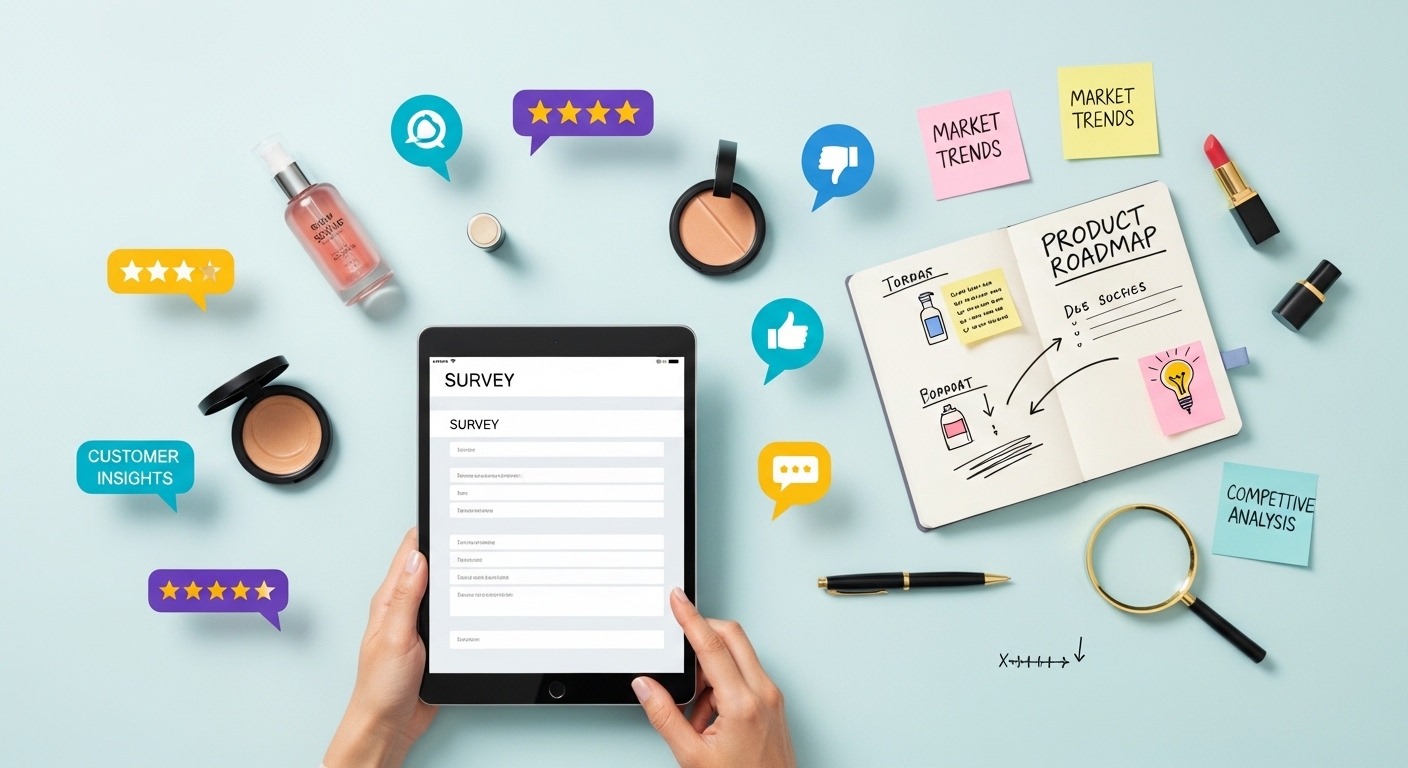
Beauty Brand Strategy
How to Use Surveys, Reviews, and Feedback to Refine Your Beauty Brand’s Positioning and Product Roadmap
Stop guessing what your customers want. Let data drive your beauty brand forward — from product formulas to brand voice.
In the crowded beauty industry, intuition alone won’t keep your brand competitive. Successful beauty founders and CMOs share one underrated habit: they listen obsessively — to customers, to reviewers, and to the data hiding inside their own feedback channels.
Whether you’re a solo indie brand or scaling toward retail, using surveys, product reviews, and structured feedback loops can dramatically sharpen your brand positioning and inform a product roadmap that actually sells.
This guide breaks down exactly how to collect, interpret, and act on customer feedback — with practical frameworks, tools, and real-world application for beauty brands at every stage.
📋 Table of Contents
- Why Customer Feedback Is a Goldmine for Beauty Brands
- Types of Surveys That Work for Beauty Brands
- The Right Questions to Ask (With Examples)
- Mining Product Reviews for Positioning Insights
- Social Media & UGC as Feedback Channels
- How to Analyze and Prioritize What You Learn
- Translating Feedback Into a Product Roadmap
- Refining Brand Positioning Based on Real Data
- Best Tools for Collecting Beauty Brand Feedback
- Common Mistakes to Avoid
1. Why Customer Feedback Is a Goldmine for Beauty Brands
The beauty industry is deeply personal. Customers buy based on skin type, values, aesthetic, lifestyle — and increasingly, identity. That means the gap between what founders think customers want and what they actually want can be enormous.
According to McKinsey’s Beauty Market Report, brands that build consumer feedback loops into their product development cycle see up to 30% higher repeat purchase rates. Here’s why feedback matters so much:
Feedback isn’t just a customer service tool — it’s a strategic asset that should influence everything from your hero product’s next reformulation to the language on your homepage.
2. Types of Surveys That Work for Beauty Brands
Not all surveys are created equal. The type of survey you deploy should match your specific strategic goal. Here’s a breakdown of the four most effective survey formats for beauty brands:
| Survey Type | Best For | When to Use | Ideal Length |
|---|---|---|---|
| Post-Purchase Survey | Product satisfaction, first impressions | 3–7 days after delivery | 3–5 questions |
| NPS Survey | Brand loyalty, advocacy tracking | Quarterly or post-interaction | 1–2 questions |
| Product Development Survey | New product validation, ingredients interest | Pre-launch or concept testing | 8–12 questions |
| Brand Perception Survey | Positioning clarity, awareness gap analysis | Annually or after a rebrand | 10–15 questions |
💡 Pro Tip: The most overlooked survey type in beauty is the “churned customer” survey — emailing customers who haven’t repurchased in 90+ days. Their candid reasons often reveal product or positioning issues that loyal fans never mention.
3. The Right Questions to Ask (With Examples)
Poorly worded survey questions lead to garbage data. Here are proven question frameworks specifically designed for beauty brands, grouped by goal:
🎯 For Brand Positioning
- “If [Brand Name] were a person, how would you describe their personality?”
- “What 3 words come to mind when you think of our brand?”
- “How does our brand compare to [Competitor]? What do we do better/worse?”
- “Why did you choose us over other options?”
🧴 For Product Development
- “What skin/hair/beauty concern do you feel isn’t being solved by any product you’ve tried?”
- “What would make you repurchase this product — or what almost stopped you?”
- “Which of these product concepts excites you most? (Show 3 options)”
- “What ingredients are most important to you? Which do you actively avoid?”
⭐ For Satisfaction & Retention
- “On a scale of 1–10, how likely are you to recommend us to a friend?”
- “What’s the #1 thing we could improve about this product?”
- “How did this product perform vs. your expectations?”
- “What would make you a customer for life?”
✅ Best Practice: Always include at least one open-ended question. Quantitative scores tell you what; open text tells you why. The verbatim answers often contain your most powerful marketing copy and product insight.
4. Mining Product Reviews for Positioning Insights
Product reviews — whether on your own website, Amazon, Sephora, Ulta, or Google — are one of the richest and most underused sources of strategic intelligence in beauty marketing.
Here’s a systematic approach to extracting insights from reviews:
The Review Mining Process
What to Look for in 1-Star and 5-Star Reviews
⭐ 1-Star Reviews Reveal:
- Unmet expectations (often a positioning/messaging problem)
- Formula or quality issues to fix
- Shipping/packaging failures
- Who your product is NOT for (and that’s valuable!)
⭐⭐⭐⭐⭐ 5-Star Reviews Reveal:
- Your real USP (usually different from what you think it is)
- Which customer segments are happiest
- Exact language to use in ads and product copy
- Features to double down on in next version
Also mine competitor reviews on platforms like Amazon and Sephora. The complaints your competitors consistently get are your white space opportunities.
6. How to Analyze and Prioritize What You Learn
Data collection without analysis is just noise. Here’s how to turn your raw feedback into actionable priorities using a simple but powerful framework:
The Impact–Frequency Matrix
Practical Analysis Steps
1. Consolidate: Pull all feedback into one spreadsheet monthly. Use Airtable or Google Sheets with columns for: Source, Date, Sentiment, Theme, Verbatim Quote, and Action Flag.
2. Theme: Tag each piece of feedback with no more than 2–3 themes (e.g., “packaging,” “scent,” “skin feel,” “results timeline”).
3. Quantify: Count how often each theme appears in positive vs. negative contexts. A simple pivot table is enough.
4. Identify outliers: Look for comments that appear only a few times but are extremely emotionally charged — these often predict future viral complaints or features.
7. Translating Feedback Into a Product Roadmap
A product roadmap built on customer feedback is dramatically more likely to succeed at launch than one built on founder hunches. Here’s how to bridge the gap between insights and execution:
| Feedback Signal | Roadmap Action | Timeline | Expected Outcome |
|---|---|---|---|
| “Too heavy for summer” | Develop a lighter-weight version or gel formula | 6–9 months | Expand summer/oily skin segment |
| “Love it but too expensive” | Introduce a travel/starter size at lower price point | 3–4 months | Reduce purchase barrier, increase trial rate |
| “Wish it came in a pump” | Redesign packaging with pump dispenser | 4–6 months | Improve UX, reduce waste, increase repurchase |
| “Need something for sensitive skin” | New SKU: fragrance-free, minimal formula version | 9–12 months | Capture large sensitive skin segment |
⚠️ Warning: Don’t build every feature customers request. Your job is to identify the patterns across requests, then design solutions that serve those underlying needs — not to implement a literal wish list. Use a Kano Model to separate “must-haves” from “nice-to-haves” from “delighters.”
8. Refining Brand Positioning Based on Real Data
Brand positioning is often treated as a one-time exercise done during launch. In reality, the most powerful brands revisit and sharpen their positioning every 12–18 months using actual customer language.
The Feedback-Driven Positioning Formula
is for
[Target Customer Segment from Feedback]
who want
[Most Requested Benefit]
without
[Top Complaint about Competitors]
Three Positioning Shifts Feedback Commonly Reveals
1. Your hero benefit is wrong. You’re marketing “luxury ingredients” but customers are buying because of how fast results come. Pivot messaging to efficacy.
2. Your target audience is wrong. You built a brand for 35+ women but your biggest fans are in their late 20s. This affects every creative decision going forward.
3. Your competitive frame is wrong. You’re competing against luxury skincare when customers actually compare you to dermatologist visits. That’s a completely different value proposition to lean into.
📣 Real Example: How Glossier Did It
Glossier’s entire early brand strategy was built on mining blog comments on Into The Gloss — a beauty editorial they owned. They learned their readers wanted products that enhanced natural features rather than covering them up. That feedback became their positioning: “Skin first, makeup second, smile always.” The rest is beauty industry history.
9. Best Tools for Collecting Beauty Brand Feedback
Typeform
Beautiful, conversational surveys with high completion rates. Perfect for post-purchase and NPS flows.
Okendo
Shopify-native review platform with rich attributes, photos, and deep segmentation for beauty brands.
Attentive
SMS marketing platform with built-in survey flows. High open rates make it ideal for quick 1–2 question pulses.
Brandwatch
Social listening at scale. Track brand mentions, competitor conversations, and trending beauty topics automatically.
Heap Analytics
Behavioral analytics that shows where customers drop off — implicit feedback that words can’t always capture.
Klaviyo
Email flows with embedded survey widgets. Segment respondents by purchase history for granular insight.
10. Common Mistakes to Avoid
If your survey links are only sent to buyers who left 4–5 star reviews, you’re in an echo chamber. Actively recruit mixed and negative reviewers for the most actionable input.
A single viral complaint or 3 survey responses is not a trend. Look for patterns across at least 50+ data points before making a roadmap decision.
Always tell customers when you’ve acted on their feedback — even a simple email saying “you asked, we listened” builds massive loyalty and drives more future responses.
A complaint about “strong scent” from a fragrance-free brand’s customer is very different from the same complaint from someone who loves bold scents. Always look at who said it, not just what they said.
Completion rates drop by ~50% for surveys over 7 questions. Keep post-purchase surveys under 5 questions. If you need more data, send a second survey two weeks later rather than overwhelming in one go.
Ready to Go Deeper?
Turn Customer Insights Into a Brand That Sells
This post is just the beginning. The Beauty Marketing Course at Easy Marketing School teaches you the complete system — from customer research to launch strategy — built specifically for beauty brand founders and marketers.
🎓 Explore the Beauty Marketing Course →
Self-paced · Beauty industry focused · Built for real brand growth
Key Takeaways
Deploy 4 survey types strategically: post-purchase, NPS, product development, and brand perception.
Mine both your own reviews and competitor reviews to find white space opportunities.
Use the Impact–Frequency Matrix to decide what to act on first.
Feedback drives both your product roadmap (what to build) and your positioning (how to talk about it).
Always close the feedback loop with customers — it builds loyalty and encourages more participation.
Related reads:
Mintel Beauty Trends ·
Cosmetics Design ·
Beauty Independent

5. Social Media & UGC as Feedback Channels
Social media is arguably the most honest feedback channel you have — because customers aren’t talking to you, they’re talking about you. Here’s how to turn it into structured insight:
How to Use UGC Strategically
User-generated content (UGC) is both feedback and marketing material. When a customer posts about your serum fixing their hormonal acne, that’s: a product validation signal, a target audience insight, a positioning proof point, and potential ad creative — all in one post.
Track which product benefits appear most in organic UGC. If customers are raving about a benefit you barely mention, that’s a positioning opportunity you’re leaving on the table.