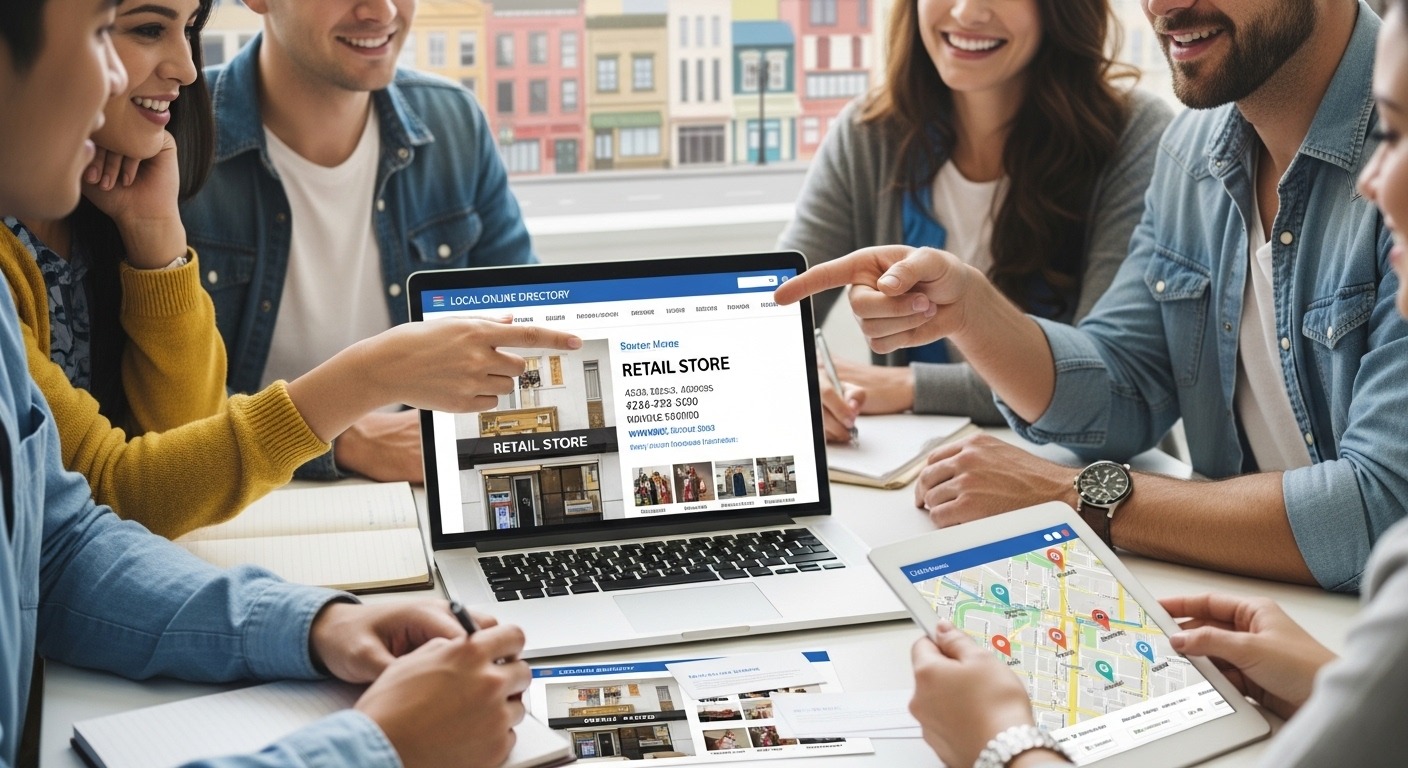
“I searched for my own store on Google and couldn’t find it. Meanwhile, the shop down the street shows up with photos, reviews, and opening hours.” — Sound familiar?
If you own a retail store and you’re not actively listed in local online directories, you’re invisible to a huge chunk of your potential customers. According to BrightLocal’s consumer research, 98% of people used the internet to find local business information in the past year — and local directories are one of the primary places they look.
The great news? Getting listed in local directories is something any retail store owner can do — without a marketing agency, without a big budget, and often for free. This guide will walk you through exactly what to do, which directories matter most, and how to optimise every single listing to turn searchers into shoppers.
Let’s get your store on the map — literally.
What You’ll Learn
- Why Local Directories Matter for Retail SEO
- The Golden Rule: NAP Consistency
- The Top 10 Directories Your Retail Store Must Be In
- How to Optimise Every Listing for Maximum Visibility
- Niche & Industry-Specific Directories
- Turning Directory Listings Into 5-Star Reviews
- How to Track Your Directory Performance
- Next Step: Retail Marketing Training
📍 Why Local Directories Matter for Retail SEO
Local online directories — also called citations — are websites that list business information for searchers in a specific area. Think Google Business Profile, Yelp, TripAdvisor, Yell.com, and dozens more. When your store appears consistently across these platforms, several powerful things happen:
Google Trusts You More
Consistent citations signal legitimacy to Google’s algorithm, boosting your local search rankings
You Appear in the Map Pack
The Google “3-pack” (map results) captures 44% of all local search clicks — directories get you there
Ready-to-Buy Traffic
Directory visitors have high purchase intent — they’re actively looking for a place to spend money
Free Backlinks
Most directories link back to your website — building domain authority and improving overall SEO
76%
of people who search for something nearby on their smartphone
visit a business within 24 hours
Source: Google / Ipsos
📌 The Golden Rule: NAP Consistency
Before you submit to a single directory, you need to understand the most important rule in local SEO: NAP Consistency. NAP stands for Name, Address, Phone number — and it must be completely identical across every single directory listing, your website, and your social profiles.
Why? Because Google cross-references your business information across the web to verify that you are a real, legitimate business. Inconsistencies — even small ones like “St.” vs “Street” or “+44” vs “0” before a phone number — create conflicting signals that erode Google’s confidence in your listing and suppress your rankings.
| NAP Element | ❌ Inconsistent (Bad) | ✅ Consistent (Good) |
|---|---|---|
| Business Name | The Green Leaf Shop / Green Leaf / Green Leaf Ltd | The Green Leaf Shop |
| Address | 12 Oak St / 12 Oak Street / 12, Oak Street | 12 Oak Street |
| Phone | 020 7946 0000 / +44 20 7946 0000 / 02079460000 | 020 7946 0000 |
| Website URL | http://greenleaf.com / www.greenleaf.com / greenleaf.co.uk | https://www.greenleaf.com |
Create a “Master NAP Document” — a single reference file with your exact business name, address, phone, URL, hours, and description. Copy-paste from this document to every directory. Never type it out fresh each time.
🏆 The Top 10 Directories Your Retail Store Must Be In
Not all directories carry the same SEO weight. These are the highest-authority, most-visited platforms that will have the greatest impact on your local visibility. Start here before expanding to niche directories.
| # | Directory | Why It Matters | Cost | Priority |
|---|---|---|---|---|
| 1 | Google Business Profile | Powers the Google Map Pack. Single most important listing for local retail. | Free | CRITICAL |
| 2 | Yelp for Business | Massive consumer base. Strong domain authority. Reviews influence purchasing decisions. | Free | CRITICAL |
| 3 | Bing Places | Powers Microsoft search — still 6%+ of all searches. Often overlooked by competitors. | Free | HIGH |
| 4 | Facebook Business Page | Social directory with 3B+ users. Google indexes Facebook Pages directly. | Free | HIGH |
| 5 | Apple Maps Connect | Default maps for all iPhone users. Enormous reach. Frequently neglected by retail owners. | Free | HIGH |
| 6 | Yell.com (UK) | UK’s leading local directory. 60M+ searches monthly. Strong trust signals for UK retailers. | Free | MEDIUM |
| 7 | TripAdvisor | Especially powerful for gift shops, tourist areas, experience-based retail, and food stores. | Free | MEDIUM |
| 8 | Foursquare | Powers location data for hundreds of apps including Uber, Snapchat, and Twitter/X. | Free | MEDIUM |
| 9 | Thomson Local / Checkatrade | Trusted by older demographics. Particularly strong for home goods, furniture, and hardware retail. | Paid/Free | LOWER |
| 10 | Trustpilot | Builds enormous trust signals. Reviews appear in Google SERPs as star ratings. | Free/Paid | MEDIUM |
⚙️ How to Optimise Every Listing for Maximum Visibility
Simply being listed isn’t enough. A bare-bones directory listing with just your name and phone number will be outranked by a competitor who has filled out every field with rich, optimised content. Here’s how to build listings that dominate:
Include your primary keywords naturally: what you sell, who you serve, and where you’re located. Example: “A family-run organic skincare boutique in central Bristol, specialising in natural face creams, body oils, and cruelty-free beauty products.” Use the same optimised description across all directories.
Listings with photos receive 42% more requests for directions and 35% more click-throughs (source: Google). Upload: your storefront, interior, products, team, and any special displays. Name photo files descriptively before uploading (e.g., organic-skincare-shop-bristol.jpg).
Most directories allow primary and secondary categories. Choose the most specific category that matches your store (e.g., “Organic Skincare Store” rather than just “Retail”). Use GBP Category tools to research all available options for your sector.
Inaccurate opening hours are the #1 reason customers leave negative reviews online. Update holiday hours in advance. Google Business Profile and Yelp both allow special hours for public holidays — use them every time.
Google Business Profile, Yelp, and others allow you to list specific products/services and publish weekly posts. These posts appear in search results and signal an active, legitimate business. Post weekly: new arrivals, promotions, events, seasonal content.
🏷 Niche & Industry-Specific Directories
Beyond the universal directories, niche directories can drive highly targeted traffic from shoppers who are specifically searching within your retail category. A listing on a niche directory sends stronger relevance signals to Google than a general one — and the traffic converts better because visitors are pre-qualified buyers.
- Lyst
- ShopStyle
- Indie Boutique directories
- Local fashion council listings
- Natural Health directory
- Fresha (beauty listings)
- Organic Trade Association
- Health food store finders
- Houzz
- Checkatrade (home goods)
- Garden Centre Association
- Local design trade directories
- Google Maps (Food category)
- OpenTable / Zomato (deli/café)
- Local farmers market listings
- Speciality food associations
- IndieBound (independent bookshops)
- Etsy Local (artisan gifts)
- Local gift guide websites
- Arts council directories
- PriceRunner
- Reevoo
- TechRadar Retailer Listings
- Authorised dealer directories
Google: “[your product type] directory UK” or “best stores [your city]”. See which listing sites appear in results — those are the directories worth your time. Also check where your top-ranking competitors are listed using Moz Local or Whitespark Citation Finder.
⭐ Turning Directory Listings Into 5-Star Reviews
A directory listing without reviews is a wasted opportunity. Reviews are the single most persuasive element on any local directory page — and they’re a confirmed ranking factor in Google’s local algorithm. According to BrightLocal’s Local SEO survey, businesses with more than 25 reviews earn 108% more revenue than average.
| Review Strategy | How to Implement | Effectiveness |
|---|---|---|
| Ask at Point of Sale | Train staff to verbally ask happy customers: “Would you mind leaving us a quick Google review?” | ⭐⭐⭐⭐⭐ |
| QR Code Cards | Print business cards with a QR code linking directly to your Google review form. Include in bags. | ⭐⭐⭐⭐ |
| Post-Purchase Email | Send automated thank-you email 2–3 days after purchase with a review link (online orders). | ⭐⭐⭐⭐ |
| Window / Shelf Signage | “Love shopping here? Share your experience on Google!” sign with QR code displayed in-store. | ⭐⭐⭐ |
| Respond to ALL Reviews | Respond to every review — positive and negative — within 48 hours. Google rewards engagement. | ⭐⭐⭐⭐⭐ |
Never buy fake reviews or incentivise customers with discounts in exchange for reviews. Google actively detects and penalises this, and it can result in your entire listing being suspended. Authentic reviews from real customers always outperform in the long run.
Want a Complete System for Getting Your
Retail Store Found Locally?
Directory listings are just one piece of the local SEO puzzle. The Retail Marketing Course at Easy Marketing School covers the complete strategy: local SEO, Google Business Profile mastery, content marketing, paid ads, and converting online visitors into in-store customers.
✅ Google Business Profile deep dive
✅ Review generation systems
✅ Content & social strategy
✅ Built for busy store owners
👉 Enrol in the Retail Marketing Course →
Join thousands of retail business owners growing their local presence
📊 How to Track Your Directory Performance
Once your listings are live and optimised, you need to measure what’s working. Most major directories provide basic analytics — but you should also be tracking from your own end to see the full picture.
| Tool | What It Tracks | Cost | Link |
|---|---|---|---|
| Google Business Profile Insights | Search views, map views, direction requests, calls, photo views | Free | business.google.com |
| Google Search Console | Impressions, clicks, position for local keywords hitting your site | Free | search.google.com |
| Moz Local | Citation consistency score, listing completeness, duplicate detection | From $14/mo | moz.com/local |
| BrightLocal | Local ranking tracker, citation audit, review monitoring across platforms | From $29/mo | brightlocal.com |
| UTM Parameters | Track exactly which directory is sending traffic to your website via Google Analytics | Free | GA Campaign Builder |
✅ Your Local Directory Action Checklist
Use this checklist to launch and maintain your directory presence. Work through it in order — it’s designed to get you maximum impact in minimum time.
📋 SETUP (Do Once)
📍 LISTINGS (Do in Order)
⭐ ONGOING (Monthly)
The Bottom Line
Getting your retail store featured in local online directories is one of the highest-return, lowest-cost marketing activities available to any physical retailer. Unlike paid advertising that stops the moment you stop spending, a well-optimised directory presence keeps working for you 24/7 — surfacing your store to shoppers who are actively looking for exactly what you sell.
Start with the fundamentals: create your Master NAP Document, claim your Google Business Profile, and expand outward from there. Be consistent, be thorough, and actively collect reviews. Within 60–90 days, you’ll see measurable improvement in your local search visibility, foot traffic, and revenue.
Your competitor is already in these directories. The question is: are you going to let them keep the advantage?
Local SEO
Retail Marketing
Google Business Profile
Updated March 2026 | 10 min read
Some links in this article are affiliate or partner links. We only recommend tools and resources we believe will deliver genuine value to retail business owners looking to grow their local online presence.