Maximize your reach and capture high-intent buyers exactly where they are searching in 2026.
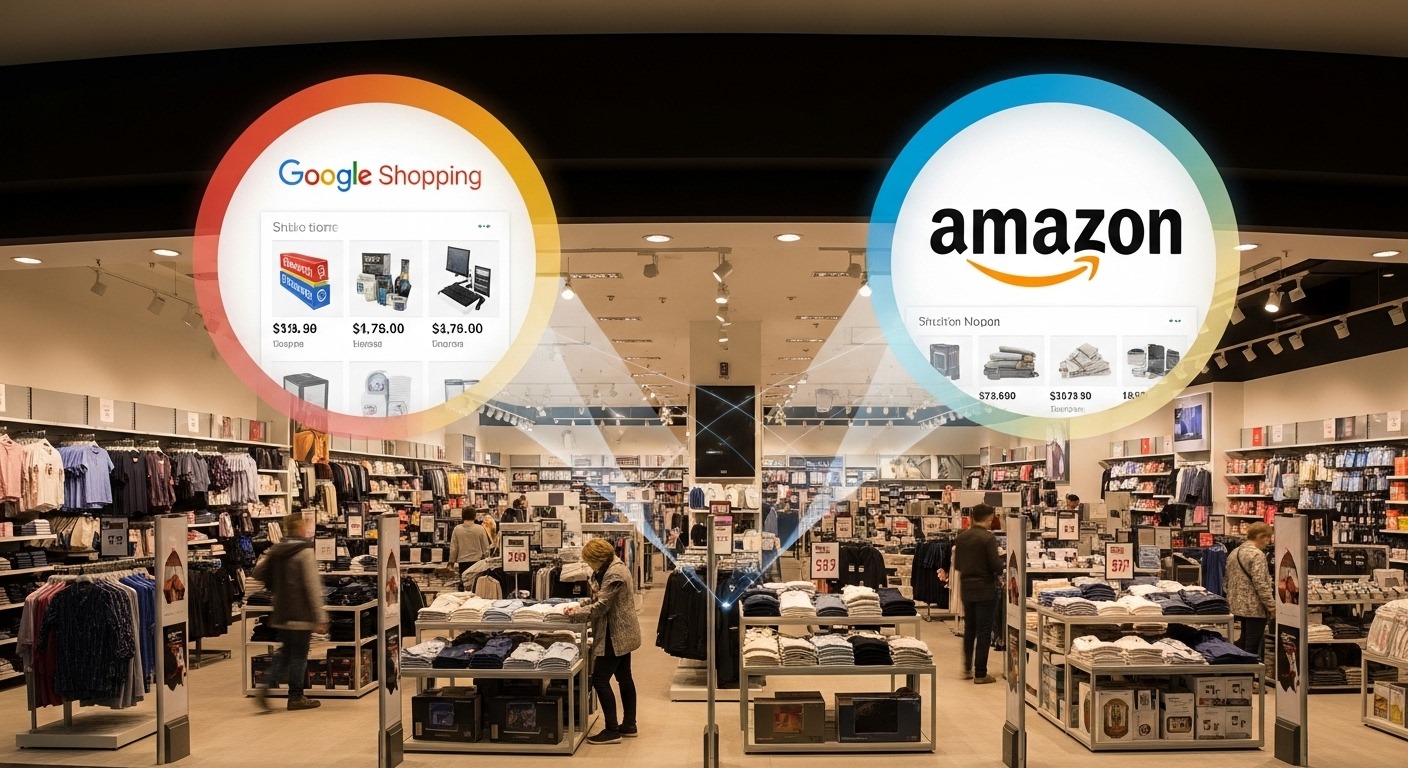
In the modern retail landscape, the debate isn’t about *where* to sell—it’s about how to be *everywhere*. Google Shopping and Amazon represent the two largest product search engines on the planet. While Google captures the “researcher,” Amazon captures the “ready-to-buy” shopper.
According to Statista, over 50% of product searches start on Amazon, yet Google still drives the majority of high-intent “near me” and comparison traffic. Running both platforms simultaneously isn’t just an option; it’s a requirement for scaling a retail brand.
1. The Strategic Divide: Discovery vs. Intent
To succeed on both platforms, you must understand their different “personalities.” Google Shopping is highly visual and relies on your website’s SEO and feed quality. Amazon is a closed ecosystem that rewards sales velocity and internal reviews.
Pro Tip: Use Google Shopping to build your brand awareness and own the customer data, while using Amazon as a high-volume sales engine to move inventory quickly.
The Sync-and-Scale Roadmap
Unified Feed
Use a tool like Channable or Feedonomics to sync inventory across both platforms instantly.
Budget Split
Allocate 60% to the platform with your highest ROAS and 40% to growth.
Data Feedback
Use Amazon’s “top search terms” to optimize your Google Shopping titles.
2. Inventory & Pricing Management
The biggest challenge of simultaneous marketing is avoiding overselling. If your Google Shopping ad leads to an “Out of Stock” page, you lose money. If you fail to fulfill an Amazon order because you sold the item in-store, your account health suffers.
| Feature | Google Shopping | Amazon Advertising |
|---|---|---|
| Traffic Ownership | You own the customer data. | Amazon owns the customer. |
| Key Ranking Factor | Feed quality & Site speed. | Sales velocity & Reviews. |
| Profit Margins | Higher (No marketplace fees). | Lower (Referral fees apply). |
Master the Full Retail Marketing Funnel
Running ads is easy. Running a profitable retail business across multiple channels is a science. Learn the inventory secrets, ad strategies, and scaling blueprints used by top 1% retailers.
3. The “Halo Effect” of Multi-Channel Marketing
One of the most overlooked benefits of being on both platforms is the “Halo Effect.” Many customers will see your product on Amazon, but then search for your brand on Google to see if they can get a better price or find more information on your website.
By maintaining a presence on both, you increase your brand authority. As noted by Shopify’s Multi-Channel Guide, businesses that sell on more than one channel see an average revenue increase of 190%.
Final Thoughts
Don’t choose between Google and Amazon—choose both. By syncing your inventory, optimizing your product feeds for Discovery (Google) and Conversion (Amazon), and using a unified budget strategy, you can dominate the search results. In 2026, the retailer with the most touchpoints wins.
© 2026 Retail Scaling Academy. All rights reserved.