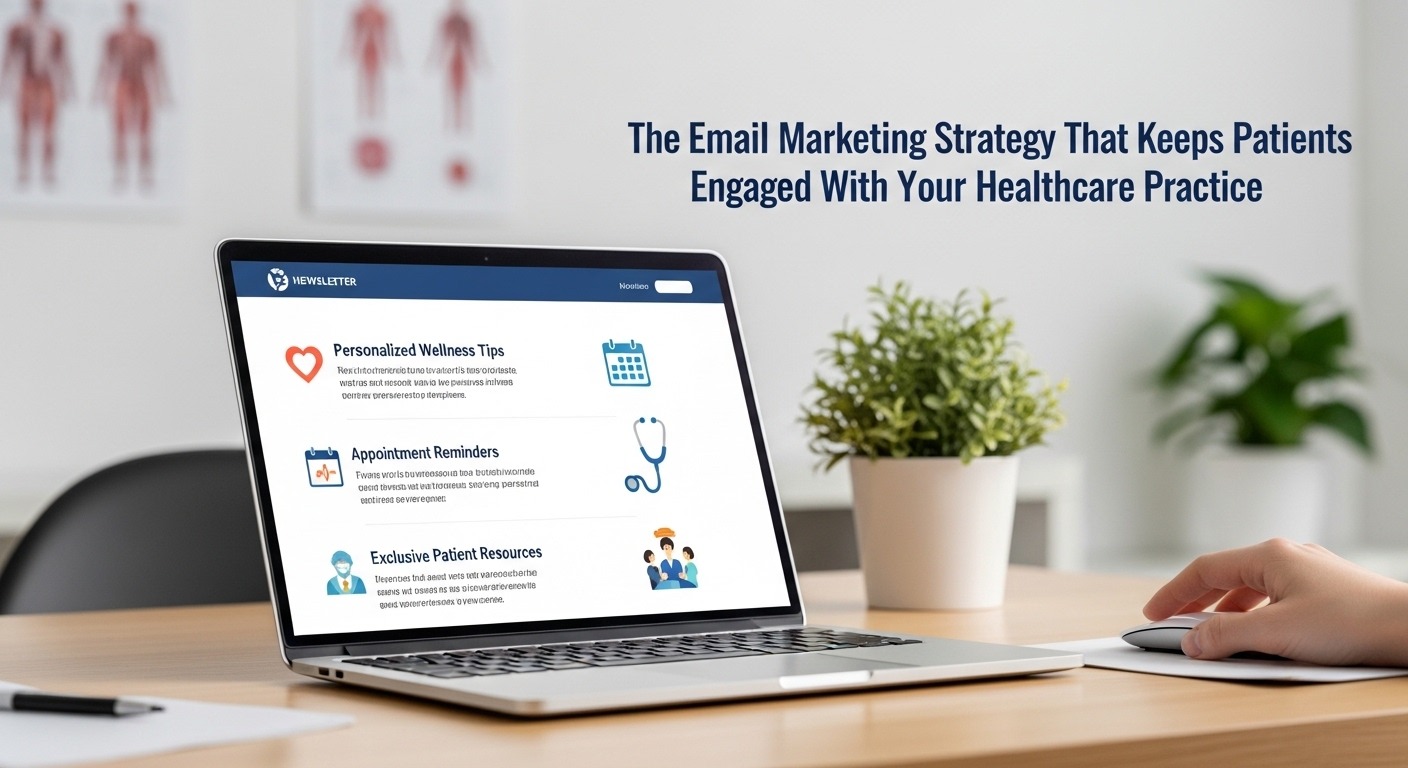
Imagine a patient who visited your clinic six months ago — they had a great experience, but life got busy, and they simply forgot to book their follow-up. A well-timed, personalized email could bring them back. That’s the quiet power of healthcare email marketing: it bridges the gap between visits, nurtures trust, and keeps your practice top-of-mind without being intrusive.
📋 Table of Contents
- Why Email Marketing Works Exceptionally Well in Healthcare
- HIPAA Compliance: The Non-Negotiable Foundation
- Patient Segmentation: The Secret to Relevance
- The 7 Types of Emails Every Healthcare Practice Needs
- Writing Subject Lines That Patients Actually Open
- Automation Sequences That Work on Autopilot
- Key Metrics and What They Tell You
- 5 Common Mistakes Healthcare Practices Make
- Take Your Healthcare Marketing to the Next Level
Why Email Marketing Works Exceptionally Well in Healthcare
In an era dominated by social media algorithms and paid advertising, email remains one of the most reliable, cost-effective, and personal communication channels available to healthcare providers. Unlike a social post that may never reach your audience, an email lands directly in a patient’s inbox.
Email Marketing By The Numbers
Sources: Campaign Monitor, Statista, Mailchimp Benchmarks
For healthcare practices specifically, email marketing serves multiple critical roles: it reminds patients of upcoming appointments, educates them about their health conditions, encourages preventive care visits, and — crucially — makes patients feel valued between appointments. According to HealthLeaders Media, practices that communicate consistently with patients between visits see significantly higher retention and lifetime patient value.
HIPAA Compliance: The Non-Negotiable Foundation
Before you send a single marketing email, you must understand the intersection of email marketing and HIPAA (Health Insurance Portability and Accountability Act). Non-compliance isn’t just a legal risk — it destroys patient trust.
⚠️ Important: Marketing emails that reference a patient’s specific health condition, treatment history, or diagnoses require explicit written authorization under HIPAA. Always work with a healthcare compliance professional when setting up your email marketing program.
| Email Type | HIPAA Classification | Authorization Required? |
|---|---|---|
| Appointment Reminders | Treatment Operations | ✅ No (TPO) |
| General Health Tips Newsletter | Marketing (Non-PHI) | ✅ No |
| Condition-Specific Promotions | Marketing (Uses PHI) | ⛔ Yes — Written Auth |
| Post-Visit Satisfaction Surveys | Healthcare Operations | ✅ No |
| Third-Party Product Promotion | Marketing (Third-Party) | ⛔ Yes — Written Auth |
TPO = Treatment, Payment, and Healthcare Operations. PHI = Protected Health Information. Consult a HIPAA compliance attorney for your specific situation.
Always use a HIPAA-compliant email marketing platform. Tools like Constant Contact, Klara, or specialized healthcare CRMs that offer Business Associate Agreements (BAAs) are essential.
Patient Segmentation: The Secret to Relevance
Sending the same email to every patient on your list is one of the fastest ways to get unsubscribes. The practices that achieve outstanding engagement results treat their patient list as multiple distinct audiences, each with different needs, communication preferences, and health journeys.
Patient Segmentation Framework
New Patients
Welcome series, practice intro, what to expect next
Active Patients
Health tips, appointment reminders, seasonal wellness
Lapsed Patients
Re-engagement, “we miss you,” overdue check-up prompts
Senior Patients
Preventive screenings, Medicare reminders, chronic care
Family Accounts
Pediatric tips, family flu campaigns, multi-member care
You can further segment by age group, appointment type, chronic condition (with appropriate authorization), geographic area, or preferred communication language. The deeper your segmentation, the more your emails feel like a one-on-one conversation rather than a mass broadcast.
The 7 Types of Emails Every Healthcare Practice Needs
Not all healthcare emails are created equal. High-performing practices use a deliberate email mix that balances transactional, educational, and relationship-building messages.
Welcome & Onboarding Emails
The first email a new patient receives sets the tone for the entire relationship. A great welcome email introduces your practice’s values, what to bring to the first appointment, how to access the patient portal, and what to expect. Send this within 24 hours of the first appointment booking.
📈 Tip: Practices that send a welcome sequence (3 emails in the first week) see up to 33% higher patient activation rates.
Appointment Reminders & Confirmations
No-shows cost US healthcare providers an estimated $150 billion annually. A strategic reminder sequence — sent 7 days, 48 hours, and 2 hours before the appointment — dramatically reduces this. Include a simple one-click confirmation or reschedule link.
📈 Tip: Include preparation instructions (fasting requirements, documents to bring) to reduce late arrivals and call-ins.
Post-Visit Follow-Up Emails
Sent 24–48 hours after an appointment, these emails reinforce care instructions, provide relevant educational resources, and invite patients to leave a Google or Healthgrades review. This touchpoint shows patients you care beyond the appointment itself.
📈 Tip: Include a brief satisfaction survey — this data is pure gold for improving your patient experience.
Preventive Care & Seasonal Health Campaigns
Use your content calendar to send timely campaigns around flu season, back-to-school physicals, open enrollment periods, or heart health month. These position your practice as a proactive health partner — not just a reactive sick-care destination.
📈 Tip: Create a 12-month health campaign calendar aligned with CDC National Health Observances.
Educational Health Newsletters
A monthly newsletter that provides genuinely useful health information — without promoting specific treatments — builds authority and keeps patients engaged. Think: “5 Foods That Support Heart Health” or “Understanding Your Blood Pressure Numbers.” Aim for 80% education, 20% practice promotion.
📈 Tip: Link to reputable external sources like Mayo Clinic or CDC.gov to boost credibility.
Re-engagement Campaigns for Lapsed Patients
Patients who haven’t visited in 12–18 months need a gentle nudge. A well-crafted “We’ve missed you” campaign with a personalized subject line can reactivate 10–25% of dormant patients. Keep the tone warm, not salesy — emphasize the health value of coming back.
📈 Tip: Offer a small incentive like a free wellness consultation or health risk assessment to lower the re-engagement barrier.
Practice Updates & New Service Announcements
New provider joining the team? Launching telehealth services? Extending office hours? These updates matter to your patients. A brief, well-designed announcement email keeps patients informed and reduces confused calls to your front desk.
📈 Tip: Use practice update emails as an opportunity to highlight patient testimonials about the new service.
Writing Subject Lines That Patients Actually Open
Your subject line is the single most important element of your email — 47% of recipients decide whether to open an email based on the subject line alone. In healthcare, you must balance curiosity-driving language with a tone of trust and professionalism.
| ❌ Weak Subject Line | ✅ High-Converting Alternative |
|---|---|
| “Our Monthly Newsletter” | “The 3-Minute Heart Health Check You Can Do Right Now” |
| “Appointment Reminder” | “[FirstName], your visit is in 48 hours — here’s what to bring” |
| “Come Back and See Us” | “It’s been a while, [FirstName] — your annual check is overdue” |
| “Flu Season Information” | “Flu shots are going fast — book yours before October 15” |
| “New Services at Our Clinic” | “Now offering telehealth — see your doctor from your couch” |
🔑 Subject Line Rules for Healthcare
- Keep it under 50 characters for mobile preview optimization
- Use the patient’s first name when possible — personalization boosts open rates by 26%
- Avoid ALL CAPS and excessive punctuation!!!! — triggers spam filters
- Create urgency without being manipulative (use real deadlines)
- Never use words like “FREE,” “CURE,” or sensationalized health claims
- A/B test two subject lines on every major campaign
Automation Sequences That Work on Autopilot
The real competitive advantage in healthcare email marketing isn’t the individual emails — it’s the automated sequences that trigger based on patient behaviors and milestones. Once set up, these sequences run silently in the background, nurturing every patient at the right moment.
New Patient Onboarding Sequence
→ Patient moves into Active Patients list
Tools like ActiveCampaign or Drip (when used with a HIPAA-compliant setup) let you build these sequences once and let them run indefinitely. This means a solo practitioner can deliver the same white-glove communication experience as a large hospital system.
Key Metrics and What They Tell You
If you’re not tracking your email performance, you’re flying blind. These are the metrics that matter most for healthcare email marketing, along with healthcare industry benchmarks to measure yourself against.
| Metric | Healthcare Avg. | Good | What It Tells You |
|---|---|---|---|
| Open Rate | 21% | 25%+ | Subject line effectiveness + list quality |
| Click-Through Rate | 2.7% | 4%+ | Content relevance and CTA clarity |
| Unsubscribe Rate | 0.4% | <0.2% | Content-audience alignment and frequency |
| Bounce Rate | 0.6% | <0.5% | List health and data quality |
| Conversion Rate | 1–3% | 5%+ | Appointments booked / actions taken per email |
Benchmarks sourced from Mailchimp Email Benchmarks and Campaign Monitor healthcare industry data.
5 Common Email Marketing Mistakes Healthcare Practices Make
Even well-intentioned healthcare email programs often fall into predictable traps. Here are the five most common pitfalls — and how to avoid them.
❌ Mistake #1: Emailing Too Infrequently
Sending one email a quarter means patients forget about you between appointments. Aim for at least 2–4 emails per month across your segments — a mix of educational content, reminders, and engagement touchpoints.
❌ Mistake #2: No Mobile Optimization
Over 60% of healthcare emails are opened on mobile devices. A poorly formatted email that requires pinching and zooming destroys credibility instantly. Always preview on mobile before sending.
❌ Mistake #3: Generic, One-Size-Fits-All Messaging
Sending a flu shot reminder to a 35-year-old and an 80-year-old in exactly the same way misses the mark for both. Invest time in segmentation upfront — it pays dividends in engagement for years.
❌ Mistake #4: Ignoring the Pre-Header Text
The pre-header (the small text preview visible after the subject line in most inboxes) is prime real estate. Don’t waste it with “View this email in your browser.” Use it to reinforce the subject line and add a second reason to open.
❌ Mistake #5: Promoting Without Nurturing
If every email is a promotion (“Book Now! Schedule Today! Call Us!”), patients will tune out quickly. Follow the 80/20 rule: 80% valuable content, 20% calls to action. Build trust first; conversions follow naturally.
🎓 Ready to Master Healthcare Marketing?
Stop Guessing. Start Growing Your Practice With Proven Marketing Systems.
The strategies in this article are just the beginning. The Healthcare Marketing Course at Easy Marketing School gives you the complete roadmap — email funnels, patient acquisition, retention strategies, SEO, and more — built specifically for healthcare providers.
🎓 Enroll in the Healthcare Marketing Course →
Join hundreds of healthcare providers growing their practices with proven marketing systems.
Final Thoughts: Start Small, Scale Strategically
Effective healthcare email marketing doesn’t require a massive team or a huge budget. It requires clarity, consistency, and a genuine desire to serve your patients between visits. Start with the foundations: a compliant platform, a clean segmented list, a welcome sequence, and an appointment reminder flow. Then layer in educational content and campaigns as you build confidence.
The practices that master patient communication — through email and beyond — aren’t just filling appointment slots. They’re building communities of loyal, informed patients who refer friends, leave five-star reviews, and return year after year.