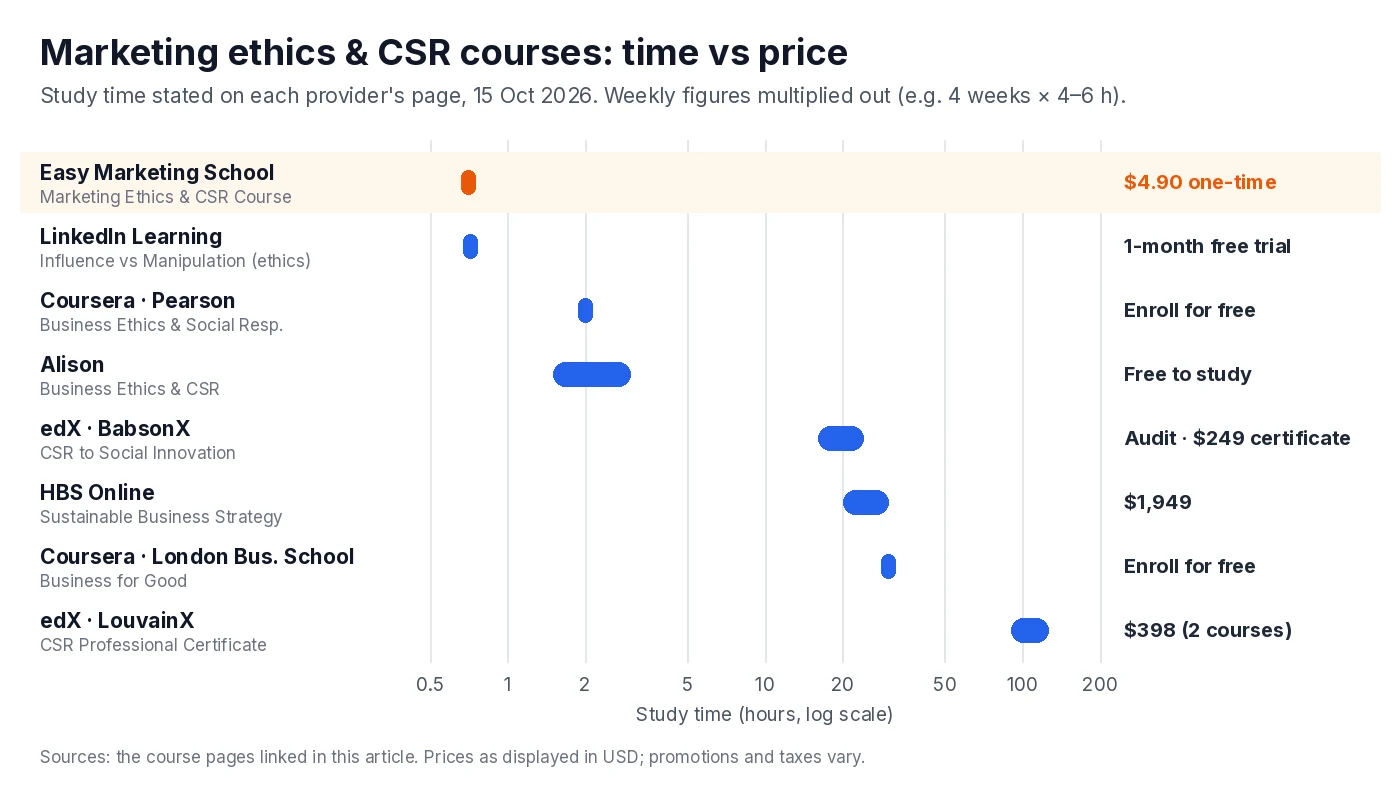
Search for a marketing ethics course and you get a mix of things. There are university programmes on corporate social responsibility (CSR), business-school courses on sustainability strategy, general business ethics courses, and a few short courses about where persuasion turns into manipulation. They answer different questions. A small-business owner who wants honest advertising, fair reviews and a believable story about doing good needs something different from a sustainability manager who has to write a CSR report. This guide compares eight real options on format, study time, price and certificate, as of October 2026. It also says which kind of buyer each one suits, including our own course and what it does not do.
Who is searching, and what each of them needs
- Owners and managers of small businesses. You want to grow without tricks you would be embarrassed to see in the local paper: no fake scarcity, no misleading claims, no buying reviews, no “green” story the business cannot back up. You need practical examples and a short list of lines not to cross, not a semester of theory.
- Marketers and communications staff in larger companies. You are asked to communicate CSR or ESG commitments, avoid greenwashing and work with a sustainability team. A recognised certificate and some strategy depth matter more to you.
- Managers who will lead sustainability work. You need business-model thinking, stakeholder strategy and a credential an employer will pay for.
- Students and career changers. You want a free or low-cost introduction and a certificate to put on a CV.
The options compared
| Program | Type | Format and length | Price (as of October 2026) | Certificate | Best for |
|---|---|---|---|---|---|
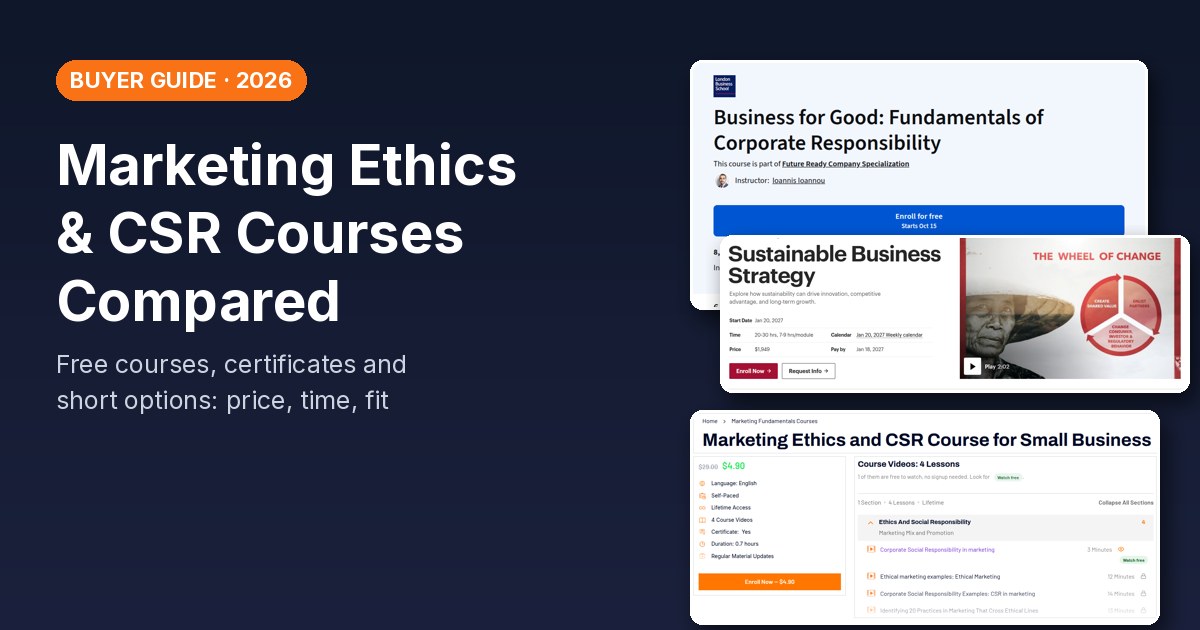
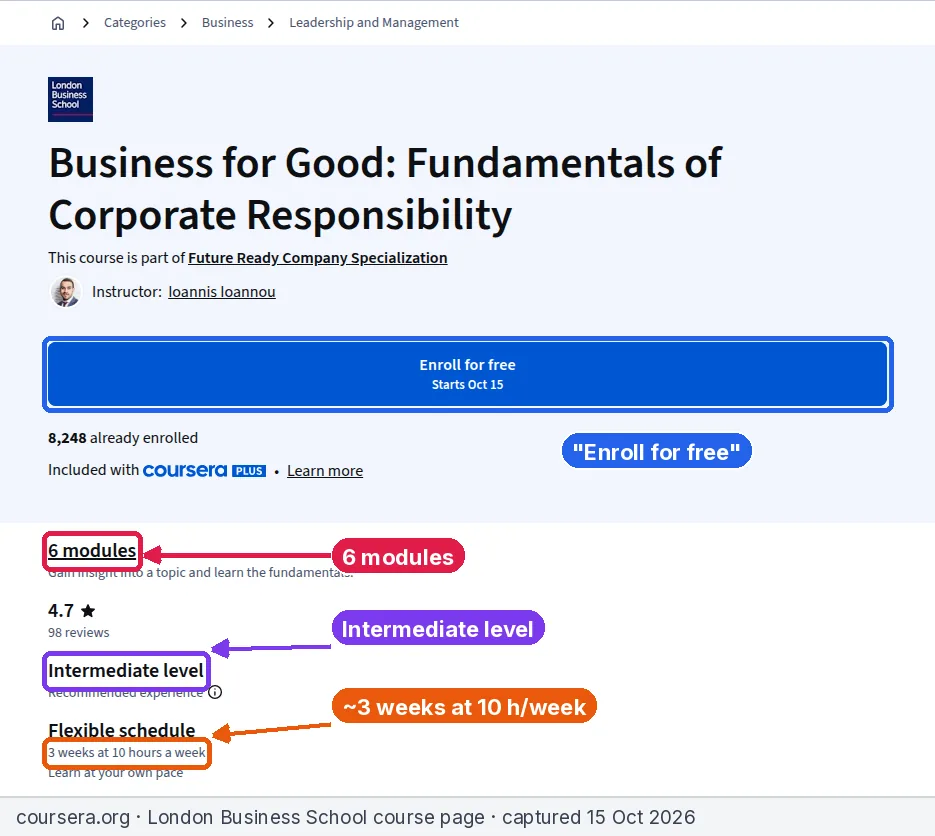
| Business for Good: Fundamentals of Corporate Responsibility (London Business School on Coursera) | Online university course | 6 modules, about 3 weeks at 10 hours a week, intermediate level | “Enroll for free” on the page; financial aid available | Shareable certificate | Managers who want the business case for responsibility |
| Business Ethics and Social Responsibility (Pearson on Coursera) | Short online course | 1 module, 2 hours, beginner level | “Enroll for free” on the page | Shareable certificate | A quick, structured introduction to the vocabulary |
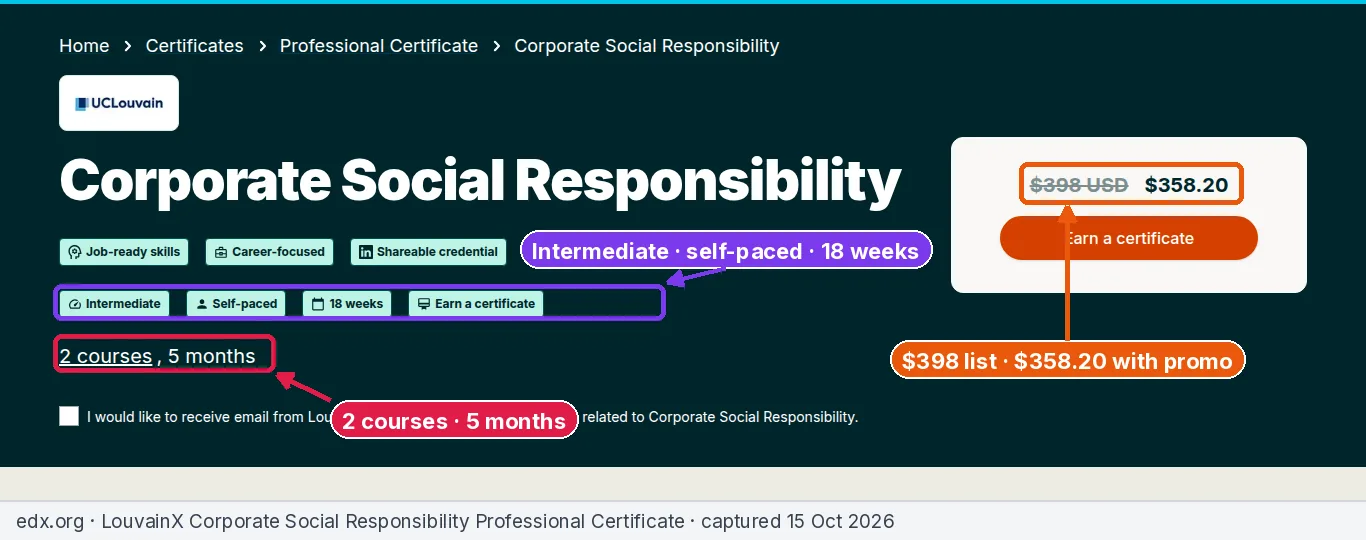
| Corporate Social Responsibility Professional Certificate (LouvainX on edX) | Professional certificate, 2 courses | 5 months at 5–7 hours a week, self-paced, intermediate | $398 USD list ($358.20 with a promotion shown at the time) | Professional certificate | People who will plan and communicate CSR |
| From Corporate Social Responsibility to Corporate Social Innovation (BabsonX on edX) | Online course | 4 weeks at 4–6 hours a week, self-paced | $249 USD certificate track; audit option with an access end date | Certificate on the paid track | Leaders who want to turn social issues into new business |
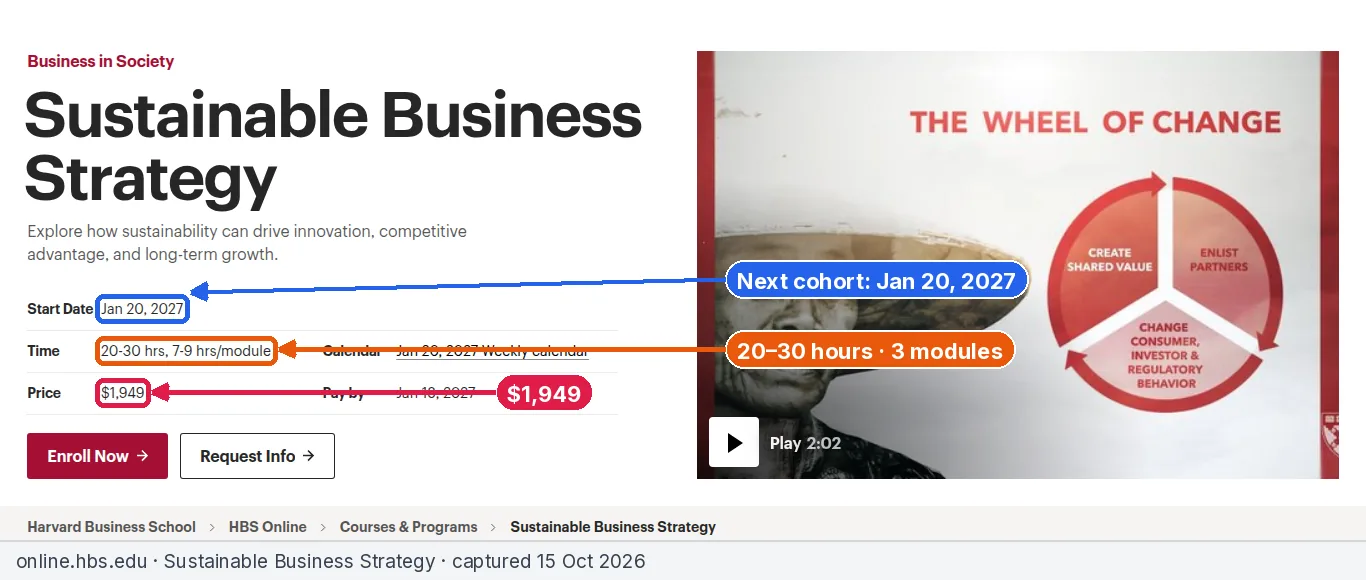
| Sustainable Business Strategy (HBS Online) | Business-school online course | 3 modules, 20–30 hours; next cohort starts Jan 20, 2027 | $1,949 | Certificate of Completion | Managers making the strategic case to leadership |
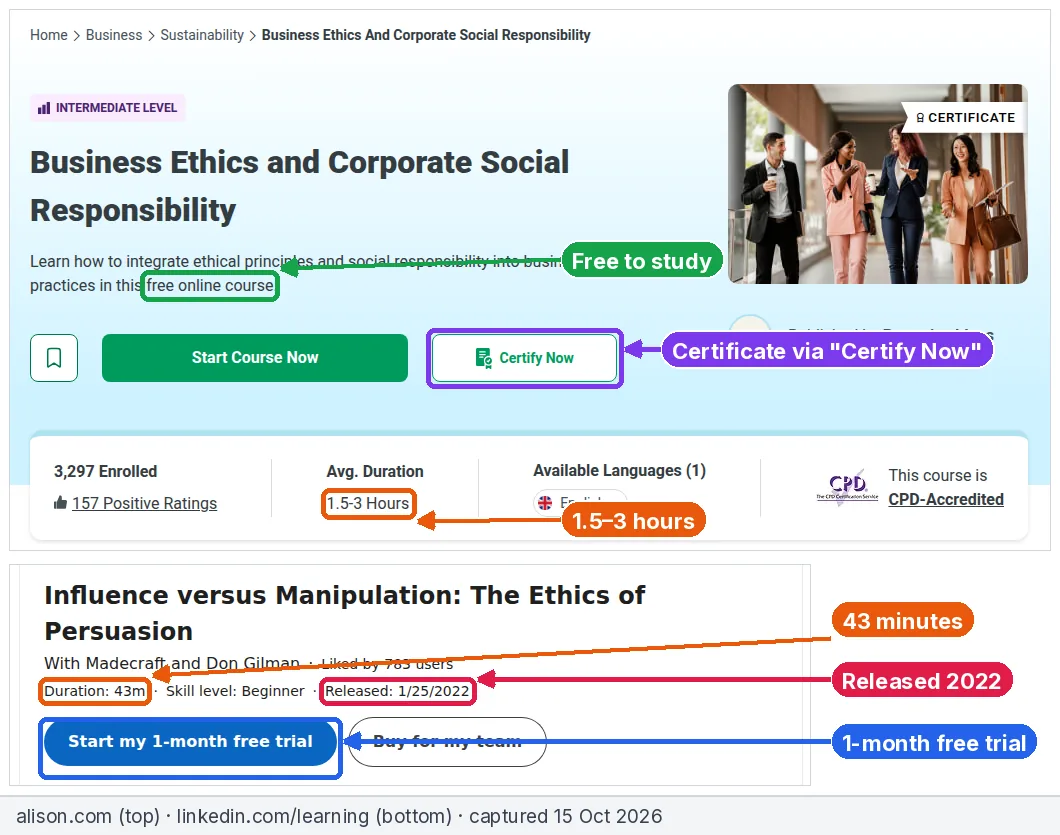
| Influence versus Manipulation: The Ethics of Persuasion (LinkedIn Learning) | Subscription video course | 43 minutes, beginner, released 2022 | LinkedIn Learning subscription; the page offers a 1-month free trial | Certificate of Completion | Anyone who persuades for a living and wants to stay on the right side of the line |
| Business Ethics and Corporate Social Responsibility (Alison) | Free online course | 1.5–3 hours on average, intermediate level | Free to study | Optional certificate through “Certify Now”; the page says the course is CPD-accredited | A free first look with a certificate option |
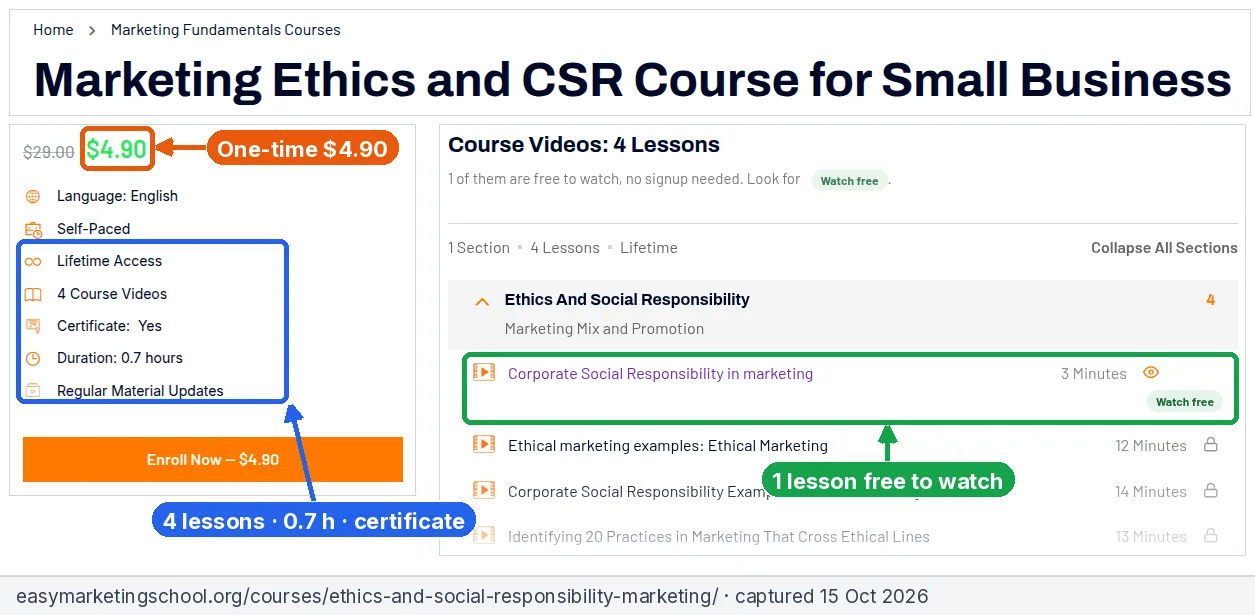
| Marketing Ethics and CSR Course for Small Business (Easy Marketing School) | Self-paced video course | 4 lessons, about 42 minutes; one lesson free to watch | $4.90 one-time, lifetime access | Certificate of completion | Small-business owners and marketers who want practical examples of ethical and unethical marketing |
Details and prices come from each provider’s public course page as of October 2026, viewed from Europe, and they change often. Promotions, taxes and local pricing vary, so confirm on the provider’s page before you enrol. Udemy was not included because its pages could not be checked for this comparison.
Each option: what it is good for, and what it is not
London Business School: Business for Good (Coursera)
This is a serious university course, taught by Ioannis Ioannou, that treats sustainability as a source of business advantage. The modules run from “The Sustainability Challenge” to “The Roadmap to Sustainability”. The page shows 6 modules, an intermediate level and “3 weeks at 10 hours a week”. It also sits inside a larger specialization. It suits a manager who has to argue the business case for responsible practice in a meeting. It is not a marketing course. You will not find much here on advertising claims, reviews or testimonials.
Pearson: Business Ethics and Social Responsibility (Coursera)
One module and “2 hours to complete” at beginner level, and the page says it was recently updated (July 2026). It separates business ethics from social responsibility and introduces decision-making models and stakeholder analysis. That makes it a fair, neutral introduction to the vocabulary. It is general business ethics, though, so a marketer will still need to work out how it applies to a campaign.
LouvainX: Corporate Social Responsibility Professional Certificate (edX)
This two-course programme (“Discovering Corporate Social Responsibility (CSR)” and “CSR Reporting and Communication”) is the closest of the university options to marketing. One of its stated outcomes is to “develop a persuasive CSR action and communication plan that avoids CSR-washing”. The page also says it applies “whether in a small or big company”. The cost is time: 5 months at 5–7 hours a week. The list price is $398, and a promotion was showing when we looked. It suits someone who will own CSR communication in an organisation.
BabsonX: From CSR to Corporate Social Innovation (edX)
This course follows how companies moved from philanthropy to CSR to social innovation. It uses interviews with company leaders who have led such initiatives. At 4 weeks and 4–6 hours a week it is a manageable size. The paid track with a certificate is $249, and there is an audit option whose access ends on a set date. It works best for someone looking for new products or programmes with a social purpose, rather than someone checking whether today’s marketing is fair.
HBS Online: Sustainable Business Strategy
This is the most expensive option here at $1,949, with three modules and 20–30 hours of study. The page shows a cohort starting January 20, 2027, with payment due January 18. You get the Harvard Business School Online brand, a certificate of completion and strategy content on shared value and stakeholders. It suits managers who will present a sustainability strategy to senior leadership and whose employer pays for training. For a small business that wants honest marketing, it is far more than the job needs.
LinkedIn Learning and Alison: the short options
The LinkedIn Learning course “Influence versus Manipulation: The Ethics of Persuasion” runs 43 minutes and was released in January 2022. It is about persuasion in general (pushing and pulling, matching and mirroring, framing) rather than advertising. Even so, the central question carries over well to sales and marketing copy. Access comes with a LinkedIn Learning subscription, and the page offers a one-month free trial.
Alison’s “Business Ethics and Corporate Social Responsibility” is free to study, takes 1.5–3 hours on average and, according to its page, is CPD-accredited. The certificate is a separate step (“Certify Now”), and the site was advertising discounts on certificates when we looked. It is a sensible first stop if your budget is zero.
How to choose: a quick checklist
- What decision will the course help you make next month? If the answer is “what to put in our ads, emails and website”, pick something practical and short. If it is “our three-year sustainability strategy”, pick a university or business-school course.
- Does it cover marketing, or business ethics in general? Look in the syllabus for claims, testimonials, reviews, pricing tactics, privacy and greenwashing. If none of these appear, you will be translating theory into marketing yourself.
- Do you need a credential, and who will recognise it? University and business-school certificates carry more weight with employers. A certificate of completion from a short course shows initiative, but it is not a qualification.
- How many hours do you really have? Multiply out the weekly figure. “5–7 hours a week for 5 months” means well over 100 hours.
- What is the full price? Check whether the certificate costs extra, whether the course needs a subscription, and whether the price you see is a time-limited promotion.
- Is it current? Look at the release or update date. Rules on advertising, influencer disclosure and environmental claims keep changing.
What a marketing ethics course should cover, whoever teaches it
- Honest claims. What you can prove about a product, and what you cannot say.
- Persuasion versus manipulation. Urgency, scarcity, social proof and pricing tactics, and the point where each becomes deception.
- Reviews, testimonials and influencers. How to ask for them, and how to disclose paid relationships.
- Customer data and privacy. Consent, email lists and targeting.
- CSR and environmental claims. How to talk about good work without greenwashing, and how to keep it believable.
- Vulnerable audiences. Children, health and financial worries, where the ethical bar is higher.
Sector rules add their own layer. Our guides on marketing a healthcare practice ethically while staying HIPAA compliant and marketing beauty products without greenwashing show how general principles become specific rules.
Where our course fits, and its limits
The marketing ethics and CSR course at Easy Marketing School is deliberately small. It has four self-paced video lessons, about 42 minutes in total:
- CSR in marketing (free to watch, no sign-up needed)
- Ethical marketing examples
- CSR examples in marketing
- 20 practices in marketing that cross ethical lines
It is taught by Kamran Taghiyev, the school’s founder. It costs a one-time $4.90 and includes lifetime access and a certificate of completion. It is for an owner or marketer who wants clear examples of what fair marketing looks like, and a list of practices to stop, in one evening.
Here is what it is not:
- It is not accredited and carries no CPD or CEU credits.
- It is not a CSR strategy or ESG reporting programme. For those, the LouvainX, London Business School and HBS Online courses go much further.
- It is not legal advice. Advertising and consumer-protection rules differ by country and sector.
- It is taught in English only.
If you need a credential an employer recognises, pick one of the university options. If you need to clean up your own marketing this week, start with the free lesson and decide from there.
Frequently asked questions
Is there a free marketing ethics course with a certificate?
Some courses are free to study, such as Alison’s course and the Coursera courses marked “Enroll for free”. Getting the certificate often involves a paid step or a subscription, so check the certificate terms on each page. Low-cost courses with a one-time price are the other route.
What is the difference between marketing ethics and CSR?
Marketing ethics is about how you sell: honest claims, fair persuasion, privacy and treatment of customers. Corporate social responsibility is about the company’s wider impact on people, communities and the environment, and how it reports and communicates that. They meet when a company talks about its CSR in its marketing, which is where greenwashing happens.
Do I need an accredited course?
Only if an employer, professional body or job application asks for one. To improve your own business’s marketing, the content and how practical it is matter more than accreditation.
How long does a marketing ethics course take?
Among the options above, from 43 minutes to more than 100 hours. Short courses take an evening. University and business-school courses take 20–30 hours over a few weeks, or several months for multi-course certificates.