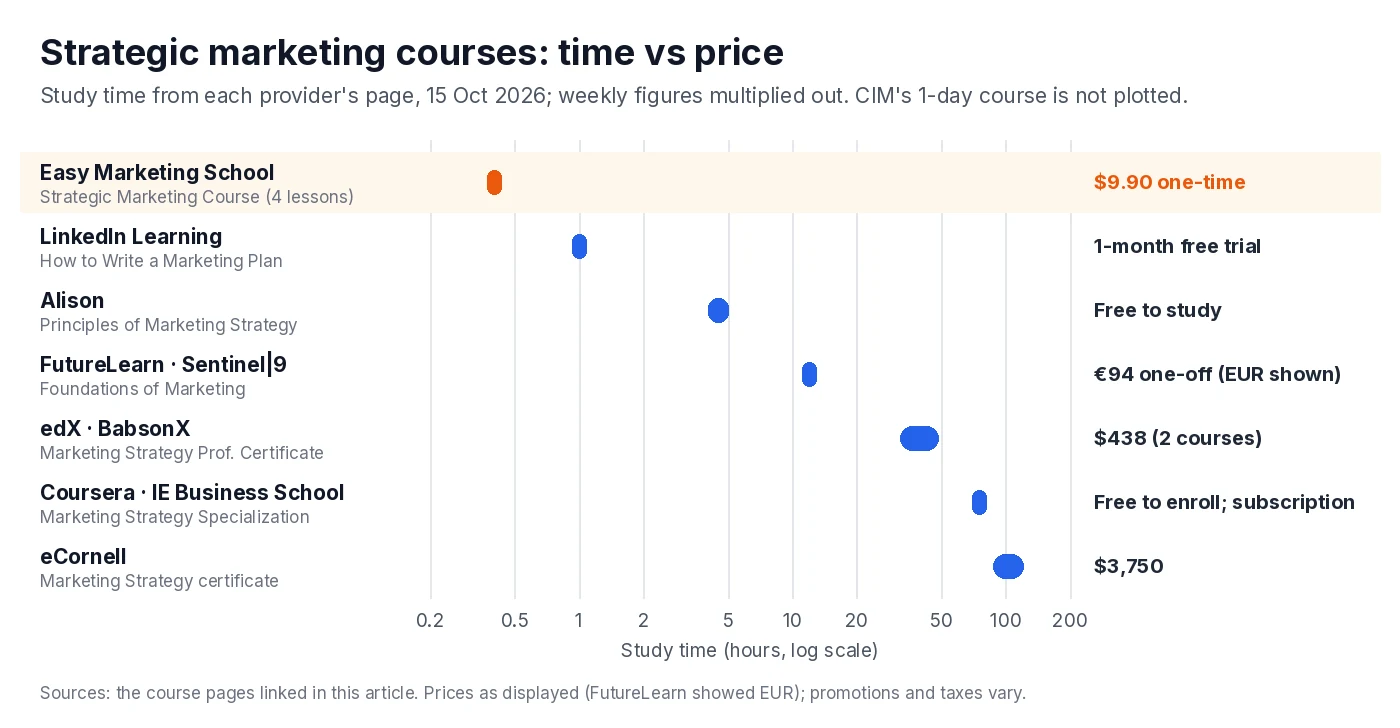
“Strategic marketing course” can mean three different purchases. One is a university certificate that takes months and teaches you to build a go-to-market strategy with data. Another is a short professional course that walks you through strategic analysis, growth and positioning in a day. The third is a quick primer on the planning tools themselves (SWOT, PESTEL, Ansoff) for someone who has to write a plan next week. Search results mix all three. This guide compares seven real options plus our own, as of October 2026, on format, study time, price and certificate, and says honestly who each one suits.
Who is searching, and what each of them needs
- Small-business owners and managers. You need to decide where to grow (new customers, new products, new markets), check what is happening around you, and set a realistic budget. You want the tools, explained clearly, and you want to use them this month.
- Marketers moving into a strategy role. You need structured depth on segmentation, positioning, pricing and channels, and a credential that shows it.
- Career changers and students. You want a recognised certificate and a guided path, and you can give it several weeks or months.
- Anyone who has been asked to “write the marketing plan”. You need a template, a method and a plan document by the end of the course.
The options compared
| Program | Type | Format and length | Price (as of October 2026) | Certificate | Best for |
|---|---|---|---|---|---|
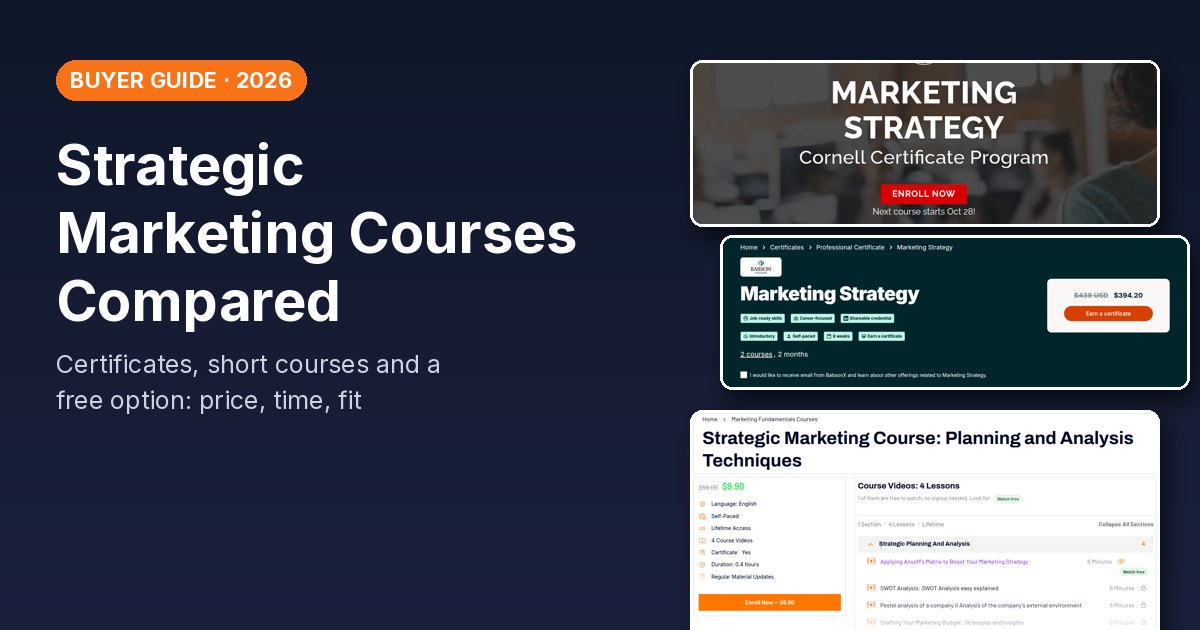
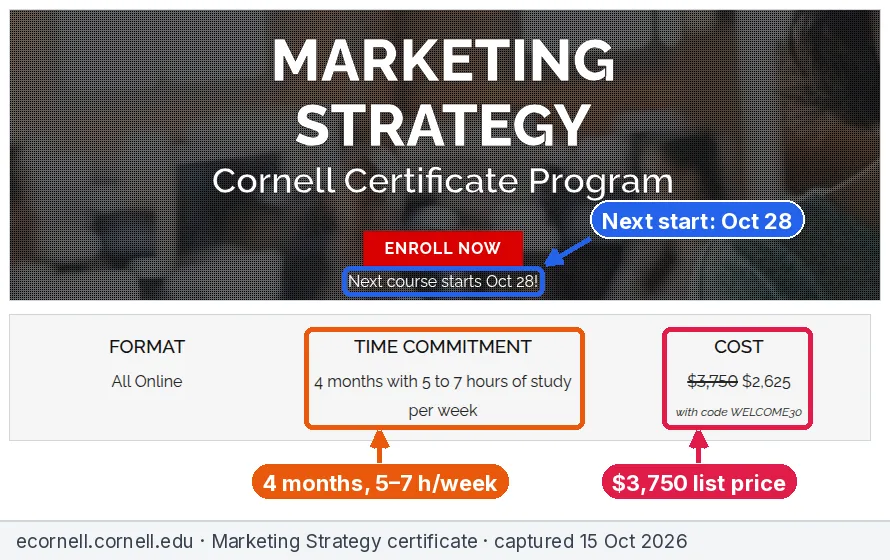
| Marketing Strategy, Cornell Certificate Program (eCornell) | University certificate, online | 7 courses taken in order; 4 months at 5–7 hours a week | $3,750 list (a time-limited code price was also shown) | Cornell SC Johnson certificate; 98 Professional Development Hours (9.8 CEUs) | Marketers who want a deep, data-led strategy credential |
| Marketing Strategy Specialization (IE Business School on Coursera) | Online specialization | 5 courses; about 2 months at 10 hours a week; beginner | “Enroll for free” on the page; full access through a Coursera subscription; financial aid available | Career certificate from IE Business School | Learners who want a structured path ending in a marketing plan capstone |
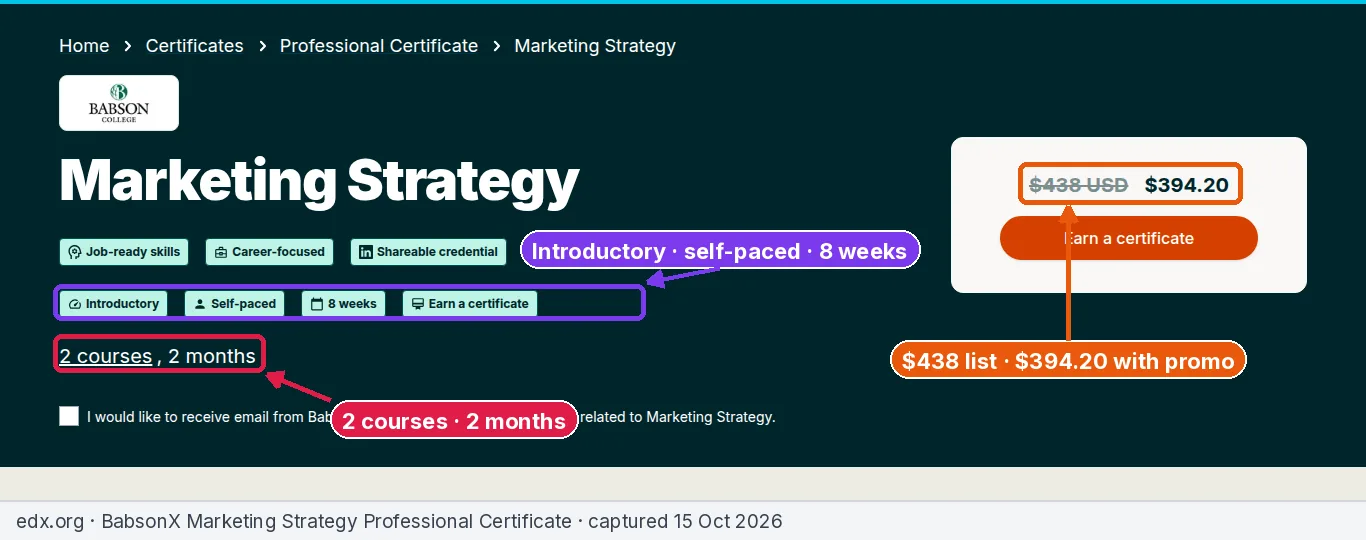
| Marketing Strategy Professional Certificate (BabsonX on edX) | Professional certificate, 2 courses | 2 months at 4–6 hours a week; self-paced; introductory | $438 USD list ($394.20 with a promotion shown at the time) | School-verified certificate | Entrepreneurs and new marketers who want customer-centred fundamentals |
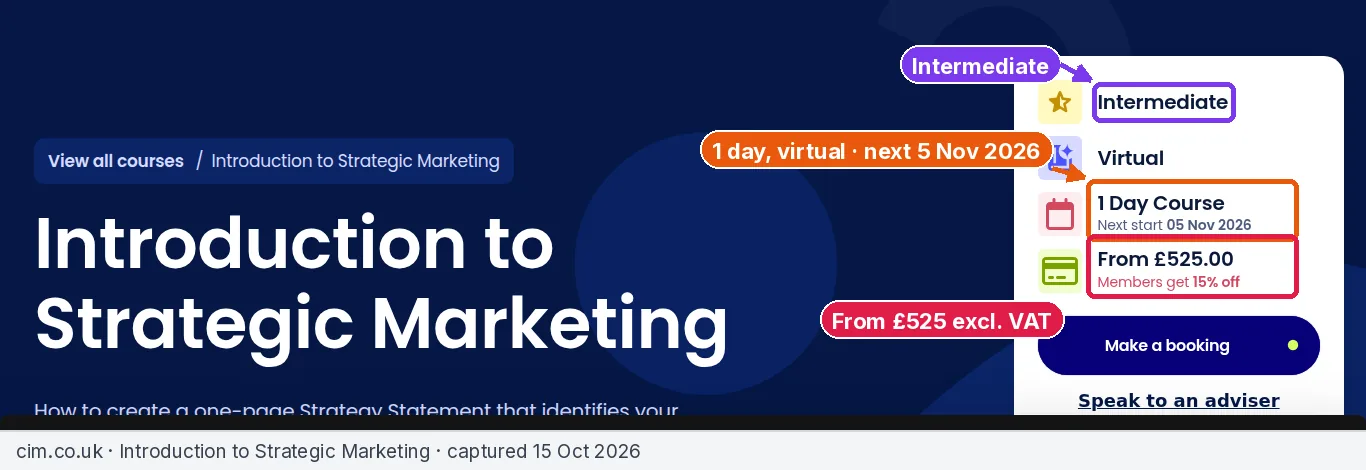
| Introduction to Strategic Marketing (The Chartered Institute of Marketing) | Professional-body short course | 1 day, virtual, intermediate; next start 5 Nov 2026 | From £525.00 excluding VAT; members get 15% off | Not stated on the page | Marketers who want a live, one-day session from a professional body |
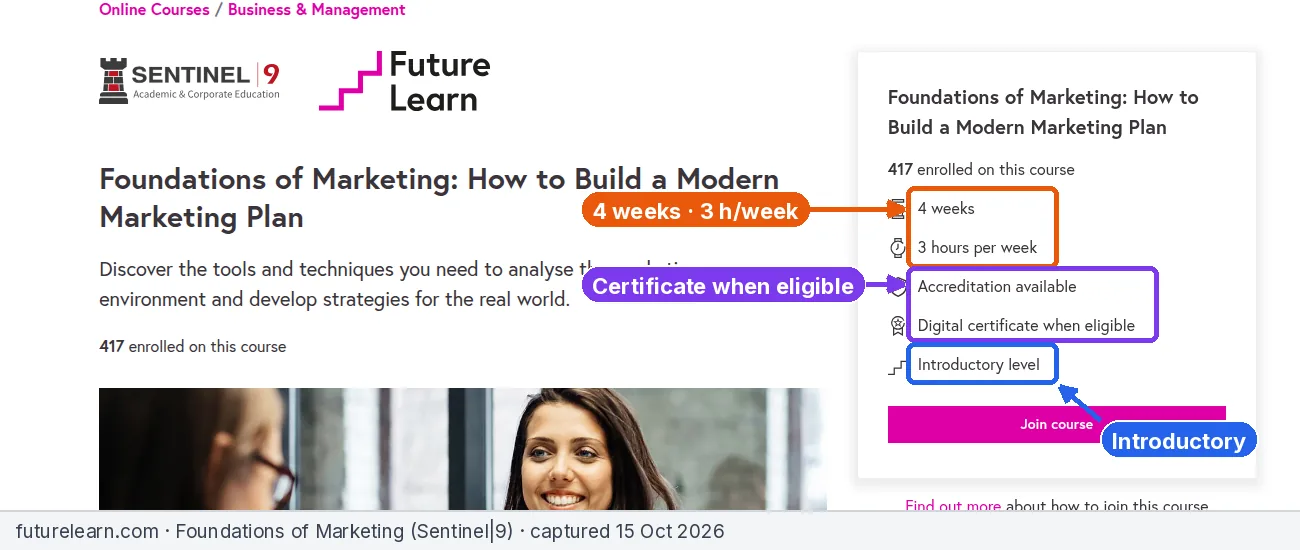
| Foundations of Marketing: How to Build a Modern Marketing Plan (Sentinel|9 on FutureLearn) | Short online course | 4 weeks at 3 hours a week; introductory | €94 one-off (shown in euros to our European connection); a free tier limited to 4 weeks; or a FutureLearn subscription | Digital certificate when eligible; accreditation available | People who want SWOT, PESTLE and five forces inside a full marketing-plan course |
| How to Write a Marketing Plan (LinkedIn Learning) | Subscription video course | 1 hour, beginner, 4 quizzes; released 2022 | LinkedIn Learning subscription; the page offers a 1-month free trial | Certificate of Completion | Marketers and small-business owners who need a plan document quickly |
| Principles of Marketing Strategy (Alison) | Free online course | 4–5 hours on average, intermediate | Free to study | Optional CPD-accredited certificate through “Certify Now” | A free overview of strategy versus tactics, persuasion and segmentation |
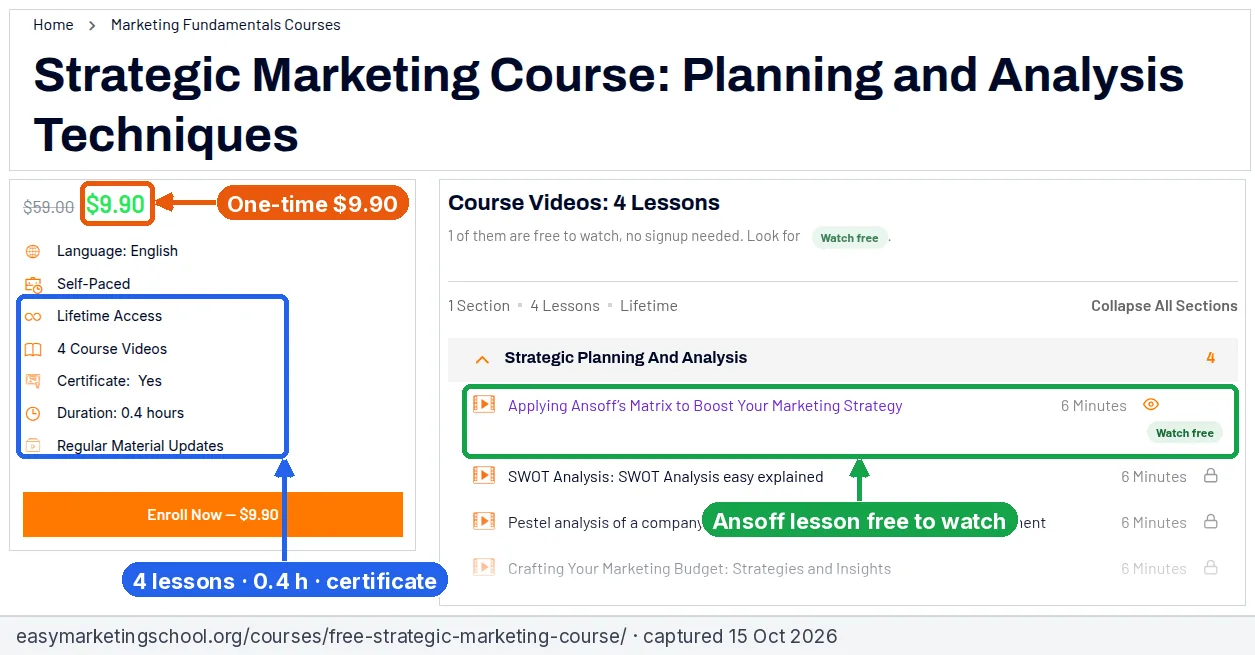
| Strategic Marketing Course: Planning and Analysis Techniques (Easy Marketing School) | Self-paced video primer | 4 lessons of about 6 minutes each (0.4 hours); the first lesson is free to watch | $9.90 one-time, lifetime access | Certificate of completion | Owners and new marketers who need Ansoff, SWOT, PESTEL and budgeting explained quickly |
Details and prices come from each provider’s public course page as of October 2026, viewed from Europe, and they change often. Promotions, VAT and local-currency pricing vary, so confirm on the provider’s page before you enrol. Wharton’s executive-education pages and Udemy could not be checked for this comparison, so they are not included.
Each option: what it is good for, and what it is not
eCornell: Marketing Strategy certificate
This is the most complete programme here. The seven courses run from “Key Performance Indicators for Marketing” through segmentation, targeting and positioning, product design and testing, distribution, pricing, and “Promotion and Attribution Strategy”. You take them in order and finish with a go-to-market strategy project. The page lists “Entrepreneurs and small business owners” among the people it is for. The certificate comes from Cornell’s SC Johnson College of Business and carries 98 Professional Development Hours (9.8 CEUs). It costs $3,750 at list price and takes about four months at 5–7 hours a week. It suits someone who wants marketing strategy as a career skill and whose employer may pay. It is a lot to take on if you need one plan for one business.
IE Business School: Marketing Strategy Specialization (Coursera)
This is a five-course path for beginners: “Market Research and Consumer Behavior”, “Positioning”, “Marketing Mix Fundamentals”, “The Marketing Plan” and a capstone project. The page estimates about two months at 10 hours a week, with listed course times adding up to around 70 hours. Enrolling is free, full access comes with a Coursera subscription, and financial aid is available. You get a solid academic structure and a plan-writing exercise at the end. It needs steady weekly time, and it goes into the marketing mix much more than a planning-tools primer does.
BabsonX: Marketing Strategy Professional Certificate (edX)
Two courses: “Marketing Fundamentals: Who Is Your Customer?” and “Customer Centric Marketing for Entrepreneurs”. They cover segmentation, targeting and positioning, the marketing mix, personas and messaging. The page says it is “perfect for entrepreneurs and managers looking to gain basic marketing knowledge”. At 2 months, 4–6 hours a week and a $438 list price, it sits in the middle of this comparison on cost and effort. It is strongest on understanding the customer. It has less on classic strategic analysis tools such as PESTEL or the Ansoff matrix.
CIM: Introduction to Strategic Marketing
This is a one-day virtual course from the Chartered Institute of Marketing. It covers how strategic marketing differs from corporate strategy and tactical marketing, then strategic analysis, growth strategy and positioning strategy. It ends with each participant summarising their decisions in a one-page Strategy Statement. The page lists it as intermediate at £525.00 excluding VAT, with 15% off for members and the next date on 5 November 2026. It suits a working marketer who learns best in a live session and wants a practical output. A one-day course won’t give you a formal qualification, and it costs more per hour than the self-paced options.
FutureLearn: Foundations of Marketing (Sentinel|9)
This is the closest match by topic to a planning-tools primer. The page says you will explore “PESTLE, five-forces, SWOT analysis, and Porter’s value chain” and learn how to develop a marketing plan. It takes four weeks at three hours a week and is marked introductory. The price was shown in euros from our European connection: €94 to buy the course, a FutureLearn subscription, or a free tier with access limited to four weeks. A US visitor may see different pricing. It suits someone who wants the analysis tools inside a broader course with exercises and some pacing.
LinkedIn Learning and Alison: the short and free options
Goldie Chan’s “How to Write a Marketing Plan” on LinkedIn Learning runs one hour and was released in August 2022. It is aimed, in its own words, at “a marketing professional or small business owner”. It is the fastest route to a plan document. It teaches the plan rather than the analysis tools behind it. Access comes with a LinkedIn Learning subscription, and the page offers a one-month free trial.
Alison’s “Principles of Marketing Strategy” is free to study and takes 4–5 hours on average. It covers first principles, strategy versus tactics, the 4Ps, the six powers of persuasion, needs-based segmentation and growth loops. The CPD-accredited certificate is an optional extra (“Certify Now”). If your budget is zero, this is the place to start.
How to choose: a quick checklist
- Do you need a credential or a decision? A credential points to eCornell, IE on Coursera or BabsonX. A decision about where to grow next quarter points to a short course you can apply at once.
- Which tools do you actually need? Strategic analysis (SWOT, PESTEL, five forces), growth options (Ansoff), positioning, and the marketing mix are different skills. Check that the syllabus names the ones you need.
- How many hours can you protect? Multiply the weekly figure: “2 months at 10 hours a week” is about 80 hours.
- Self-paced or live? Cohorts and live days keep you moving. Self-paced courses fit around a business but need discipline.
- What is the real price? Check currency, VAT, whether the certificate costs extra, whether a subscription renews, and whether the price you see is a time-limited promotion.
- Will you finish with something you can use? The best courses end with a plan, a strategy statement or a project, not just a quiz.
What a strategic marketing course should cover, whoever teaches it
- External analysis. PESTEL and the market and industry around you.
- Internal analysis. SWOT, done honestly rather than as a list of compliments.
- Growth options. The Ansoff matrix: more of the same customers, new markets, new products, or diversification, and the risk of each.
- Segmentation, targeting and positioning. Who you serve and why they should choose you.
- Budget and objectives. What you will spend, on what, and how you will know it worked.
- A written plan. One page is often enough to start.
For worked examples, see our guides to B2B marketing strategy for small companies and the 12-month restaurant marketing plan template. They show what a finished strategy looks like for a real business.
Where our course fits, and its limits
The strategic marketing course at Easy Marketing School is a primer. It has four self-paced video lessons of about six minutes each, 0.4 hours in total:
- Applying Ansoff’s matrix to your marketing strategy (free to watch, no sign-up needed)
- SWOT analysis
- PESTEL analysis of a company’s external environment
- Building a marketing budget
It is taught by Kamran Taghiyev, the school’s founder. It costs a one-time $9.90 (it is a paid course, despite the word “free” in its web address) and includes lifetime access and a certificate of completion. It is for an owner or new marketer who needs these four tools explained in plain words before writing a plan.
Here is what it is not:
- It is a 24-minute introduction, not a strategy programme. It does not cover segmentation, positioning, pricing or channels in depth, and there is no graded project.
- It is not accredited and carries no CPD credits or CEUs.
- It is taught in English only.
If you need the credential, choose eCornell, IE on Coursera or BabsonX. If you need a live day with a professional body, choose CIM. If you need to understand Ansoff, SWOT, PESTEL and a budget before tonight’s planning session, start with our free lesson and decide from there.
Frequently asked questions
What is the difference between strategic marketing and marketing strategy?
The terms are often used interchangeably. Strategic marketing usually refers to the analysis and long-term choices (which markets, which customers, which growth path). A marketing strategy is the resulting plan for a product or business. Most courses here teach both.
Is there a free strategic marketing course?
Yes. Alison’s “Principles of Marketing Strategy” is free to study, FutureLearn offers limited free access to its course, and the Coursera specialization is free to enrol. Certificates usually involve a payment or subscription. Our own course is paid ($9.90), with the first lesson free to watch.
How long does a strategic marketing course take?
From under half an hour for a primer to about four months for a university certificate. The middle options take 12–50 hours over a few weeks.
Do I need a certificate to do strategic marketing?
No. To do strategic marketing for your own business, a clear method and an honest analysis matter more. For a marketing job, a recognised certificate such as eCornell’s, or a professional body’s course, helps your application.