
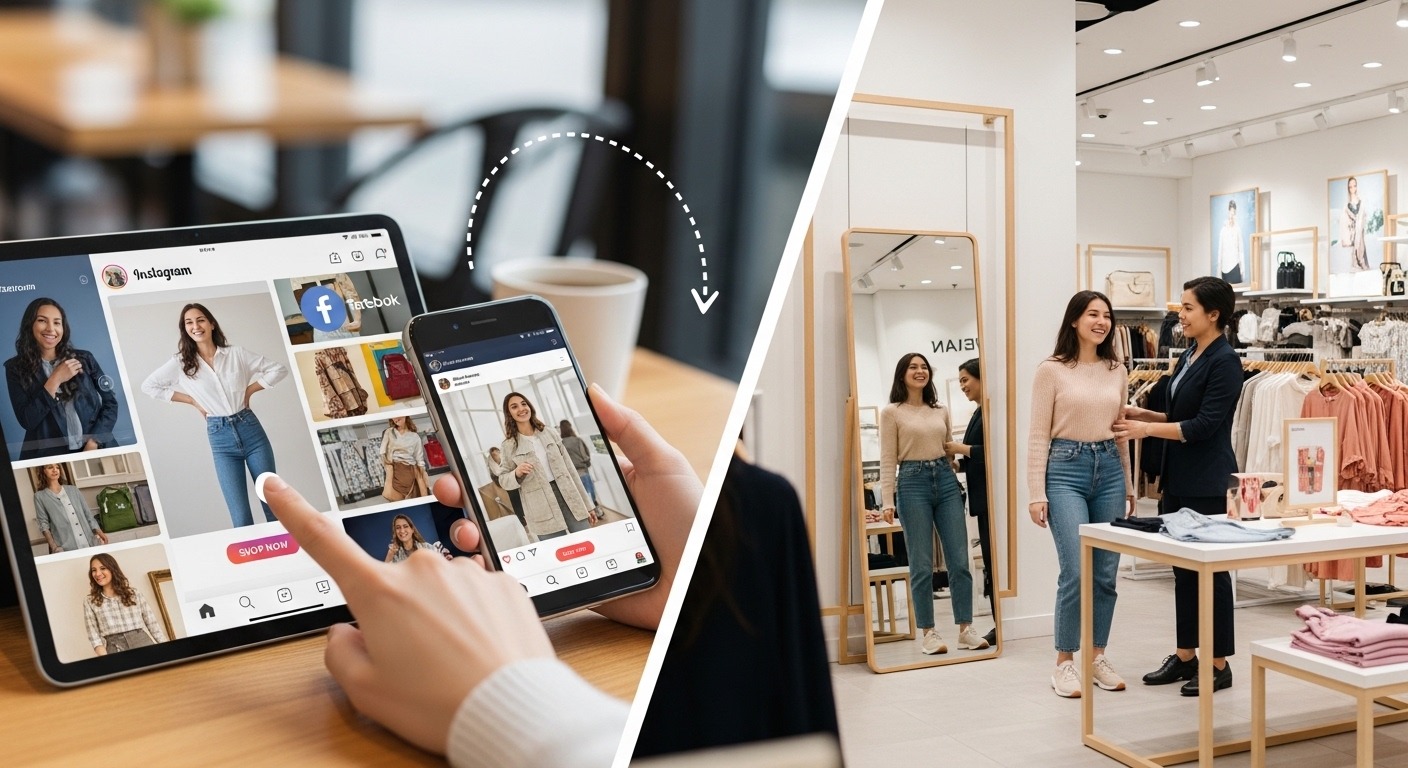
Your customer’s journey doesn’t begin when they walk through your door. It begins the moment they tap your Instagram post, watch your TikTok, or read a review from a friend. The store visit is simply the final act of a story that starts entirely online.
The retailers who understand this — and deliberately design every touchpoint of that journey — are the ones seeing record footfall, high conversion rates, and fiercely loyal repeat customers.
This guide maps every stage of the modern retail customer journey and shows you exactly what to do at each step to move a social media scroller into your store — and turn them into a lifelong customer.
Understanding the Modern
Retail Customer Journey
Today’s retail customer doesn’t travel a straight line from awareness to purchase. Research by McKinsey describes a circular, non-linear journey with multiple online touchpoints before any offline commitment.
The average shopper now encounters a brand 6–8 times before making an in-store visit. Each of those encounters — a TikTok, an Instagram story, a Google review, a Facebook ad — is either building or eroding their intention to walk through your door.
Why This Matters
A broken customer journey — where social media and your store feel like two different brands — causes invisible leakage at every stage. Customers who were 80% ready to visit simply drift away. Your job is to remove every point of friction between that first scroll and your checkout counter.
Stage 2: Consideration & Research —
The Moment of Evaluation
Once you’ve captured attention, the curious customer begins researching. They’ll check your website, read your reviews, look up your address, and scan your highlights. This is the stage where you either build enough confidence to earn a visit — or lose them to a competitor who makes it easier.
Stage 3: Turning Intent Into
a Confirmed Store Visit
A customer at the intent stage is warm — they like you, they’ve done their research, and they’re thinking about coming in. Now you need to give them a reason to act today, not “sometime.” These are the most powerful tactics to convert intent into footfall:
Social-Exclusive Offers
Publish in-store-only discounts exclusively on your social channels. “Show this post at checkout for 15% off” turns passive followers into active store visitors — with measurable attribution.
Urgency-Driven Content
“Only 3 of these left” or “Sale ends Sunday” posts create time-sensitive motivation. Post stock-count updates and deadline reminders in Stories — they’re watched by people already following and already warm.
In-Store Events
Trunk shows, VIP evenings, product launches, styling sessions — an event gives customers a reason to visit that feels special, not transactional. Promote across all channels with RSVP links for email capture.
Local Targeting Ads
Use Meta’s radius targeting to serve ads exclusively to people within 5–15km of your store. A perfectly timed ad reaching someone nearby is far more valuable than wide reach with zero proximity.
Click & Collect
Let customers reserve or buy online and collect in-store. 85% of BOPIS customers make additional unplanned purchases on collection. It’s the most reliable foot traffic conversion mechanic available to independent retailers.
Frictionless Directions
Every post, Story, and bio should have a one-tap path to directions. Link to Google Maps directly. Include parking tips and nearest transit. The easier you make the logistics, the more visits you get.
Stage 4: The In-Store Experience
Must Match the Social Promise
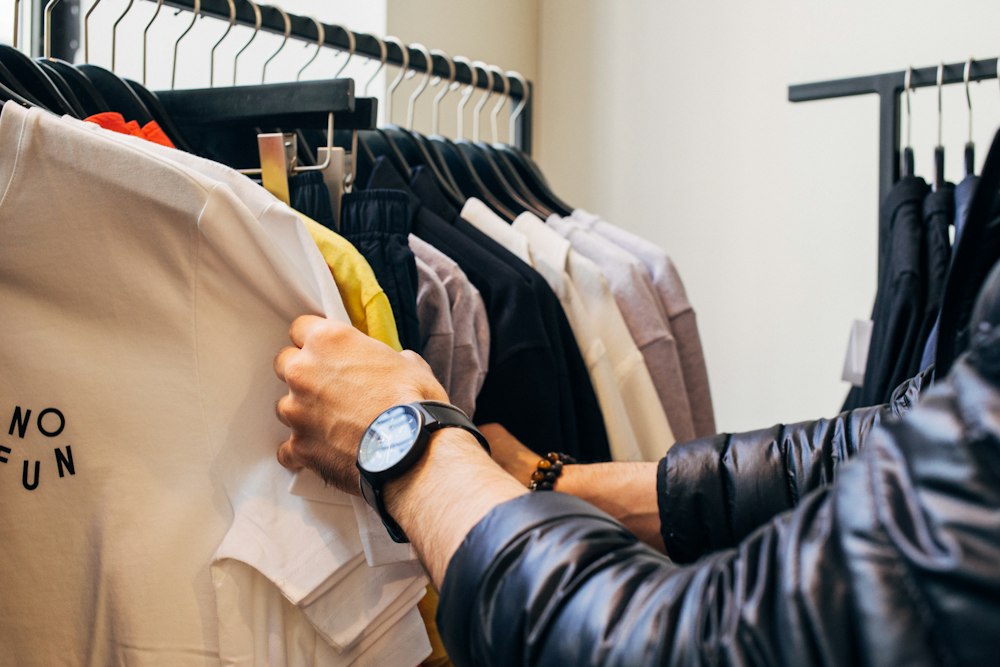
A customer who arrives having seen your curated Instagram feed has formed expectations. Your store’s atmosphere, visual merchandising, staff warmth, and even music must feel like a natural extension of your social identity. Disappointment at this stage destroys the entire journey — and produces negative reviews that break it for future customers too.
In-Store to Social Alignment Checklist
Visual Consistency
Your store décor, colour palette, and signage should feel like your Instagram feed in three dimensions.
Staff Social Knowledge
Staff should know your current social offers and be able to acknowledge “I saw this on your Instagram” moments with enthusiasm.
Photo-Worthy Moments
Create deliberate photo opportunities — a styled corner, a branded mirror, a gorgeous display. Customers who photograph your store create free UGC content.
Redeem Social Offers Seamlessly
If you promoted a discount online, make redemption effortless. Train staff and have the offer ready. Friction at this moment destroys trust.
Capture Email at Point of Sale
Offer a loyalty programme, receipt by email, or a gift with newsletter sign-up. Every email address is a direct line for post-visit marketing.
Invite Them to Follow & Share
Display your social handles prominently. Ask staff to mention it. Add a QR code to receipts and bags. Turn every in-store visit into a new social follower.
Stage 5: Post-Visit Retention
& Turning Customers Into Advocates
The sale is not the end of the journey — it’s the beginning of the most valuable phase. A customer who visits once and has a great experience is primed to become a regular. The right post-visit strategy compounds their loyalty and turns them into unpaid brand ambassadors.
Post-Visit Email Sequence
Send a thank-you email within 24 hours. Follow it with new arrival alerts, exclusive subscriber offers, and event invitations. Mailchimp or Klaviyo make this automatable.
Review Request (48 Hours After)
Send a friendly review request 48 hours after the visit — when the experience is fresh and positive emotion is highest. A simple “How was your visit?” with a Google review link works beautifully.
Loyalty Programme
A stamp card, points system, or VIP tier gives customers a structural reason to return. Promote the programme on social media so new followers know what regulars enjoy.
Encourage UGC Sharing
Add a branded hashtag to receipts and bags. Re-share customer photos on your feed. UGC is trusted more than branded content and extends your awareness reach to entirely new audiences.
Seasonal Re-Engagement
Use your email list and retargeting ads to re-engage lapsed customers at key retail moments — Christmas, new season launches, anniversary sales. A customer who visited once is 70% more likely to return than a stranger.
Referral Incentives
Offer a discount or gift for customers who bring a friend. Peer referrals drive more first-time visits than any paid advertising channel — and arrive with built-in trust.
The Tools That Connect
Every Stage of the Journey
You don’t need an enterprise budget to build a seamless customer journey. These tools — many of them free or low-cost — power each stage effectively:
| Tool | Journey Stage | Primary Use | Cost |
|---|---|---|---|
| Google Business Profile | Discovery + Research | Local search visibility, reviews, maps | Free |
| Meta Business Suite | Awareness + Intent | Facebook & Instagram ads, scheduling | Paid Ads |
| Mailchimp | Intent + Retention | Email campaigns, automations, segmenting | Free tier |
| Shopify POS | Intent + In-store | Click & collect, inventory, customer data | From $29/mo |
| Later / Buffer | Awareness | Content scheduling, analytics, link in bio | Free tier |
| Klaviyo | Retention | Advanced email/SMS, post-visit flows, loyalty | From $45/mo |
💡 Start Simple
You don’t need all of these tools at once. Start with Google Business Profile (free, highest impact), consistent social content, and an email list. Add tools progressively as your journey becomes more sophisticated. The most important thing is that each stage connects to the next — tools help, but strategy comes first.
The Journey Never Truly Ends —
That’s the Point
The most successful retailers understand that the customer journey is circular, not linear. A loyal customer becomes an advocate who creates awareness for new customers — who then begin their own journeys. Every stage feeds the next.
What you’ve read in this guide isn’t a checklist to complete once. It’s a system to build, refine, and optimise continuously. Start with the stage that has the most obvious gap in your current business — and fix it.
The retailers who win are the ones who treat every scroll, every click, every store visit, and every receipt as part of one seamless, intentional story.
Easy Marketing School
Retail Marketing Education
Practical, no-fluff marketing education designed specifically for independent retail business owners ready to grow with confidence in the digital age.
Social Discovery & Awareness:
Your Store’s First Impression
For most retail customers, their first encounter with your brand is a piece of social content — not your storefront. This means your Instagram feed, TikTok profile, or Facebook Page is your shopfront. And it needs to instantly communicate what makes you worth visiting.
What Your Social Content Must Communicate at This Stage
Your Physical Identity
Show your store interior, neighbourhood, window displays, and team. Let people visualise being there before they arrive.
What Makes You Different
Your curation, your values, your story. Why should someone choose you over a big-box store or Amazon? Lead with that daily.
Products Worth Seeing in Person
Show texture, scale, and detail that photos alone can’t capture. Create the “I need to see this in person” feeling in every post.
Findability Signals
Your location, opening hours, and “how to find us” content should appear regularly — not just in the bio. Treat every post as a potential first impression.
Content Types That Drive In-Store Awareness