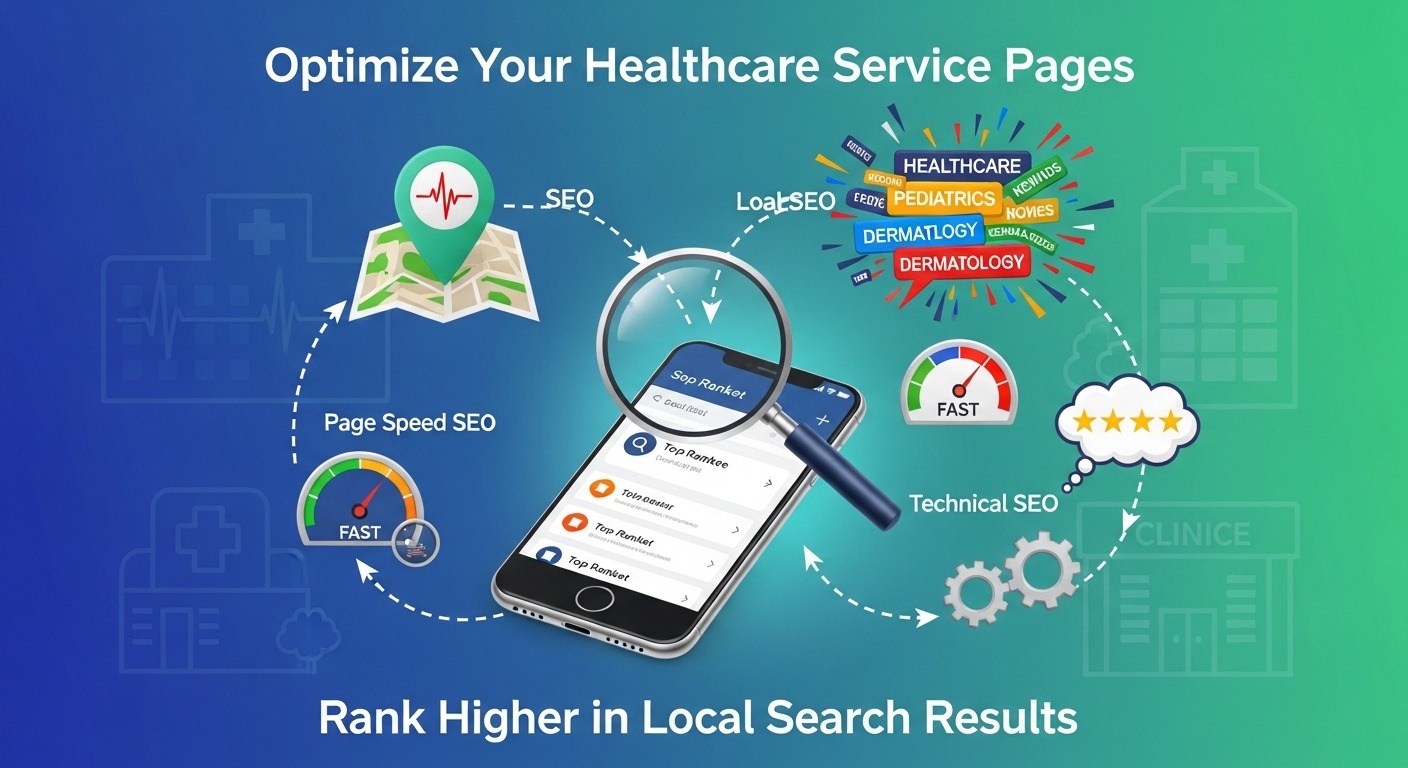
Turn your medical service descriptions into high-ranking patient acquisition assets in 2026.
In the competitive medical landscape of 2026, simply having a website isn’t enough. When a patient searches for “pediatric dentist near me” or “physical therapy for back pain,” Google isn’t just looking at your homepage—it’s looking for the most relevant **Service Page**.
According to Statista, 77% of patients begin their healthcare journey with a search engine. If your service pages are thin on content or lack local optimization, you are effectively invisible to three-quarters of your market. Here is how to fix the “leaky bucket” in your Local SEO strategy.
1. The “One Service, One Page” Rule
The biggest mistake healthcare providers make is grouping all services onto a single “Our Services” page. Google ranks specific pages for specific queries. If you offer “Dental Implants,” “Teeth Whitening,” and “Invisalign,” each needs a dedicated URL.
Pro Tip: Use a localized URL structure. Instead of /services/implants, use /dental-implants-[City-Name] to signal geographic relevance to search crawlers.
Anatomy of a Perfect Service Page
Local Keywords
H1 and H2 tags containing the service + [Your City].
Expert Content
Answer the top 3 questions patients ask about this treatment.
Social Proof
Patient testimonials specific to THIS service page.
2. Optimizing for Conversion (UX)
Ranking is half the battle; booking is the other half. A high-ranking page that doesn’t convert is a waste of traffic. In 2026, patients demand frictionless scheduling.
| Element | Why It Matters | SEO/CX Impact |
|---|---|---|
| Schema Markup | Tells Google this is a “Medical Business” | Higher Visibility |
| Mobile CTA | Sticky “Call” or “Book” button | Lower Bounce Rate |
| Video Bio | Patient hears the doctor’s voice | Dwell Time Increase |
Master the Science of Healthcare Growth
Service page optimization is just one piece of the patient acquisition puzzle. To truly dominate your local market, you need a full-funnel strategy. Learn how to automate your reputation, manage Local SEO, and scale your practice using the professional frameworks in our flagship course.
3. Building Authority with E-E-A-T
Google’s search guidelines prioritize **Experience, Expertise, Authoritativeness, and Trustworthiness (E-E-A-T)**, especially for YMYL (Your Money Your Life) topics like healthcare. To rank higher, your service pages should include:
- Links to peer-reviewed research or clinical guidelines from trusted sources.
- Brief doctor bios specific to the service provided.
- A “last updated” or “medically reviewed” date to signal current info.
Final Thoughts
In 2026, the practices that win aren’t necessarily the ones with the best medicine—they are the ones that are the easiest to find and trust online. By treating each service page as a standalone “landing page” for a specific patient problem, you create a robust network of digital front doors that lead straight to your practice.
© 2026 Health Marketing Insights. All rights reserved.