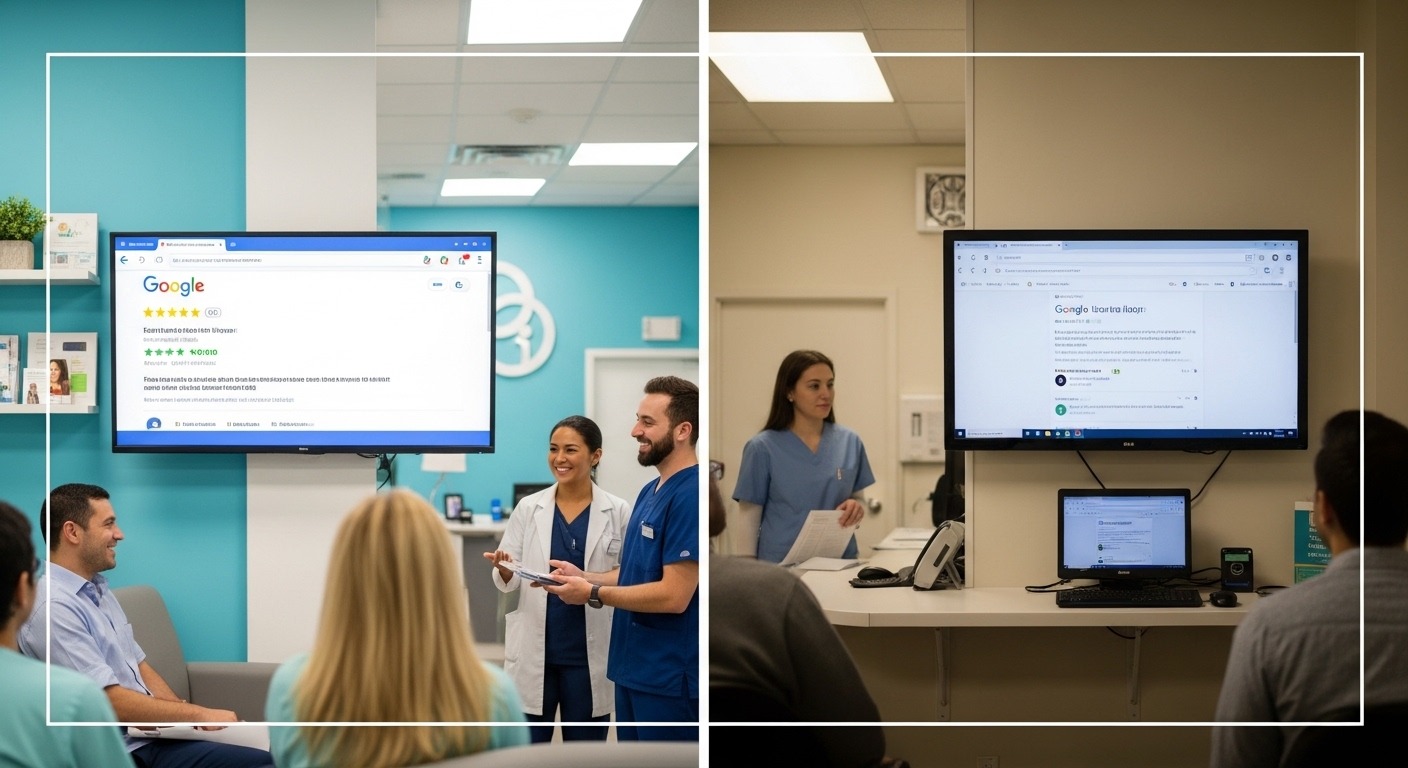
You open Google in incognito mode. You type your specialty and your city. Your competitor’s name appears in the top 3. Yours does not. What are they doing that you’re not?
Google rankings are not random and they are not permanent. Every practice that outranks you today is outranking you for specific, identifiable, fixable reasons. The gap between position 1 and position 7 is almost never about the quality of care — it’s about the quality of digital signals Google is receiving from each practice.
The search position gap between your practice and your local competitor can translate to a staggering difference in new patient volume. According to SISTRIX’s click-through-rate research, the #1 organic result receives 27.6% of all clicks while position #7 receives just 2.1%. On the same local search, the top-ranked practice is receiving 13× more potential patients clicking through to their website.
This guide is a forensic-level analysis of why competitors outrank medical practices — and a step-by-step counter-strategy to not just match them, but surpass them. No guesswork. No vague advice. Specific gaps, specific fixes.
THE INTELLIGENCE BRIEF — WHAT THIS GUIDE COVERS
- Run a Proper Competitor SEO Audit in 30 Minutes
- The 7 Reasons Competitors Outrank Medical Practices
- Google Business Profile: Where Most Ranking Gaps Live
- Reverse-Engineering Their Keyword Strategy
- Backlink and Authority Gap Analysis
- Content Gap: What They’re Publishing That You Aren’t
- The Technical Advantage You Can Close in a Weekend
- The Overtake Strategy: Your 90-Day Execution Plan
- The Complete Healthcare Marketing System
Run a Proper Competitor SEO Audit in 30 Minutes
Before you can overtake a competitor, you need to understand them precisely. Vague impressions (“they seem to rank better”) won’t give you an action plan. A structured 30-minute audit reveals the exact gaps you need to close.

The 30-Minute Competitor Intelligence Protocol
Min 0–8
Identify Your True Competitors
Open an incognito browser. Search your primary keyword: “[specialty] + [your city].” Note the top 3 organic results AND the top 3 local 3-Pack listings. These are your real competitors — not necessarily who you think of as rivals. A competitor in SEO is whoever ranks above you for your most important keywords.
Min 8–16
Benchmark Their Google Business Profile
Click on each competitor’s GBP listing. Record: star rating, review count, review recency (when was the last review?), photo count, post frequency, services listed, categories, and whether they have a booking link. This data alone often reveals 80% of the ranking gap.
Min 16–24
Audit Their Website Structure and Content
Visit their website. Count the number of service pages, check if they have location pages, look for a blog section and when it was last updated. View the page source (Ctrl+U) and check the title tags on their top pages. Note the structure of their homepage H1. This tells you their keyword targeting strategy.
Min 24–30
Document Everything in a Gap Analysis Sheet
Create a simple spreadsheet with columns: Competitor Name, GBP Rating, Review Count, Photo Count, Page Count, Blog Posts, Domain Authority (use free Moz Domain Analysis), and Last Content Published. Comparing yourself against each column reveals your specific action items.
YOUR COMPETITOR GAP ANALYSIS TEMPLATE
| Metric | Your Practice | Competitor #1 | Gap |
|---|---|---|---|
| Google Rating | ___ ★ | ___ ★ | ___ |
| Review Count | ___ | ___ | ___ |
| GBP Photos | ___ | ___ | ___ |
| Website Pages | ___ | ___ | ___ |
| Domain Authority | ___ | ___ | ___ |
The 7 Reasons Competitors Outrank Medical Practices
After analyzing hundreds of local healthcare ranking gaps, these seven factors account for the vast majority of cases where a competitor consistently outranks a practice that offers equal or better care.
More Reviews,
More Recent
Review velocity and recency are top-3 local ranking signals. Fresh reviews from last week outweigh older reviews from two years ago.
Fully Optimized
GBP Profile
They’ve filled every GBP field — services, photos, posts, Q&A, booking link, health attributes. Most practices are 40% complete.
More Content,
Better Optimized
They have dedicated service pages for every offering, condition pages, and active blog content. Each page signals relevance to Google.
Higher Domain
Authority
They have more backlinks from relevant, high-authority local sources — local news, medical associations, partner businesses.
Perfect NAP
Consistency
Their Name, Address, Phone number matches exactly across 50+ directories. Inconsistencies in your citations suppress your local rankings.
Faster Mobile
Website
Their site loads in under 2 seconds on mobile. Slow sites lose rankings AND conversions — patients leave a slow site before it even loads.
Structured Data
(Schema Markup)
They have LocalBusiness, Physician, FAQ, and Review schema coded into their pages, feeding Google direct structured information about their practice.
Google Business Profile: Where Most Ranking Gaps Live
In local healthcare SEO, Google Business Profile optimization accounts for roughly 36% of local pack ranking factors, according to the Moz Local Search Ranking Factors study. More GBP audits reveal larger gaps between practices than any other single factor. Here’s how to close the GBP gap completely.
| GBP ELEMENT | TYPICAL LAGGING PRACTICE | TYPICAL TOP-RANKED PRACTICE |
|---|---|---|
| Google Rating | 3.6–4.0 ★ | 4.4–4.9 ★ |
| Review Count | 8–22 reviews | 75–250+ reviews |
| Most Recent Review | 2–8 months ago | Last 1–2 weeks |
| Photos Uploaded | 5–12 photos | 45–100+ photos |
| GBP Posts | Never or rarely | Weekly posts |
| Review Response Rate | Under 20% | 80–100% |
| Services Listed | 2–4 generic services | 15–30 specific services |
🔑
The Fastest GBP Win: The Weekly Post System
Practices that post to their GBP once per week consistently outrank those that don’t. Topics: health tips, seasonal reminders, team spotlights, new service announcements, office hours changes, community involvement. Each post includes your primary keyword and your city. Schedule these 30 minutes every Monday morning and protect that time.
Reverse-Engineering Their Keyword Strategy
Your competitor didn’t stumble into their keyword strategy. They’re either intentionally targeting the right keywords or accidentally ranking for them through volume and authority. Either way, you can decode exactly what they’re targeting and build a strategy to compete for every keyword that matters.

How to Uncover a Competitor’s Keyword Strategy (Free)
VIEW SOURCE ANALYSIS
On every competitor page, right-click → View Page Source. Search for: <title>, <h1>, and <meta name=”description”>. These three elements reveal exactly which keyword each page is targeting.
FREE TOOL: UBERSUGGEST
Ubersuggest‘s free tier lets you enter a competitor’s domain and see their top-ranking keywords, estimated monthly traffic, and which pages receive the most visitors. This is your competitor’s playbook handed to you.
SITE:DOMAIN SEARCH
In Google, type site:competitordomain.com to see every indexed page on their site. This reveals how many pages they have, which services they’ve built dedicated pages for, and how their content architecture is structured.
SEMRUSH FREE TIER
SEMrush‘s free tier (10 searches/day) shows a competitor’s organic keywords, estimated traffic, and keyword difficulty. Focus your 10 daily queries on their highest-traffic pages to uncover the most valuable opportunities.
KEYWORD GAP PRIORITY MATRIX — WHAT TO TARGET FIRST
| Scenario | Action | Priority |
|---|---|---|
| They rank, you have the page but it’s thin | Expand page to 800+ words with FAQ section and schema | 🔥 URGENT |
| They rank, you have no page for that service | Build a dedicated service/location page immediately | 🔥 URGENT |
| They rank page 1, you rank page 2 | Add internal links, build 2–3 backlinks to that page, improve on-page | HIGH |
| Both rank poorly, high-intent keyword | Build better page than theirs + actively earn citations | OPPORTUNITY |
Backlink and Authority Gap Analysis
Backlinks — other websites linking to yours — remain one of Google’s top organic ranking factors. A competitor with more high-quality backlinks will outrank you on competitive keywords even with equal on-page optimization. But the gap is closable if you’re strategic.
| BACKLINK SOURCE | AUTHORITY LEVEL | HOW TO EARN IT |
|---|---|---|
| Healthgrades, Vitals, Doximity | DA 75–95 | Claim and complete your profile on each platform |
| Local Chamber of Commerce | DA 40–60 | Join as a member — almost always includes a website listing |
| Local news publications | DA 40–70 | Offer to be the quoted local health expert on seasonal topics |
| Medical specialty associations | DA 60–80 | Professional membership — most include member directory listings |
| Partner businesses (gyms, pharmacies) | DA 20–45 | Mutual resource page exchanges with complementary local businesses |
| Hospital / university affiliations | DA 70–95 | Ensure your affiliation is listed on the institution’s provider pages |
⚡
Find Competitor Backlinks Free
Use Ahrefs Free Backlink Checker or Moz Link Explorer (both have free tiers) to see exactly who is linking to your competitor. Every site linking to them is a potential site you can reach out to as well. This “link gap” analysis gives you a pre-qualified backlink acquisition list.
Content Gap: What They’re Publishing That You Aren’t
Content depth is one of the clearest differences between a practice that dominates search and one that struggles. But the content gap is rarely about the total number of articles — it’s about the right pages. Here’s what to look for and how to close it decisively.
CONTENT THEY HAVE, YOU DON’T
- Individual service page for each treatment
- Location pages for nearby neighborhoods
- Condition-specific landing pages
- Active blog (1–4 posts/month)
- Provider bio pages with credentials
- Before/after or patient FAQ pages
HOW TO CLOSE THE CONTENT GAP FAST
- Build one new service page per week for 4 weeks
- Expand thin pages from 200 to 800+ words
- Add FAQ sections to every service page
- Create one location page per area you serve
- Publish one 1,000-word blog post per month minimum
- Ensure every provider has a 400+ word bio with credentials
CONTENT DEPTH: PAGE QUALITY COMPARISON
| Page Element | Thin Page (Loses) | Optimized Page (Wins) |
|---|---|---|
| Word count | 150–300 words | 800–1,500 words |
| Headings | H1 only | H1 + 3–5 H2s + H3s |
| FAQ section | None | 5–8 Q&As with schema |
| Internal links | 0–1 | 3–5 to related pages |
| Author byline | No physician attribution | Named MD/DO with bio link |
The Technical Advantage You Can Close in a Weekend
Technical SEO issues can suppress rankings even when all other signals are strong. The good news: most technical gaps between practices are fixable without a developer. Here’s a weekend checklist that often produces visible ranking improvements within 30–60 days.

| TECHNICAL ISSUE | HOW TO CHECK | HOW TO FIX | DIFFICULTY |
|---|---|---|---|
| Slow mobile speed | PageSpeed Insights (free) | Compress images to WebP, install caching plugin, enable CDN | Easy |
| Missing title tags | Search Console Coverage report | Add unique keyword-rich title to every page via Yoast/RankMath | Easy |
| No schema markup | Rich Results Test (free) | Generate LocalBusiness + FAQ schema at schema generator, add to pages | Medium |
| Not mobile-friendly | Mobile-Friendly Test (free) | Switch to responsive WordPress theme, fix tap target sizing | Medium |
| No XML sitemap submitted | Search Console → Sitemaps section | Generate via Yoast SEO (free), submit URL to Google Search Console | Easy |
| Missing HTTPS | Check browser address bar for padlock icon | Enable free SSL certificate via Let’s Encrypt through your host | Easy |
The Overtake Strategy: Your 90-Day Execution Plan
Analysis without execution is useless. Here is a sequenced 90-day plan that focuses your effort where it produces the fastest ranking gains — so you start overtaking competitors in local results within one quarter.
Complete 30-min competitor audit · Fill all GBP gaps · Set up Google Search Console + GA4 if not done
Fix all missing title tags and meta descriptions · Run PageSpeed Insights · Fix top 3 speed issues
Launch review request SMS system · Claim top 5 unclaimed directory listings · Add schema markup to homepage and service pages
Build 2 new service pages using competitor keyword data · Expand your 3 thinnest pages to 800+ words · Add FAQs with schema to all service pages
Publish first blog post (1,200+ words) targeting a “People Also Ask” question · Create location pages for top 2 service areas beyond your main city
Reach out to 5 local businesses for mutual link partnerships · Contact local news outlet to offer as health expert source · Join 1 professional medical association
Review first 90-day metrics in Search Console and GBP Insights · Identify which keywords moved to page 1 · Plan next 90-day sprint based on remaining gaps
📈 REALISTIC RESULTS TIMELINE
| TIMEFRAME | WHAT TO EXPECT |
|---|---|
| Days 7–14 | GBP improvements visible; Google re-indexes updated pages. Some quick-win ranking jumps on long-tail keywords. |
| Days 30–45 | New service pages indexed and beginning to rank. Review velocity increasing. Local 3-Pack positioning improving. |
| Days 60–90 | Measurable ranking improvements on primary keywords. First signs of new patient attribution to search. New blog post beginning to rank. |
| Month 4–6 | Sustained ranking improvements. Competitor gap visibly closing on 40–60% of target keywords. New patient volume from organic search measurably increasing. |
The Ranking Gap Is a System Gap — and Systems Can Be Fixed
Your competitor isn’t ranked higher because they’re a better practice. They’re ranked higher because they’ve built better digital infrastructure around an equal or often inferior practice. Every component of that infrastructure — their GBP, their content, their backlinks, their technical SEO — is auditable, reverse-engineerable, and surpassable.
The 90-day plan in this guide won’t just close the gap. Executed fully, it will put you in position to become the practice that your competitors are Googling in incognito mode, wondering how you did it.
KEY ACTIONS SUMMARY
- Run a 30-minute competitor audit in incognito mode — document every gap
- Complete your GBP to 100% — services, photos, posts, booking link, Q&A
- Launch a review request system — velocity and recency are top ranking signals
- Use free tools to decode competitor keyword strategy and build missing pages
- Fix top technical issues first — speed, title tags, schema, HTTPS
- Build 3–5 local backlinks per month through directories, partnerships, and press
- Measure monthly in Search Console — track which gaps are closing