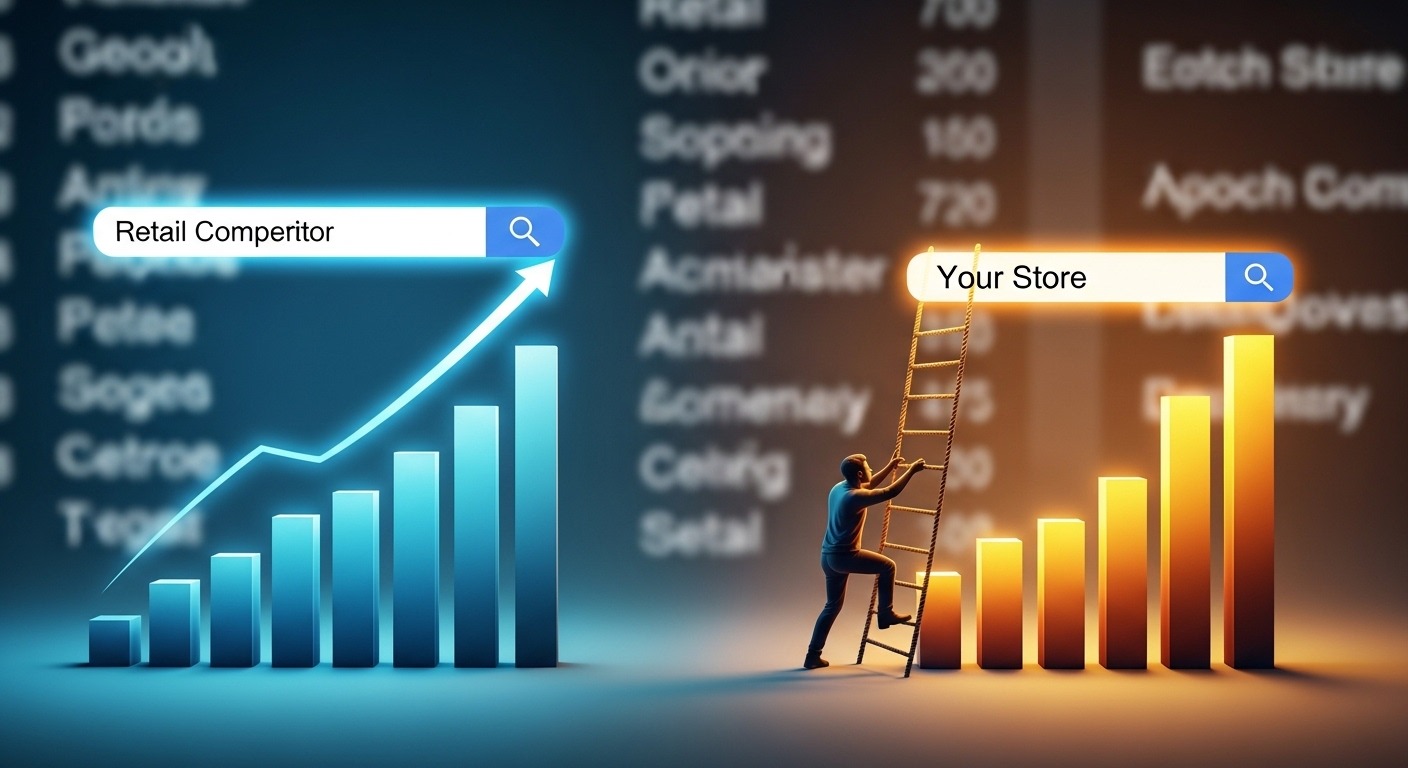
You open Google, type in the exact keywords that describe your products, and there it is — your competitor’s website sitting proudly on page one while yours is buried somewhere on page three. Sound familiar?
This isn’t a coincidence, and it isn’t magic. There are concrete, learnable reasons why one retail website outranks another — and the good news is that every single one of those reasons can be addressed, fixed, and turned into your competitive advantage.
In this post, we’ll break down exactly what your competitors are doing better on Google, explain the SEO mechanics behind the gap, and show you a step-by-step path to overtake them — even if you’re starting from scratch.
📋 Table of Contents
🎯 1. They’ve Mastered Retail Keyword Intent
Most retail store owners pick keywords based on volume — they chase the biggest search numbers. Your competitors who rank higher have moved past that. They target keywords based on buyer intent, which is the single most important factor Google evaluates when deciding who deserves a top spot.
📊 The Retail Keyword Intent Spectrum
| Intent Type | Example Keyword | Buyer Stage | Conversion Rate |
|---|---|---|---|
| Informational | “what is organic skincare” | Awareness | Low |
| Navigational | “[Brand] online store” | Research | Medium |
| Commercial | “best organic face cream under $50” | Comparison | High |
| Transactional ⭐ | “buy organic face cream London” | Ready to Buy | Very High |
Your competitor has likely built content and product pages specifically targeting commercial and transactional keywords — the ones that convert. Tools like Ahrefs Keyword Generator and SEMrush can show you exactly which high-intent keywords they’re targeting that you’re not.
Go to Google Search Console → Performance → Queries. Sort by CTR. Any query where you appear on page 2 with good impressions is a keyword you can realistically push to page 1 with targeted optimisation.
🔧 2. Their On-Page SEO Is Surgically Optimised
Walk through your competitor’s top-ranking product or category pages and you’ll notice a pattern: every element is engineered for Google’s crawlers and human shoppers simultaneously. This is advanced on-page SEO — and it’s one of the clearest reasons they outrank you.
🏆 On-Page SEO Elements Your Competitor Nails
Title Tags
Primary keyword in first 60 chars, brand appended, power word included (Best, Buy, Sale)
URL Structure
Short, hyphenated slugs with target keyword: /buy-organic-face-cream-london/
Image Alt Text
Descriptive alt text with keyword variations on every product image
Schema Markup
Product schema, review stars, price range showing directly in SERPs
Meta Descriptions
155 chars, includes CTA, keyword, USP — written to maximise click-through rate
Header Hierarchy
H1 with exact keyword, H2s with LSI terms, H3s for FAQ sections
Google’s own Search Essentials documentation confirms that these elements directly affect how pages are indexed and ranked. If your competitor appears with star ratings and pricing directly in Google results, they’re using Product Schema — and you can implement the same.
🔗 3. They Have More (and Better) Backlinks
Backlinks remain one of Google’s top three ranking factors. A backlink is simply another website linking to yours — and in Google’s eyes, it’s a vote of authority. Your competitor likely has significantly more high-quality backlinks than you, and this creates a compounding advantage over time.
⚖️ Backlink Quality vs Quantity: What Actually Matters
What NOT to do
100+ links from unknown, low-DA directories and link farms. Spammy. May trigger Google penalties.
What your competitor does
10–20 links from industry blogs, local news, PR coverage, supplier pages & niche roundups.
Use Moz Link Explorer to see your competitor’s exact backlink profile — then reverse-engineer it.
The fastest path to building quality backlinks for a retail business? Local PR (get featured in local news stories), supplier partnerships (get listed on your suppliers’ “Where to Buy” pages), and guest articles on retail or lifestyle blogs relevant to your niche.
⚡ 4. Their Site Speed & Core Web Vitals Win
Since Google’s Page Experience update, site speed is no longer just a nice-to-have — it’s a confirmed ranking signal. Google measures this through its Core Web Vitals framework: three metrics that measure loading performance, interactivity, and visual stability.
| Metric | What It Measures | Good Score | Impact if Slow |
|---|---|---|---|
| LCP | Largest Contentful Paint — loading speed | ≤ 2.5s | High ranking penalty |
| FID / INP | Interaction to Next Paint — responsiveness | ≤ 200ms | Moderate penalty |
| CLS | Cumulative Layout Shift — visual stability | ≤ 0.1 | Bounce rate spike |
Run your site through Google PageSpeed Insights. If any Core Web Vitals show red or orange, that’s a direct ranking disadvantage versus competitors who score green.
📍 5. They Dominate Local SEO
For physical retail stores, local SEO is the most valuable SEO channel you have. Nearly half of all Google searches have local intent, and the businesses that appear in the “Local Pack” (the map section at the top of search results) receive the lion’s share of clicks, calls, and foot traffic.
Google Business Profile
Fully completed, verified, with weekly posts and up-to-date hours
Reviews Strategy
50+ reviews with responses. Review quantity AND recency both matter
NAP Consistency
Name, Address, Phone identical across every directory, website & social
Local Citations
Listed on Yelp, TripAdvisor, industry directories, local chambers
According to BrightLocal’s research, 87% of consumers read online reviews for local businesses. If your competitor has 80 five-star reviews and you have 12, Google’s algorithm — and your potential customers — will consistently choose them.
✍️ 6. Their Content Strategy Is a Machine
The biggest difference between a retail site on page 1 versus page 3 often comes down to content depth and consistency. Your competitor isn’t just selling products — they’ve built a content ecosystem that attracts, educates, and converts shoppers at every stage of the buying journey.
📐 The Retail Content Funnel That Ranks
“How to choose the right running shoes” — Blog posts, guides, tips
“Best trail running shoes 2026” — Comparison pages, category SEO
“Buy Salomon XT-6 London” — Optimised product pages
This approach — called Topical Authority — tells Google that your website is the most comprehensive, trustworthy source on your subject. When you cover a topic deeply with a cluster of related content, Google rewards your entire site with higher rankings across that topic. Learn more about this in Moz’s guide to Topical Authority.
🚀 Your Overtake Plan: Step-by-Step
Now that you know why they rank higher, here’s what to do about it. This is a 90-day roadmap structured for retail business owners who want to close the gap fast without a massive agency budget.
| Phase | Timeframe | Priority Actions | Expected Outcome |
|---|---|---|---|
| 🔍 Audit | Week 1–2 | Competitor keyword gap analysis, on-page audit, PageSpeed test, GBP audit | Clear roadmap of gaps |
| ⚙️ Fix | Week 3–5 | Update title tags, meta descriptions, URL slugs, image alt text, add schema markup | Crawl improvements in 2–4 weeks |
| 📝 Create | Week 4–10 | Publish 4–6 blog posts targeting commercial-intent keywords. Optimise top 5 product pages | New ranking entries, topical authority |
| 🔗 Build | Week 6–12 | Outreach for 5–10 backlinks from local press, supplier pages, niche blogs | Domain authority increase |
| 📍 Local | Ongoing | GBP weekly posts, review request system, local citations cleanup | Local Pack visibility in 6–10 weeks |
🎓 Recommended Course
Ready to Stop Watching Your Competitor Win?
The Retail Marketing Course at Easy Marketing School teaches you every strategy covered in this post — keyword research, on-page SEO, local search, backlinks, and content — all built specifically for retail businesses.
✅ Step-by-step implementation
✅ No tech background needed
✅ Real-world retail case studies
👉 Start the Retail Marketing Course →
Join retail business owners already ranking higher on Google
✅ Quick-Win SEO Checklist for Retail Stores
Before you close this post, run through this checklist. Tick off what you have — and action what you don’t.
The Bottom Line
Your competitor doesn’t rank higher on Google because they’re smarter, have a bigger budget, or got lucky. They rank higher because they’ve learned — and consistently applied — the same SEO principles that any retail business can use.
The six reasons we covered — keyword intent, on-page optimisation, backlinks, site speed, local SEO, and content strategy — are all learnable, actionable, and achievable even with a small team. The question isn’t whether you can do this. The question is whether you’re going to start.
Your competitor has a head start. But every day you implement these strategies, you close the gap. Google rewards consistency. Start today, and in 90 days, you’ll be the one they’re trying to figure out.
Retail SEO
Digital Marketing
Google Ranking
Some links in this post are affiliate or partner links. We only recommend tools and resources we believe will genuinely help retail business owners improve their Google rankings.