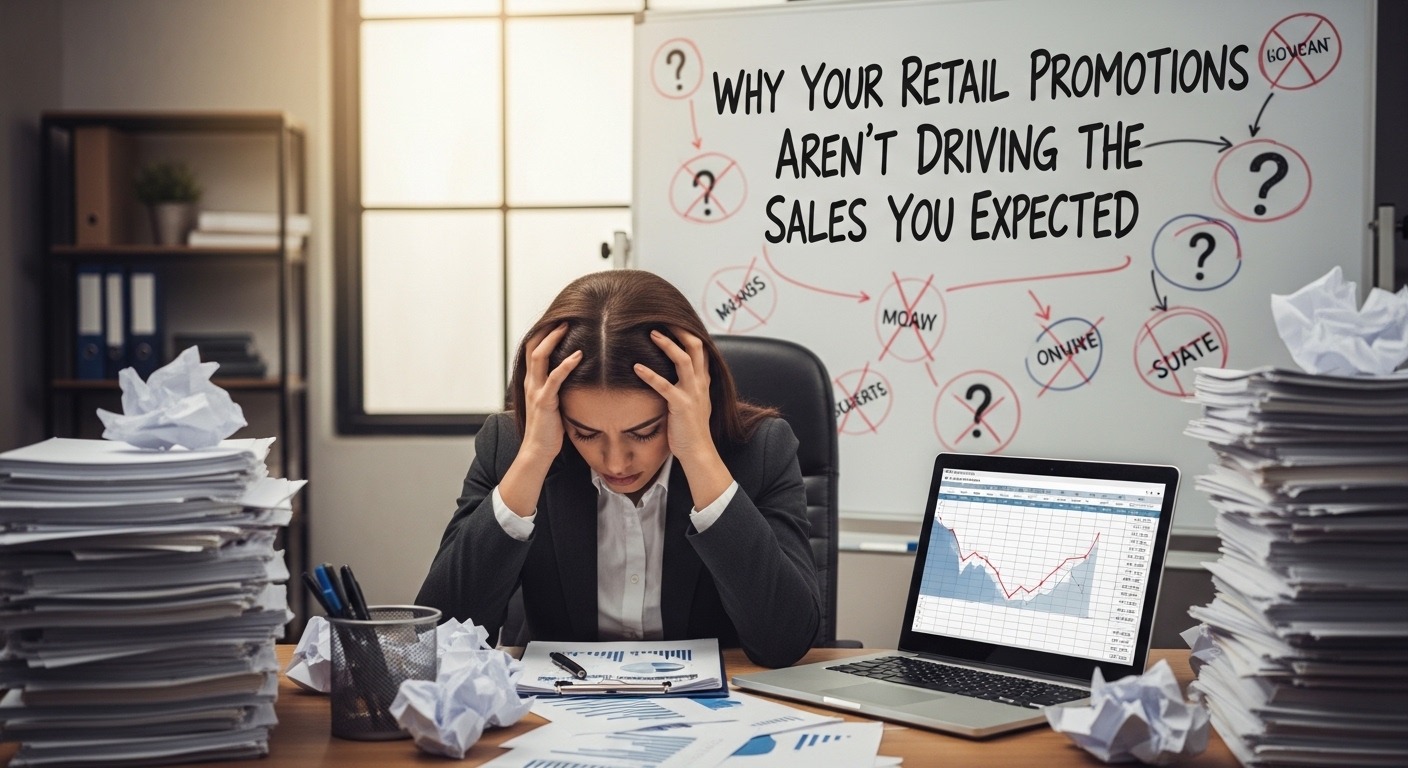
You offered 30% off. You put up the signs. You posted it everywhere. And then… a slight uptick on day one, a trickle on day two, and by the end of the promotion, your total revenue was barely better than a regular week — with a margin that felt like a punishment.
Sound familiar? You’re not alone. The uncomfortable truth is that most retail promotions are structurally broken — not because the discount is wrong, but because the strategy, timing, communication, and audience targeting haven’t been designed to convert. A promotion isn’t just a lower price. It’s a carefully engineered moment of decision for your customer.
In this guide, we dissect the 8 most common reasons retail promotions underperform, show you what the data says, and give you a concrete framework for designing promotions that genuinely move product — without destroying your margin or training customers to wait for the next sale.
Your Promotion Has No Defined Goal — So It Can’t Succeed
“Run a sale” is not a goal. It’s a tactic without a destination. Before a single promotion is designed, you need to answer one question with precision: what do I want this promotion to achieve?
🎯 The 5 Legitimate Goals of a Retail Promotion
01
Clear Excess Stock
Move slow-moving or end-of-season inventory. Deep discounts here are justified.
02
Drive New Customers
Introductory offer to acquire customers who’ve never bought. Cost is justified by lifetime value.
03
Reward Loyalty
Exclusive offers for existing customers. Strengthens retention without training new buyers on discounts.
04
Increase Basket Size
“Spend £50, get £10 off” — drives higher transaction value without devaluing individual items.
05
Fill a Quiet Period
A targeted event to stimulate footfall during your slowest trading days or weeks.
You’re Running the Wrong Offer for Your Actual Audience
A 20% discount might excite a bargain-hunter but feel irrelevant to a premium buyer who chose you for quality and experience. Harvard Business Review’s retail personalisation study found that customers respond to offers that align with why they originally bought — not generic price reductions.
| Customer Type | What They Value | Offers That Convert | Offers That Repel |
|---|---|---|---|
| Value Seeker | Getting the most for their money | % off, BOGOF, bundle deals | Loyalty points, VIP events |
| Premium Buyer | Quality, exclusivity, experience | Early access, free gift, VIP event | 50% off (signals low quality) |
| Gift Buyer | Convenience, presentation, certainty | Free wrapping, gift sets, card bundle | Clearance discounts |
| Loyal Regular | Recognition, belonging, reward | Member-only deals, first access | Public discounts (they feel equal to new buyers) |
Timing and Duration Are Killing Your Conversion
Run a promotion too long and you destroy urgency — customers assume it’ll still be there next week. Run it too short and you never build enough visibility to reach the critical mass of buyers. According to Shopify’s Retail Promotions Guide, the sweet spot for most independent retailers is 5–10 days — long enough to spread organically, short enough to create genuine urgency.
Your Promotion Isn’t Getting Enough Visibility
Most independent retailers promote their promotions in one place — usually Instagram or a window sign — and then wonder why uptake is low. Google’s retail research shows customers need to see a message 5–7 times across multiple touchpoints before acting. One post is not a campaign.
📣 The 10-Point Promotion Visibility Checklist
Window display — clear, bold, date-stamped
Email to full list — sent at launch + reminder day before end
3+ social posts — launch, mid-point, final day
SMS or WhatsApp to opted-in customers
Google Business post — updated on launch day
In-store signage at every key touch point including till
Staff trained to mention it to every visitor
Local community groups or neighbourhood socials
Receipts & bags mention the offer to encourage sharing
Paid local boost on one post for £5–£20 to extend reach
You’re Discounting Your Best Products Instead of the Right Ones
Discounting your bestsellers to drive traffic is a common and costly mistake. Those products sell anyway — at full margin. You’ve just given away profit on sales that would have happened regardless. Retail Dive’s analysis of promotional pricing consistently shows that the products which should be discounted are the ones that are close to converting — not the ones already converting.
| Product Category | Promote With… | Because… | Avoid… |
|---|---|---|---|
| Bestsellers | Bundle with slower lines | Protects margin while moving stock | Direct price cuts |
| Slow Movers | Targeted % off or BOGOF | Clears stock and recovers capital | High visibility — keeps perception low |
| New Arrivals | Early access, not discounts | Creates exclusivity and buzz | Discounting anchors expectation low |
| High-Margin Items | Gift with purchase / experience add-on | Adds perceived value without touching price | Any discount — margin is your friend here |
There’s No Urgency, No Exclusivity — So There’s No Rush to Act
“Available while stocks last” is not urgency. Real urgency is a specific deadline combined with a reason to believe it’s real. Robert Cialdini’s foundational research on influence identified scarcity and urgency as two of the six most powerful conversion triggers — and retail promotions that don’t use them are leaving conversions on the table every single day.
⚡ 6 Legitimate Urgency & Scarcity Mechanisms
⏰
Hard End Date
“Ends Sunday 6pm” — specific time creates real urgency. “While stocks last” does not.
🔢
Limited Quantity
“Only 12 gift sets at this price” — specific numbers feel credible and trigger fear of missing out.
🔐
Member Exclusivity
“For loyalty members only” — exclusivity adds value without lowering price. Also drives sign-ups.
📦
Bundle Expiry
Bundle deals that expire create urgency while protecting the full price of individual items.
🎟
First-Come Bonus
“First 20 customers get a free gift” — rewards speed of action, not just price sensitivity.
📅
Tied to a Real Reason
“Our 10th anniversary” or “End of season clearance” — a credible reason makes the urgency feel honest, not manufactured.
Your Promotion Ends — and You Never Follow Up
A promotion is not a transaction — it’s an opening of a relationship. The customers who came in during your sale are telling you something: they’re interested. The ones who almost bought but didn’t are even more interesting. According to Klaviyo’s post-purchase email research, retailers who send a strategic follow-up sequence after a promotion see 28–42% higher repeat purchase rates in the following 60 days compared to those who do nothing.
📬 The Post-Promotion Follow-Up Timeline
Day 1 — Thank You
Email buyers with a genuine thank you, product care tips, and a soft invitation to share their purchase on social media. Do not include another offer.
Day 5 — Valuable Content
Send buyers a helpful tip, guide, or story related to what they bought. This builds relationship and positions you as an expert, not just a shop.
Day 14 — Cross-Sell
Suggest one complementary product that pairs naturally with their purchase. Personalisation here can lift click-through rates by up to 60%.
Day 30 — Loyalty Invite
Invite them to join your loyalty programme or VIP list with a genuine reason — early access, exclusive events, member pricing. Convert a promo buyer into a long-term advocate.
You’re Measuring Revenue Lifted — Not Actual Promotion Profitability
“We made £3,000 more this week” is not evidence that a promotion worked. If your margin dropped from 45% to 22% to fund it, you may have destroyed more profit than you created. The only meaningful metric is incremental margin — the additional profit generated above what you would have made without the promotion.
| Metric | What It Tells You | What It Doesn’t Tell You | Use It? |
|---|---|---|---|
| Revenue during promo | Total sales volume | What would have sold anyway | ⚠ Partially |
| Units sold | Volume cleared | Margin impact per unit | ⚠ Partially |
| New customers acquired | Acquisition volume | Whether they’ll return | ✅ Yes |
| Incremental margin | Actual profit generated by promo | — | ✅ Primary metric |
| Repeat purchase rate (60-day) | Customer quality acquired | — | ✅ Essential |
The G.A.I.N. Framework: How to Design Promotions That Actually Work

Every successful retail promotion can be reverse-engineered through four components. Miss any one of them and performance suffers. Use all four and you create a system that compounds over time — each promotion making the next one more effective because you’re building a customer base, not just clearing stock.
The Promotion That Underperforms Is Trying to Tell You Something
Every failed promotion is data. It tells you something about your goal clarity, your offer alignment, your timing, your visibility, or the gap between what you’re communicating and what your customer needs to hear. The mistake is not the promotion itself — it’s treating each one as a standalone event instead of part of a learning system.
The retailers who consistently run profitable promotions are not luckier or better funded. They’ve built a repeatable framework — and they measure what matters. That framework is learnable, and it starts with the eight reasons covered in this article.
Written by
Easy Marketing School
Practical retail marketing education for independent store owners.
easymarketingschool.org
Offer Strategy
Customer Retention
Margin Strategy