“Introduction to marketing course” is one search for several different purchases. A founder about to launch a product wants to know how to research the market and set a price. A student wants a recognised course, ideally with a certificate or credit. An employee moving into a marketing role wants a short, credible overview for the CV. The results mix free university courses, subscription libraries, open textbooks and short paid courses, and they differ by a factor of thirty in study time. This guide compares the main options as of October 2026 on format, length, price and certificate, says who each one suits, and is honest about where our own short course fits and where it does not.
Who is looking for an introduction to marketing course
- Small-business owners and founders: you need the practical basics in the order you will use them: who the customer is, what the market looks like, whether the product idea holds up, and what to charge. You have evenings, not a semester.
- Students and self-directed learners: you want the full map of marketing (strategy, consumer behaviour, the marketing mix, branding) and something that shows you finished it, such as a certificate, continuing-education units or recommended college credit.
- Career changers and new marketing hires: you want a recognised name and a certificate you can add to a profile, plus enough vocabulary to follow the conversation in your first meetings.
The right choice depends mostly on which of these you are, not on which course is “best” in general.
Introduction to marketing courses compared
| Option | Type | Format and length | Price (as of October 2026) | Certificate | Best for |
|---|---|---|---|---|---|
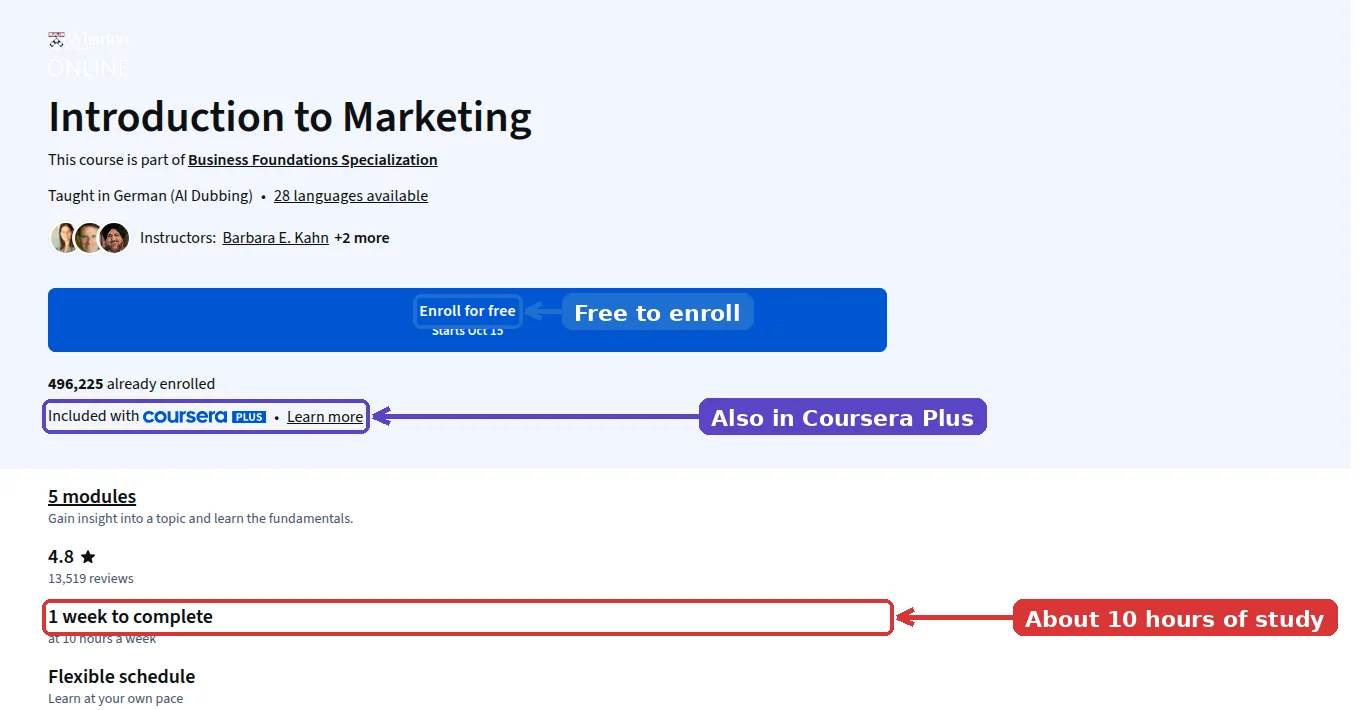
| Introduction to Marketing (Wharton, University of Pennsylvania, on Coursera) | University course on a MOOC platform | 5 modules; “1 week at 10 hours a week”; flexible schedule | Free to enroll; also included with Coursera Plus | Shareable certificate listed | Learners who want a top business school’s view of branding, customer centricity and go-to-market strategy |
| Pricing Strategy (IE Business School, on Coursera) | University course, part of the Marketing Mix Implementation Specialization | 4 modules; beginner level; “1 week at 10 hours a week” | Free to enroll; also included with Coursera Plus | Shareable certificate listed | Anyone whose main question is how to set prices |
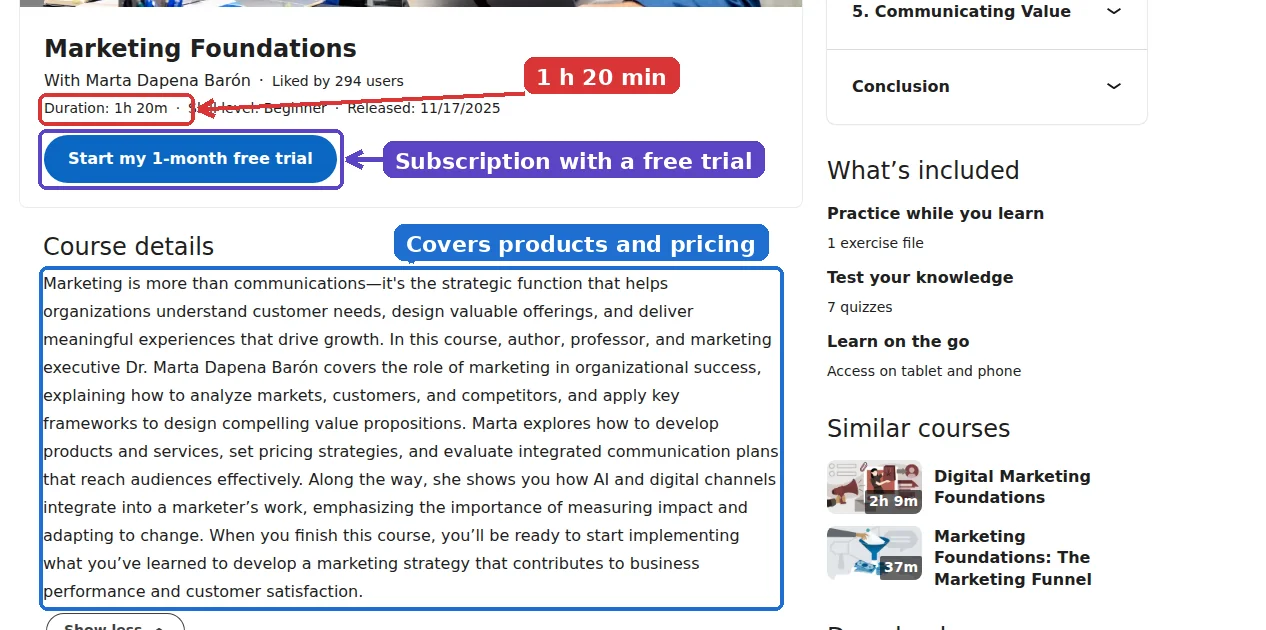
| Marketing Foundations (LinkedIn Learning) | Video course in a subscription library | 1 h 20 min; beginner; released November 2025 | Subscription; the page offers a 1-month free trial | Certificate of completion | People who already have LinkedIn Learning access and want a short, recent overview |
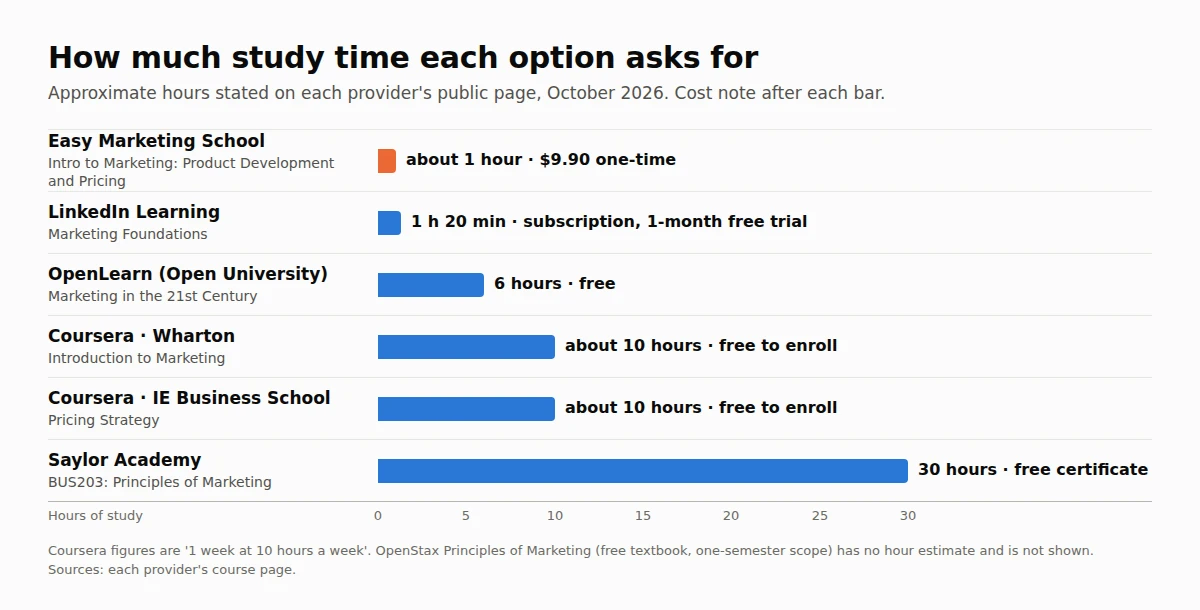
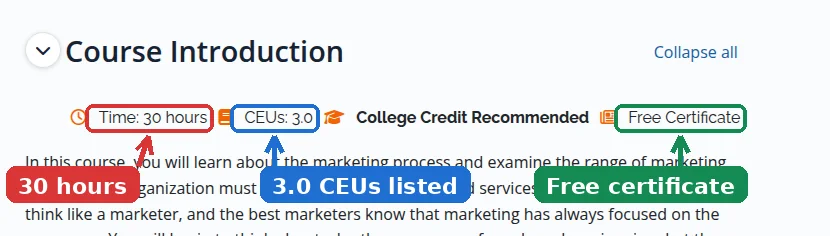
| BUS203: Principles of Marketing (Saylor Academy) | Free self-paced college-level course | 30 hours | Free | Free certificate; 3.0 CEUs listed; college credit recommended | Learners who want depth and a free certificate and can give it 30 hours |
| Marketing in the 21st Century (OpenLearn, The Open University) | Free university short course | 6 hours; listed as Level 3: Advanced | Free | Free statement of participation | Managers who want a managerial perspective on marketing, brands and ethics |
| Principles of Marketing (OpenStax textbook) | Free open textbook | Designed for a one-semester undergraduate course; read online or as a PDF | Free (print copy available to buy) | None | Readers who prefer a book and want a complete reference |
| Introduction to Marketing Course: Product Development and Pricing (Easy Marketing School) | Short self-paced video course | 8 video lessons, about 1 hour in total; lifetime access | $9.90 one-time | Certificate of completion | Small-business owners who need market research, product development and pricing basics quickly |
All details come from each provider’s public course page as of October 2026. Prices, trials and certificate rules change, so confirm on the provider’s page before you enroll.
Each option: what it is good for, and what it is not
Wharton’s Introduction to Marketing on Coursera
Taught by three members of Wharton’s marketing faculty, the course covers three topics: branding, customer centricity and practical go-to-market strategies. It is part of Wharton’s Business Foundations Specialization, which ends with an optional capstone project. Enrolment is free, it is also included with Coursera Plus, and the page lists a shareable certificate, five modules and nine assignments.
Good for: a rigorous, well-known introduction with assessments and a recognisable name on your profile. Less suited to: someone whose immediate problem is researching a market or pricing a new product; those topics are not the focus listed on the page, and the course expects around ten hours.
IE Business School’s Pricing Strategy on Coursera
If pricing is the part that keeps you up at night, this is the most focused free option we found. The page lists pricing psychology, price discrimination using customer characteristics, bundling and versioning, measuring willingness to pay with surveys and experiments, and calculating price elasticity to find an optimal price. It is beginner level, free to enroll and part of IE’s Marketing Mix Implementation Specialization.
Good for: depth on pricing, including the numbers. Less suited to: a general introduction; it does not cover market research, product development or the rest of the marketing basics.
LinkedIn Learning: Marketing Foundations
A recent (November 2025) beginner course by Dr. Marta Dapena Barón, 1 hour 20 minutes long. The description covers analysing markets, customers and competitors, designing value propositions, developing products and services, setting pricing strategies and planning integrated communication, including how AI and digital channels fit in. It comes with a LinkedIn Learning certificate of completion.
Good for: a short, current overview, especially if your employer or library already gives you LinkedIn Learning. Less suited to: anyone who does not want a subscription; access is through the library, with a one-month free trial shown on the page.
Saylor Academy: BUS203 Principles of Marketing
The most complete free option in this list. The course page lists 30 hours of study, 3.0 continuing-education units, a college-credit recommendation and a free certificate. It walks through the whole marketing process: creating products and services, communicating a value proposition, delivering value and exchanging it.
Good for: learners who want breadth, a free certificate and possible credit, and who can commit the time. Less suited to: a business owner who needs a pricing decision this month; thirty hours is a real commitment.
OpenLearn: Marketing in the 21st Century
A free six-hour course from The Open University with a free statement of participation. It takes a managerial perspective: whether marketing is a process or a philosophy, marketing ethics, what brands are worth, and how marketing practice is changing. OpenLearn lists it as Level 3 (advanced), and the page shows it was first published in 2013 and updated in 2019.
Good for: a thoughtful, free university-level read on what marketing is for. Less suited to: hands-on product or pricing work.
OpenStax: Principles of Marketing (free textbook)
The “book” option. OpenStax’s textbook is written for a one-semester undergraduate marketing course, free to read online or download as a PDF, with a printed copy available to buy. It is the most complete reference here, but it is a textbook: no certificate, no videos, and you choose your own pace and path through it.
Good for: readers who like to look things up and want a free reference to keep. Less suited to: anyone who needs structure to finish.
How to choose: a short checklist
- Name the outcome. A decision for your business (who to target, what to charge) calls for a short practical course. A credential calls for a course with assessments and a certificate your audience recognises.
- Be honest about time. One hour, six hours, ten hours and thirty hours are different commitments. A finished short course beats an abandoned long one.
- Check the topic list, not the title. “Introduction to marketing” can mean branding and customer centricity (Wharton), pricing (IE), the whole process (Saylor) or research, product and pricing (ours).
- Check what the certificate is. A certificate of completion, a statement of participation, CEUs and recommended college credit are not the same thing.
- Check the cost model. Free, one-time payment and subscription each suit different people. Note when a free trial ends.
- Watch a free lesson first. Most options let you see some content before you pay; the teaching style matters as much as the syllabus.
Where our course fits, and its limits
Our introduction to marketing course on product development and pricing is built for the first group: owners and founders who need the basics in the order they will use them. It has eight short video lessons, about an hour in total: what a marketing strategy is, writing a mission statement for a new company, market research for a new business, primary and secondary research, the product life cycle, testing a product concept before launch, the product development phase, and pricing new products. It costs $9.90 as a one-time payment, with lifetime access and a certificate of completion, and two of the lessons can be watched free without signing up.
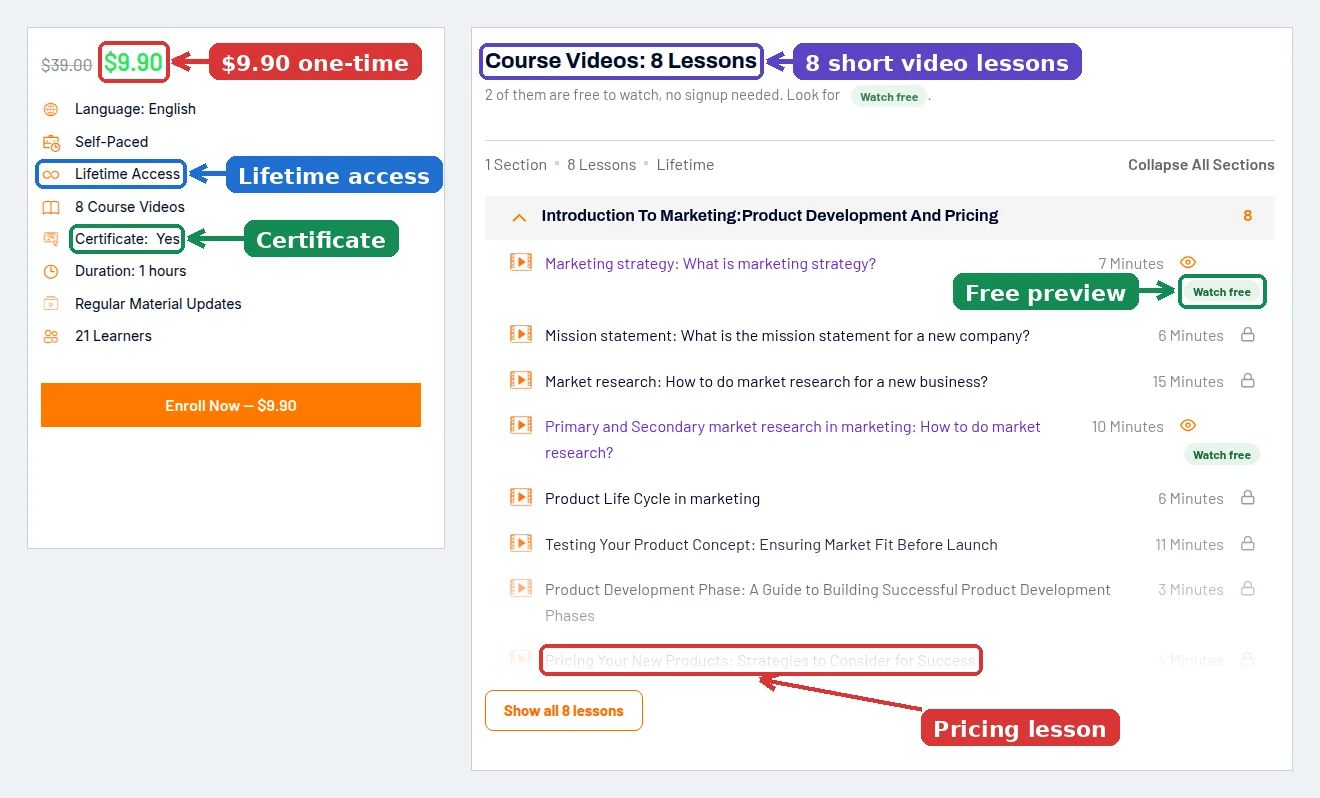
What it is not: it is a short introduction, not a semester course. It is not accredited, it carries no CEUs or college credit, and it has no graded assignments. It covers research, product and pricing basics rather than branding, advertising or digital channels in depth. If you want the full map of marketing with a free certificate, Saylor’s BUS203 is the better choice; if you want deep pricing analysis, IE’s Pricing Strategy goes much further. If you want to check the vocabulary first, our free article on the core marketing concepts, with examples is a good start, and if you sell to other businesses, our comparison of B2B marketing courses covers that path.
For career changers: once you finish whichever course you choose, make sure your CV shows it. MyEasyCV can rewrite your CV around the new skill and check how it matches a job description.
Frequently asked questions
Is a free introduction to marketing course enough?
For understanding the concepts, often yes: Saylor, OpenLearn, OpenStax and the free enrolment on Coursera cover a great deal at no cost. What free courses rarely do is walk a small business through its own research, product and pricing decisions in a short time, which is where a short practical course earns its place.
Which option gives a certificate?
Saylor Academy offers a free certificate and lists 3.0 CEUs. OpenLearn gives a free statement of participation. Coursera lists a shareable certificate for both Wharton and IE courses. LinkedIn Learning and Easy Marketing School give certificates of completion. The OpenStax textbook has no certificate.
How long does it take to learn the basics of marketing?
Based on the providers’ own estimates, between about one hour for a short practical course and thirty hours for a full college-level course. Ten hours (Wharton, IE) is a common middle ground.
What should a small-business owner learn first?
Who your customer is and what the market looks like, then whether your product idea holds up, then what to charge. Branding and advertising work much better once those three are settled.